当前位置:网站首页>LeetCode+ 16 - 20
LeetCode+ 16 - 20
2022-06-10 23:29:00 【Sauerkraut】
The closest sum of three
Algorithm tags : Array 、 Double pointer 、 Sort


LeetCode+ 11 - 15_ Xiaoxuecai's blog -CSDN Blog
Give you a length of n Array of integers for nums and A target value target. Please start from nums Choose three integers , Make their sum with target Nearest
The closest has two meanings :① Greater than or equal to target The smallest number of ② Less than or equal to target The maximum number of , One is in t On the right , One is in t On the left , Both cases should be considered
There is only one answer to the question , There is no need to consider the problem of weight determination

In the worst case , Triple cycle , enumeration i、j、k, Enumerate each answer , Just ask for the nearest one , Violent solution
Consider double pointer optimization , First sort the array from small to large , Because there are three variables , It's not good to use double pointers directly , First enumerate one of the variables i, enumeration i after nums[ i ] Fix , Enumerate with two pointers j and k, For each of these j To find the smallest k, bring num[ i ] + nums[ j ] + nums[ k ] ≥ target, In this way, it is possible to enumerate greater than or equal to target The minimum value of
Let's look at another situation : Less than or equal to target The maximum of , There is no need to rewrite the entire code , As long as the number of pieces is greater than or equal to target The smallest k,num[ i ] + nums[ j ] + nums[ k - 1 ] necessarily < target, It can be found that as long as k - 1 Bring in is less than target The maximum number of
For each of these i、j、k Use these two cases to update the minimum value

nums[ i ] Is constant , When nums[ j ] When it gets bigger ,num[ i ] + nums[ j ] + nums[ k ] still ≥ target, therefore nums[ k ] It can't get bigger , It can only be the same or smaller
because j When it's added ,k Must reduce , You can use the double pointer algorithm to remove one dimension
abs The efficiency of a function is O(1) Of ,pair Compare first first, If first Compare the same second:C++ pair Compare the size of

class Solution {
public:
    int threeSumClosest(vector<int>& nums, int target) {
        // Sort
        sort(nums.begin(),nums.end());
        // Need an answer   When storing, you should not only store the difference, but also store and   Need to use  pair  Storage
        pair<int,int> res(INT_MAX,INT_MAX);
        // enumeration  i j k
        for(int i = 0;i < nums.size();i++) {
            for(int j = i + 1,k = nums.size()- 1;j < k;j++) {
                // For each of these  j  Find the smallest  k
                while(k - 1 > j && nums[i] + nums[j] +nums[k -1] >= target) k--;
                // The sum of the
                int s = nums[i] + nums[j] + nums[k];
                // The answer is the smallest one   Be careful  s - target  Not necessarily greater than or equal to  target,target  It is likely that less than or equal to target The situation of
                res = min(res,make_pair(abs(s - target),s));
                if(k - 1 > j) {
                    s = nums[i] + nums[j] + nums[k - 1];
                    res = min(res,make_pair(target - s,s));
                }
            }
        }
        return res.second;
    }
};
Letter combination of telephone number
Algorithm tags : Hash 、 character string 、 to flash back 、 Violent search 、 recursive


Give a number only 2-9 String , Returns all the letter combinations it can represent , Each number represents 3 ~ 4 Characters , Give the order of pressing , ask : How many different character sequences correspond to ?
Press... In the example 23,2 Yes abc Three options ,3 Yes def Three options , There are nine choices for multiplication
A string of indefinite length is given in the title , It is required to output all possible combinations , classical dfs problem
The recursive search tree is given below , Then convert the recursive search tree into code
Recursion and recursion _ Xiaoxuecai's blog -CSDN Blog

In recursion :① Need to use string path Storage path / programme ② Need to use int u Store the current number of bits
How can we easily find out which letters a number can represent ? You can open an array to represent
The time complexity of the whole algorithm is related to the length , In the worst case , Each number has 4 A choice , The worst time complexity is 4^n,push_back Answer needs O( n ) Time complexity of , The string length is n, The final time complexity is 4^n × n
class Solution {
public:
    // External variables record the answer
    vector<string> ans;
    // Use an array to represent all possible cases of each number
    string strs[10] = {
        //0 1  It's empty
        "","","abc","def",
        "ghi","jkl","mno",
        "pqrs","tuv","wxyz",
    };
    vector<string> letterCombinations(string digits) {
        // If the string is empty, it directly returns
        if(digits.empty()) return ans;
        // Incoming string   What is the current number   The initial path is empty
        dfs(digits,0,"");
        return ans;
    }
    void dfs(string& digits,int u,string path) {
        // If equal to the last digit , Add the current solution to the answer
        if(u == digits.size()) ans.push_back(path);
        else {
            // Otherwise, traverse the characters that can be taken from the current bit
            for(auto c : strs[digits[u] - '0'])
                dfs(digits,u + 1,path + c);
        }
    }
};
Sum of four numbers
Algorithm tags : Array 、 Double pointer 、 Sort


Refer to the first 15 topic LeetCode+ 11 - 15_ Xiaoxuecai's blog -CSDN Blog
The sum of four and the practice of violence , The time complexity of the quadruple cycle is O( n^4 ), Double pointer optimization is O( n^3 )
Enumerate two variables first , The last two variables are optimized into with the double pointer algorithm O( n ), The method of weight removal is the same as before
If each pointer is the same as the previous number , Just skip. , In this way, we can find all the solutions without repetition ( If it is the same as the previous number , It means that the current status has been enumerated before , And as long as the current number is different from the previous one , The plan must be completely different )
The sum of three numbers enumerates one of them first , The sum of four numbers enumerates two of them first . . .
i , j, k,u Add up and it may overflow
hold nums[i] + nums[j] + nums[k] + nums[u] == targe Change to nums[i] + nums[j] - target == - nums[k] - nums[u]
hold nums[i] + nums[j] + nums[k] + nums[u-1] >= target Change to nums[i] + nums[j] >= target - (nums[k] + nums[u-1])
class Solution {
public:
    vector<vector<int>> fourSum(vector<int>& nums, int target) {
        // Sort
        sort(nums.begin(),nums.end());
        // Record answer
        vector<vector<int>> res;
        // First enumerate the first pointer
        for(int i = 0;i < nums.size();i++ ) {
            // Judge that if the current number is equal to the previous number, skip
            if(i && nums[i] == nums[i - 1]) continue;
            // Enumerate the second pointer
            for(int j = i + 1;j < nums.size();j++ ) {
                //j  Not the first  1  Number   also  nums[j]  Equal to the previous number   skip
                if(j > i + 1 && nums[j] == nums[j - 1]) continue;
                // Enumerate the third variable   from  j + 1  Start the double pointer algorithm
                for(int k = j + 1,u = nums.size() - 1;k < u;k++ ) {
                    if(k > j + 1 && nums[k] == nums[k - 1]) continue;
                    // For this  k  Find the smallest  u  Make the sum of four numbers greater than or equal to  target
                    while(u - 1 > k && nums[i] + nums[j] >= target - (nums[k] + nums[u-1])) u--;
                    // If the sum of four numbers equals  target  Add the current solution to the answer
                    if(nums[i] + nums[j] - target == - nums[k] - nums[u]) {
                        res.push_back({nums[i],nums[j],nums[k],nums[u]});
                    }
                }
            }
        }
        return res;
    }
};
Delete the last of the linked list N Nodes
Algorithm tags : Linked list 、 Double pointer


Give a list , It is required to delete the penultimate of the linked list n Nodes
The header node may be deleted , In case the header node will change , You can add a virtual head node , In this way, the header node will not be deleted


Delete the last k The core of this point is : Find the last k A point before a point , Then let the previous point next The pointer is equal to the next pointer at the current point
The total length of the linked list is n, Looking for the penultimate k A point before a point , That's the penultimate k + 1 A little bit , You can traverse the entire linked list first , Find the total length of the linked list n, Traverse from top to bottom k + 1 Just a little bit

Start with the virtual head node , Want to find the penultimate k + 1 How many steps does it take to jump a point ? jump 1 Step can skip to step 2 A little bit , To jump to the penultimate k + 1 A little bit , Altogether n A little bit , Last but not least k + 1 A dot is a positive number n + 1 - ( k + 1 ), That is, the positive number n - k A little bit
jump 1 Step can skip to step 2 A little bit , If you want to jump to the n - k A little bit , Need to jump n - k - 1 Step

/**
 * Definition for singly-linked list.
 * struct ListNode {
 *     int val;
 *     ListNode *next;
 *     ListNode() : val(0), next(nullptr) {}
 *     ListNode(int x) : val(x), next(nullptr) {}
 *     ListNode(int x, ListNode *next) : val(x), next(next) {}
 * };
 */
class Solution {
public:
    ListNode* removeNthFromEnd(ListNode* head, int k) {
        // Create a virtual header node
        auto dummy = new ListNode(-1);
        dummy->next = head;
        // First find the total length of the linked list , Every point traversed  n++, Last  n  Is the total length of the linked list
        int n = 0;
        for(auto p = dummy;p;p = p->next) n++;

        // Start with the virtual head node
        auto p = dummy;
        // Need to jump  n - k - 1  Step
        for(int i = 0;i < n - k - 1;i++ ) p = p->next;
        // Delete
        p->next = p->next->next;
        // Return to the next position of the virtual head node   That is, the real head node
        return dummy->next;
    }
};
Valid parenthesis
Algorithm tags : Stack 、 character string


Given a contains only '(',')','{','}','[',']' Sequence , Judge whether the sequence is legal
The left parenthesis is passive , The right parenthesis is active
The left bracket can only wait in place , The right parenthesis can find the nearest left parenthesis that has not been taken away , And match it
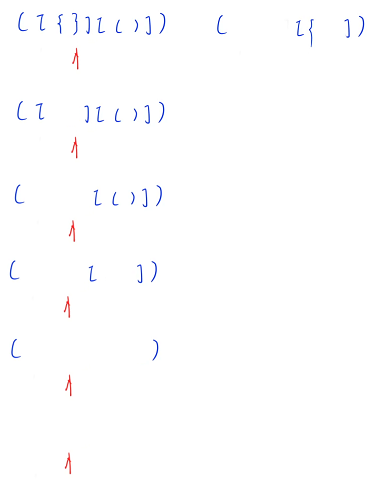
The analysis process can be simulated by stack
Every time you encounter an open parenthesis , Add the left bracket to the top of the stack , After encountering the right bracket , At this point, the top element of the stack is the left bracket nearest to the right bracket that has not been taken away , Determine whether the current closing bracket matches it , If the match , Just take it away , If it doesn't match, it means it's illegal
There are two illegal schemes
① If the closing bracket does not find a match , It means it's illegal
② It is also illegal to leave some left parentheses
If you encounter an open bracket, put it on the top of the stack , See if the top of the stack matches the right parenthesis , If it doesn't match, it's illegal , If it matches, pop the top of the stack
At the end, judge whether the stack is empty , If it is empty, it means it is legal , If it is not empty, it means it is illegal
class Solution {
public:
    bool isValid(string s) {
        // Define a stack
        stack<char> stk;
        // Enumerate all characters from front to back
        for(auto c : s) {
            // If the current character is an open parenthesis, add it to the stack
            if(c == '(' || c == '[' || c == '{') stk.push(c);
            // Otherwise, judge whether it matches
            else {
                /*   Left and right parentheses ASCII Yards don't go very far
                     If the two parentheses are a pair   So between them ASCII The difference between codes will not be greater than 2
                */
                // If there are elements in the stack   And the top element of the stack ASCII Code and current element ASCII If the code is less than or equal to 2 It is a match   Delete the top of the stack
                if(stk.size() && abs(stk.top() - c) <= 2) stk.pop();
                // Otherwise, the description does not match
                else return false;
            }
        }
        // If the stack is empty, it means it is legal   Otherwise, it is illegal
        return stk.empty();
    }
};边栏推荐
- 1.打开R程序,使用 apply 函数计算1到12按先后次序每隔3个数一组的和。即,计算1+4+7+10=?2+5+8+11=?,3+6+9+12=?
- 项目实训10——对特定数据库的备份
- 关于高考的那些事儿
- 关于idea中src下 无法new一个package
- unity 代码为动画注册事件
- Redis list list common commands
- C语言创建动态二维数组
- 可扩展到Max–MCU和MPU开发,使用相同的许可证
- R language to draw two-dimensional normal distribution density surface;
- 【sql语句基础】——增(insert)
猜你喜欢

Design language testing for functional testing: what tests are included in functional testing? What is the role of each

一 组工人合作完成某一部件的装配工序所需的时间(单位:分钟)分别如下:

Why is the kotlin language not popular now?

PwnTheBox,Web:hello

可扩展到Max–MCU和MPU开发,使用相同的许可证

数据与信息资源共享平台(八)

Yuntu says that every successful business system cannot be separated from apig
字蛛(font-spider)教学——ttf/otf字体文件压缩

Lenovo explained for the first time the five advantages of hybrid cloud Lenovo xcloud and how to build an intelligent digital base

PwnTheBox,Pwn:tutorial1
随机推荐
Project training 13 - Interface supplement
OpenVP*整合ldap認證
Dell R730 raid5 安装Server 2016(解决磁盘大于2T)
Two aspects of embedded audio development
Relevant knowledge of flowable BPMN
启牛的证券是哪个证券公司的呢?安全吗?
Which securities company does qiniu's securities belong to? Is it safe?
06151020 mysterious code, waiting for you to decipher
Ribbon负载均衡策略
嵌入式软件开发中的2种调试技术
Example analysis of SQL query optimization principle
Postgraduate entrance examination English vocabulary unit1
我们对产业互联网的认识,还是困囿于互联网式的平台和中心的逻辑之中
leetcode 130. Surrounded Regions 被围绕的区域(中等)
Introduction to Wireshark capturing RTP load TS stream (UDP multicast)
优化代码去除if-else
掌握高性能计算前,我们先了解一下它的历史
iframe框架自适应大小/全屏显示网页框架的方法
1. open the R program, and use the apply function to calculate the sum of 1 to 12 in the sequence of every 3 numbers. That is, calculate 1+4+7+10=? 2+5+8+11=?, 3+6+9+12=?
中银证券股票开户安全吗?是正规的吗?