当前位置:网站首页>VirtualLab basic experiment tutorial -5 Poisson bright spot
VirtualLab basic experiment tutorial -5 Poisson bright spot
2022-06-12 18:08:00 【Chengyuan】
List of articles
Preface
This is the fifth collective work of Dachuang team , Basic experiments for physical optics – Poisson bright spot made exploration and attempt .
One 、 Introduction to the principle of Poisson bright spot experiment
1、 The phenomenon
When monochromatic light shines on a small circular plate or ball of appropriate diameter , There will be circular diffraction fringes of concentric circles on the subsequent light screen , And a tiny bright spot will appear at the center of all concentric circles , This bright spot is called Poisson bright spot .
2、 Half wave zone theory

Observation point P Centered , The radius is r 0 r_0 r0 A series of spheres , The intersection of these spheres and the diffraction screen is a series of rings as shown in the figure .
When r 0 ≫ λ r_0\gg\lambda r0≫λ, These rings have the same area .P The amplitude of the point can be seen as how many wave bands the light has reached P spot , These wave bands are P The superposition of the amplitudes produced by the points is P The amplitude intensity of the point . Since the area of each wave band is equal , Then each wave band finally reaches P The amplitude of points depends on the distance between them . Because adjacent waves are brought to P The distances between points are different λ 2 \frac{\lambda}{2} 2λ, Adjacent wave bands arrive P Phase difference of points π \pi π, Adjacent wave bands arrive P The sign of the amplitude of the point is different ( One is one minus one. ).
3、 The formula
E = { ∣ E 1 ∣ 2 + ∣ E 0 ∣ 2 ( n by p. Count ) ∣ E 1 ∣ 2 + ∣ E n − 1 ∣ 2 − ∣ E n ∣ ( n by accidentally Count ) E=\left\{ \begin{aligned} \frac{\vert E_1\vert }{2} +& \frac{\vert E_0\vert }{2} &(n It's odd )&\\ \frac{\vert E_1\vert }{2} + &\frac{\vert E_{n-1}\vert }{2}-\vert E_n\vert &(n For the even )& \end{aligned} \right. E=⎩⎪⎪⎨⎪⎪⎧2∣E1∣+2∣E1∣+2∣E0∣2∣En−1∣−∣En∣(n by p. Count )(n by accidentally Count )
n → ∞ , ∣ E n ∣ = 0 , ∣ E n − 1 ∣ = 0 n\rarr\infin,\vert E_n\vert=0,\vert E_{n-1}\vert=0 n→∞,∣En∣=0,∣En−1∣=0
Therefore, the circular screen diffraction is always a bright spot , and P The total amplitude of the point is the first wave band at P The point produces half the amplitude .
Two 、Virtualab Simulation
1、 Build a light path
First, drag a Gaussian wave into the panel , Double click to set its properties :
You can choose Hermite Gauss wave or Laguerre Gauss wave , Laguerre Gaussian light is expressed in cylindrical coordinates , With azimuth phase , There is definite orbital angular momentum , When Laguerre Gaussian light interacts with the medium, its orbital angular momentum will be transferred to the medium , Hermite Gaussian light is represented by rectangular coordinates ( No order is set in the experiment order Therefore, the results of the replacement mode show little difference , The default can be )
In this experiment, we choose the default Hermite Gauss wave , And set the girdle radius as 100um×100um, The setting of waist radius can change the half divergence angle and Rayleigh length at the same time ( These three quantities are related to each other ).
Set the Gaussian wavelength to 532nm The green light of

Then drag the round screen into the panel : Find... In the library stop Drag in .
Double click to set its attribute shape to ellipse , Set its size to 100um×100um Round .
After that, two detectors are dragged to detect one dimension 、 Two dimensional image , Both detectors are located behind the circular plate 2mm Location .
because camera detector Pixels need to be as realistic as possible CCD Or detector , So we will 2D The probe window size of the probe is set to 1.28×1.28mm,
The sampling point is set to 256×256
1D The probe window size of the probe is set to 1.28mm×5um, Change the sampling point to the custom setting of 256×1
It is worth noting that ,2013 In the version, you need to select 2 Follow up on behalf of the market , Just track the classic field in the trial version .
So far, the image of Poisson bright spot and one-dimensional light intensity distribution curve can be obtained :
2、 The detector window size is determined
For the determination of detector window size , You can use the ray tracing function to get the point column diagram 

After that, you need to select... Above Show Rectangle or Ellipse Marker To activate the window .
After activation, you can import... Into the detector , The window size in the probe will change automatically .
This concludes the basic section .
3、 ... and 、 Result display
1、 Change the screen radius
Set the radius of the round screen to 50um,100um and 200um.


After running, the following simulation result images can be obtained .
You can see that the larger the radius of the circular screen , The deeper it is . The larger the round screen , The smaller the number of half wave bands , The corresponding brightness is also darker , The deeper the dark part appears on the image .
Check with light intensity .
Disconnect the last detector , Directly connect another detector to measure the light intensity at the center of the Gaussian beam .
Is roughly 1(V/m)^2.
Restore the original optical path .
The reality of one-dimensional detectors ,2mm The light intensity of the circular screen at is 0.35(V/m)^2, At this time, the size of the round screen is 100um.
If the 200um The diameter of the round screen , stay 2mm The light intensity of the round screen is very weak , Further conversion is required to read relatively accurately 

by 0.00081638(v/m)^2.
If the 50um The diameter of the round screen , stay 2mm The light intensity of the round screen is very strong , Further conversion is also required to read relatively accurately , by 0.83257(v/m)^2

about 2mm Although there are no obvious bright spots on the round screen at , But as the distance increases , The intensity of bright spots will gradually increase , As shown in the figure, the blue line represents the detector in 2mm It's about , The red line stands for 10mm, The green line stands for 20mm.
2、 Change detector position
Use parameter run function , Change the position of both detectors at the same time , from 1um To 2mm change .
You can get the following dynamic rendering .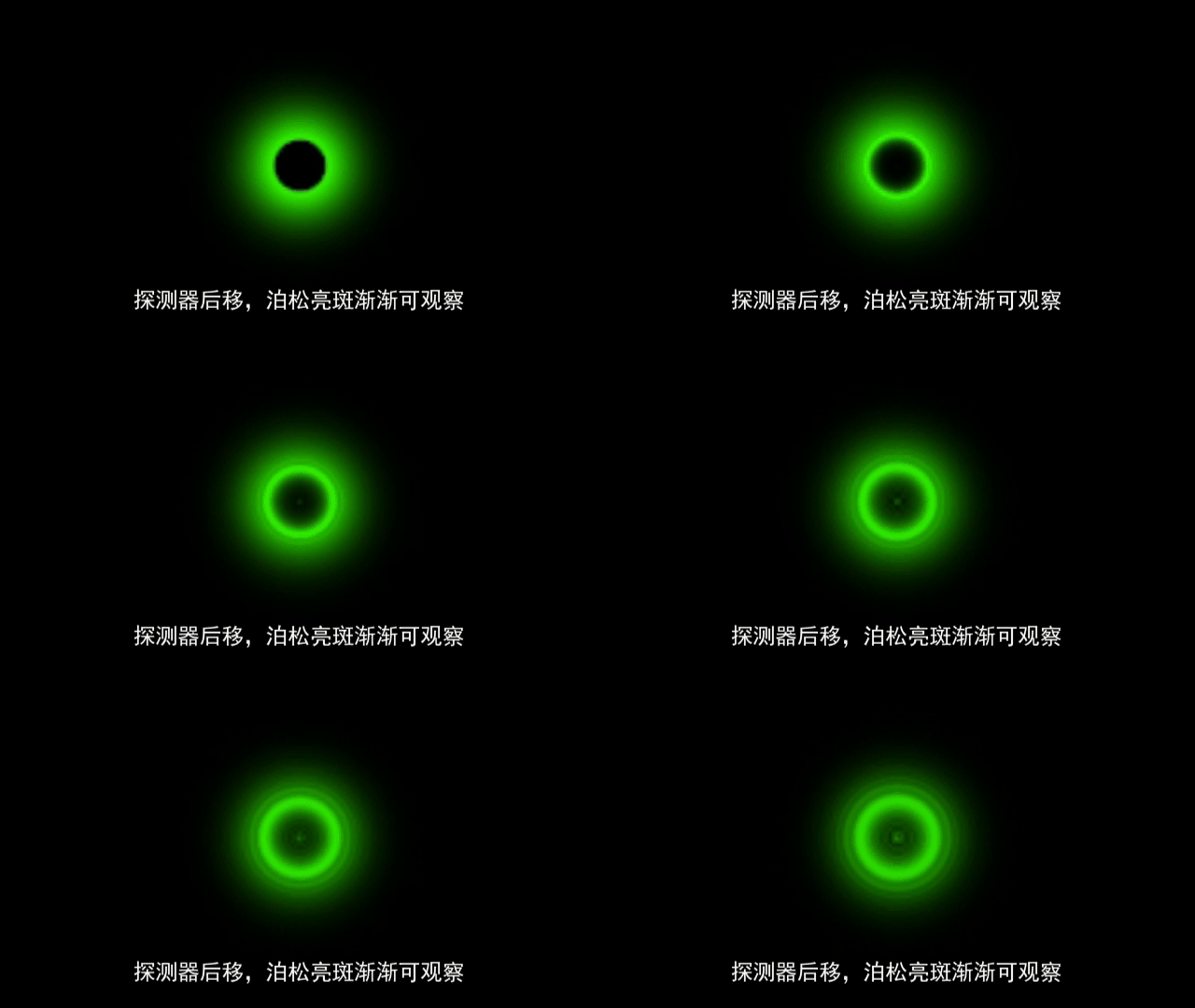
The diffraction result is a set of concentric rings with bright and dark phases , When the detector moves axially , From no bright spots to bright spots .
With 200mm The round screen is an example for 2mm Although there are no obvious bright spots on the round screen at , But as the distance increases , The intensity of bright spots will gradually increase , As shown in the figure, the blue line represents the detector in 2mm It's about , The red line stands for 10mm, The green line stands for 20mm.
And when 200mm The round screen is pulled far away 50mm It's about 、100mm It's about 、200mm It's about , The light intensity in the center began to drop again , At the red line , The curve is very similar to the Fraunhofer diffraction curve of a circular hole .
Mainly change the size of the detector window , At this time, not only the central bright spot , The next diffraction order has also become the object of study 
You can see 200mm The time curve and stripe pattern are very similar to the scene of Fraunhofer diffraction through a circular hole .
3、 Change the wavelength

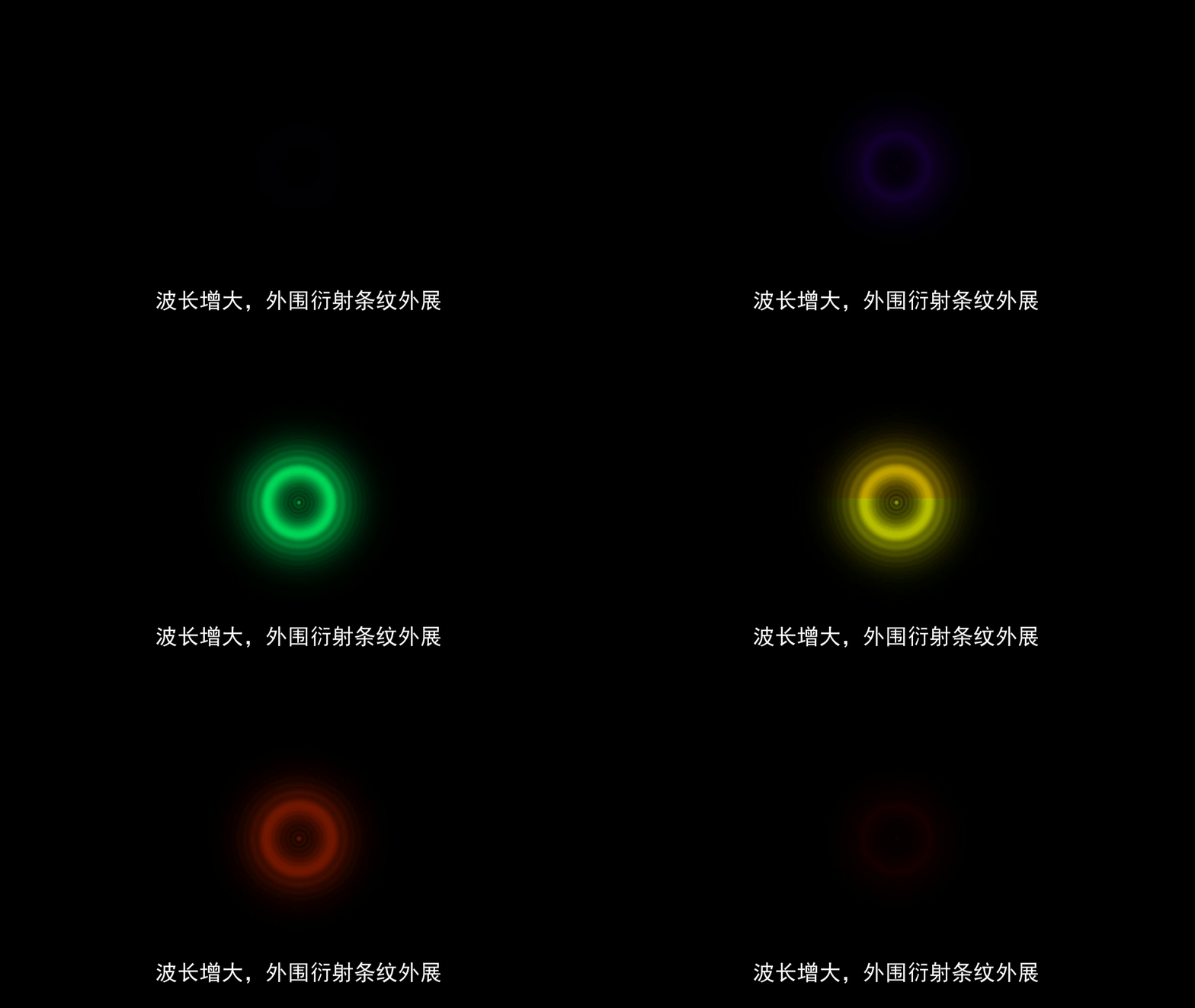

( The color of this picture is not well chosen , The legend shall prevail , The outer diffraction fringes follow the law of Fraunhofer diffraction , The center of the wave is slightly wider , But it's not obvious )
4、 Circular hole diffraction
If we look at circular hole diffraction , The corresponding whole optical path is built as follows .
The corresponding settings are as follows .
The wavelength is 532nm. The diameter of the round hole is 1.13mm, According to the calculation formula of Fresnel half wave zone 10 0 2 + ( 1.13 / 2 ) 2 − 100 = n ∗ 532 ∗ 1 0 − 6 2 \sqrt{100^2+(1.13/2)^2}-100=n*\frac{532*10^{-6}}{2} 1002+(1.13/2)2−100=n∗2532∗10−6, By calculation, we can get ,n=6, That is to say 6 Half wave zone ( even numbers ), therefore , The center of the image is a dark dot .
The detector can also give play to the advantages of simulation software and set it more carefully .
use classic field tracing Simulation .( Analogy to single slit Fraunhofer diffraction )
Convert to numeric mode .
Look at the curve .


Because the diaphragm allows 6 A half wave band passes through , The center of the diffraction field is a dark spot .
Change the diameter of the diaphragm .
Get a light dark alternation .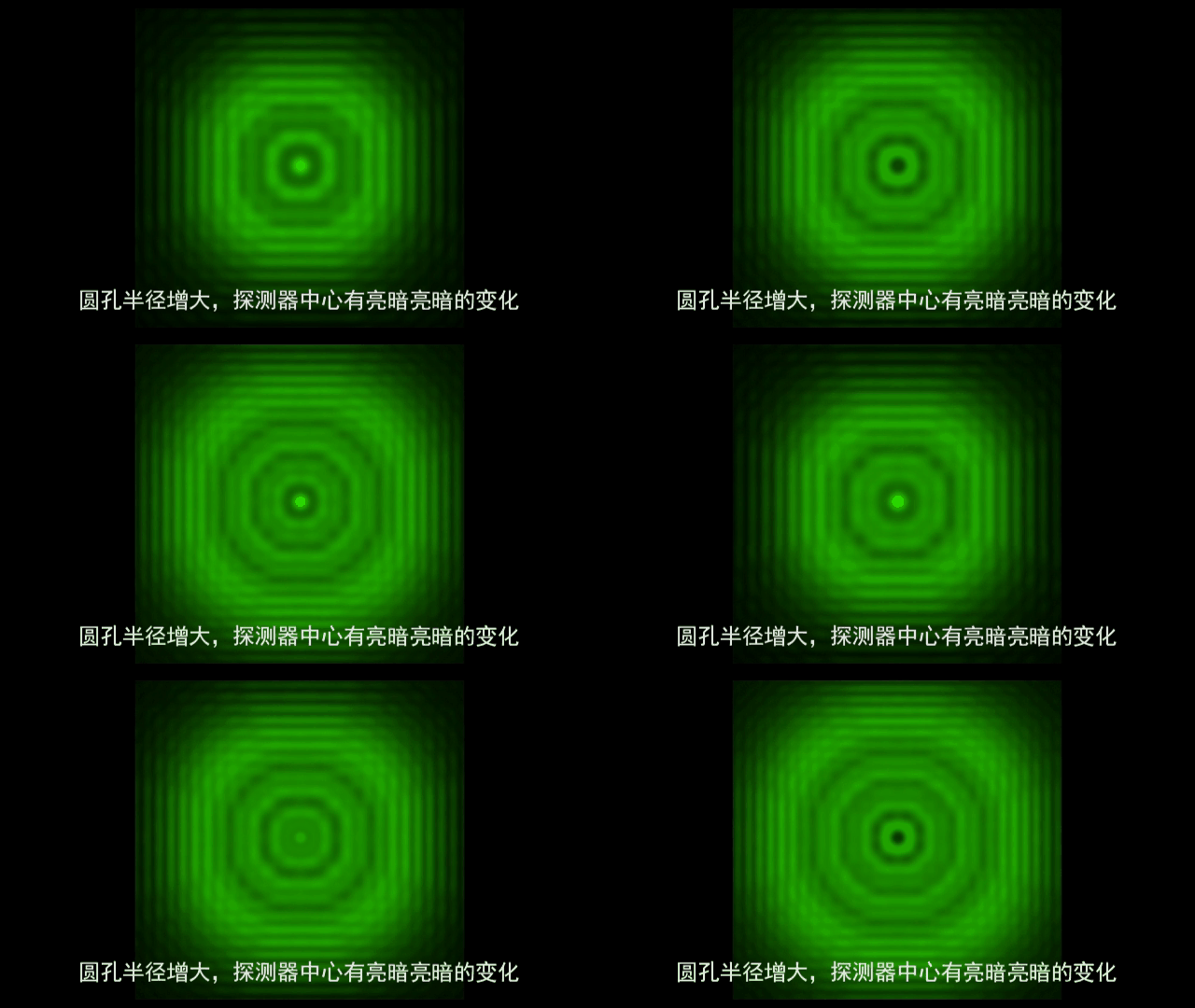
Change the distance of the detector .
It has the same effect .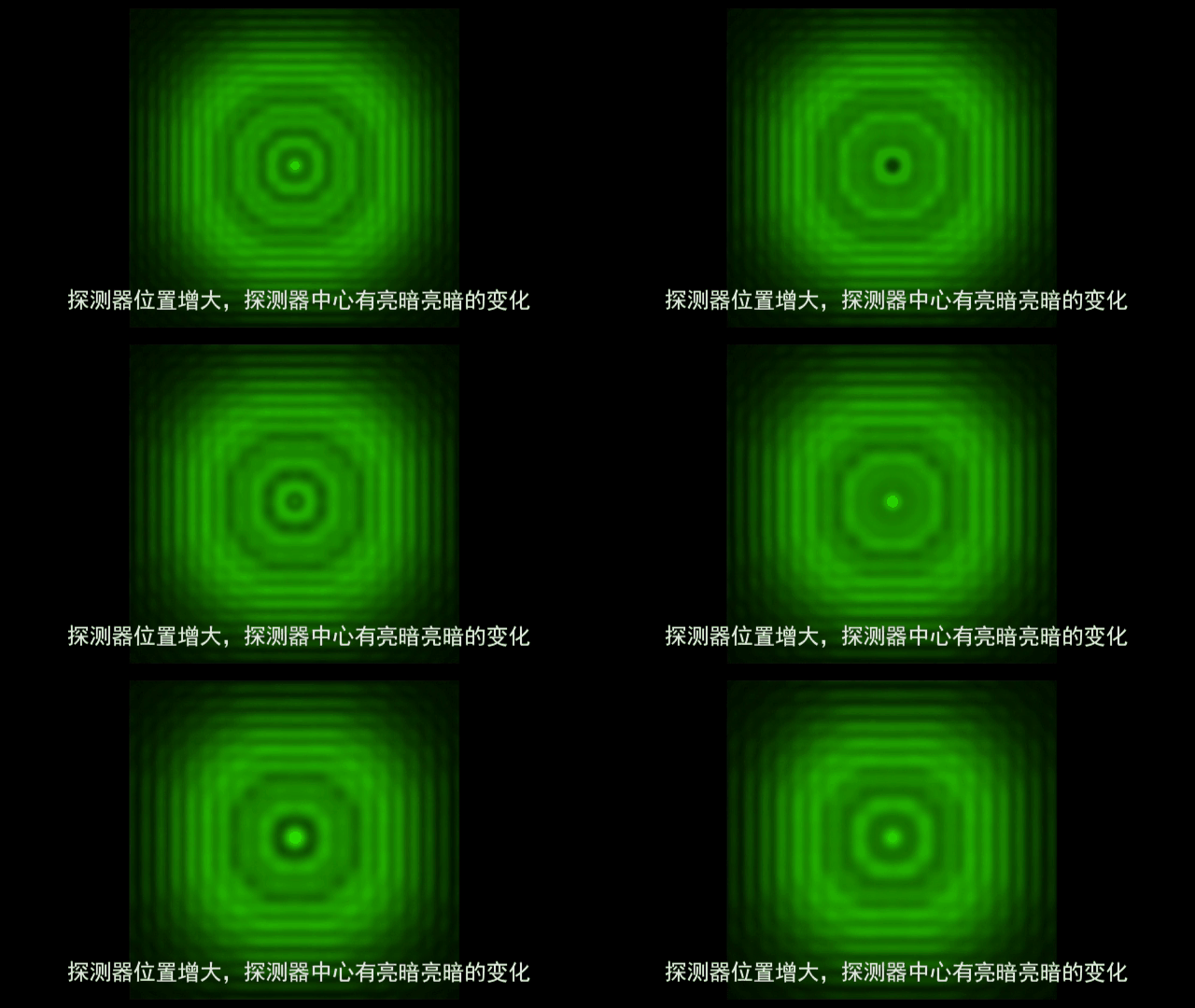
5、 A little explanation of Babinet's principle
hold stop Replace it with a round hole of the same size ( The plane wave is used as the light source to irradiate the unified variable ). By superimposing the circular screen diffraction and circular hole diffraction, we can see that the final difference is basically in the paraxial region or the point on the axis , The rest have the same light intensity .
Four 、 About modes in Gaussian beams

Set... Here .( Usually 00 Then there is only the basic module )
Hermite Gaussian beam is square .
The Laguerre Gaussian beam comes out and turns out to be circular .
summary
This article is written by members of Da Chuang team : Tang Yiheng 、 Help Yang Yu 、 Huang Yinuo 、 Li Sitong 、 Ming Yue jointly completed .
This article adopts the trial version and 7.6.1.18 Version for experiment and demonstration , Enhanced applicability .
Poisson bright spot and near-field circular hole diffraction are another important part of diffraction theory part, Fresnel diffraction , It's also very meaningful .
边栏推荐
- js两数之和
- Tutoriel de démarrage rapide JDBC
- USB转串口那些事儿—串口驱动类型
- ESP32-C3 ESP-IDF 配置smartconfig 和 sntp 获取网络时间
- Array sorts in the specified order
- Schedule update | 2022 Microsoft and Intel hacker song competition is in hot registration
- JS quick sort
- About datasets
- General differences between SQL server versions released by Microsoft in different periods so far, for reference
- 企业架构的第一性原理
猜你喜欢

Write a select based concurrent server

First principles of enterprise architecture

Message queuing MySQL tables that store message data

vant3+ts 封装uploader上传图片组件

Variable of C #

C operation database added business data value content case school table

C#简单介绍
![[csp]202012-2 optimal threshold for period end forecast](/img/40/9b59bd692bcfe05d16614cc6d55d1f.png)
[csp]202012-2 optimal threshold for period end forecast
High-Speed Layout Guidelines 未完...

Advanced mountain -asp Net core router basic use demo 0.1
随机推荐
MIPS general purpose register + instruction
Idea common shortcut keys
JS中的字符串(含leetcode例题)<持续更新~>
HTTP cache < strong cache and negotiation cache >
Remote gadget putty (Alibaba cloud mirror station address sharing)
Window版本pytorch入门深度学习环境安装与配置
Queue priority of message queue practice
es7不使用父子和嵌套关系来实现一对多功能
USB转串口那些事儿—串口驱动类型
Esp-idf adds its own components
Section qemu+gdb
Advanced mountain -asp Net core router basic use demo 0.1
一种好用、易上手的小程序IDE
General differences between SQL server versions released by Microsoft in different periods so far, for reference
leetcode151 翻转字符串里的单词
JDBC快速入門教程
Gospel of audio and video developers, rapid integration of AI dubbing capability
Gossip about the source code of redis 89
在同花顺开户证券安全吗
JS quick sort