当前位置:网站首页>Masa auth - overall design from the user's perspective
Masa auth - overall design from the user's perspective
2022-06-13 03:22:00 【MASA team】
user
In the system , User is a core concept . It represents a person's unique identity , In addition to roles 、 The team 、 Organizational structure, etc , It will even affect the operation process and display content of different users in the same interface , If it's more complicated , Perhaps the identity of a user in the same system will change after entering different products
Users and roles
Users can have one or more roles , Let roles act as permission groups , Assign one or more groups of permissions to users indirectly

Users and teams
Users can work in multiple teams , Each team can have one or more roles , Associate one or more groups of permissions with the team through roles , And give it to the members of the team
Team members can be internal , It can also be external . The unified user table is used as the unique identity of people . Re pass Employee and ThirdPartyUser Distinguish user identity attributes .

Users and organizational structure
Users can be specified in a node of the organizational structure
But the organizational structure is a virtual tree structure , It belongs to the business , Therefore, it is not directly associated with permissions
besides , It is sometimes difficult for an organizational structure to represent role inheritance relationships . Different members in the same organizational structure node often have different roles , And the parent-child relationship may not be closely linked as a parent-child node . There may be several levels between the upper and lower levels of some companies
In our early definition, organizational structure is associated with authority and does not have the concept of team . But in fact, the project system exists in many companies , When running on a project basis , People's permissions and virtual organization relationships change frequently . As a result, it is often necessary to make choices on the adjustment of organizational structure and a large number of fine-tuning of personal permissions , In order to completely solve this split behavior . We regard the organizational structure as a virtual tree structure to describe everyone's department ownership , At the same time, the team approach is adopted to solve the problem of authority change caused by frequent personnel access and four operations under the project system

Users and permissions
In addition to having roles , There may also be some permissions that need to be granted or disabled temporarily under some special businesses
Although with RBAC2 There is a little conflict , But in fact, such scenes do exist , For example, the finance department that is about to leave the company needs the temporary payment recovery function , This obviously violates the principle of mutual exclusion , In terms of design, our choice is that the priority of extended permission is higher than the permission contained in the role . In this way, some sensitive permissions can be withdrawn through hedging

The user types
There are three types of users : End user , staff , Resident staff
for instance :
- A It's the employees of the company , Have internal permissions . It is also the end user of the company's products
- B They are resident employees , Have some internal permissions . It is also the end user of the company's products

User privilege priority
The user's permissions should have a certain priority , To select which permission to activate when multiple permissions under the same business are effective at the same time
We will apply the following rules :
Super administrator / Administrators
The super administrator is the system administrator , The administrator is the administrator of the specified project
User's extended configuration permissions
User role permissions
When the user's role permissions conflict , Deny has priority over allow , Lower than the user's extended configuration permission
Default role permissions for the team
Parent role permissions in the team
In the future, after the team supports the parent-child relationship , The current user is not assigned permission , When the current team has a parent, it will recursively look up the nearest default role to obtain the permission list
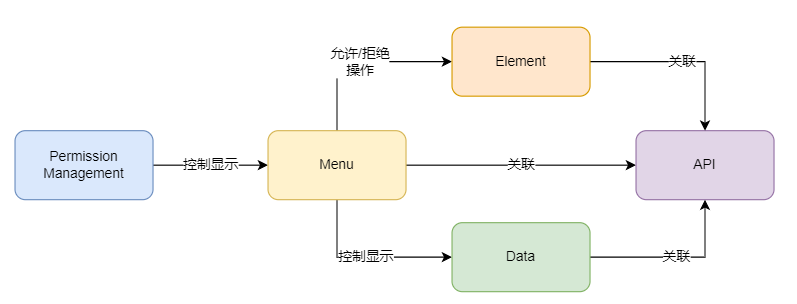
User permission type
The permission types of users can be divided into four categories
menu : Whether a page can be accessed through the menu
Page elements : Whether the elements in the page can be operated , Button like . Page elements need to be hung under the menu
data : Whether to display the specified field . Data needs to be hung under the menu
Data is similar to page elements , But it is independent of page elements
API: Whether the specified... Can be accessed API.API It usually needs to be hung under the menu or page element , It can also be hung under the data if necessary

Authority hierarchy
summary
thus , From the perspective of a user, we define roles and permissions , Front end and back end are connected in series . But so far, it is still the stage of combing the concept , It is difficult to be a authority center . Each team has its own management style , How to extract common ground from different team requirements and connect the main line , It still needs time to verify that it can not only meet the needs of most scenarios, but also leave room for expansion .
( This article does not represent the final design )
Reference resources :
https://uxdesign.cc/design-permissions-for-a-saas-app-db6c1825f20e
Open source address
MASA.BuildingBlocks:https://github.com/masastack/MASA.BuildingBlocks
MASA.Contrib:https://github.com/masastack/MASA.Contrib
MASA.Utils:https://github.com/masastack/MASA.Utils
MASA.EShop:https://github.com/masalabs/MASA.EShop
MASA.Blazor:https://github.com/BlazorComponent/MASA.Blazor
If you treat our MASA Framework Interested in , Whether it's code contribution 、 Use 、 carry Issue, Welcome to contact us

边栏推荐
- Loading process of [JVM series 3] classes
- A data modeling optimization solution for graph data super nodes
- Vs 2022 new features_ What's new in visual studio2022
- MySQL index bottom layer (I)
- 开源-校园论坛和资源共享小程序
- Technical documentbookmark
- The extra money we made in those years
- C 10 new features_ C 10 new features
- 视频播放屡破1000W+,在快手如何利用二次元打造爆款
- English语法_方式副词-位置
猜你喜欢

【pytorch 記錄】pytorch的變量parameter、buffer。self.register_buffer()、self.register_parameter()
JVM virtual machine stack (III)

Use of jstack

Vs Code modify default terminal_ Modify the default terminal opened by vs Code

Available types in C #_ Unavailable type_ C double question mark_ C question mark point_ C null is not equal to
![Loading process of [JVM series 3] classes](/img/a7/707c5cb95de71d95bf6ad9b2f69afa.jpg)
Loading process of [JVM series 3] classes
Pytorch record: pytorch variables parameter and buffer. self. register_ buffer()、self. register_ parameter()

Flutter reports an error type 'Int' is not a subtype of type 'string' wonderful experience

Use cypher to get the tree of the specified structure

视频播放屡破1000W+,在快手如何利用二次元打造爆款
随机推荐
Nuggets new oil: financial knowledge map data modeling and actual sharing
look on? What is the case between neo4j and ongdb?
C method parameter: in
【同步功能】2.0.16-19 版本都有同步功能修复的更新,但未解决问题
Array in PHP array function_ Slice and array_ flip
Graph data modeling tool
Personal understanding of grammar sugar
最近最少使用缓存(来源力扣)
Introduction to Kestrel_ Introduction to kestrel web server
Use of interceptors webmvcconfigurer
Neo4j auradb free, the world's leading map database
Wechat applet obtains the current location (startlocationupdate, onlocationchange, offlocationchange)
The extra money we made in those years
Explode and implode in PHP
C language function strcmp() (compare two strings)
Transaction processing in PDO
brew工具-“fatal: Could not resolve HEAD to a revision”错误解决
Loading process of [JVM series 3] classes
C 10 new features_ C 10 new features
JMeter quick start