当前位置:网站首页>Flink1.15 source code reading Flink clients client execution process (reading is boring)
Flink1.15 source code reading Flink clients client execution process (reading is boring)
2022-07-27 08:34:00 【Jinghe small ant】
Follow the previous article flink-clients debugging , Then read the more detailed source code , It's boring , Read slowly .
Reference link :https://blog.51cto.com/u_13870740/5321778, The explanation was very good
List of articles
- 1. Start reading
- CliFrontend#main Source code analysis
- obtain flink Profile path for
- Parse and load flink-conf.yaml Configuration in the configuration file to Configuration( It's essentially a Map)
- initialization 3 Different species CLI Namely GenericCLI The corresponding is per-job Pattern ,flinkYarnSessionCLI The corresponding is yarn-session Pattern , as well as DefaultCLI The corresponding is standalone Pattern
- initialization CliFrontend Client object
- SecurityUtils.install(new SecurityConfiguration(cli.configuration));
- call parseAndRun Parse and execute the program
1. Start reading
public class CliFrontend {

    public static void main(final String[] args) {
    }
}
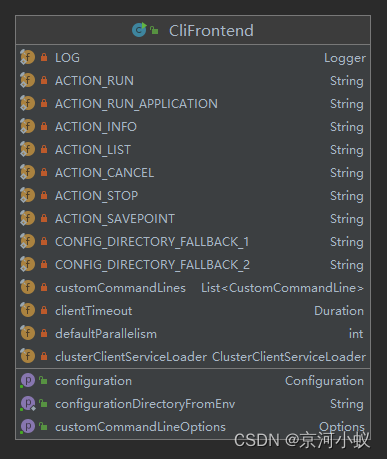
customCommandLines This variable is used to save CustomCommandLine, Its main functions will be explained below ,configuration It's for keeping flink-conf.yaml Configuration information in the configuration file , Equivalent to one map,clusterClientServiceLoader It is used to find the appropriate cluster client factory according to the provided components . Initialize it in the constructor .
CliFrontend#main Source code analysis
/** Submits the job based on the arguments. */
    public static void main(final String[] args) {

    	//  obtain  JVM  Information 、hadoop  Information, etc. print logs
        EnvironmentInformation.logEnvironmentInfo(LOG, "Command Line Client", args);

        // 1. find the configuration directory
        //  obtain  flink  Profile path for   namely : flink/conf/flink-conf.yaml
        final String configurationDirectory = getConfigurationDirectoryFromEnv();

        // 2. load the global configuration
        //  Parse and load  flink-conf.yaml  Configuration in the configuration file to  Configuration( It's essentially a  Map<object,object>)
        final Configuration configuration = GlobalConfiguration.loadConfiguration(configurationDirectory);

        // 3. load the custom command lines
        //  initialization  3  Different species  CLI  Namely  GenericCLI  The corresponding is  per-job  Pattern ,flinkYarnSessionCLI  The corresponding is  yarn-session  Pattern , as well as  DefaultCLI  The corresponding is  standalone  Pattern
        final List<CustomCommandLine> customCommandLines = loadCustomCommandLines(configuration, configurationDirectory);

        int retCode = 31;
        try {

            //  initialization  CliFrontend  Client object
            final CliFrontend cli = new CliFrontend(configuration, customCommandLines);

            SecurityUtils.install(new SecurityConfiguration(cli.configuration));
            //  call  parseAndRun  perform
            retCode = SecurityUtils.getInstalledContext().runSecured(() -> cli.parseAndRun(args));
        } catch (Throwable t) {

        //  When reading the source code , Just look at the trunk code ,catch The source code inside can be ignored
            final Throwable strippedThrowable =
                    ExceptionUtils.stripException(t, UndeclaredThrowableException.class);
            LOG.error("Fatal error while running command line interface.", strippedThrowable);
            strippedThrowable.printStackTrace();
        } finally {

            System.exit(retCode);
        }
    }
main The code logic of the method is very clear , It can be roughly divided into the following 5 A step :
- obtain flink Profile path for namely : flink/conf/flink-conf.yaml
- Parse and load flink-conf.yaml Configuration in the configuration file to Configuration( It's essentially a Map)
- initialization 3 Different species CLI Namely GenericCLI The corresponding is per-job Pattern ,flinkYarnSessionCLI The corresponding is yarn-session Pattern , as well as DefaultCLI The corresponding is standalone Pattern
- initialization CliFrontend Client object
- call parseAndRun Parse and execute the program
Let's take a look at what has been done in each step .
obtain flink Profile path for
final String configurationDirectory = getConfigurationDirectoryFromEnv();
call getConfigurationDirectoryFromEnv()
public static String getConfigurationDirectoryFromEnv() {

//  Get from the environment variable FLINK_CONF_DIR value
        String location = System.getenv(ConfigConstants.ENV_FLINK_CONF_DIR);
//  If location Not empty
        if (location != null) {

        // If the file path exists, return directly FLINK_CONF_DIR File path
            if (new File(location).exists()) {

                return location;
            } else {

                throw new RuntimeException(
                        "The configuration directory '"
                                + location
                                + "', specified in the '"
                                + ConfigConstants.ENV_FLINK_CONF_DIR
                                + "' environment variable, does not exist.");
            }
            //  If there is 1  return  private static final String CONFIG_DIRECTORY_FALLBACK_1 = "../conf";
        } else if (new File(CONFIG_DIRECTORY_FALLBACK_1).exists()) {

            location = CONFIG_DIRECTORY_FALLBACK_1;
            //  If there is 2  return  private static final String CONFIG_DIRECTORY_FALLBACK_2 = "conf";
        } else if (new File(CONFIG_DIRECTORY_FALLBACK_2).exists()) {

            location = CONFIG_DIRECTORY_FALLBACK_2;
        } else {

            throw new RuntimeException(
                    "The configuration directory was not specified. "
                            + "Please specify the directory containing the configuration file through the '"
                            + ConfigConstants.ENV_FLINK_CONF_DIR
                            + "' environment variable.");
        }
        return location;
    }
Simple code , Get the value of the system environment variable directly , Then return flink-conf.yaml The path to the configuration file .
Parse and load flink-conf.yaml Configuration in the configuration file to Configuration( It's essentially a Map)
// 2. load the global configuration
        final Configuration configuration =
                GlobalConfiguration.loadConfiguration(configurationDirectory);
Get the configuration call method implementation source code as follows :
/** * Loads the configuration files from the specified directory. *  Load the configuration file from the specified directory  * <p>YAML files are supported as configuration files. * yaml Files are supported as configuration files  * @param configDir the directory which contains the configuration files */
    public static Configuration loadConfiguration(final String configDir) {

        return loadConfiguration(configDir, null);
    }
The code pasted from above , We can't see how to get the configuration , Then enter the next level of code
/** * Loads the configuration files from the specified directory. If the dynamic properties * configuration is not null, then it is added to the loaded configuration. *  Load the configuration file through the specified file directory , If the dynamic attribute is not empty , Then it can also be loaded into the configuration  * @param configDir directory to load the configuration from  The specified file path is immutable  * @param dynamicProperties configuration file containing the dynamic properties. Null if none.  Specify dynamic properties  * @return The configuration loaded from the given configuration directory */
    public static Configuration loadConfiguration(
            final String configDir, @Nullable final Configuration dynamicProperties) {

// Judge configDir It's empty , Throw an exception
        if (configDir == null) {

            throw new IllegalArgumentException(
                    "Given configuration directory is null, cannot load configuration");
        }
//  If this file does not exist , Throw an exception
        final File confDirFile = new File(configDir);
        if (!(confDirFile.exists())) {

            throw new IllegalConfigurationException(
                    "The given configuration directory name '"
                            + configDir
                            + "' ("
                            + confDirFile.getAbsolutePath()
                            + ") does not describe an existing directory.");
        }

        // get Flink yaml configuration file
        //  The English notes are very clear , obtain yaml file
        final File yamlConfigFile = new File(confDirFile, FLINK_CONF_FILENAME);

		//  If not, throw an exception
        if (!yamlConfigFile.exists()) {

            throw new IllegalConfigurationException(
                    "The Flink config file '"
                            + yamlConfigFile
                            + "' ("
                            + yamlConfigFile.getAbsolutePath()
                            + ") does not exist.");
        }

		//  Load through this method yaml To configure
        Configuration configuration = loadYAMLResource(yamlConfigFile);

		//  If the dynamic configuration is not empty , Then all are loaded into the configuration object
        if (dynamicProperties != null) {

            configuration.addAll(dynamicProperties);
        }

		// over  Return the configuration object
        return configuration;
    }
I still don't see how the source code loads the configuration in the file into the configuration , Look again loadYAMLResource(yamlConfigFile); The concrete realization of
    /** * Loads a YAML-file of key-value pairs. * * <p>Colon and whitespace ": " separate key and value (one per line). The hash tag "#" starts a * single-line comment. * * <p>Example: * * <pre> * jobmanager.rpc.address: localhost # network address for communication with the job manager * jobmanager.rpc.port : 6123 # network port to connect to for communication with the job manager * taskmanager.rpc.port : 6122 # network port the task manager expects incoming IPC connections * </pre> * * <p>This does not span the whole YAML specification, but only the *syntax* of simple YAML * key-value pairs (see issue #113 on GitHub). If at any point in time, there is a need to go * beyond simple key-value pairs syntax compatibility will allow to introduce a YAML parser * library. * * @param file the YAML file to read from * @see <a href="http://www.yaml.org/spec/1.2/spec.html">YAML 1.2 specification</a> */
    private static Configuration loadYAMLResource(File file) {

        final Configuration config = new Configuration();
//  It seems that these are also used at the bottom of the source code
        try (BufferedReader reader =
                new BufferedReader(new InputStreamReader(new FileInputStream(file)))) {

//  Initialize the line number cursor
            String line;
            int lineNo = 0;
            //  loop reader by null Out of the loop
            while ((line = reader.readLine()) != null) {

                lineNo++;
                // 1. check for comments
                String[] comments = line.split("#", 2);
                String conf = comments[0].trim();

                // 2. get key and value
                if (conf.length() > 0) {

                    String[] kv = conf.split(": ", 2);

                    // skip line with no valid key-value pair
                    if (kv.length == 1) {

                        LOG.warn(
                                "Error while trying to split key and value in configuration file "
                                        + file
                                        + ":"
                                        + lineNo
                                        + ": \""
                                        + line
                                        + "\"");
                        continue;
                    }

                  //  Get configured  key: value
                  //  such as ,jobmanager.rpc.address: flink1
                  // key: jobmanager.rpc.address
                  // value: flink1
                    String key = kv[0].trim();
                    String value = kv[1].trim();

                    // sanity check
                    if (key.length() == 0 || value.length() == 0) {

                        LOG.warn(
                                "Error after splitting key and value in configuration file "
                                        + file
                                        + ":"
                                        + lineNo
                                        + ": \""
                                        + line
                                        + "\"");
                        continue;
                    }

                    LOG.info(
                            "Loading configuration property: {}, {}",
                            key,
                            isSensitive(key) ? HIDDEN_CONTENT : value);
                    config.setString(key, value);
                }
            }
        } catch (IOException e) {

            throw new RuntimeException("Error parsing YAML configuration.", e);
        }

        return config;
    }
ok , The original read configuration file is like this , Is it similar to the file reading program written by ourselves .
initialization 3 Different species CLI Namely GenericCLI The corresponding is per-job Pattern ,flinkYarnSessionCLI The corresponding is yarn-session Pattern , as well as DefaultCLI The corresponding is standalone Pattern
// 3. load the custom command lines
        final List<CustomCommandLine> customCommandLines =
                loadCustomCommandLines(configuration, configurationDirectory);
Enter into loadCustomCommandLines In the method ,
public static List<CustomCommandLine> loadCustomCommandLines(
            Configuration configuration, String configurationDirectory) {

            //  Initialize the command line set
        List<CustomCommandLine> customCommandLines = new ArrayList<>();
		// 1.  add to GenericCLI To the command line set
        customCommandLines.add(new GenericCLI(configuration, configurationDirectory));

        // Command line interface of the YARN session, with a special initialization here
        // to prefix all options with y/yarn.
        //  The command line interface belongs to YARN session, Is a special initialization   Prefix options are y/yarn,
        //  You can see org.apache.flink.yarn.cli.FlinkYarnSessionCli
        final String flinkYarnSessionCLI = "org.apache.flink.yarn.cli.FlinkYarnSessionCli";
        try {

        // 2.  add to flinkYarnSessionCLI To the command line set
            customCommandLines.add(
                    loadCustomCommandLine(
                            flinkYarnSessionCLI,
                            configuration,
                            configurationDirectory,
                            "y",
                            "yarn"));
        } catch (NoClassDefFoundError | Exception e) {

            final String errorYarnSessionCLI = "org.apache.flink.yarn.cli.FallbackYarnSessionCli";
            try {

                LOG.info("Loading FallbackYarnSessionCli");
                customCommandLines.add(loadCustomCommandLine(errorYarnSessionCLI, configuration));
            } catch (Exception exception) {

                LOG.warn("Could not load CLI class {}.", flinkYarnSessionCLI, e);
            }
        }

        // Tips: DefaultCLI must be added at last, because getActiveCustomCommandLine(..) will get
        // the
        // active CustomCommandLine in order and DefaultCLI isActive always return true.
        //  Roughly translate from the above three lines : Tips :DefaultCLI Must be added last , because getActiveCustomCommandLine(..) The activated... Will be obtained in sequence CustomCommandLine, and DefaultCLI isActive Always returns true.
		// 3.  add to DefaultCLI To the command line set
        customCommandLines.add(new DefaultCLI());

        return customCommandLines;
    }
loadCustomCommandLines It is mainly used to initialize CustomCommandLine Of , Return to one CustomCommandLine Set .CustomCommandLine Is a custom command line interface used to load the command line .
There are mainly three different CustomCommandLine Implementation class , Namely GenericCLI,FlinkYarnSessionCli,DefaultCLI.
Although at first glance, it can be realized CustomCommandLine There are so many implementation classes of interfaces , But the three implementation classes above are really used , Others can be classified as test or exception implementation classes .
If you want to specifically compare the differences between the three , Please move to my other article 《Flink1.15 Source code reading flink-clients And GenericCLI、flinkYarnSessionCLI and DefaultCLI》.
initialization CliFrontend Client object
final CliFrontend cli = new CliFrontend(configuration, customCommandLines);
Then look at
public CliFrontend(Configuration configuration, List<CustomCommandLine> customCommandLines) {

        this(configuration, new DefaultClusterClientServiceLoader(), customCommandLines);
    }

public CliFrontend(
            Configuration configuration,
            ClusterClientServiceLoader clusterClientServiceLoader,
            List<CustomCommandLine> customCommandLines) {

        this.configuration = checkNotNull(configuration);
        this.customCommandLines = checkNotNull(customCommandLines);
        this.clusterClientServiceLoader = checkNotNull(clusterClientServiceLoader);

        FileSystem.initialize(
                configuration, PluginUtils.createPluginManagerFromRootFolder(configuration));

        this.customCommandLineOptions = new Options();

        for (CustomCommandLine customCommandLine : customCommandLines) {

            customCommandLine.addGeneralOptions(customCommandLineOptions);
            customCommandLine.addRunOptions(customCommandLineOptions);
        }

        this.clientTimeout = configuration.get(ClientOptions.CLIENT_TIMEOUT);
        this.defaultParallelism = configuration.getInteger(CoreOptions.DEFAULT_PARALLELISM);
    }
Obtained from the above configuration and customCommandLines Information initialization CliFrontend object .
SecurityUtils.install(new SecurityConfiguration(cli.configuration));
//  Install security configuration
SecurityUtils.install(new SecurityConfiguration(cli.configuration));
/** * Installs a process-wide security configuration. * * <p>Applies the configuration using the available security modules (i.e. Hadoop, JAAS). */
    public static void install(SecurityConfiguration config) throws Exception {

        // Install the security modules first before installing the security context
        installModules(config);
        installContext(config);
    }

static void installModules(SecurityConfiguration config) throws Exception {


        // install the security module factories
        List<SecurityModule> modules = new ArrayList<>();
        for (String moduleFactoryClass : config.getSecurityModuleFactories()) {

            SecurityModuleFactory moduleFactory = null;
            try {

                moduleFactory = SecurityFactoryServiceLoader.findModuleFactory(moduleFactoryClass);
            } catch (NoMatchSecurityFactoryException ne) {

                LOG.error("Unable to instantiate security module factory {}", moduleFactoryClass);
                throw new IllegalArgumentException("Unable to find module factory class", ne);
            }
            SecurityModule module = moduleFactory.createModule(config);
            // can be null if a SecurityModule is not supported in the current environment
            if (module != null) {

                module.install();
                modules.add(module);
            }
        }
        installedModules = modules;
    }

static void installContext(SecurityConfiguration config) throws Exception {

        // install the security context factory
        for (String contextFactoryClass : config.getSecurityContextFactories()) {

            try {

                SecurityContextFactory contextFactory =
                        SecurityFactoryServiceLoader.findContextFactory(contextFactoryClass);
                if (contextFactory.isCompatibleWith(config)) {

                    try {

                        installedContext = contextFactory.createContext(config);
                        // install the first context that's compatible and ignore the remaining.
                        break;
                    } catch (SecurityContextInitializeException e) {

                        LOG.error(
                                "Cannot instantiate security context with: " + contextFactoryClass,
                                e);
                    } catch (LinkageError le) {

                        LOG.error(
                                "Error occur when instantiate security context with: "
                                        + contextFactoryClass,
                                le);
                    }
                } else {

                    LOG.debug("Unable to install security context factory {}", contextFactoryClass);
                }
            } catch (NoMatchSecurityFactoryException ne) {

                LOG.warn("Unable to instantiate security context factory {}", contextFactoryClass);
            }
        }
        if (installedContext == null) {

            LOG.error("Unable to install a valid security context factory!");
            throw new Exception("Unable to install a valid security context factory!");
        }
    }
call parseAndRun Parse and execute the program
parseAndRun Analyze and run the program source code
retCode = SecurityUtils.getInstalledContext().runSecured(() -> cli.parseAndRun(args));
So let's look down
/** * Parses the command line arguments and starts the requested action. * * @param args command line arguments of the client. * @return The return code of the program */
    public int parseAndRun(String[] args) {


        // check for action
        if (args.length < 1) {

            CliFrontendParser.printHelp(customCommandLines);
            System.out.println("Please specify an action.");
            return 1;
        }

        // get action
        //  Get the upcoming action ID
        String action = args[0];

        // remove action from parameters
        final String[] params = Arrays.copyOfRange(args, 1, args.length);

        try {

            // do action
            switch (action) {

                case ACTION_RUN:
                //  This time just say run
                    run(params);
                    return 0;
                case ACTION_RUN_APPLICATION:
                    runApplication(params);
                    return 0;
                case ACTION_LIST:
                    list(params);
                    return 0;
                case ACTION_INFO:
                    info(params);
                    return 0;
                case ACTION_CANCEL:
                    cancel(params);
                    return 0;
                case ACTION_STOP:
                    stop(params);
                    return 0;
                case ACTION_SAVEPOINT:
                    savepoint(params);
                    return 0;
                case "-h":
                case "--help":
                    CliFrontendParser.printHelp(customCommandLines);
                    return 0;
                case "-v":
                case "--version":
                    String version = EnvironmentInformation.getVersion();
                    String commitID = EnvironmentInformation.getRevisionInformation().commitId;
                    System.out.print("Version: " + version);
                    System.out.println(
                            commitID.equals(EnvironmentInformation.UNKNOWN)
                                    ? ""
                                    : ", Commit ID: " + commitID);
                    return 0;
                default:
                    System.out.printf("\"%s\" is not a valid action.\n", action);
                    System.out.println();
                    System.out.println(
                            "Valid actions are \"run\", \"run-application\", \"list\", \"info\", \"savepoint\", \"stop\", or \"cancel\".");
                    System.out.println();
                    System.out.println(
                            "Specify the version option (-v or --version) to print Flink version.");
                    System.out.println();
                    System.out.println(
                            "Specify the help option (-h or --help) to get help on the command.");
                    return 1;
            }
        } catch (CliArgsException ce) {

            return handleArgException(ce);
        } catch (ProgramParametrizationException ppe) {

            return handleParametrizationException(ppe);
        } catch (ProgramMissingJobException pmje) {

            return handleMissingJobException();
        } catch (Exception e) {

            return handleError(e);
        }
    }
front 5 Each step is to do some preparatory work , The last step is to really start executing the program , Because what we do is flink run command , So I will go to run(params) Method inside .
/** * Executions the run action. * * @param args Command line arguments for the run action. */
    protected void run(String[] args) throws Exception {

        LOG.info("Running 'run' command.");

        final Options commandOptions = CliFrontendParser.getRunCommandOptions();
        final CommandLine commandLine = getCommandLine(commandOptions, args, true);

        // evaluate help flag
        if (commandLine.hasOption(HELP_OPTION.getOpt())) {

            CliFrontendParser.printHelpForRun(customCommandLines);
            return;
        }

        final CustomCommandLine activeCommandLine =
                validateAndGetActiveCommandLine(checkNotNull(commandLine));

        final ProgramOptions programOptions = ProgramOptions.create(commandLine);

        final List<URL> jobJars = getJobJarAndDependencies(programOptions);

        final Configuration effectiveConfiguration =
                getEffectiveConfiguration(activeCommandLine, commandLine, programOptions, jobJars);

        LOG.debug("Effective executor configuration: {}", effectiveConfiguration);

        try (
        PackagedProgram program = getPackagedProgram(programOptions, effectiveConfiguration)) {

        //  Really start implementing
            executeProgram(effectiveConfiguration, program);
        }
    }
First of all, I will get flink be-all options, Then get what we entered flink command . If there is h Will print help Information . Next, you will get the information in active State of CustomCommandLine, What we get here should be GenericCLI . Then get the submitted by the user jar Packages and dependency packages , Last call executeProgram Start the real execution program .
Let's move on , from executeProgram Method click in
protected void executeProgram(final Configuration configuration, final PackagedProgram program)
            throws ProgramInvocationException {

        ClientUtils.executeProgram(
                new DefaultExecutorServiceLoader(), configuration, program, false, false);
    }
next see see
public static void executeProgram(
            PipelineExecutorServiceLoader executorServiceLoader,
            Configuration configuration,
            PackagedProgram program,
            boolean enforceSingleJobExecution,
            boolean suppressSysout)
            throws ProgramInvocationException {

        checkNotNull(executorServiceLoader);
            //  Get the class loader of user code , By default  ChildFirstClassLoader  This can be configured in the configuration file
        final ClassLoader userCodeClassLoader = program.getUserCodeClassLoader();
            //  Get the classloader of the current thread
        final ClassLoader contextClassLoader = Thread.currentThread().getContextClassLoader();
        try {

                    //  Set the classloader of the current thread to  ChildFirstClassLoader
Thread.currentThread().setContextClassLoader(userCodeClassLoader);

            LOG.info(
                    "Starting program (detached: {})",
                    !configuration.getBoolean(DeploymentOptions.ATTACHED));
        //  Initialization context configuration information  ContextEnvironment
            ContextEnvironment.setAsContext(
                    executorServiceLoader,
                    configuration,
                    userCodeClassLoader,
                    enforceSingleJobExecution,
                    suppressSysout);
        //  initialization  StreamContextEnvironment
            StreamContextEnvironment.setAsContext(
                    executorServiceLoader,
                    configuration,
                    userCodeClassLoader,
                    enforceSingleJobExecution,
                    suppressSysout);

            try {

            //  Execute user written code through reflection
                program.invokeInteractiveModeForExecution();
            } finally {

                ContextEnvironment.unsetAsContext();
                StreamContextEnvironment.unsetAsContext();
            }
        } finally {

                      //  Finally, switch the class loader back
Thread.currentThread().setContextClassLoader(contextClassLoader);
        }
    }
First, the class loader that will get the user code , By default ChildFirstClassLoader This can be flink-conf.yaml Configuration file
#Flink Class loading strategy of
classloader.resolve-order: child-first/parent-first
Here is a very interesting place , Get the classloader of the current thread contextClassLoader , Then set the classloader of the current thread to ChildFirstClassLoader perhaps ParentFirstClassLoader And then initialization ContextEnvironment and StreamContextEnvironment Context configuration information , Finally, it is called by reflection invokeInteractiveModeForExecution Method , That is, executing the user's code , Pay attention to the last finally After the user code is executed, the classloader of the current thread is switched to the previous contextClassLoader, It is equivalent to switching the thread class loader , In this way , User code and flink Isolation of framework code .
Next, let's look at the code
/** * This method assumes that the context environment is prepared, or the execution will be a * local execution by default. */
    public void invokeInteractiveModeForExecution() throws ProgramInvocationException {

        FlinkSecurityManager.monitorUserSystemExitForCurrentThread();
        try {

            callMainMethod(mainClass, args);
        } finally {

            FlinkSecurityManager.unmonitorUserSystemExitForCurrentThread();
        }
    }
The above code calls callMainMethod(mainClass, args);, It should be possible to think of , What is called here is the main method of user code
private static void callMainMethod(Class<?> entryClass, String[] args)
            throws ProgramInvocationException {

        Method mainMethod;
        if (!Modifier.isPublic(entryClass.getModifiers())) {

            throw new ProgramInvocationException(
                    "The class " + entryClass.getName() + " must be public.");
        }

        try {

           // Get main Method
            mainMethod = entryClass.getMethod("main", String[].class);
        } catch (NoSuchMethodException e) {

            throw new ProgramInvocationException(
                    "The class " + entryClass.getName() + " has no main(String[]) method.");
        } catch (Throwable t) {

            throw new ProgramInvocationException(
                    "Could not look up the main(String[]) method from the class "
                            + entryClass.getName()
                            + ": "
                            + t.getMessage(),
                    t);
        }

        if (!Modifier.isStatic(mainMethod.getModifiers())) {

            throw new ProgramInvocationException(
                    "The class " + entryClass.getName() + " declares a non-static main method.");
        }
        if (!Modifier.isPublic(mainMethod.getModifiers())) {

            throw new ProgramInvocationException(
                    "The class " + entryClass.getName() + " declares a non-public main method.");
        }

        try {

        //  Here is the Lord , Call user code main The program starts here
            mainMethod.invoke(null, (Object) args);
        } catch (IllegalArgumentException e) {

            throw new ProgramInvocationException(
                    "Could not invoke the main method, arguments are not matching.", e);
        } catch (IllegalAccessException e) {

            throw new ProgramInvocationException(
                    "Access to the main method was denied: " + e.getMessage(), e);
        } catch (InvocationTargetException e) {

            Throwable exceptionInMethod = e.getTargetException();
            if (exceptionInMethod instanceof Error) {

                throw (Error) exceptionInMethod;
            } else if (exceptionInMethod instanceof ProgramParametrizationException) {

                throw (ProgramParametrizationException) exceptionInMethod;
            } else if (exceptionInMethod instanceof ProgramInvocationException) {

                throw (ProgramInvocationException) exceptionInMethod;
            } else {

                throw new ProgramInvocationException(
                        "The main method caused an error: " + exceptionInMethod.getMessage(),
                        exceptionInMethod);
            }
        } catch (Throwable t) {

            throw new ProgramInvocationException(
                    "An error occurred while invoking the program's main method: " + t.getMessage(),
                    t);
        }
    }
stay callMainMethod In the method , First, judge whether this kind of decoration is public Of , Then get the main method , Continue to determine whether the main method is a static method and whether it is public Method , Finally through mainMethod.invoke(null,(Object) args) Call user code .
This article mainly talked about flink-client modular client End start process , So as to deepen the understanding of flink Understanding of the underlying execution process , In addition, I also read about user code and flink Logic of self framework code isolation ;
First of all, the client execution process must often be asked by the interview , User code isolation failed once two years ago , These are the key points .
边栏推荐
- Day3 -- flag state holding, exception handling and request hook
- "Basic knowledge of PHP" implement mathematical operations in PHP
- Luogu Taotao picks apples
- Luogu super Mary game
- Solution to the program design of the sequence structure of one book (Chapter 1)
- Shenzhi Kalan Temple
- You may need an additional loader to handle the result of these loaders.
- Use of string type "PHP Basics"
- All in one 1329 cells (breadth first search)
- "PHP Basics" use of integer data
猜你喜欢

第2章 前台数据展现

海关总署:这类产品暂停进口

"Basic knowledge of PHP" implement mathematical operations in PHP

IBM3650M4实体机安装VCenter7.0

Bandwidth and currency

Interviewer: what is scaffolding? Why do you need scaffolding? What are the commonly used scaffolds?

"PHP Basics" use of integer data
P7 Day1 get to know the flask framework

信息化项目风险控制与应用

Flask project configuration
随机推荐
UVM入门实验1
Containerd failed to pull private database image (kubelet)
Creation and simple application of QPushButton button button
List删除集合元素
Attack and defense world MFW
2022-07-26 group 4 abstract classes and interfaces
while Loop
After downloading URL loader and specifying the size of the image with limit, the image will not be displayed
Software test interview questions (key points)
Weekly learning summary
Virtual machine cloning
Installation and use of Supervisor
1178 questions of Olympiad in informatics -- ranking of grades
Node installation and debugging
Management of product pictures
Luogu Taotao picks apples
Set set
On Valentine's day, I drew an object with characters!
"PHP Basics" PHP statements and statement blocks
The third letter to the little sister of the test | Oracle stored procedure knowledge sharing and test instructions