当前位置:网站首页>Pytoch learning notes -- seresnet50 construction
Pytoch learning notes -- seresnet50 construction
2022-07-25 15:41:00 【whut_ L】
Catalog
4-- Use of examples SEResNet50 Implement datasets CIFAR10 classification
1--ResNet50 Introduce

analysis : The picture above shows ResNet50 Overall structure , except Input and Output Out of link , Also contains 5 A link :Stem Block link 、Stage1-4 Links and Subsequent Processing link .
1-1--Stem Block link

analysis :Stem Block Link of Input It's a three channel (C = 3, W = 224, H = 224) Image , First pass through Convolution operation (kernel_size = 7 x 7,stride = 2, Number of convolution kernels = 64 )、 Normalization operation 、RELU operation , after Maximum pooling operation obtain Output(C = 64, W = 56, H = 56), This link can be understood as four Stage Pretreatment before , The core code is as follows :
self.Stem = nn.Sequential(
            nn.Conv2d(3, 64, kernel_size = 7, stride = 2, padding = 3, bias = False),
            nn.BatchNorm2d(64),
            nn.ReLU(),
            nn.MaxPool2d(kernel_size = 3, stride = 2, padding = 1)
        )
1-2--Stage link

The picture above shows 4 individual Stage Link network structure , Every Stage There are two network structures :Conv Block structure and Identity Block structure .
With Stage1 As an example, the differences between the two structures are analyzed :

Visible from above :Conv Block structure Than Identity Block structure One more on the right Conv and BN operation , Build two Block The core code is as follows :
##  Import third-party library
import torch
from torch import nn

#  build Conv Block and Identity Block Network structure
class Block(nn.Module):
    def __init__(self, in_channels, filters, stride = 1, is_1x1conv = False):
        super(Block, self).__init__()

        #  each Stage The output dimension of each block in the , namely channel(filter1 = filter2 = filter3 / 4)
        filter1, filter2, filter3 = filters

        self.is_1x1conv = is_1x1conv #  Judge whether it is Conv Block
        self.relu = nn.ReLU(inplace = True) # RELU operation

        #  The first piece , stride = 1(stage = 1) or stride = 2(stage = 2, 3, 4)
        self.conv1 = nn.Sequential(
            nn.Conv2d(in_channels, filter1, kernel_size = 1, stride = stride, bias = False),
            nn.BatchNorm2d(filter1),
            nn.ReLU()
        )

        #  A small piece in the middle
        self.conv2 = nn.Sequential(
            nn.Conv2d(filter1, filter2, kernel_size=3, stride = 1, padding = 1, bias=False),
            nn.BatchNorm2d(filter2),
            nn.ReLU()
        )

        #  The last piece , There is no need for ReLu operation
        self.conv3 = nn.Sequential(
            nn.Conv2d(filter2, filter3, kernel_size = 1, stride = 1, bias=False),
            nn.BatchNorm2d(filter3),
        )

        # Conv Block Input of requires additional Conv and BN operation ( combination Conv Block Network diagram understanding )
        if is_1x1conv:
            self.shortcut = nn.Sequential(
                nn.Conv2d(in_channels, filter3, kernel_size = 1, stride = stride, bias = False),
                nn.BatchNorm2d(filter3)
            )

    def forward(self, x):
        x_shortcut = x #  The transmission value on the right in the network diagram
        x1 = self.conv1(x) #  Execute the first small Block operation
        x1 = self.conv2(x1) #  Execute the middle small Block operation
        x1 = self.conv3(x1) #  Execute the last small Block operation

        if self.is_1x1conv:  # Conv Block Make additional Conv and BN operation
            x_shortcut = self.shortcut(x_shortcut)

        x1 = x1 + x_shortcut  # Add operation
        x1 = self.relu(x1)  # ReLU operation

        return x1
Detail analysis :
- Every Stage As the next Stage The input of ;
- Stage1 and Stage2-4 Of Conv Block In structure , The first one on the left and right Block Medium stride Different values .(Stage1: stride = 1; Stage2-4: stride = 2);
- Whether it's Conv Block still Identity Block, The last little Block Of channel Are the first and the middle small Block Of channel Four times the size of .
- Whether it's Conv Block still Identity Block, The last little Block No, RELU operation ( Compared with the previous two small Block)

1-3--ResNet50 Core code :
#  build ResNet50
class Resnet(nn.Module):
    def __init__(self, cfg):
        super(Resnet, self).__init__()
        classes = cfg['classes']  #  Category of classification
        num = cfg['num']  # ResNet50[3, 4, 6, 3];Conv Block and  Identity Block The number of

        # Stem Block
        self.conv1 = nn.Sequential(
            nn.Conv2d(3, 64, kernel_size = 7, stride = 2, padding = 3, bias = False),
            nn.BatchNorm2d(64),
            nn.ReLU(),
            nn.MaxPool2d(kernel_size = 3, stride = 2, padding = 1)
        )

        # Stage1
        filters = (64, 64, 256)  # channel
        self.Stage1 = self._make_layer(in_channels = 64, filters = filters, num = num[0], stride = 1)

        # Stage2
        filters = (128, 128, 512) # channel
        self.Stage2 = self._make_layer(in_channels = 256, filters = filters, num = num[1], stride = 2)

        # Stage3
        filters = (256, 256, 1024) # channel
        self.Stage3 = self._make_layer(in_channels = 512, filters = filters, num = num[2], stride = 2)

        # Stage4
        filters = (512, 512, 2048) # channel
        self.Stage4 = self._make_layer(in_channels = 1024, filters = filters, num = num[3], stride = 2)

        #  The average pooling
        self.global_average_pool = nn.AdaptiveAvgPool2d((1, 1))

        #  Fully connected layer   Here can be understood as four in the network Stage After Subsequent Processing  link
        self.fc = nn.Sequential(
            nn.Linear(2048, classes)
        )


    #  Single form Stage Network structure
    def _make_layer(self, in_channels, filters, num, stride = 1):
        layers = []

        # Conv Block
        block_1 = Block(in_channels, filters, stride = stride, is_1x1conv = True)
        layers.append(block_1)

        # Identity Block Structural superposition ;  be based on [3, 4, 6, 3]
        for i in range(1, num):
            layers.append(Block(filters[2], filters, stride = 1, is_1x1conv = False))

        #  return Conv Block and Identity Block Set , To form a Stage Network structure
        return nn.Sequential(*layers)


    def forward(self, x):

        # Stem Block link
        x = self.conv1(x)

        #  Carry out four Stage link
        x = self.Stage1(x)
        x = self.Stage2(x)
        x = self.Stage3(x)
        x = self.Stage4(x)

        #  perform Subsequent Processing link
        x = self.global_average_pool(x)
        x = torch.flatten(x, 1)
        x = self.fc(x)

        return x
2--SENet Introduce
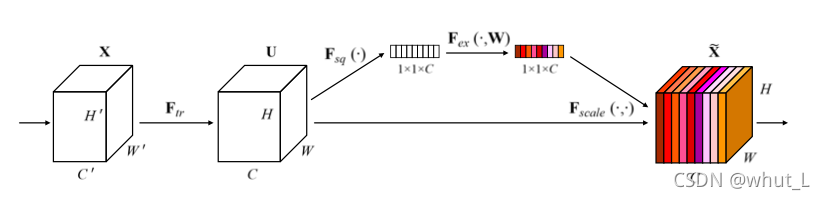
analysis : The above figure is taken from the literature 《Squeeze-and-Excitation Networks》,SENet The intuitive understanding of the original image is all The channel is weighted , The following figure shows the main process of its weighting operation .

analysis : It can be seen from the above figure , Weight the original image , Mainly through Global average pooling 、 Fully connected linear layer 、ReLU operation 、 Fully connected linear layer as well as Sigmoid function Get the weight value of each channel , Re pass Scale( The product of ) operation Complete weighting . In the example , use The convolution layer replaces the full connection layer , Try to reduce the semantic loss of pictures , Calculation The core code of weighting matrix as follows :
 # SENet( combination SENet Network diagram understanding )
        self.se = nn.Sequential(
            nn.AdaptiveAvgPool2d((1, 1)), #  Global average pooling
            nn.Conv2d(filter3, filter3 // 16, kernel_size=1), # 16 Express r,filter3//16 Express C/r, Here, the convolution layer is used instead of the full connection layer
            nn.ReLU(),
            nn.Conv2d(filter3 // 16, filter3, kernel_size=1),
            nn.Sigmoid()
        )
3--SEResNet50 Introduce
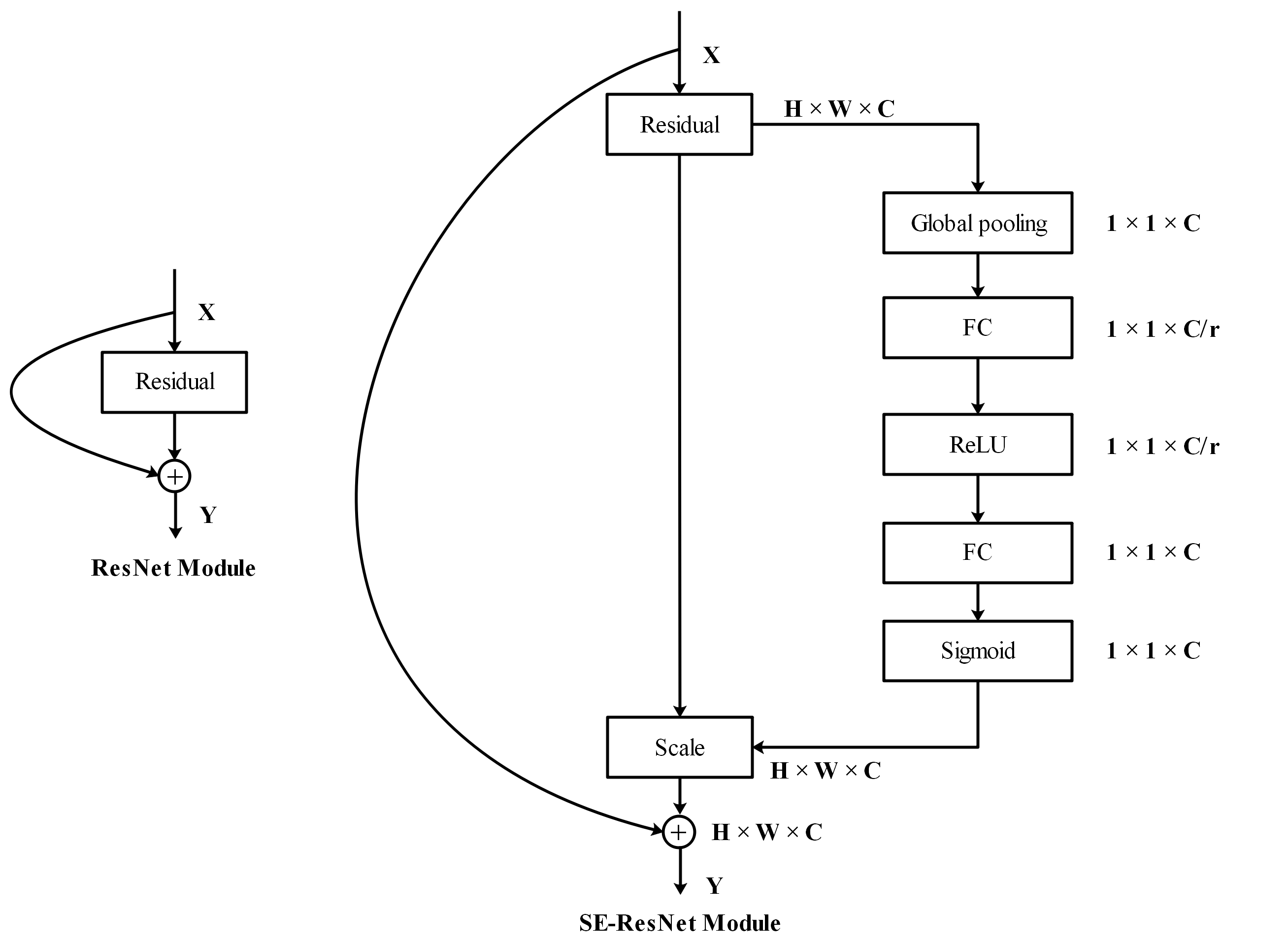
analysis : The picture above will SENet Added to the Residual Module , the SENet Add module to ResNet in Conv Block and Identity Block Of The last little Block after . be based on SENet build Conv Block and Identity Block Of Core code as follows :
#  Set up based on SENet Of Conv Block and Identity Block Network structure
class Block(nn.Module):
    def __init__(self, in_channels, filters, stride = 1, is_1x1conv = False):
        super(Block, self).__init__()

        #  each Stage The output dimension of each block in the , namely channel(filter1 = filter2 = filter3 / 4)
        filter1, filter2, filter3 = filters

        self.is_1x1conv = is_1x1conv #  Judge whether it is Conv Block
        self.relu = nn.ReLU(inplace = True) # RELU operation

        #  The first piece , stride = 1(stage = 1) or stride = 2(stage = 2, 3, 4)
        self.conv1 = nn.Sequential(
            nn.Conv2d(in_channels, filter1, kernel_size = 1, stride = stride, bias = False),
            nn.BatchNorm2d(filter1),
            nn.ReLU()
        )

        #  A small piece in the middle
        self.conv2 = nn.Sequential(
            nn.Conv2d(filter1, filter2, kernel_size=3, stride = 1, padding = 1, bias=False),
            nn.BatchNorm2d(filter2),
            nn.ReLU()
        )

        #  The last piece , There is no need for ReLu operation
        self.conv3 = nn.Sequential(
            nn.Conv2d(filter2, filter3, kernel_size = 1, stride = 1, bias=False),
            nn.BatchNorm2d(filter3),
        )

        # Conv Block The input of requires additional convolution and normalization ( combination Conv Block Network diagram understanding )
        if is_1x1conv:
            self.shortcut = nn.Sequential(
                nn.Conv2d(in_channels, filter3, kernel_size = 1, stride = stride, bias = False),
                nn.BatchNorm2d(filter3)
            )

        # SENet( combination SENet Network diagram understanding )
        self.se = nn.Sequential(
            nn.AdaptiveAvgPool2d((1, 1)), #  Global average pooling
            nn.Conv2d(filter3, filter3 // 16, kernel_size=1), # 16 Express r,filter3//16 Express C/r, Here, the convolution layer is used instead of the full connection layer
            nn.ReLU(),
            nn.Conv2d(filter3 // 16, filter3, kernel_size=1),
            nn.Sigmoid()
        )

    def forward(self, x):
        x_shortcut = x
        x1 = self.conv1(x) #  Execute the first Block operation
        x1 = self.conv2(x1) #  Execute intermediate Block operation
        x1 = self.conv3(x1) #  Execute the last Block operation

        x2 = self.se(x1)  #  utilize SENet Calculate the weight of each channel
        x1 = x1 * x2  #  Weight the original channel

        if self.is_1x1conv:  # Conv Block Perform additional convolution normalization
            x_shortcut = self.shortcut(x_shortcut)

        x1 = x1 + x_shortcut  # Add operation
        x1 = self.relu(x1)  # ReLU operation

        return x1
4-- Use of examples SEResNet50 Implement datasets CIFAR10 classification
Direct running code ( Detailed notes ):
##  Import third-party library
from torch import nn
import time
import torch
import torchvision
import torchvision.transforms as transforms
import matplotlib.pyplot as plt
import torch.optim as optim


#  Set up based on SENet Of Conv Block and Identity Block Network structure
class Block(nn.Module):
    def __init__(self, in_channels, filters, stride = 1, is_1x1conv = False):
        super(Block, self).__init__()

        #  each Stage The output dimension of each block in the , namely channel(filter1 = filter2 = filter3 / 4)
        filter1, filter2, filter3 = filters

        self.is_1x1conv = is_1x1conv #  Judge whether it is Conv Block
        self.relu = nn.ReLU(inplace = True) # RELU operation

        #  The first piece , stride = 1(stage = 1) or stride = 2(stage = 2, 3, 4)
        self.conv1 = nn.Sequential(
            nn.Conv2d(in_channels, filter1, kernel_size = 1, stride = stride, bias = False),
            nn.BatchNorm2d(filter1),
            nn.ReLU()
        )

        #  A small piece in the middle
        self.conv2 = nn.Sequential(
            nn.Conv2d(filter1, filter2, kernel_size=3, stride = 1, padding = 1, bias=False),
            nn.BatchNorm2d(filter2),
            nn.ReLU()
        )

        #  The last piece , There is no need for ReLu operation
        self.conv3 = nn.Sequential(
            nn.Conv2d(filter2, filter3, kernel_size = 1, stride = 1, bias=False),
            nn.BatchNorm2d(filter3),
        )

        # Conv Block The input of requires additional convolution and normalization ( combination Conv Block Network diagram understanding )
        if is_1x1conv:
            self.shortcut = nn.Sequential(
                nn.Conv2d(in_channels, filter3, kernel_size = 1, stride = stride, bias = False),
                nn.BatchNorm2d(filter3)
            )

        # SENet( combination SENet Network diagram understanding )
        self.se = nn.Sequential(
            nn.AdaptiveAvgPool2d((1, 1)), #  Global average pooling
            nn.Conv2d(filter3, filter3 // 16, kernel_size=1), # 16 Express r,filter3//16 Express C/r, Here, the convolution layer is used instead of the full connection layer
            nn.ReLU(),
            nn.Conv2d(filter3 // 16, filter3, kernel_size=1),
            nn.Sigmoid()
        )

    def forward(self, x):
        x_shortcut = x
        x1 = self.conv1(x) #  Execute the first Block operation
        x1 = self.conv2(x1) #  Execute intermediate Block operation
        x1 = self.conv3(x1) #  Execute the last Block operation

        x2 = self.se(x1)  #  utilize SENet Calculate the weight of each channel
        x1 = x1 * x2  #  Weight the original channel

        if self.is_1x1conv:  # Conv Block Perform additional convolution normalization
            x_shortcut = self.shortcut(x_shortcut)

        x1 = x1 + x_shortcut  # Add operation
        x1 = self.relu(x1)  # ReLU operation

        return x1


#  build SEResNet50
class SEResnet(nn.Module):
    def __init__(self, cfg):
        super(SEResnet, self).__init__()
        classes = cfg['classes']  #  Category of classification
        num = cfg['num']  # ResNet50[3, 4, 6, 3];Conv Block and  Identity Block The number of

        # Stem Block
        self.conv1 = nn.Sequential(
            nn.Conv2d(3, 64, kernel_size = 7, stride = 2, padding = 3, bias = False),
            nn.BatchNorm2d(64),
            nn.ReLU(),
            nn.MaxPool2d(kernel_size = 3, stride = 2, padding = 1)
        )

        # Stage1
        filters = (64, 64, 256)  # channel
        self.Stage1 = self._make_layer(in_channels = 64, filters = filters, num = num[0], stride = 1)

        # Stage2
        filters = (128, 128, 512) # channel
        self.Stage2 = self._make_layer(in_channels = 256, filters = filters, num = num[1], stride = 2)

        # Stage3
        filters = (256, 256, 1024) # channel
        self.Stage3 = self._make_layer(in_channels = 512, filters = filters, num = num[2], stride = 2)

        # Stage4
        filters = (512, 512, 2048) # channel
        self.Stage4 = self._make_layer(in_channels = 1024, filters = filters, num = num[3], stride = 2)

        #  Adaptive average pooling ,(1, 1) Indicates the size of the output (H x W)
        self.global_average_pool = nn.AdaptiveAvgPool2d((1, 1))

        #  Fully connected layer   Here can be understood as four in the network Stage After Subsequent Processing  link
        self.fc = nn.Sequential(
            nn.Linear(2048, classes)
        )


    #  Single form Stage Network structure
    def _make_layer(self, in_channels, filters, num, stride = 1):
        layers = []

        # Conv Block
        block_1 = Block(in_channels, filters, stride = stride, is_1x1conv = True)
        layers.append(block_1)

        # Identity Block Structural superposition ;  be based on [3, 4, 6, 3]
        for i in range(1, num):
            layers.append(Block(filters[2], filters, stride = 1, is_1x1conv = False))

        #  return Conv Block and Identity Block Set , To form a Stage Network structure
        return nn.Sequential(*layers)


    def forward(self, x):

        # Stem Block link
        x = self.conv1(x)

        #  Carry out four Stage link
        x = self.Stage1(x)
        x = self.Stage2(x)
        x = self.Stage3(x)
        x = self.Stage4(x)

        #  perform Subsequent Processing link
        x = self.global_average_pool(x)
        x = torch.flatten(x, 1)
        x = self.fc(x)

        return x


# SeResNet50 Parameters of   ( Note that calling this function will indirectly call SEResnet, A separate function is written here to facilitate modification to other ResNet The structure of the network )
def SeResNet50():
    cfg = {
        'num':(3, 4, 6, 3), # ResNet50, four Stage in Block The number of ( among Conv Block by 1 individual , The rest are increased Identity Block)
        'classes': (10)  #  Number of data set classifications
    }

    return SEResnet(cfg) #  call SEResnet The Internet


##  Import dataset
def load_dataset(batch_size):

    #  Download training set
    train_set = torchvision.datasets.CIFAR10(
        root = "data/cifar-10", train = True,
        download = True, transform = transforms.ToTensor()
    )

    #  Download test set
    test_set = torchvision.datasets.CIFAR10(
        root = "data/cifar-10", train = False,
        download = True, transform = transforms.ToTensor()
    )

    train_iter = torch.utils.data.DataLoader(
        train_set, batch_size = batch_size, shuffle = True, num_workers = 4
    )

    test_iter = torch.utils.data.DataLoader(
        test_set, batch_size = batch_size, shuffle = True, num_workers = 4
    )

    return train_iter, test_iter


#  Training models
def train(net, train_iter, criterion, optimizer, num_epochs, device, num_print, lr_scheduler = None, test_iter = None):

    net.train() #  Training mode
    record_train = list() #  Record each Epoch Accuracy of lower training set
    record_test = list()  #  Record each Epoch The accuracy of the next test set

    for epoch in range(num_epochs):
        print("========== epoch: [{}/{}] ==========".format(epoch + 1, num_epochs))

        total, correct, train_loss = 0, 0, 0
        start = time.time()

        for i, (X, y) in enumerate(train_iter):
            X, y = X.to(device), y.to(device) # GPU or CPU function

            output = net(X)  #  Calculate the output
            loss = criterion(output, y)  #  Calculate the loss

            optimizer.zero_grad() #  Gradient set 0
            loss.backward() #  Calculate the gradient
            optimizer.step()  #  Optimization parameters

            train_loss += loss.item() #  Accumulated losses
            total += y.size(0) #  Cumulative total number of samples

            correct += (output.argmax(dim=1) == y).sum().item() #  The number of samples with correct cumulative prediction
            train_acc = 100.0 * correct / total  #  Computational accuracy

            if (i + 1) % num_print == 0:
                print("step: [{}/{}], train_loss: {:.3f} | train_acc: {:6.3f}% | lr: {:.6f}" \
                    .format(i + 1, len(train_iter), train_loss / (i + 1), \
                            train_acc, get_cur_lr(optimizer)))

        #  Adjust the learning rate of gradient descent algorithm
        if lr_scheduler is not None:
            lr_scheduler.step()

        #  Output training time
        print("--- cost time: {:.4f}s ---".format(time.time() - start))

        if test_iter is not None: #  Judge whether the test set is empty  ( Notice here that test function )
            record_test.append(test(net, test_iter, criterion, device))  #  Every training one Epoch Model , Use the test set to test the accuracy of the model
        record_train.append(train_acc)

    #  Return to each Epoch The accuracy of test set and training set
    return record_train, record_test


#  Validate the model
def test(net, test_iter, criterion, device):
    total, correct = 0, 0
    net.eval()  #  Test mode

    with torch.no_grad():  #  Don't calculate the gradient
        print("*************** test ***************")
        for X, y in test_iter:
            X, y = X.to(device), y.to(device)  # CPU or GPU function

            output = net(X)  #  Calculate the output
            loss = criterion(output, y)  #  Calculate the loss

            total += y.size(0)  #  Calculate the number of test samples
            correct += (output.argmax(dim=1) == y).sum().item()  #  Calculate the number of samples that the test set predicts accurately

    test_acc = 100.0 * correct / total  #  Test set accuracy

    #  Loss of output test set
    print("test_loss: {:.3f} | test_acc: {:6.3f}%" \
          .format(loss.item(), test_acc))
    print("************************************\n")

    #  Training mode  ( Because here is because every time I pass by Epoch Just use the test set once , After using the test set , Go to the next Epoch Put the model back into training mode before )
    net.train()

    return test_acc


#  Return to learning rate lr Function of
def get_cur_lr(optimizer):
    for param_group in optimizer.param_groups:
        return param_group['lr']

#  Draw each Epoch The accuracy of test set and training set
def learning_curve(record_train, record_test=None):
    plt.style.use("ggplot")

    plt.plot(range(1, len(record_train) + 1), record_train, label = "train acc")
    if record_test is not None:
        plt.plot(range(1, len(record_test) + 1), record_test, label = "test acc")

    plt.legend(loc=4)
    plt.title("learning curve")
    plt.xticks(range(0, len(record_train) + 1, 5))
    plt.yticks(range(0, 101, 5))
    plt.xlabel("epoch")
    plt.ylabel("accuracy")

    plt.show()


BATCH_SIZE = 128  #  Batch size
NUM_EPOCHS = 12  # Epoch size
NUM_CLASSES = 10  #  Number of categories
LEARNING_RATE = 0.01  #  Gradient descent learning rate
MOMENTUM = 0.9  #  Impulse size
WEIGHT_DECAY = 0.0005 #  Weight attenuation coefficient
NUM_PRINT = 100
DEVICE = "cuda" if torch.cuda.is_available() else "cpu"  # GPU or CPU function


def main():
    net = SeResNet50()
    net = net.to(DEVICE)  # GPU or CPU  function

    train_iter, test_iter = load_dataset(BATCH_SIZE)  #  Import training set and test set

    criterion = nn.CrossEntropyLoss()  #  Loss calculator

    #  Optimizer
    optimizer = optim.SGD(
        net.parameters(),
        lr = LEARNING_RATE,
        momentum = MOMENTUM,
        weight_decay = WEIGHT_DECAY,
        nesterov = True
    )

    #  Adjust the learning rate  (step_size: Every training step_size individual epoch, Update parameters once ; gamma: to update lr Multiplication factor of )
    lr_scheduler = optim.lr_scheduler.StepLR(optimizer, step_size = 5, gamma = 0.1)

    record_train, record_test = train(net, train_iter, criterion, optimizer, NUM_EPOCHS, DEVICE, NUM_PRINT,
                                      lr_scheduler, test_iter)

    learning_curve(record_train, record_test) #  Draw the accuracy curve


main()

5-- Reference resources
SENet Reference resources
边栏推荐
- PAT甲级1152 Google Recruitment (20 分)
- I want to ask whether the variable configuration function can only be used in SQL mode
- Qtime definition (manual waste utilization is simple and beautiful)
- Games101 review: 3D transformation
- C # fine sorting knowledge points 10 generic (recommended Collection)
- MySQL optimization summary II
- Brain racking CPU context switching
- 2019浙江省赛C-错排问题,贪心
- CF685B-求有根树每颗子树的重心
- Games101 review: Transformation
猜你喜欢

JVM - classloader and parental delegation model

LeetCode - 707 设计链表 (设计)

Leetcode - 303 area and retrieval - array immutable (design prefix and array)

No tracked branch configured for branch xxx or the branch doesn‘t exist. To make your branch trac

使用cpolar建立一个商业网站(如何购买域名)

Pytorch学习笔记-Advanced_CNN(Using Inception_Module)实现Mnist数据集分类-(注释及结果)

解决vender-base.66c6fc1c0b393478adf7.js:6 TypeError: Cannot read property ‘validate‘ of undefined问题
matlab---错误使用 var 数据类型无效。第一个输入参数必须为单精度值或双精度值
LeetCode - 303 区域和检索 - 数组不可变 (设计 前缀和数组)

LeetCode - 225 用队列实现栈
随机推荐
LeetCode - 379 电话目录管理系统(设计)
Leetcode - 379 telephone directory management system (Design)
2019陕西省省赛K-变种Dijstra
Cf685b find the center of gravity of each subtree of a rooted tree
P4552 differential
2019 Shaanxi Provincial race K-variant Dijstra
Take you to learn more about JS basic grammar (recommended Collection)
JVM—类加载器和双亲委派模型
Understanding the difference between wait() and sleep()
死锁杂谈
JVM knowledge brain map sharing
LeetCode - 303 区域和检索 - 数组不可变 (设计 前缀和数组)
Pat grade a 1151 LCA in a binary tree (30 points)
Pytorch学习笔记--Pytorch常用函数总结1
2021江苏省赛A. Array-线段树,维护值域,欧拉降幂
Brain racking CPU context switching
MySQL optimization summary II
活动回顾|7月6日安远AI x 机器之心系列讲座第2期|麻省理工教授Max Tegmark分享「人类与AI的共生演化 」
Matlab randInt, matlab randInt function usage "recommended collection"
Graph theory and concept