当前位置:网站首页>What can the graph of training and verification indicators tell us in machine learning?
What can the graph of training and verification indicators tell us in machine learning?
2022-06-10 13:46:00 【deephub】
When we train and verify the model, we will save the training indicators and make them into charts , In this way, you can view and analyze after you finish , But do you really understand the meaning of these indicators ?
In this article, we will summarize the possible situations of training and verification and introduce what kind of information these charts can provide us .
Let's start with some simple code , The following code establishes a basic training process framework .
from sklearn.model_selection import train_test_split
from sklearn.datasets import  make_classification
import torch
from torch.utils.data import Dataset, DataLoader
import torch.optim as torch_optim
import torch.nn as nn
import torch.nn.functional as F
import numpy as np
import matplotlib.pyplot as pltclass MyCustomDataset(Dataset):
    def __init__(self, X, Y, scale=False):
        self.X = torch.from_numpy(X.astype(np.float32))
        self.y = torch.from_numpy(Y.astype(np.int64))

    def __len__(self):
        return len(self.y)

    def __getitem__(self, idx):
        return self.X[idx], self.y[idx]def get_optimizer(model, lr=0.001, wd=0.0):
    parameters = filter(lambda p: p.requires_grad, model.parameters())
    optim = torch_optim.Adam(parameters, lr=lr, weight_decay=wd)
    return optimdef train_model(model, optim, train_dl, loss_func):
    # Ensure the model is in Training mode
    model.train()
    total = 0
    sum_loss = 0
    for x, y in train_dl:
        batch = y.shape[0]
        # Train the model for this batch worth of data
        logits = model(x)
        # Run the loss function. We will decide what this will be when we call our Training Loop
        loss = loss_func(logits, y)
        # The next 3 lines do all the PyTorch back propagation goodness
        optim.zero_grad()
        loss.backward()
        optim.step()
        # Keep a running check of our total number of samples in this epoch
        total += batch
        # And keep a running total of our loss
        sum_loss += batch*(loss.item())
    return sum_loss/total
def train_loop(model, train_dl, valid_dl, epochs, loss_func, lr=0.1, wd=0):
    optim = get_optimizer(model, lr=lr, wd=wd)
    train_loss_list = []
    val_loss_list = []
    acc_list = []
    for i in range(epochs):
        loss = train_model(model, optim, train_dl, loss_func)
        # After training this epoch, keep a list of progress of
        # the loss of each epoch
        train_loss_list.append(loss)
        val, acc = val_loss(model, valid_dl, loss_func)
        # Likewise for the validation loss and accuracy
        val_loss_list.append(val)
        acc_list.append(acc)
        print("training loss: %.5f     valid loss: %.5f     accuracy: %.5f" % (loss, val, acc))

    return train_loss_list, val_loss_list, acc_list
def val_loss(model, valid_dl, loss_func):
    # Put the model into evaluation mode, not training mode
    model.eval()
    total = 0
    sum_loss = 0
    correct = 0
    batch_count = 0
    for x, y in valid_dl:
        batch_count += 1
        current_batch_size = y.shape[0]
        logits = model(x)
        loss = loss_func(logits, y)
        sum_loss += current_batch_size*(loss.item())
        total += current_batch_size
        # All of the code above is the same, in essence, to
        # Training, so see the comments there
        # Find out which of the returned predictions is the loudest
        # of them all, and that's our prediction(s)
        preds = logits.sigmoid().argmax(1)
        # See if our predictions are right
        correct += (preds == y).float().mean().item()
    return sum_loss/total, correct/batch_count
def view_results(train_loss_list, val_loss_list, acc_list):
    plt.rcParams["figure.figsize"] = (15, 5)
    plt.figure()
    epochs = np.arange(0, len(train_loss_list))    plt.subplot(1, 2, 1)
    plt.plot(epochs-0.5, train_loss_list)
    plt.plot(epochs, val_loss_list)
    plt.title('model loss')
    plt.ylabel('loss')
    plt.xlabel('epoch')
    plt.legend(['train', 'val', 'acc'], loc = 'upper left')

    plt.subplot(1, 2, 2)
    plt.plot(acc_list)
    plt.title('accuracy')
    plt.ylabel('accuracy')
    plt.xlabel('epoch')
    plt.legend(['train', 'val', 'acc'], loc = 'upper left')
    plt.show()

def get_data_train_and_show(model, batch_size=128, n_samples=10000, n_classes=2, n_features=30, val_size=0.2, epochs=20, lr=0.1, wd=0, break_it=False):
    # We'll make a fictitious dataset, assuming all relevant
    # EDA / Feature Engineering has been done and this is our
    # resultant data
    X, y = make_classification(n_samples=n_samples, n_classes=n_classes, n_features=n_features, n_informative=n_features, n_redundant=0, random_state=1972)

    if break_it: # Specifically mess up the data
        X = np.random.rand(n_samples,n_features)
    X_train, X_val, y_train, y_val = train_test_split(X, y, test_size=val_size, random_state=1972)    train_ds = MyCustomDataset(X_train, y_train)
    valid_ds = MyCustomDataset(X_val, y_val)
    train_dl = DataLoader(train_ds, batch_size=batch_size, shuffle=True)
    valid_dl = DataLoader(valid_ds, batch_size=batch_size, shuffle=True)    train_loss_list, val_loss_list, acc_list = train_loop(model, train_dl, valid_dl, epochs=epochs, loss_func=F.cross_entropy, lr=lr, wd=wd)
    view_results(train_loss_list, val_loss_list, acc_list)
The above code is simple , It's about getting data , Training , Verify such a basic process , Now let's get to the point .
scene 1 - The model seems to be learnable , But poor performance in validation or accuracy
No matter what the super parameter is , Model Train loss Will slow down , but Val loss It won't fall , And its Accuracy It doesn't mean it's learning anything .
For example, in this case , The accuracy of binary classification hovers in 50% about .
class Scenario_1_Model_1(nn.Module):
    def __init__(self, in_features=30, out_features=2):
        super().__init__()
        self.lin1 = nn.Linear(in_features, out_features)
    def forward(self, x):
        x = self.lin1(x)
        return x

get_data_train_and_show(Scenario_1_Model_1(), lr=0.001, break_it=True)

There is not enough information in the data to allow ‘ Study ’, The training data may not contain enough information to make the model “ Study ”.
under these circumstances ( The training data in the code is random data ), This means that it cannot learn any substance .
Data must have enough information to learn from .EDA And feature engineering is the key ! What model learning can learn , Instead of making up something that doesn't exist .
scene 2 — Training 、 The validation and accuracy curves are very unstable
For example, the following code :lr=0.1,bs=128
class Scenario_2_Model_1(nn.Module):
    def __init__(self, in_features=30, out_features=2):
        super().__init__()
        self.lin1 = nn.Linear(in_features, out_features)
    def forward(self, x):
        x = self.lin1(x)
        return x

get_data_train_and_show(Scenario_2_Model_1(), lr=0.1)

“ Learning rate is too high ” or “ The batch size is too small ” Try to reduce the learning rate from 0.1 Down to 0.001, That means it won't “ rebound ”, But it will decrease steadily .
get_data_train_and_show(Scenario_1_Model_1(), lr=0.001)

In addition to reducing the learning rate , Increasing the batch size will also make it smoother .
get_data_train_and_show(Scenario_1_Model_1(), lr=0.001, batch_size=256)

scene 3—— The training loss is close to zero , The accuracy looks good , But verification It didn't go down , And it went up
class Scenario_3_Model_1(nn.Module):
    def __init__(self, in_features=30, out_features=2):
        super().__init__()
        self.lin1 = nn.Linear(in_features, 50)
        self.lin2 = nn.Linear(50, 150)
        self.lin3 = nn.Linear(150, 50)
        self.lin4 = nn.Linear(50, out_features)
    def forward(self, x):
        x = F.relu(self.lin1(x))
        x = F.relu(self.lin2(x))
        x = F.relu(self.lin3(x))
        x = self.lin4(x)
        return x
get_data_train_and_show(Scenario_3_Model_1(), lr=0.001)
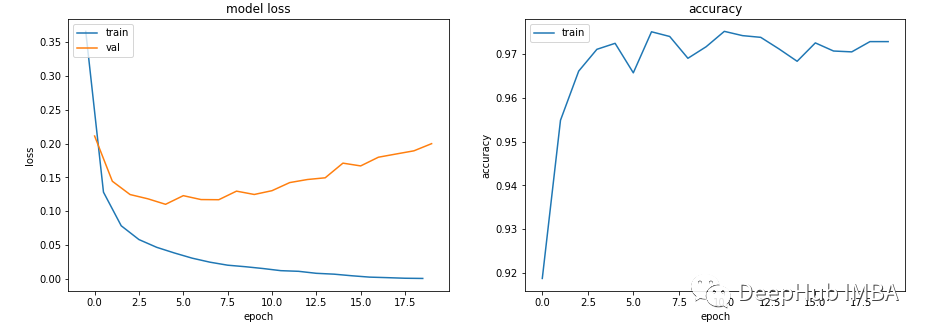
This must be a fitting : Low training loss and high accuracy , And the loss of verification and training is getting larger and larger , Are classic over fitting indicators .
Basically , Your model learning ability is too strong . It has a good memory of training data , This means that it cannot be generalized to new data .
The first thing we can try is to reduce the complexity of the model .
class Scenario_3_Model_2(nn.Module):
    def __init__(self, in_features=30, out_features=2):
        super().__init__()
        self.lin1 = nn.Linear(in_features, 50)
        self.lin2 = nn.Linear(50, out_features)
    def forward(self, x):
        x = F.relu(self.lin1(x))
        x = self.lin2(x)
        return x

get_data_train_and_show(Scenario_3_Model_2(), lr=0.001)

This makes it better , You can also introduce L2 Weight attenuation regularization , Make it better again ( Suitable for shallow models ).
get_data_train_and_show(Scenario_3_Model_2(), lr=0.001, wd=0.02)

If we want to keep the depth and size of the model , You can try to use dropout( For deeper models ).
class Scenario_3_Model_3(nn.Module):
    def __init__(self, in_features=30, out_features=2):
        super().__init__()
        self.lin1 = nn.Linear(in_features, 50)
        self.lin2 = nn.Linear(50, 150)
        self.lin3 = nn.Linear(150, 50)
        self.lin4 = nn.Linear(50, out_features)
        self.drops = nn.Dropout(0.4)
    def forward(self, x):
        x = F.relu(self.lin1(x))
        x = self.drops(x)
        x = F.relu(self.lin2(x))
        x = self.drops(x)
        x = F.relu(self.lin3(x))
        x = self.drops(x)
        x = self.lin4(x)
        return x
get_data_train_and_show(Scenario_3_Model_3(), lr=0.001)

scene 4 - Good training and verification , But the accuracy is not improved
lr = 0.001,bs = 128( Default , Classification categories = 5
class Scenario_4_Model_1(nn.Module):
    def __init__(self, in_features=30, out_features=2):
        super().__init__()
        self.lin1 = nn.Linear(in_features, 2)
        self.lin2 = nn.Linear(2, out_features)
    def forward(self, x):
        x = F.relu(self.lin1(x))
        x = self.lin2(x)
        return x

get_data_train_and_show(Scenario_4_Model_1(out_features=5), lr=0.001, n_classes=5)

Not enough learning ability : The parameters of one layer in the model are less than the classes in the possible output of the model . under these circumstances , When there is 5 Possible output classes , The only intermediate parameters are 2 individual .
This means that the model loses information , Because it has to fill it with a smaller layer , So once the layer parameters are expanded again , It is difficult to recover this information .
Therefore, the parameters of the recording layer should never be smaller than the output size of the model .
class Scenario_4_Model_2(nn.Module):
    def __init__(self, in_features=30, out_features=2):
        super().__init__()
        self.lin1 = nn.Linear(in_features, 50)
        self.lin2 = nn.Linear(50, out_features)
    def forward(self, x):
        x = F.relu(self.lin1(x))
        x = self.lin2(x)
        return x
get_data_train_and_show(Scenario_4_Model_2(out_features=5), lr=0.001, n_classes=5)

summary
These are some common exercises 、 Examples of curves at the time of validation , I hope you can quickly locate and improve in the same situation .
https://avoid.overfit.cn/post/5f52eb0868ce41a3a847783d5e87a04f
author :Martin Keywood
边栏推荐
- Libre circulation des ressources dans le cloud et localement
- Periodically brush the data in the database and synchronize only the modified fields
- Ten easy-to-use cross browser testing tools to share, good things worth collecting
- "Reduce the burden" so that the "pig" can fly higher
- 聊聊消息中间件(1),AMQP那些事儿
- Im instant messaging development: the underlying principle of process killed and app skills to deal with killed
- How to write code that is not easy to overflow memory
- 数码管驱动芯片+语音芯片的应用场景介绍,WT588E02B-24SS
- buuctf [PHP]CVE-2019-11043
- 五角大楼首次承认资助46个乌生物设施 俄方曾曝只有3个安全
猜你喜欢

CL210OpenStack操作的故障排除--常见核心问题的故障排除

The relocation of Apple's production line shows that 5g industrial interconnection and intelligent manufacturing have limited help for manufacturing in China

If I write the for loop again, I will hammer myself
10 competitive airpods Pro products worth your choice

In depth analysis of "circle group" relationship system design | series of articles on "circle group" technology

【笔记】C语言数组指针、结构体+二维数组指针小记

超详细的FFmpeg安装及简单使用教程
![buuctf [PHP]XDebug RCE](/img/e2/bcae10e2051b7e9dce918bf87fdc05.png)
buuctf [PHP]XDebug RCE
![buuctf [PHP]inclusion](/img/02/d328ed84e4641c09c5b1eba3ac6ea9.png)
buuctf [PHP]inclusion

High performance practical Alibaba sentinel notes, in-depth restoration of Alibaba micro service high concurrency scheme

随机推荐
10 competitive airpods Pro products worth your choice
【抬杠C#】如何实现接口的base调用
Normal controller structure
Ekuiper newsletter 2022-05 protobuf codec support, visual drag and drop writing rules
数码管驱动芯片+语音芯片的应用场景介绍,WT588E02B-24SS
From "chemist" to developer, from Oracle to tdengine, two important choices in my life
618 大促来袭,浅谈如何做好大促备战
buuctf [PHP]inclusion
#yyds干货盘点# 解决剑指offer:跳台阶扩展问题
智慧校园安全通道及视频监控解决方案
leetcode-56-合并区间
Recommend an efficient IO component - okio
Solve the problem that win10 virtual machine and host cannot paste and copy each other
机器学习中训练和验证指标曲线图能告诉我们什么?
[yellow code] SVN version control tutorial
【Golang】创建有配置参数的结构体时,可选参数应该怎么传?
超详细的FFmpeg安装及简单使用教程
TabLayout 使用详解(修改文字大小、下划线样式等)
The shortcomings of the "big model" and the strengths of the "knowledge map"
【无标题】音频蓝牙语音芯片,WT2605C-32N实时录音上传技术方案介绍