当前位置:网站首页>(heap sort) heap sort is super detailed, I don't believe you can't (C language code implementation)
(heap sort) heap sort is super detailed, I don't believe you can't (C language code implementation)
2022-07-29 04:31:00 【Small clock HHH】

List of articles
The basic introduction of heap
Pile up (Heap) Is a general term for a special class of data structures in computer science .
A heap is usually a tree that can be seen as a tree Perfect binary tree Array object of . Store all its elements in a one-dimensional array in the order of a complete binary tree , And satisfy that the value of any parent node must be less than or equal to ( Greater than or equal to ) The value of the child node .
Two properties of heap :
- The value of a node in the heap is always no greater than or less than the value of its parent node
- The heap is always a complete binary tree .
The classification of heaps :
- Heap ( Little heap ): The smallest heap in the root node
- Big root pile ( A lot ): The largest heap at the root node

The implementation of heap sorting
Since it's heap sorting , We have to build a heap , Sort on the basis of the heap .
First, build a heap , Then how can we make a pile of disordered numbers form a pile ?
First of all, we need to understand the basic algorithm of heap sorting —— Adjust the algorithm down
Building the heap ( Adjust the algorithm down )
First we give an array , Logically, it's a complete binary tree .int array[] = {27,15,19,18,28,34,65,49,25,37};
This is a group Special data , But this group of data just meets the condition of downward adjustment algorithm
The downward adjustment algorithm has a premise : The left and right subtrees must be a heap , To adjust .
We can go through Downward adjustment algorithm starting from the root node It can be adjusted into a small pile .
We can find that only the data of the root node does not satisfy the small heap , And the left and right subtrees are satisfied , So we need to adjust from the root node step by step , Make it form a small pile .
The basis of adjustment is the condition of small piles : Any parent node is less than or equal to the child node .
Adjust the algorithm down :
1. Start at the root node , Keep adjusting downward
2. Choose the smaller of the left and right children , Compared with my father
- If you are younger than your father , Just exchange with my father
- If you are older than your father , Just stop switching , At this time, the heap has been formed
3. At worst, the exchange stops when the child is a leaf node

Code implementation :
// In exchange for
void swap(int* px, int *py)
{

	int tmp = 0;
	tmp = *px;
	*px = *py;
	*py = tmp;
}

// Adjust the algorithm down , Conditions : The left and right subtrees are piles

// Let's assume a small pile ( A lot of them will be modified accordingly )

//a For array first address ,n Is the number of data ,parent Parent node
void AdjustDown(int* a, int n, int parent)
{

	int child = parent * 2 + 1;// First, point to the left child by default

    // The end condition is child The subscript of is less than n, When child When it is a leaf node , next step child Is greater than n Of , The loop ends
	while (child < n)
	{

		// Find the small one around the child , send child For the younger child
		if ((child + 1 < n) && (a[child + 1] < a[child]))
		{

			child++;// By default, the subscript of the right child is more than that of the left child
		}

		//1. If a young child is younger than his father , The exchange , Continue to adjust downward
		//2. If a young child is older than his father , End adjustment

		if (a[child] < a[parent])
		{

			// In exchange for
			swap(&a[child], &a[parent]);
			parent = child;
			child = parent * 2 + 1;
		}
		else
		{

			break;
		}
	}
}
The downward adjustment algorithm is over , But we will find that this is very chicken ribs , A heap can only be formed under certain circumstances , So how to ensure that heaps can be formed in general ?
First, give a complete binary tree that is not satisfied that the left and right subtrees are stacked ,int arr[] = {12, 34, 45, 56, 14, 20, 90, 67, 42, 74};
We make this complete binary tree into a small pile .
Main idea :
1. Adjust downward from the penultimate non leaf node
2. Stop when adjusting to the root node

Code implementation :
// Build a small pile
//i The initial value of is the subscript of the first non leaf node
for (int i = (n - 1 - 1) / 2; i >= 0; i--)
{

	// Adjust downward from the penultimate non leaf node , All the way to the root
	AdjustDown(a, n, i);
}
// After adjustment, you get a small root pile
After adjusting the operation of the algorithm downward , The generally complete binary tree has formed a heap , Now how to sort ?
The implementation of sorting
The implementation of sorting , We should consider the ascending order , Or in descending order , Building piles can be divided into building large piles and building small piles , So how to choose the best ?
Rank ascending : It's better to build a lot , Small piles can also be built , Unable to reflect the value brought by reactor building
In descending order : It's better to build small piles , Empathy
So how to sort ?
1. The pile has been built , The first value is the minimum ( If it's a lot , Then the first value is the largest ), Swap the first value with the last value , Store it
2. Remove the last number , Adjust downward from the root node , Repeat , Get the minimum value in turn and store , Until only the last number is left .


Code implementation :
int end = n - 1;
	while (end > 0)
	{

		swap(&a[0], &a[end]);// Exchange the minimum value with the subsequent elements of the array , Store it behind the array , Form descending order
		AdjustDown(a, end, 0);// Then adjust it in turn to get the minimum value
		end--;
	}
Heap sort complete code
Moving graph :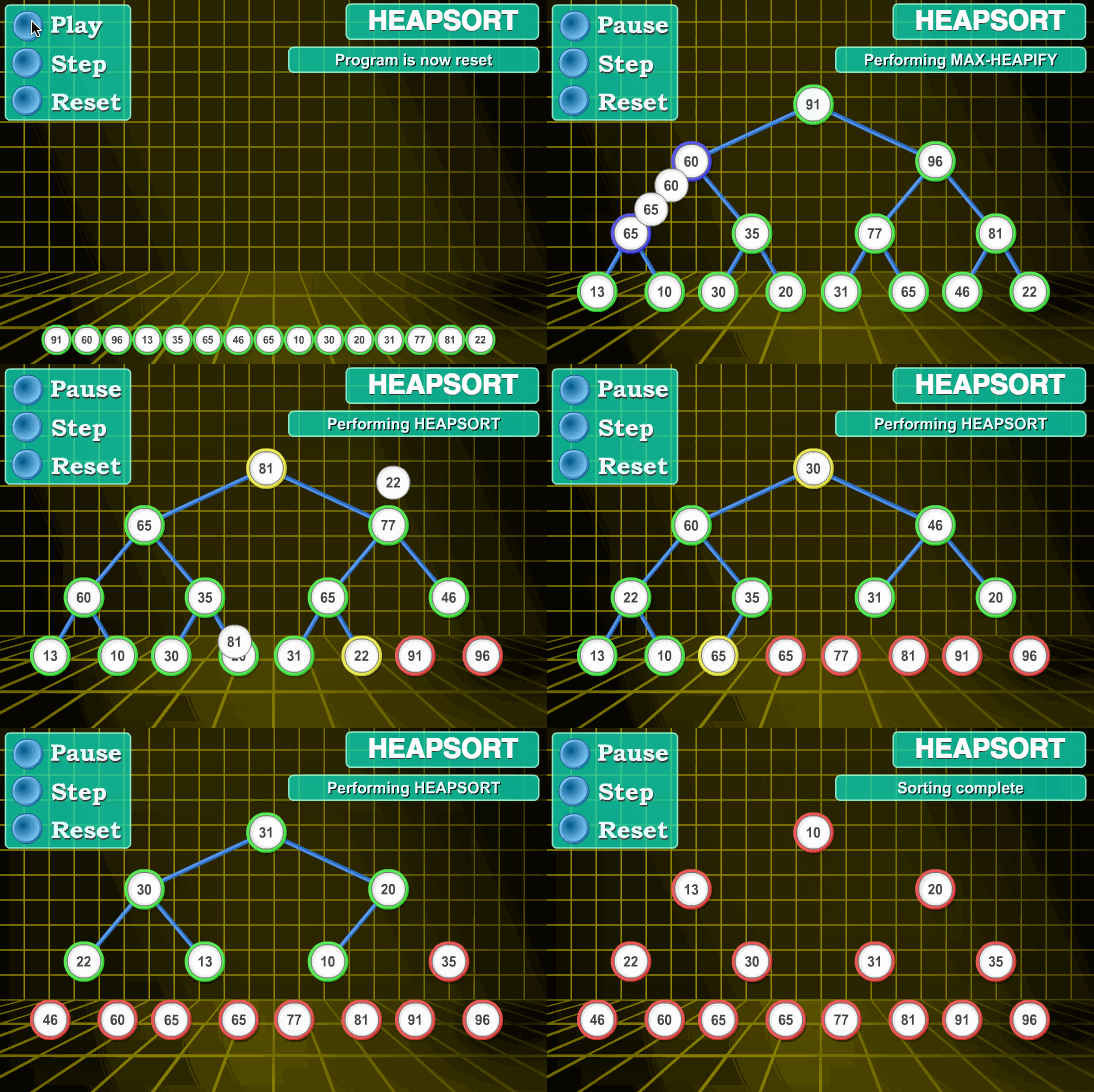
Code :
#include<stdio.h>

// In exchange for
void swap(int* px, int *py)
{

	int tmp = 0;
	tmp = *px;
	*px = *py;
	*py = tmp;
}

// Adjust the algorithm down , Conditions : The left and right subtrees are piles

// Let's assume a small pile ( A lot of them will be modified accordingly )
void AdjustDown(int* a, int n, int parent)
{

	int child = parent * 2 + 1;// By default, it points to the left child

	while (child < n)
	{

		// Find the small one around the child
		if ((child + 1 < n) && (a[child + 1] < a[child]))
		{

			child++;// By default, the subscript of the right child is more than that of the left child
		}

		//1. If a young child is younger than his father , The exchange , Continue to adjust downward
		//2. If a young child is older than his father , End adjustment

		if (a[child] < a[parent])
		{

			// In exchange for
			swap(&a[child], &a[parent]);
			parent = child;
			child = parent * 2 + 1;
		}
		else
		{

			break;
		}
	}
}

void HeapSort(int* a, int n)
{

	// Build a small pile
	for (int i = (n - 1 - 1) / 2; i >= 0; i--)
	{

		// Adjust downward from the penultimate non leaf node , All the way to the root
		AdjustDown(a, n, i);
	}
	// After adjustment, you get a small root pile

	// In descending order
	int end = n - 1;
	while (end > 0)
	{

		swap(&a[0], &a[end]);// Exchange the minimum value with the subsequent elements of the array , Store it behind the array , Form descending order

		AdjustDown(a, end, 0);// Then adjust it in turn to get the minimum value

		end--;
	}
}

int main()
{

	int a[] = {
     12, 34, 45, 56, 14, 20, 90, 67, 42, 74 };

	// Heap sort
	HeapSort(a, sizeof(a) / sizeof(int));

	// Print data
	for (int i = 0; i < sizeof(a) / sizeof(int); i++)
	{

		printf("%d ", a[i]);
	}
	return 0;
}

success !!!
Time complexity analysis of reactor building

So the time complexity of heap sorting is O(N*log2N)(2 Base number )
边栏推荐
- Simply change the picture color
- 你真的会写Restful API吗?
- Machine vision series 3:vs2019 opencv environment configuration
- TypeError: Cannot read properties of undefined (reading ‘then‘)
- Flutter实战-请求封装(二)之dio
- Understand the Internet giant [the war between China and Taiwan] and the development thinking of China and Taiwan
- LeetCode(剑指 Offer)- 53 - I. 在排序数组中查找数字 I
- MySQL - 深入解析MySQL索引数据结构
- Pyqt5 learning pit encounter and pit drainage (3) background picture coverage button style and check button status
- Shell string segmentation
猜你喜欢

Idea small settings

Jenkins 参数化构建中 各参数介绍与示例

12.优先级队列和惰性队列

Don't stick to it for 68 days. Baboons eat bananas

The third ACM program design competition of Wuhan University of Engineering
不会就坚持68天吧 狒狒吃香蕉

不会就坚持67天吧 平方根

Actual combat of flutter - DIO of request encapsulation (II)

Class starts! See how smardaten decomposes complex business scenarios
![[express connection to MySQL database]](/img/a6/d68327fa74b8c94d250ea469301839.png)
[express connection to MySQL database]
随机推荐
MySQL - 聚簇索引和辅助索引
Target detection learning process
Vscode one click compilation and debugging
Semantic segmentation correlation
C语言:typedef知识点总结
12. Priority queue and inert queue
14. Haproxy+kept load balancing and high availability
C language: enumerating knowledge points summary
[hands on deep learning] environment configuration (detailed records, starting from the installation of VMware virtual machine)
Incubator course design (April 12, 2021)
Sign the college entrance examination
C language: structure simple syntax summary
Multi rotor six axis hardware selection
Class starts! See how smardaten decomposes complex business scenarios
不会就坚持64天吧 查找插入位置
6.pytest生成allure报告
Locker 2022.1.1
Make a virtual human with zego avatar | virtual anchor live broadcast solution
Pytorch GPU and CPU models load each other
Back propagation process of manual BP neural network