当前位置:网站首页>Seven parameters of thread pool and custom thread pool
Seven parameters of thread pool and custom thread pool
2022-06-22 06:18:00 【Kuxiaoya】
The first part describes three methods of thread pool , First review the following :
Executors.newSingleThreadExecutor(); Single thread
Executors.newFixedThreadPool(5); Fixed number of threads
Executors.newCachedThreadPool(); Buffer pool , Scalable
Let's see “ Three ways ” Source code analysis , In this way, we can better understand “ Seven parameters ”:
//Executors.newSingleThreadExecutor();  Single thread
// Source code analysis :
public static ExecutorService newSingleThreadExecutor() {

    return new FinalizableDelegatedExecutorService
        (new ThreadPoolExecutor(1, 1,
                                0L, TimeUnit.MILLISECONDS,
                                new LinkedBlockingQueue<Runnable>()));
}

//Executors.newFixedThreadPool(5);  Fixed number of threads
// Source code analysis :
public static ExecutorService newFixedThreadPool(int nThreads) {

        return new ThreadPoolExecutor(nThreads, nThreads,
                                      0L, TimeUnit.MILLISECONDS,
                                      new LinkedBlockingQueue<Runnable>());
}

//Executors.newCachedThreadPool();  Buffer pool , Scalable
// Source code analysis :
public static ExecutorService newCachedThreadPool() {

        return new ThreadPoolExecutor(0, Integer.MAX_VALUE,//21 Billion  OOM:Out Of Memory, out of memory
                                      60L, TimeUnit.SECONDS,
                                      new SynchronousQueue<Runnable>());
}
Source code analysis :( There are three methods ThreadPoolExecutor)
Continue clicking ThreadPoolExecutor , View source code :
// The essence : ThreadPoolExecutor

public ThreadPoolExecutor(int corePoolSize,// Core thread pool size
                              int maximumPoolSize,// Maximum core thread pool size
                              long keepAliveTime,// If no one calls after the timeout, it will be released
                              TimeUnit unit, // Timeout unit
                              BlockingQueue<Runnable> workQueue,// Blocking queues
                              ThreadFactory threadFactory,// Thread factory :  Create thread of , Generally don't move
                              RejectedExecutionHandler handler// Refusal strategy ) {

        if (corePoolSize < 0 ||
            maximumPoolSize <= 0 ||
            maximumPoolSize < corePoolSize ||
            keepAliveTime < 0)
            throw new IllegalArgumentException();
        if (workQueue == null || threadFactory == null || handler == null)
            throw new NullPointerException();
        this.acc = System.getSecurityManager() == null ?
                null :
                AccessController.getContext();
        this.corePoolSize = corePoolSize;
        this.maximumPoolSize = maximumPoolSize;
        this.workQueue = workQueue;
        this.keepAliveTime = unit.toNanos(keepAliveTime);
        this.threadFactory = threadFactory;
        this.handler = handler;
    }
Get seven parameters :
int corePoolSize,// Core thread pool size
int maximumPoolSize,// Maximum core thread pool size
long keepAliveTime,// If no one calls after the timeout, it will be released
TimeUnit unit, // Timeout unit
BlockingQueue<Runnable> workQueue,// Blocking queues
ThreadFactory threadFactory,// Thread factory :  Create thread of , Generally don't move
RejectedExecutionHandler handler// Refusal strategy
Custom thread pool :
package pool;

import java.util.concurrent.*;

public class Demo2 {

    public static void main(String[] args) {


        //  Custom thread pool ! Work  ThreadPoolExecutor( Seven parameters )
        ExecutorService threadPool = new ThreadPoolExecutor(
          2,
          5,
          3,
          TimeUnit.SECONDS,
          new LinkedBlockingDeque<>(3),
          Executors.defaultThreadFactory(),
          // There are four rejection strategies , Use what suits you !
          new ThreadPoolExecutor.DiscardOldestPolicy() // The queue is full , Try to compete with the earliest , It doesn't throw an exception !
        );

        try {

            // Maximum bearing capacity : Deque + max
            // exceed  RejectedExecutionException  Throw a reject execution exception
            for (int i = 1; i <= 9; i++) {

                // After using the thread pool , Use thread pool to create threads
                threadPool.execute(()->{

                    System.out.println(Thread.currentThread().getName()+" OK!");
                });
            }
        } catch (Exception e) {

            e.printStackTrace();
        } finally {

            // Out of thread pool , Program end , Close thread pool
            threadPool.shutdown();
        }
    }
}
Four rejection strategies :

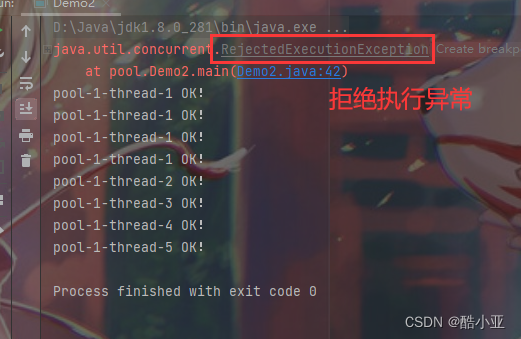
1、new ThreadPoolExecutor.AbortPolicy()
The bank is full , There are people coming in , Just don't deal with this person ,
Throw a reject execution exception RejectedExecutionException
Running results :
2、new ThreadPoolExecutor.CallerRunsPolicy()
Where you come from, where you go !
Running results :

3、new ThreadPoolExecutor.DiscardPolicy()
The queue is full , Lose the job , Does not throw an exception
Running results :

4、new ThreadPoolExecutor.DiscardOldestPolicy()
The queue is full , Try to compete with the earliest , It doesn't throw an exception !
Running results :

边栏推荐
- 性能对比分析
- Use of stopwatch
- 单细胞论文记录(part9)--Spatial charting of single-cell transcriptomes in tissues
- Geoswath plus technology and data acquisition and processing
- R language observation log (part24) -- writexl package
- 单细胞论文记录(part13)--SpaGCN: Integrating gene expression, spatial location and histology to ...
- idea本地运行scope
- h = key.hashCode()) ^ (h >>> 16) 详细解读以及为什么要将hashCode值右移16位并且与原来的hashCode值进行异或操作
- SQL 注入漏洞(十四)xff 注入攻击
- Vulnérabilité à l'injection SQL (XIII) injection base64
猜你喜欢

Subqueries in sqlserver

ReadWriteLock

Little bear school bearpi HM micro officially integrated into openharmony trunk

Shengxin visualization (Part2) -- box diagram

Logback custom pattern parameter resolution

Geoswath plus technology and data acquisition and processing

动态创建对象执行方法

SQL 注入漏洞(十三)base64注入

Pyg tutorial (7): dissecting neighborhood aggregation

线程和进程的区别
随机推荐
Geoswath plus technology and data acquisition and processing
ForkJoinPool
文献记录(part106)--GRAPH AUTO-ENCODER VIA NEIGHBORHOOD WASSERSTEIN RECONSTRUCTION
生信可视化(part4)--相关性图
单细胞论文记录(part12)--Unsupervised Spatial Embedded Deep Representation of Spatial Transcriptomics
Upload file prompt 413 request entity too large error
tab[i = (n - 1) & hash] 的详细解读
matlab 的离散pid控制
Vulnérabilité à l'injection SQL (XIII) injection base64
pip升级难题(已解决)You are using pip version 19.0.3, however version 22.1.2 is available.
R language observation log (part24) -- writexl package
生信文献学习(part1)--PRECISE: a ... approach to transfer predictors of drug response from pre-clinical ...
SQL injection vulnerability (XI) wide byte injection
postgresql数据库中根据某个字段判断存在则更新(update)操作,不存在则插入(insert)
simulink中搭建专家pid控制
动态创建对象执行方法
Huiding technology gr551x series development board supports openharmony
SQL injection vulnerability (XIII) Base64 injection
Flink核心功能和原理
swagger常用注解汇总