writing | Ding Fei ( flower : Luther )
Senior engineer of ant group

Deep in SOFAMesh Commercialization of products
The main direction is the design and implementation of system architecture upgrading scheme based on Service Grid Technology
this paper 4394 word read 10 minute
| Preface |
MOSN As an ant group ServiceMesh Data side components in the solution , From the beginning of the design, the expansion development needs of the third party have been taken into account . at present ,MOSN Supported by gRPC、WASM、 as well as Go Three mechanisms of native plug-ins extend it .
I am leading the design and landing based on Go There are many problems in the extension ability of the native plug-in mechanism , In view of the lack of relevant information in this regard , So I have this idea to make a very shallow summary , I hope it can help you .
notes : This article only talks about problems and solutions , Don't read the code , The core source code will be given at the end of the article checklist.
PART. 1-- Article technical background
One 、 Runtime
generally , In the field of computer programming languages ,“ Runtime ” The concept and some need to be used VM Language related . The operation of the program consists of two parts : Object code and “ virtual machine ”. For example, the most typical JAVA, namely Java Class + JRE.
For some seemingly unnecessary “ virtual machine ” Programming language , There will not be “ Runtime ” The concept of , The program only needs one part to run , I.e. target code . But in fact , Even if it's C/C++, Also have “ Runtime ”, That is, the platform it runs OS/Lib.
Go Is the same , Because running Go The program does not need pre deployment, similar to JRE Of “ Runtime ”, So it looks like “ virtual machine ” perhaps “ Runtime ” Do not have what relation . But in fact ,Go Linguistic “ Runtime ” It is compiled into part of the binary object code by the compiler .

chart 1-1. Java Program 、runtime and OS Relationship

chart 1-2. C/C++ Program 、runtime and OS Relationship

chart 1-3. Go Program 、runtime and OS Relationship
Two 、Go Native plug-in mechanism
As one looks closer C/C++ Technology stack Go language , Supporting the expansion of similar dynamic link libraries has always been a strong demand in the community .
Pictured 1-5,Go In the standard library, there is a plugin package , Language level programming interface as a plug-in ,src/plugin The essence of a package is
Use cgo Mechanism call unix Standard interface for :dlopen() and dlsym()
. therefore , It gives C/C++ A programmer with a background “ I will answer this question ” Illusion .

chart 1-4. C/C++ Program loading dynamic link library
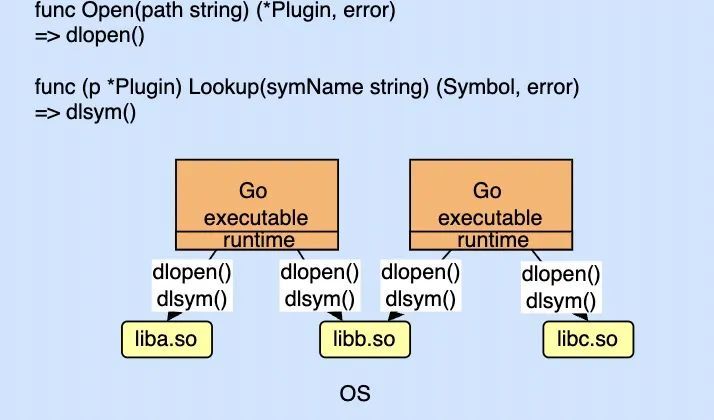
chart 1-5. Go Program loading dynamic link library
PART. 2-- Typical problem solving
unfortunately , And C/C++ Compared with the technology stack ,Go Although the output of the plug-in is also a dynamic link library file , But it is for plug-in development 、 There are a series of complex built-in constraints . What's bigger is ,Go The language not only does not systematically introduce these constraints , Even wrote some poor design and implementation , The troubleshooting that leads to plug-in related problems is very anti-human .
This chapter focuses on following with you , Developing 、 Use Go plug-in unit , Mainly compiling 、 When loading plug-ins , Most common 、 But it must be located Go Standard library
( Mainly including compiler 、 The linker 、 Packer and runtime part )
Several problems that can be fully understood by the source code , And corresponding solutions .
In short ,Go The main program of is loading plugin when , Will be in “runtime” A bunch of constraint checks are carried out for both , Including but not limited to :
-
go version Agreement
-
go path Agreement
-
go dependency The intersection of is consistent
-
go build some flag Agreement
One 、 Inconsistent standard library versions
Error occurs when the main program loads the plug-in :
plugin was built with a different version of package runtime/internal/sys
From the text of this error report, we can know , The library with specific problems is runtime/internal/sys , Obviously this is a go Built in standard library . See here , You may have great doubts :
I obviously use the same local environment to compile the main program and plug-in , Why is the standard library not a version ?
The answer is ,
Go Of error The log description is inaccurate
. The root cause of this error can be attributed to :
Some key compilation of main programs and plug-ins flag atypism
, Follow “ edition ” Do not have what relation .
such as , You use the following command to compile the plug-in :
GO111MODULE=on go build --buildmode=plugin -mod readonly -o ./codec.so ./codec.go
But you use goland Of debug Mode debugging main program , here ,goland Will help you with go build The command is assembled according to the following example :

Be careful ,goland The compilation command of the assembly contains key -gcflags all=-N -l Parameters , But there are no commands in the plug-in compilation . here , When you try to pull up the plug-in, you will get a related runtime/internal/sys The error of .

chart 2-1. compile flag Loading failure caused by inconsistency
The solution to this kind of standard library version inconsistency is relatively simple :
Try to align the main program with the compiled plug-in flag
. in fact , Somewhat flag It does not affect the loading of plug-ins , You can explore slowly in specific practice .
Two 、 Inconsistent third-party library versions
If you use vendor To manage Go The dependent libraries , Then, after solving the problems in the previous section , you 100% You will immediately encounter the following error report :plugin was built with a different version of package xxxxxxxx
among ,xxxxxxxx It refers to a specific third-party library , such as github.com/stretchr/testify. There are several typical reasons for this error , If there is no relevant troubleshooting experience , Several of them may burn developers' time .
Case 1. Version inconsistency
As shown in the error report , It seems that the reason is very clear , namely
The version of a third-party library on which the main program and plug-in depend is inconsistent
, The error report will clearly tell you which database has problems . here , You can compare and check the main program and plug-in go.mod file , Find the version of the problem base respectively , See if they agree . If at this time you find that the main program and plug-ins do have commitid or tag Inconsistencies in , The solution is also very simple :
Align them
.
But in many scenarios , You will only use part of the tripartite Library : Like a package, Or just some interface. This part of the code may not have changed at all in different versions , But other unused code changes , It will also lead to changes in the version of the entire third-party library , Which leads you to become that “ Version inconsistency ” Innocent victims of .
and , At this point, you may immediately encounter another problem : Align with who ? The main program ? Or plug-ins ?
In common sense , Taking the main program as the baseline for alignment is a better strategy , After all, plug-ins are new “ Accessories ”, And the main program and plug-in are usually “ One to many ” The relationship between . however , What if the third-party library dependency of the plug-in cannot be aligned with the main program for any reason ? After trying for a long time , I haven't found a perfect solution to this problem for the time being .
If the version cannot be aligned , You can only fundamentally give up taking the plug-in path .
Go Language of this kind of tripartite Library 、 Almost mindless strong consistency constraint , On the one hand , Avoid potential problems caused by inconsistent versions at runtime ; On the other hand , This design deliberately does not give programmers flexibility , Plug in 、 Customized 、 Extended development is very unfriendly .

chart 2-2. Loading failure caused by inconsistent versions of the three party libraries of common dependencies
Case 2. The version number is the same , Code inconsistency
When you follow case 1 The way of thinking go.mod file , But I was surprised to find that the wrong library version is the same , It's going to get complicated . You may come up with the most advanced text checking tool in the world , And spend the whole morning going diff Three party Library commitid, But they are exactly the same , It seems to fall into the Schrodinger version .
One possible reason for this problem is : Someone directly modified vendor Directory code ,Go The plug-in mechanism will verify the consistency of code content .
This is really a very heady , And the reasons that are difficult to check . Except for the person who modified the code , And already in other case Middle quilt “ pit ” Those who have , No one will know about it . If modified vendor The code appears in the main program , You have almost no reliable way to make them work properly .
Don't go straight to vendor Change the code inside !!!
Don't go straight to vendor Change the code inside !!!
Don't go straight to vendor Change the code inside !!!
Give back to the open source community , perhaps fork-replace!!!
The good news is , You don't need to solve this problem . Because even if it is solved , There will also be bigger problems waiting for you .

chart 2-3. The loading failure caused by the local modification of the code of the jointly dependent third-party library
Case 3. The path is inconsistent
When according to case 1 and case 2 The idea of troubleshooting 、 Solved , But it still reports different version of package When , Maybe you will start to be right Go The plug-in mechanism of has lost patience :
Version really “ 10 Fen is the same ”, The code really doesn't move a line , Why do you report different versions ???
as a result of :
The plug-in mechanism will verify the source code of the dependent Library 「 route 」
, So it can't be used vendor Management dependence .
for instance : Your main program source code is placed in /path/to/main Under the table of contents , therefore , The directory on which one of your third-party libraries depends should be :
/path/to/main/vendor/some/thrid/part/lib;
Empathy , Your plug-in source code is placed in /path/to/plugin Under the table of contents , therefore , The directory that the same third-party library depends on should be :
/path/to/plugin/vendor/some/thrid/part/lib.
these 「
File path
」 The data will be packaged into binary executable files and used for verification , When the main program loads the plug-in ,Go Of “ Runtime ”“ smart ” adopt 「
File path
」 The difference is that it is not the same code as the plug-in , And then I reported different version of package.

chart 2-4. Use vendor Loading failure caused by mechanism management of third-party libraries
The same problem may also occur when using different machines / user , Compile the main program separately 、 Plug in scenario : Different user names ,go The path of the code should also be different .
The way to solve this kind of problem is very violent and direct :
Delete the main program and plug-in vendor Catalog , Or use
-mod=readonly
compile flag
.
Come here , If you are using the same machine to compile the main program and plug-in , Then the common problems should be basically solved , The plug-in mechanism should work properly . On the other hand , Because it is no longer used vendor Management dependence , therefore case 2 The problem of will also be forcibly solved here : Or mention PR To the community , or fork-replace.
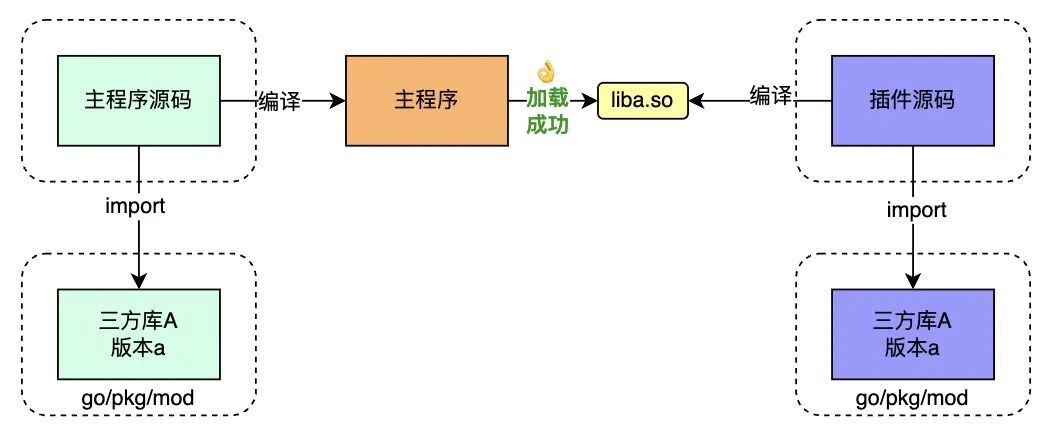
chart 2-5. Successfully loaded
3、 ... and 、 inconsistent Go edition
fatal error: runtime: no plugin module data
In addition to the above problems , There is also one that compiles the main program separately on multiple machines / Common error reports in plug-in scenarios . One possible reason for this error is
Go Version inconsistency
, Just align them .( What if the alignment is not possible at the machine level ?……)

chart 2-6. Go Loading failure caused by version inconsistency
PART. 3-- Unified solution
From the second Part in , We have seen some that are difficult to check , It's not a very easy problem to deal with . besides , In fact, there are still some problems that have not been highlighted . As an extension mechanism officially supported by a programming language , It's really unexpected to do so user unfriendly .
because 「
Proprietary cloud MOSN
」 Focus on Go The plug-in mechanism of is set to open , Therefore, we must come up with a systematic plan to solve all these problems . Trying to modify directly Go After the source code is fruitless
( Make complaints :Go The source code of the plug-in mechanism is slightly regrettable )
, We focus on “ Product layer ” And peripheral infrastructure :
-
Unified compilation environment :
-
Unified Makefile:
-
Unified plug-in development scaffolding :
-
Pipelining :

chart 3-1. Unified solution
PART. 4-- Key source location
If you really want to fundamentally understand the mechanism of plug-in verification , Here are some entries for you to quickly enter the source code reading state . I use Go The source code is 1.15.2 edition . relevant Go Source location :
- compiler
:go/src/cmd/compile/*
- linker
:go/src/cmd/link/internal/ld/*
- pkg loader
:go/src/cmd/go/internal/load/*
- runtime
:go/src/runtime/*
One 、go build What are you doing
You can go build Add -x Parameters , Print out explicitly Go Program compilation 、 link 、 The whole process of packaging , for example :
go build -x -buildmode=plugin -o ../calc_plugin.so calc_plugin.go
Two 、 Target code generation
go/src/cmd/compile/internal/gc/obj.go:55 : Pay attention to the 67 And the 72 That's ok , Here are two entrances ;
go/src/cmd/compile/internal/gc/iexport.go:244 : Be careful 280 That's ok , It will be recorded here path related data .
3、 ... and 、 Library hash generation algorithm
go/src/cmd/link/internal/ld/lib.go:967: Pay attention to the 995-1025 That's ok , Here's the calculation pkg Of hash.
Four 、 Library hash check
go/src/runtime/symtab.go:392 : Key data structure ;
go/src/runtime/plugin.go:52 : Link period hash And runtime hash Value check point ;
go/src/cmd/link/internal/ld/symtab.go:621 : Link period hash Assignment point ;
go/src/cmd/link/internal/ld/symtab.go:521 : Runtime hash Assignment point .
PART. 5-- summary
You can see , Even if Go The native plug-in mechanism of has various headache problems ,SOFAStack The team still upholds “ Open source 、 to open up 、 Scalable ” The purpose of , Solve problems by various means , And finally make this capability available for production .
at present , Proprietary cloud MOSN Protocol codec and logger The customized development of has achieved a comprehensive plug-in . Next , We will continue to MOSN Architecture upgrade , The target pair includes routing logic 、LB Logic 、 Registry Center / Plug in support of various capabilities including configuration center docking .
Learn more about ...
MOSN Star once :
https://github.com/mosn/mosn
Let's build together 🧸
原网站版权声明
本文为[InfoQ]所创,转载请带上原文链接,感谢
https://yzsam.com/2022/197/202207131208475746.html