Introduction
Let's talk today ZGC.ZGC(Z Garbage Collector) Is a performance ratio G1 Better garbage collector .ZGC The first time it appeared was in JDK 11 Introduce... With experimental characteristics , This is also JDK 11 The biggest bright spot in . stay JDK 15 in ZGC It's no longer an experimental function , It can be officially put into production , Use –XX:+UseZGC Enable ZGC.
Text
ZGC Yes 3 There are two important characteristics :
The pause time will not exceed 10 ms.
JDK 16 After the release of ,GC The pause time has been reduced to 1 ms within , And the time complexity is o(1), That means GC The pause time is a fixed value , It is not affected by the size of heap memory .
The picture below is from :https://malloc.se/blog/zgc-jdk16

1、 Memory multiple mapping
Memory multiple mapping , Is the use of mmap Map different virtual memory addresses to the same physical memory address . Here's the picture :

ZGC In order to manage memory more flexibly and efficiently , Memory multi mapping used , Map the same physical memory to Marked0、Marked1 and Remapped Three virtual memories .
When an application creates an object , Will apply for a virtual address on the heap , At this time ZGC Will be in... For this object Marked0、Marked1 and Remapped These three view spaces apply for a virtual address respectively , These three virtual addresses map to the same physical address .
Marked0、Marked1 and Remapped These three virtual memories are used as ZGC Three view spaces of , There can only be one valid... At the same time point .ZGC It is through the switching of these three view spaces , To complete concurrent garbage collection .
Related video analysis :
2、 Dye pointer
2.1 Three color mark review
We know G1 The garbage collector uses three color markers , Here's a review . The following is an example of object reference in the three color marking process :
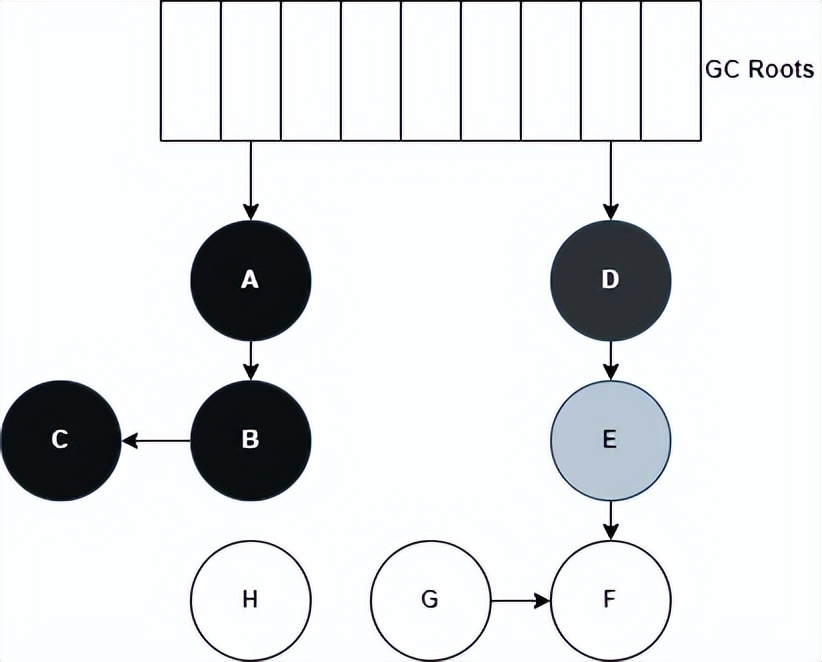
There are three colors in total , The explanation is as follows : white : This object has not been accessed by the marked thread . gray : This object has been accessed , However, the other objects referenced by this object have not been fully accessed . black : This object has been accessed , And other objects referenced by this object have also been accessed .
The process of three color marking is as follows : Initial stage , All objects are white . take GC Roots Directly referenced objects are marked gray . Handle gray objects , Turns all objects referenced by the current gray object gray , Then change the current gray object to black . Repeat step 3, Until there are no gray objects . After the three color mark , White objects are objects that are not referenced ( Like the one above H and G), Can be recycled .
2.2 Dye pointer
ZGC Before appearance , GC The information is stored in the header of the object Mark Word in . such as 64 Bit JVM, The head of the object Mark Word The information saved in is shown in the figure below :

front 62 Bit saved GC Information , The last two bits hold the lock flag .
ZGC One of my great innovations is to GC The information is saved on the dyeing pointer . Coloring a pointer is a technique to store a small amount of information directly on the pointer . stay 64 position JVM in , The object pointer is 64 position , Here's the picture :

In this 64 Bit pointer , high 16 All places are 0, Not for the time being . The rest 48 Bit supported memory can reach 256 TB(2 ^48), This can meet the needs of most large servers . however ZGC Not yet 48 Bits are used to store object information , But with high 4 Bit holds four flag bits , such ZGC The maximum memory that can be managed can reach 16 TB(2 ^ 44).
Through these four flag bits ,JVM You can directly see the three color mark status of the object from the pointer (Marked0、Marked1)、 Whether the reallocation set is entered (Remapped)、 Whether it is necessary to pass finalize Method to access (Finalizable).
No object access is required to get GC Information , This greatly improves GC efficiency .
3、 Memory layout
Let's first review G1 The memory layout of the garbage collector .G1 Divide the whole heap into the same size region, Each heap can have about 2048 individual region, Every region The size is 1~32 MB ( Must be 2 To the power of ). Here's the picture :

Follow G1 similar ,ZGC Heap memory is also based on Region To distribute , however ZGC It does not distinguish between the new generation and the old . The difference is ,ZGC Of Region Support dynamic creation and destruction , also Region The size of is not fixed , There are three types of Region :
Large Region:N * 2MB. This type of Region It can change dynamically , But it has to be 2MB Integer multiple , Minimum support 4 MB. Every Large Region Place only one large object , And will not be redistributed .
4、 Reading barrier
The read barrier is similar to Spring AOP Pre enhancement of , yes JVM Insert a small piece of code into the application code , When the application thread reads the reference of the object from the heap , Will execute this code first . Be careful : Only when reading a reference to an object from heap memory , Will execute this code . Only the first line of the following code needs to add a read barrier .
Object o = obj.FieldA
Object p = o // Instead of reading references from the heap
o.dosomething() // Instead of reading references from the heap
int i = obj.FieldB // It's not a reference type
The read barrier passes through when interpreting execution load Relevant bytecode instructions load data . The function is in the process of object marking and transfer , Judge whether the reference address of the object meets the conditions , And act accordingly . Here's the picture :

Mark 、 See the next section for the process of transferring and relocating . The read barrier will have an impact on the performance of the application , According to the test , The highest impact on performance is 4%, But it improves GC Concurrency capability , To reduce the STW.
5 GC The process
As I said before ,ZGC Using memory multiple mapping technology , Map physical memory to Marked0、Marked1 and Remapped Three address views , Using the switching of address view ,ZGC It realizes efficient concurrent collection .
ZGC The garbage collection process includes marking 、 There are three stages of transfer and relocation . Here's the picture :

ZGC After the initialization , The address view of the entire memory space is set to Remapped.
5.1 Initial marker
from GC Roots set out , find GC Roots Directly referenced objects , Put into the active object collection , This process requires STW, however STW Time with GC Roots The quantity is proportional to , It takes less time .
5.2 Concurrent Tags
During concurrent tagging ,GC Threads and Java Application threads run in parallel . This process needs to pay attention to the following points :
GC When the tag thread accesses an object , If the object address view is Remapped, Just switch the object address view to Marked0, If the object address view is already Marked0, Indicates that it has been accessed by other tag threads , Skip do not process .
In the process of marking Java When an application thread accesses an object , If the address view of the object is Remapped, Just switch the object address view to Marked0, You can refer to the reading barrier mentioned earlier .
After marking , If the object address view is Marked0, That's active , If the object address view is Remapped, That's inactive .
The active view of the marking phase may also be Marked1, Why two views ?
Two views are used here to distinguish between the previous tag and this tag . If the marked view is Marked0, Then the next time the concurrency tag switches the view to Marked1. This can cooperate with ZGC According to the practice of recycling garbage on page . Here's the picture :

At the second mark , If you still switch to Marked0, that 2 This object cannot tell whether it is active or last marked . If the second mark is switched to Marked1, You can distinguish .
At this time Marked0 The object of this view is that the last marking process was marked as too active , It was not transferred when it was transferred , But this time the tag is not marked as an active object .Marked1 The object of the view is the object marked as active this time .Remapped The object of the view is that the garbage collection was transferred or Java The application thread has accessed , Objects marked as inactive in this garbage collection .
5.3 Re labelled
Concurrent tagging phase GC Threads and Java Application threads execute concurrently , During the marking process, there may be missing marking caused by the change of reference relationship . Relabeling phase relabels objects that have changed in the concurrent marking phase , There are also non strong references ( Soft application , Virtual reference, etc ) Parallel marking .
This stage requires STW, But there are fewer objects to mark , It takes a short time .
5.4 Initial transfer
Transfer is to copy the active object to the new memory , The previous memory space can be recycled .
Initial transfer requires scanning GC Roots Directly reference the object and transfer it , This process requires STW,STW Time follows GC Roots In direct proportion to .
5.5 Concurrent transfers
Concurrent transfer process GC Threads and Java Threads are concurrent . It's already said , During the transfer, the object view will be cut back Remapped .
The following points need to be paid attention to in the transfer process :
5.6 relocation
The address of the transfer process object has changed , At this stage , Adjust all pointers to the old address of the object to the new address of the object .
6、 Garbage collection algorithm
ZGC Using tag - Sorting algorithm , The idea of the algorithm is to move all living objects to one side of the heap , After moving, recycle the objects outside the boundary .
6.1 JDK 16 Before
stay JDK 16 Before ,ZGC Will reserve (Reserve) Heap memory together , This reserved memory cannot be used for Java Memory allocation for threads . Even from Java From the perspective of threads, the heap memory is full and cannot be used Reserve, Only GC It can only be used when moving living objects in the process . Here's the picture :

The advantage of this is that the algorithm is simple , Very suitable for parallel collection . But there are several problems with this :
because Reserve You can't give GC Moving objects in the process Java Thread usage , The moving thread may not be able to complete the object moving because it cannot apply for enough memory , This will cause the application to return again OOM.
6.2 JDK 16 improvement
JDK 16 After the release of ,ZGC Supports moving objects in place (G1 stay Full GC It is also moved on the spot when ). The advantage of this is that there is no need to reserve free memory . Here's the picture :
However, there are some challenges in moving locally . such as : The order of moving objects must be considered , Otherwise, objects that have not been moved may be overwritten . This requires GC Better collaboration between threads , It is not conducive to concurrent collection , At the same time, it will also lead to the of moving objects Java Threads need to consider what they can do and what they can't do .
In order to get better GC performance ,JDK 16 While supporting local relocation , Reservation is also supported (Reserve) The way heap memory works , also ZGC There is no need to really reserve free heap memory . By default , As long as there is free region,ZGC Will use the method of reserving heap memory , If there is no free region, otherwise ZGC Local movement will be enabled . If you have free time region, ZGC It will switch to the move mode of reserved heap memory .
7、 summary
Memory multiple mapping and the introduction of colored pointers , send ZGC Greatly improve the performance of concurrency .
ZGC Only 3 A need STW The stage of , The initial marking and initial transfer only need to scan all GC Roots,STW Time GC Roots In proportion to the number of , It won't take much time . The relabeling process mainly deals with the object whose reference address changes during concurrent marking , The number of these objects is relatively small , It takes a very short time . You can see the whole thing ZGC Of STW Time is almost only related to GC Roots Quantity matters , Does not change with heap size and number of objects .
ZGC There is also a drawback , Floating garbage . because ZGC There is no generational concept , although ZGC Of STW Time in 1ms within , however ZGC The whole execution process of is still very time-consuming . In the process Java Threads may create a large number of new objects , These objects become floating garbage , I can only wait for next time GC When it's time to recycle .
Link to the original text :https://mp.weixin.qq.com/s/UuelBa8vasVbDjnUzlIs4w
原网站版权声明
本文为[InfoQ]所创,转载请带上原文链接,感谢
https://yzsam.com/2022/204/202207231431462645.html


