当前位置:网站首页>Three types of transactions in EF core (saveChanges, dbcontexttransaction, transactionscope)
Three types of transactions in EF core (saveChanges, dbcontexttransaction, transactionscope)
2022-06-23 23:51:00 【I left my life to work】
Default transaction (SaveChanges)
(1). By default , If the database provider supports transactions , Single SaveChanges() All changes in the invocation are committed in a transaction . If any of these changes fail , Then the transaction rolls back , No changes will be applied to the database . It means SaveChanges() Be able to ensure that it is either saved successfully , Or do not make any changes to the database when an error occurs .
(2). Close the default transaction :context.Database.AutoTransactionsEnabled = false; Such as :Test3() Method , First data saved successfully , The second failure .
/// <summary>
        ///  All success
        /// </summary>
        public static void Test1()
        {

            using (EFDB01Context db = new EFDB01Context())
            {

                db.T_RoleInfor.Add(new T_RoleInfor() {
     roleName = " Administrators 1", addTime = DateTime.Now });
                db.T_RoleInfor.Add(new T_RoleInfor() {
     roleName = " Administrators 2", addTime = DateTime.Now });
                db.SaveChanges();
            }
        }

        /// <summary>
        ///  All failed
        /// </summary>
        public static void Test2()
        {

            using (EFDB01Context db = new EFDB01Context())
            {

                try
                {

                    db.T_RoleInfor.Add(new T_RoleInfor() {
     roleName = " Administrators 1", addTime = DateTime.Now });
                    db.T_RoleInfor.Add(new T_RoleInfor() {
     id = 123, roleName = " Administrators 2", addTime = DateTime.Now });
                    db.SaveChanges();
                }
                catch (Exception)
                {

                    Console.WriteLine(" Something went wrong , Neither data was successfully executed ");
                }
            }
        }

        /// <summary>
        ///  Article 1 success , The second failure
        /// </summary>
        public static void Test3()
        {

            using (EFDB01Context db = new EFDB01Context())
            {

                try
                {

                    // close SaveChanges Default transaction for
                    db.Database.AutoTransactionsEnabled = false;

                    db.T_RoleInfor.Add(new T_RoleInfor() {
     roleName = " Administrators 1", addTime = DateTime.Now });
                    db.T_RoleInfor.Add(new T_RoleInfor() {
     id = 123, roleName = " Administrators 2", addTime = DateTime.Now });

                    //db.T_UserInfor.Add(new T_UserInfor() { id = Guid.NewGuid().ToString("N"), userName = " Administrators 1", addTime = DateTime.Now });
                    //db.T_UserInfor.Add(new T_UserInfor() { id = Guid.NewGuid().ToString("N")+"123", userName = " Administrators 2", addTime = DateTime.Now });

                    db.SaveChanges();
                }
                catch (Exception)
                {

                    Console.WriteLine(" Something went wrong , The first piece of data was inserted successfully ");
                }
            }
        }
DbContextTransaction
1. Usage mode
BeginTransaction Open transaction 、Commit Commit transaction 、Rollback Roll back the transaction 、Dispose The destruction , If you use Using If the package , No more manual Rollback, Walk the Using Will automatically roll back . If not Using Parcel transaction , It needs to be in Catch Medium manual RollBack Roll back , And it's best to do it manually Dispose once .( Such as SameDbContext In folder Test1 and Test2 Method )
2. Use scenarios
A. Multiple in the same context SaveChanges Methods ( Such as : The auto increment primary key will be used later , Such as Test2 Method )、SaveChanges and EF call SQL Statement mixing ( Such as Test2 Method )
/// <summary>
        ///  Three add statements share the same transaction , Finally using  transaction.Commit()  Unified submission , All three items were successfully implemented , Affect the database ,
        ///  If any command fails , The transaction is recycled (Dispose) Will be rolled back automatically , No impact on the database .
        /// </summary>
        public static void Test1()
        {

            using (EFDB01Context db = new EFDB01Context())
            {

                using (var transaction = db.Database.BeginTransaction())
                {

                    try
                    {

                        db.T_RoleInfor.Add(new T_RoleInfor() {
     roleName = " Administrators 1", addTime = DateTime.Now });
                        db.SaveChanges();

                        db.T_RoleInfor.Add(new T_RoleInfor() {
     id = 111, roleName = " Administrators 2", addTime = DateTime.Now });  // Report errors
                        db.SaveChanges();

                        string sql1 = @"insert into T_RoleInfor (roleName,roleDescription,addTime) values (@roleName,@roleDescription,@addTime)";
                        SqlParameter[] pars1 ={

                                                 new SqlParameter("@roleName"," Administrators 3"),
                                                 new SqlParameter("@roleDescription","txt11"),
                                                 new SqlParameter("@addTime",DateTime.Now)
                                            };
                        db.Database.ExecuteSqlCommand(sql1, pars1);
                        transaction.Commit();

                        Console.WriteLine(" succeed ");
                    }
                    catch (Exception)
                    {

                        Console.WriteLine(" failed ");
                    }
                }
            }
        }

        /// <summary>
        ///  If not Using Parcel transaction , It needs to be in Catch Medium manual RollBack Roll back
        /// </summary>
        public static void Test2()
        {

            using (EFDB01Context db = new EFDB01Context())
            {

                var transaction = db.Database.BeginTransaction();
                try
                {

                    var d1 = new T_RoleInfor() {
     roleName = " Administrators 1", addTime = DateTime.Now };
                    db.T_RoleInfor.Add(d1);
                    db.SaveChanges();

                    db.T_RoleInfor.Add(new T_RoleInfor() {
     roleName = " Administrators 2"+d1.id, addTime = DateTime.Now });
                    db.SaveChanges();

                    string sql1 = @"insert into T_RoleInfor (roleName,roleDescription,addTime) values (@roleName,@roleDescription,@addTime)";
                    SqlParameter[] pars1 ={

                                                 new SqlParameter("@roleName"," Administrators 3"),
                                                 new SqlParameter("@roleDescription","txt11"),
                                                 new SqlParameter("@addTime",DateTime.Now)
                                            };
                    db.Database.ExecuteSqlCommand(sql1, pars1);
                    transaction.Commit();

                    Console.WriteLine(" succeed ");

                }
                catch (Exception)
                {

                    transaction.Rollback();
                    Console.WriteLine(" failed ");
                }
                finally
                {

                    transaction.Dispose();
                }

            }
        }
B. The same database has multiple contexts but “ The same connection ” The business of . One of the contexts starts the transaction , In addition, the context passes through UseTransaction Method to implement shared transactions .
situation ①:
EFDB01Context Directly in OnConfiguring Write a dead connection string in , many times new Context , Such as Test1 Method , Multiple connections , Cannot share transactions .
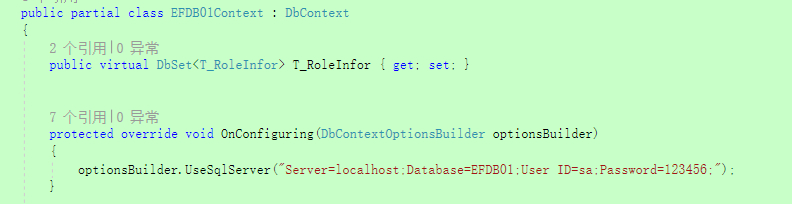
/// <summary>
        ///  Situation 1 : stay OnConfiguring Write the connection string in , Create two contexts , Equivalent to two connections , Two connections cannot be connected by using UseTransaction, Establish a transaction connection .
        ///  I'll report the following error .
        /// The specified transaction is not associated with the current connection. Only transactions associated with the current connection may be used.
        /// </summary>
        public static void Test1()
        {

            using (EFDB01Context context1 = new EFDB01Context())
            {

                using (var transaction = context1.Database.BeginTransaction())
                {

                    try
                    {

                        context1.T_RoleInfor.Add(new T_RoleInfor() {
     roleName = " Administrators 1", addTime = DateTime.Now });
                        context1.SaveChanges();

                        using (EFDB01Context context2 = new EFDB01Context())
                        {

                            context2.Database.UseTransaction(transaction.GetDbTransaction());

                            context1.T_RoleInfor.Add(new T_RoleInfor() {
     roleName = " Administrators 1", addTime = DateTime.Now });
                            context1.SaveChanges();
                        }

                        // Unified submission
                        transaction.Commit();
                        Console.WriteLine(" succeed ");
                    }
                    catch (Exception ex)
                    {

                        Console.WriteLine(ex.Message);
                    }
                }
            }


        }
situation ②:
EFDB01Context2 adopt public EFDB01Context2(DbContextOptions options) : base(options) This form of constructor , then new When Unified incoming : new DbContextOptionsBuilder().UseSqlServer(new SqlConnection(connectionString)).Options;, To share connections , Such as Test2 Method .

/// <summary>
        ///  Situation two : Through the parent class constructor
        /// </summary>
        public static void Test2()
        {

            var connectionString = "Server=localhost;Database=EFDB01;User ID=sa;Password=123456;";
            // Take out the connection , To multiple contexts , This is sharing the same connection
            var option = new DbContextOptionsBuilder<EFDB01Context2>().UseSqlServer(new SqlConnection(connectionString)).Options;

            using (var context1 = new EFDB01Context2(option))
            {

                using (var transaction = context1.Database.BeginTransaction())
                {

                    try
                    {

                        context1.T_RoleInfor.Add(new T_RoleInfor() {
     roleName = " Administrators 1", addTime = DateTime.Now });
                        context1.SaveChanges();

                        using (var context2 = new EFDB01Context2(option))
                        {

                            context2.Database.UseTransaction(transaction.GetDbTransaction());

                            context1.T_RoleInfor.Add(new T_RoleInfor() {
     roleName = " Administrators 1", addTime = DateTime.Now });
                            context1.SaveChanges();
                        }

                        // Unified submission
                        transaction.Commit();
                        Console.WriteLine(" succeed ");
                    }
                    catch (Exception ex)
                    {

                        Console.WriteLine(ex.Message);
                    }
                }
            }
        }
situation ③:
EFDB01Context3 adopt Pass in SqlConnection To realize shared connection , Such as Test3 Method .

public static void Test3()
        {

            var connectionString = "Server=localhost;Database=EFDB01;User ID=sa;Password=123456;";
            // Take out the connection , To multiple contexts , This is sharing the same connection
            var connection = new SqlConnection(connectionString);

            using (var context1 = new EFDB01Context3(connection))
            {

                using (var transaction = context1.Database.BeginTransaction())
                {

                    try
                    {

                        context1.T_RoleInfor.Add(new T_RoleInfor() {
     roleName = " Administrators 1", addTime = DateTime.Now });
                        context1.SaveChanges();

                        using (var context2 = new EFDB01Context3(connection))
                        {

                            context2.Database.UseTransaction(transaction.GetDbTransaction());

                            context1.T_RoleInfor.Add(new T_RoleInfor() {
     roleName = " Administrators 1", addTime = DateTime.Now });
                            context1.SaveChanges();
                        }

                        // Unified submission
                        transaction.Commit();
                        Console.WriteLine(" succeed ");
                    }
                    catch (Exception ex)
                    {

                        Console.WriteLine(ex.Message);
                    }
                }
            }
        }
C. Multiple database technologies transactions in the same database
Such as ADO.Net and EF The common use , Utilization method “UseTransaction” Share the same transaction , Jointly submit . Such as :Test1 Method
/// <summary>
        /// ADO.Net  and  EF A mixture of , Multiple database technologies access the same database
        /// </summary>
        public static void Test1()
        {

            var conStr = @"Server=localhost;Database=EFDB01;User ID=sa;Password=123456;";
            using (var connection=new SqlConnection(conStr))
            {

                connection.Open();
                using (var transaction=connection.BeginTransaction())
                {

                    try
                    {

                        //ADO.Net
                        var command = connection.CreateCommand();
                        command.Transaction = transaction;
                        command.CommandText = "DELETE FROM T_RoleInfor";
                        command.ExecuteNonQuery();

                        //EF
                        var options = new DbContextOptionsBuilder<EFDB01Context>().UseSqlServer(connection).Options;
                        using (var context = new EFDB01Context(options))
                        {

                            context.Database.UseTransaction(transaction);
                            context.T_RoleInfor.Add(new T_RoleInfor() {
     roleName = " Administrators 1", addTime = DateTime.Now });
                            context.SaveChanges();
                        }
                        // Comprehensive submission
                        transaction.Commit();

                        Console.WriteLine(" succeed ");

                    }
                    catch (Exception ex)
                    {

                        Console.WriteLine(ex.Message);
                    }
                }

            }
        }
Environmental Affairs (TransactionScope)
1. Usage mode
new TransactionScope Create transaction 、Complete Commit transaction 、 Transaction.Current.Rollback(); Roll back the transaction 、Dispose Destroy object . If you use Using If the package , No more manual Rollback, Walk the Using Will automatically roll back . If not Using Parcel transaction , It needs to be in Catch Medium manual RollBack Roll back , And it's best to do it manually Dispose once .
2. purpose
A. Transactions in the same context .( Multiple SaveChanges( Subsequent use of auto increment primary key )、SaveChanges and EF call SQL Statement mixing )( Such as Test1 Method )
/// <summary>
        /// A.  Transactions in the same context .( Multiple SaveChanges( Subsequent use of auto increment primary key )、SaveChanges and EF call SQL Statement mixing )
        /// </summary>
        public static void Test1()
        {

            using (EFDB01Context1 db = new EFDB01Context1())
            {

                using (var scope = new TransactionScope(/*TransactionScopeOption.Required, new TransactionOptions { IsolationLevel = IsolationLevel.ReadCommitted }*/))
                {

                    try
                    {

                        var data1 = new T_RoleInfor() {
     roleName = " Administrators 1", addTime = DateTime.Now };
                        db.T_RoleInfor.Add(data1);
                        db.SaveChanges();

                        db.T_RoleInfor.Add(new T_RoleInfor() {
     roleName = " Administrators 2" + data1.id, addTime = DateTime.Now });  // Report errors
                        db.SaveChanges();

                        string sql1 = @"insert into T_RoleInfor (roleName,roleDescription,addTime) values (@roleName,@roleDescription,@addTime)";
                        SqlParameter[] pars1 ={

                                                 new SqlParameter("@roleName"," Administrators 3"),
                                                 new SqlParameter("@roleDescription","txt11"),
                                                 new SqlParameter("@addTime",DateTime.Now)
                                            };
                        db.Database.ExecuteSqlCommand(sql1, pars1);
                        scope.Complete();


                        Console.WriteLine(" succeed ");
                    }
                    catch (Exception)
                    {

                        Console.WriteLine(" failed ");
                    }
                }
            }
        }
B. Multiple database technologies access transactions in the same database ( Such as Test2 Method )
/// <summary>
        /// B.  Multiple database technologies access transactions in the same database
        /// </summary>
        public static void Test2()
        {

            var conStr = @"Server=localhost;Database=EFDB01;User ID=sa;Password=123456;";
            using (var connection = new SqlConnection(conStr))
            {

                connection.Open();
                using (var scope = new TransactionScope())
                {

                    try
                    {

                        //ADO.Net
                        var command = connection.CreateCommand();
                        command.CommandText = "DELETE FROM T_RoleInfor";
                        command.ExecuteNonQuery();

                        //EF
                        using (var context = new EFDB01Context1())
                        {

                            context.T_RoleInfor.Add(new T_RoleInfor() {
     roleName = " Administrators 1", addTime = DateTime.Now });
                            context.SaveChanges();
                        }
                        // Comprehensive submission
                        scope.Complete();

                        Console.WriteLine(" succeed ");

                    }
                    catch (Exception ex)
                    {

                        Console.WriteLine(ex.Message);
                    }
                }
            }
        }
C. Multiple different contexts of the same database are supported ( Such as Test3 Method )
1   public partial class EFDB01Context1 : DbContext
 2     {

 3         public virtual DbSet<T_RoleInfor> T_RoleInfor {
     get; set; }
 4         public virtual DbSet<T_UserInfor> T_UserInfor {
     get; set; }
 5
 6         protected override void OnConfiguring(DbContextOptionsBuilder optionsBuilder)
 7         {

 8             optionsBuilder.UseSqlServer("Server=localhost;Database=EFDB01;User ID=sa;Password=123456;");
 9         }
10
11         protected override void OnModelCreating(ModelBuilder modelBuilder)
12         {

13             modelBuilder.HasAnnotation("ProductVersion", "2.2.0-rtm-35687");
14
15             modelBuilder.Entity<T_RoleInfor>(entity =>
16             {

17                 entity.Property(e => e.roleDescription).IsUnicode(false);
18
19                 entity.Property(e => e.roleName).IsUnicode(false);
20             });
21
22             modelBuilder.Entity<T_UserInfor>(entity =>
23             {

24                 entity.Property(e => e.id)
25                     .IsUnicode(false)
26                     .ValueGeneratedNever();
27
28                 entity.Property(e => e.userName).IsUnicode(false);
29
30                 entity.Property(e => e.userSex).IsUnicode(false);
31             });
32         }
33     }

EFDB01Context1
1   public partial class EFDB01Context2 : DbContext
 2     {

 3         public virtual DbSet<T_RoleInfor> T_RoleInfor {
     get; set; }
 4         public virtual DbSet<T_UserInfor> T_UserInfor {
     get; set; }
 5
 6         protected override void OnConfiguring(DbContextOptionsBuilder optionsBuilder)
 7         {

 8             optionsBuilder.UseSqlServer("Server=localhost;Database=EFDB01;User ID=sa;Password=123456;");
 9         }
10
11         protected override void OnModelCreating(ModelBuilder modelBuilder)
12         {

13             modelBuilder.HasAnnotation("ProductVersion", "2.2.0-rtm-35687");
14
15             modelBuilder.Entity<T_RoleInfor>(entity =>
16             {

17                 entity.Property(e => e.roleDescription).IsUnicode(false);
18
19                 entity.Property(e => e.roleName).IsUnicode(false);
20             });
21
22             modelBuilder.Entity<T_UserInfor>(entity =>
23             {

24                 entity.Property(e => e.id)
25                     .IsUnicode(false)
26                     .ValueGeneratedNever();
27
28                 entity.Property(e => e.userName).IsUnicode(false);
29
30                 entity.Property(e => e.userSex).IsUnicode(false);
31             });
32         }
33     }

EFDB01Context2
Run code :
/// <summary>
        ///C.  Two different contexts of the same database are supported
        /// </summary>
        public static void Test3()
        {

            using (var scope = new TransactionScope())
            {

                try
                {

                    using (var context = new EFDB01Context1())
                    {

                        context.T_RoleInfor.Add(new T_RoleInfor() {
     roleName = " Administrators 1", addTime = DateTime.Now });
                        context.SaveChanges();
                    }
                    using (var context = new EFDB01Context2())
                    {

                        context.T_RoleInfor.Add(new T_RoleInfor() {
     roleName = " Administrators 1", addTime = DateTime.Now });
                        context.SaveChanges();
                    }

                    // Comprehensive submission
                    scope.Complete();

                    Console.WriteLine(" succeed ");
                }
                catch (Exception ex)
                {

                    Console.WriteLine(ex.Message);
                }
            }
        }
D. Different database contexts are not supported ,( Such as Test4 Method , Turn on msdtc Service steps : cmd command → net start msdtc , And then I found that there was a mistake :This platform does not support distributed transactions. Explain that at present Core Distributed transactions are not supported on the platform )
Context code :
1  public partial class dbCore1Context : DbContext
 2     {

 3         public dbCore1Context()
 4         {

 5         }
 6
 7         public dbCore1Context(DbContextOptions<dbCore1Context> options)
 8             : base(options)
 9         {

10         }
11
12         public virtual DbSet<UserInfors> UserInfors {
     get; set; }
13
14         protected override void OnConfiguring(DbContextOptionsBuilder optionsBuilder)
15         {

16             optionsBuilder.UseSqlServer("Server=localhost;Database=dbCore1;User ID=sa;Password=123456;");
17
18         }
19
20         protected override void OnModelCreating(ModelBuilder modelBuilder)
21         {

22             modelBuilder.HasAnnotation("ProductVersion", "2.2.0-rtm-35687");
23
24             modelBuilder.Entity<UserInfors>(entity =>
25             {

26                 entity.Property(e => e.id).ValueGeneratedNever();
27             });
28         }
29     }

dbCore1Context
1   public partial class EFDB01Context1 : DbContext
 2     {

 3         public virtual DbSet<T_RoleInfor> T_RoleInfor {
     get; set; }
 4         public virtual DbSet<T_UserInfor> T_UserInfor {
     get; set; }
 5
 6         protected override void OnConfiguring(DbContextOptionsBuilder optionsBuilder)
 7         {

 8             optionsBuilder.UseSqlServer("Server=localhost;Database=EFDB01;User ID=sa;Password=123456;");
 9         }
10
11         protected override void OnModelCreating(ModelBuilder modelBuilder)
12         {

13             modelBuilder.HasAnnotation("ProductVersion", "2.2.0-rtm-35687");
14
15             modelBuilder.Entity<T_RoleInfor>(entity =>
16             {

17                 entity.Property(e => e.roleDescription).IsUnicode(false);
18
19                 entity.Property(e => e.roleName).IsUnicode(false);
20             });
21
22             modelBuilder.Entity<T_UserInfor>(entity =>
23             {

24                 entity.Property(e => e.id)
25                     .IsUnicode(false)
26                     .ValueGeneratedNever();
27
28                 entity.Property(e => e.userName).IsUnicode(false);
29
30                 entity.Property(e => e.userSex).IsUnicode(false);
31             });
32         }
33     }

EFDB01Context1
Run code :
/// <summary>
        ///D.  Transactions between different databases
        /// </summary>
        public static void Test4()
        {

            using (var scope = new TransactionScope())
            {

                try
                {

                    using (var context = new EFDB01Context1())
                    {

                        context.T_RoleInfor.Add(new T_RoleInfor() {
     roleName = " Administrators 1", addTime = DateTime.Now });
                        context.SaveChanges();
                    }
                    using (var context = new dbCore1Context())
                    {

                        context.UserInfors.Add(new UserInfors() {
     id = Guid.NewGuid().ToString("N"), userName = " Administrators 1", userSex = " male " });
                        context.SaveChanges();
                    }

                    // Comprehensive submission
                    scope.Complete();

                    Console.WriteLine(" succeed ");
                }
                catch (Exception ex)
                {

                    Console.WriteLine(ex.Message);
                }
            }
        }
notes :EF Core Medium System.Transactions The implementation will not include support for distributed transactions , So it can't be used
TransactionScope or CommittableTransaction To coordinate transactions across multiple resource managers . Major distributed transactions need to rely on
Windows Systematic MSDTC service , but .NET Core To achieve cross platform , There is no unified standard for cross platform distributed transactions , The following version hopes to improve .
边栏推荐
- 2022年信息安全工程師考試知識點:訪問控制
- PMP考试相关计算公式汇总!考前必看
- [proteus simulation] example of T6963C driving pg12864 (with Chinese and English display)
- Avoid confusion when switching between arouter components
- log Network Execution Time
- 点乘和叉乘
- Total number of combinations ii[each element can only be solved by + once]
- 生成所有可能的二叉搜索树
- Six complete open source projects, learning enough at a time
- 推荐4个Flutter重磅开源项目
猜你喜欢

产线工控安全有什么好的解决方案

CVPR2019/图像翻译:TransGaGa: Geometry-Aware Unsupervised Image-to-Image Translation几何感知的无监督图像到图像的翻译

A person even ran a Weibo app

6 大完整开源项目,一次学个够

Facebook open source shimmer effect

高仿书旗小说 Flutter 版,学起来

The lower left corner of vs QT VTK displays the synchronized minor coordinate axis

开口式霍尔电流传感器助力直流配电改造

老龄化下背景下,综合能效管理平台为医院保驾护航
![组合总数II[每个元素只能用一次 + 去重复解集]](/img/06/a40e28a1882a4278883202bc9c72d3.png)
组合总数II[每个元素只能用一次 + 去重复解集]
随机推荐
Niuke.com: the double pointer problem of receiving rainwater
Postman返回值中文乱码????
1004. number of maximum consecutive 1 III ●●
log Network Execution Time
产线工控安全有什么好的解决方案
再来一个高仿开眼的短视频APP
三款很酷很骚气的底部导航
What is the same origin policy?
Multi store drug inventory system source code large chain drugstore management system source code
Thinking (86): master-slave realization idea
2018/GAN:Self-Attention Generative Adversarial Networks自我注意生成对抗网络
E: Unable to acquire lock /var/lib/dpkg/lock
IDEA 自动生成单元测试,效率倍增!
matlab实现对图像批量重命名
Docker deploy redis
Embedded interface review materials
MySQL导致索引失效的情况详解
电子元器件行业B2B交易管理系统:提升数据化驱动能力,促进企业销售业绩增长
老龄化下背景下,综合能效管理平台为医院保驾护航
Acrel-3000WEB电能管理系统在都巴高速的应用