当前位置:网站首页>Leetcode 19. delete the penultimate node of the linked list [knowledge points: speed pointer, recursion, stack]
Leetcode 19. delete the penultimate node of the linked list [knowledge points: speed pointer, recursion, stack]
2022-07-28 21:30:00 【Hongyan Hongdou】
subject
I'll give you a list , Delete the last of the linked list n Nodes , And return the head node of the list .
Example 1:
Input :head = [1,2,3,4,5], n = 2
Output :[1,2,3,5]
Example 2:
Input :head = [1], n = 1
Output :[]
Example 3:
Input :head = [1,2], n = 1
Output :[1]
Tips :
The number of nodes in the list is sz
1 <= sz <= 30
0 <= Node.val <= 100
1 <= n <= sz
Advanced : Can you try a scan implementation ?
source : Power button (LeetCode)
link :leetcode 19. Delete the last of the linked list N Nodes
Copyright belongs to the network . For commercial reprint, please contact the official authority , Non-commercial reprint please indicate the source .
Problem solving
Method 1 : Follow the meaning of the topic , Calculate the length of the list
First traverse the entire linked list to calculate the length of the linked list L, Then traverse the linked list to the previous node of the node to be deleted : The deleted node is L-n+1 individual , Traversing L-n stop
/** * Definition for singly-linked list. * struct ListNode { * int val; * struct ListNode *next; * }; */


struct ListNode* removeNthFromEnd(struct ListNode* head, int n)
{

    struct ListNode dummyHead;
    dummyHead.next = head;
    dummyHead.val = 0; // Store the number of linked list elements
    struct ListNode* p;

    for(p=head;p;p=p->next,dummyHead.val++);

    int i = 0;
    for(p=&dummyHead;i < dummyHead.val-n;p=p->next,i++);

    struct ListNode* temp = p->next;
    p->next = temp->next;
    free(temp);

    return dummyHead.next;
}
Method 2 : Front and rear double pointers ( Optimal solution of this problem )( Just traverse once )
Double pointer p,q Initialization points to the virtual header ; Front pointer q Go ahead , When p,q Interval between n Node time ,p,q All walk back at the same time ; until q End of traversal , here p It refers to the previous node that needs to be deleted ;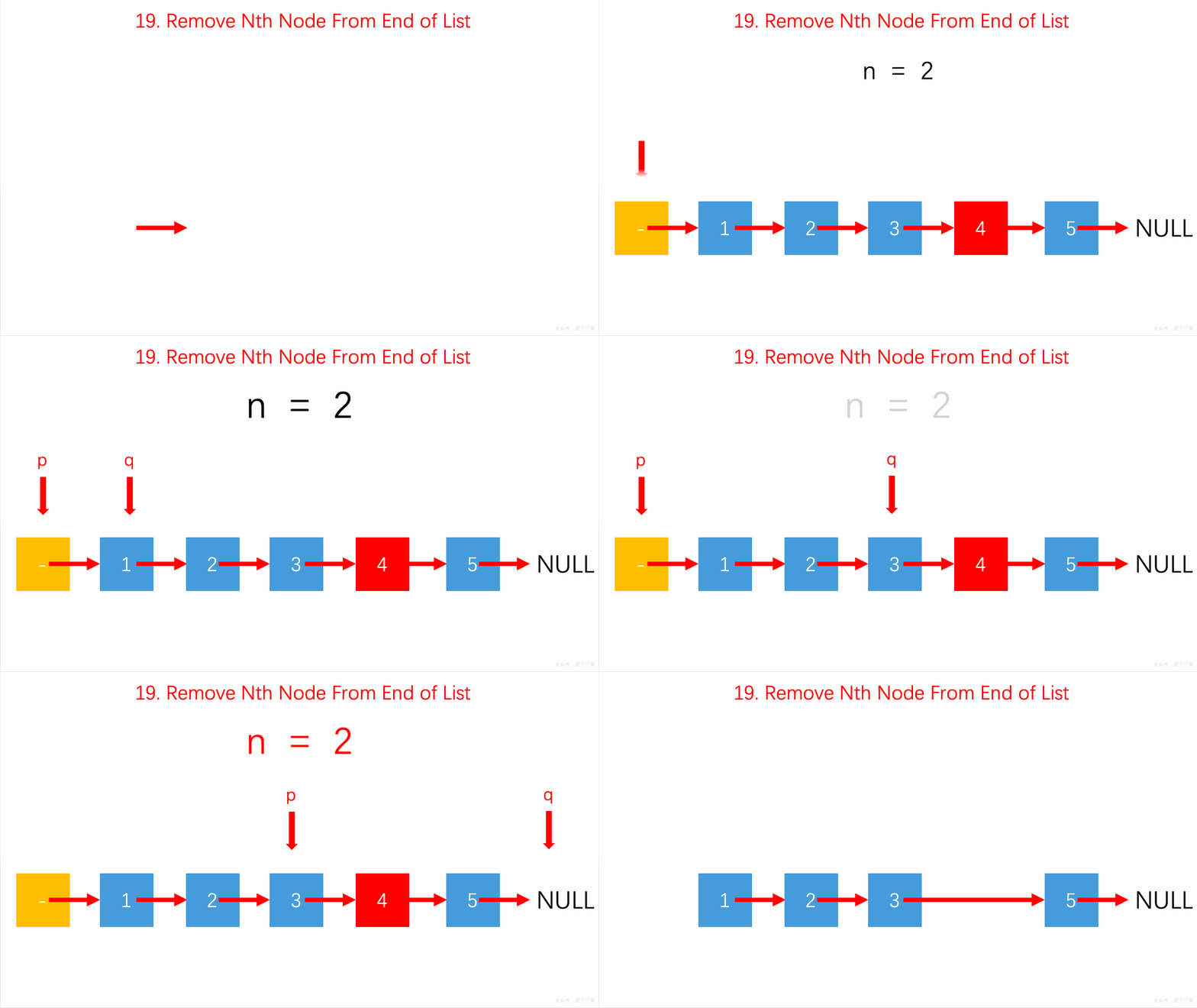
struct ListNode* removeNthFromEnd(struct ListNode* head, int n)
{

    struct ListNode dummyHead;
    dummyHead.next = head;

    struct ListNode *front,*behind;
    front = behind = &dummyHead;

    int TheIntervalBetweenTwoPointers = -1;
    while(behind){


        if(TheIntervalBetweenTwoPointers != n){


            behind = behind->next;
            TheIntervalBetweenTwoPointers++;
        }else{


            front = front->next;
            behind = behind->next;
        }
    }

    struct ListNode* temp = front->next;
    front->next = temp->next;
    free(temp);

    return dummyHead.next;
}
Method 3 : Stack
Because it is to be deleted, press the reciprocal , It's easy to think of stacks , Last in, first out , Put the whole list on the stack at one time , Further stack Find the front node of the node that needs to be deleted ;
Array stack :
typedef struct _Stack{

    struct ListNode* A[31];
    int Top;
}Stack;

void Push( Stack* S,struct ListNode* p )
{

    S->Top++;
    S->A[S->Top] = p;
}

struct ListNode* Pop( Stack* S )
{

    return S->A[S->Top--];
}

struct ListNode* removeNthFromEnd(struct ListNode* head, int n)
{

    struct ListNode dummyHead;
    dummyHead.next = head;

    Stack* S = malloc(sizeof(Stack));
    S->Top = -1;

    struct ListNode* p = &dummyHead;
    while(p){


        Push( S,p );
        p = p->next;
    }

    while(n--){

        Pop( S );
    }

    p = Pop( S );
    struct ListNode* temp = p->next;
    p->next = temp->next;
    free(temp);
    free( S );

    return dummyHead.next;
}
Chain stack :
Method four : recursive
Another way to count backwards is recursion , In fact, linked lists are very suitable for recursion , For example, the application of recursion in binary tree
struct ListNode* removeNthFromEnd(struct ListNode* head, int n)
{

    static int K = 0;

    if(head->next){

        head->next = removeNthFromEnd( head->next,n );
    }

    K++;

    if(K == n){

        struct ListNode* temp = head->next;
        free(head);
        return temp;
    }else{

        return head;
    }
}
The test case :[1] 1 When tested separately , No problem ; But it just couldn't pass when submitting , strange
Reference to others java Code :
class Solution {

    int i=0;
    public ListNode removeNthFromEnd(ListNode head, int n) {

        if(head.next!=null)
            head.next=removeNthFromEnd(head.next,n);
        i++;
        if(i==n)
            return head.next;
        else return head;
    }
}
边栏推荐
- Maintenance of delta hot metal detector principle analysis of v5g-jc-r1 laser measurement sensor / detector
- ABB电磁流量计维修信号变送器维修41F/E4技术参数
- ST法国三座工厂大罢工,芯片缺货情况或将更加严重!
- Reading and writing basic data types in protobuf
- 数据库读写分离目的是做什么[通俗易懂]
- How to measure software architecture
- How NPM switches Taobao source images
- The greatest romance of programmers~
- Link with bracket sequence I (state based multidimensional DP)
- 【Bluetooth蓝牙开发】八、BLE协议之传输层
猜你喜欢

属性基加密仿真及代码实现(CP-ABE)论文:Ciphertext-Policy Attribute-Based Encryption

关键路径的分析

Database -- use of explain

Api 接口优化的几个技巧

Sharkteam completes the safety audit of flow ecological NFT market matrixmarket
![[tidb] importing TXT documents into the database is really efficient](/img/2a/d33849987a75c4a0d52d8f0ab767ca.png)
[tidb] importing TXT documents into the database is really efficient

Buuctf questions upload labs record pass-01~pass-10

ctfshow 网络迷踪做题记录(1)

Confession of a graduate student: why am I addicted to opengauss community?

Maintenance of delta hot metal detector principle analysis of v5g-jc-r1 laser measurement sensor / detector
随机推荐
八、QOS队列调度与报文丢弃
Quii Cordova plugin telerik imagepicker plug-in multi image upload out of sequence
Applet container technology improves mobile R & D efficiency by 500%
How Oracle exports data (how Oracle backs up databases)
顶级“Redis 笔记”, 缓存雪崩 + 击穿 + 穿透 + 集群 + 分布式锁,NB 了
Introduction to blue team: efficiency tools
Cloud security core technology
酷派主动终止针对小米公司的专利侵权诉讼
Invalid prompt object name in SQL Server
Study - Summary of geometric calculations
How NPM switches Taobao source images
[Topic] add two numbers
Another installation artifact
MySQL
ctfshow 做题 web模块 web11~web14
实习日记第一周
编码用这16个命名规则能让你少写一半以上的注释!
Niuke turns on the camera and the picture disappears a few seconds later | the picture flashes when the camera is turned on
Why on earth is it not recommended to use select *?
[cloud native] what is ci/cd| Ci/cd to smooth delivery obstacles