当前位置:网站首页>Classic topics of leetcode tree (I)
Classic topics of leetcode tree (I)
2022-06-10 17:52:00 【[email protected]】
List of articles
- 427. Build a quadtree
- Interview questions 04.06. The successor
- 1022. Sum of binary numbers from root to leaf
- 450. Delete nodes in binary search tree
- 530. The minimum absolute difference of binary search tree
- 99. Restore binary search tree
- 1008. A binary search tree is constructed by preorder traversal
- 199. Right side view of binary tree
- 513. Find the value in the lower left corner of the tree
- 671. The second smallest node in a binary tree
427. Build a quadtree
https://leetcode-cn.com/problems/construct-quad-tree/


Ideas : For a given nn Lattice of , Judge this first nn Whether all the grids are 0 Or both 1, If it is , Go directly back to a node , There is no need to create child nodes ; otherwise . Recursive creation 4 Child node , About the present nn A grid is divided into 4 individual n/2n/2 The rectangular , Then repeat the above steps
details : To know n*n Whether all the grids are 0 Or both 1, You can create a prefix and an array first , Given (a,b) (c,d) These two points ( Top left and bottom right ) The elements of the rectangle and , Judge whether and are 0( All elements are 0) Or equal to the area ( All elements are 1); If not , According to (a,b) (c,d) Find the upper left and right corners of the four sub rectangles , Do recursive operations
/* // Definition for a QuadTree node. class Node { public boolean val; public boolean isLeaf; public Node topLeft; public Node topRight; public Node bottomLeft; public Node bottomRight; public Node() { this.val = false; this.isLeaf = false; this.topLeft = null; this.topRight = null; this.bottomLeft = null; this.bottomRight = null; } public Node(boolean val, boolean isLeaf) { this.val = val; this.isLeaf = isLeaf; this.topLeft = null; this.topRight = null; this.bottomLeft = null; this.bottomRight = null; } public Node(boolean val, boolean isLeaf, Node topLeft, Node topRight, Node bottomLeft, Node bottomRight) { this.val = val; this.isLeaf = isLeaf; this.topLeft = topLeft; this.topRight = topRight; this.bottomLeft = bottomLeft; this.bottomRight = bottomRight; } }; */

class Solution {

    public Node construct(int[][] grid) {

        int m=grid.length,n=grid[0].length;
        int[][] pre=new int[m+1][n+1];
        for(int i=1;i<=m;i++){

            for(int j=1;j<=n;j++){

                pre[i][j]=pre[i][j-1]+pre[i-1][j]+grid[i-1][j-1]-pre[i-1][j-1];
            }
        }


        return dfs(grid,pre,0,0,m-1,n-1);
    }
    public Node dfs(int[][] grid,int[][] pre,int a,int b,int c,int d){

        int sum=pre[c+1][d+1]-pre[a][d+1]-pre[c+1][b]+pre[a][b];
        int w=d-b+1,h=c-a+1;
        if(sum==0||sum==w*h)
            return new Node(grid[a][b]==1,true);// Leaf node  val The value depends on grid[a][b] yes 0 still 1
        Node root=new Node(true,false);// Nonleaf node
        root.topLeft=dfs(grid,pre,a,b,a+h/2-1,b+w/2-1);// Rectangle in the upper left corner
        root.topRight=dfs(grid,pre,a,b+w/2,a+h/2-1,d);
        root.bottomLeft=dfs(grid,pre,a+h/2,b,c,b+w/2-1);
        root.bottomRight=dfs(grid,pre,a+h/2,b+w/2,c,d);
        return root;
    }
}

Interview questions 04.06. The successor
https://leetcode.cn/problems/successor-lcci/

Ideas : For one BST for , node X There are two situations for the follow-up of :
- X Right subtree of is not empty , be X Is followed by the smallest node in the right subtree
- X The right subtree of is empty , be X Subsequent to X The first left ancestor node of Y(Y yes X The ancestor node of , also X stay Y In the left subtree )
class Solution {

    public TreeNode inorderSuccessor(TreeNode root, TreeNode p) {

        if(p.right!=null){

            TreeNode node=p.right;
            while(node.left!=null)
                node=node.left;
            return node;
        }
        TreeNode successor=null;
        TreeNode node=root;
        while(node!=null){

            if(node.val>p.val){

                successor=node;//suc Point to p First right ancestor node of
                node=node.left;
            }else{

                node=node.right;
            }
        }
        return successor;
    }

}
//O(n)
//O(1)
1022. Sum of binary numbers from root to leaf
https://leetcode.cn/problems/sum-of-root-to-leaf-binary-numbers/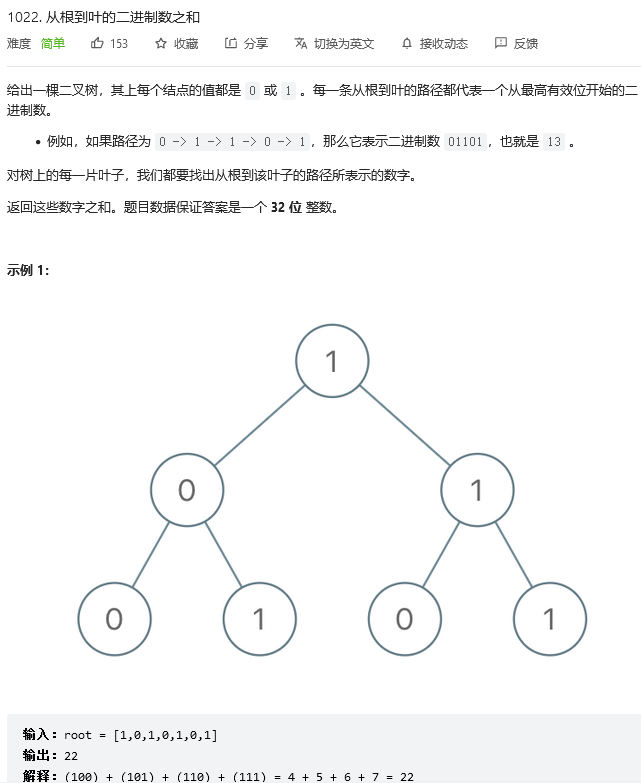
Ideas : Accumulate data from top to bottom , For leaf nodes , Directly return the node value ; For non leaf nodes , Returns the cumulative sum of the values of its left subtree ,sum=sum<<1|val : Indicates that will val Added to the value formed on the right side of the binary
class Solution {


    public int sumRootToLeaf(TreeNode root) {

        return dfs(root,0);
    }
    public int dfs(TreeNode root,int sum){

        if(root==null)
            return 0;
        sum=sum<<1|root.val;
        if(root.left==null&&root.right==null){

            return sum;
        }
        return dfs(root.left,sum)+dfs(root.right,sum);
    }
}
//O(n)
//O(n)
450. Delete nodes in binary search tree
https://leetcode.cn/problems/delete-node-in-a-bst/
Ideas : Delete BST One of the nodes in x, Divided into the following 4 In this case ( Suppose the node to be deleted x Exist in BST in ):
- x It's a leaf node
- x Only the left child nodes
- x Only the right child nodes
- x There are both left and right child nodes
class Solution {

    public TreeNode deleteNode(TreeNode root, int key) {

        if(root==null){

            return null;
        }
        if(root.val<key){
    // The current node value is less than key  Go to root Delete from the right subtree of
            root.right=deleteNode(root.right,key);
        }else if(root.val>key){
    // The current node value is greater than key  Go to root Delete from the left subtree of
            root.left=deleteNode(root.left,key);
        }else if(root.val==key){
    // At present root A node is a node to be deleted
            if(root.left==null&root.right==null){
    // The current node is a leaf node   Delete directly
                return null;
            }else if(root.left==null){
    // The current node has no left child nodes   Replace with the right child node root
               return root.right;
           }else if(root.right==null){
    // The current node has no right child node   Replace with the left child node root
               return root.left;
           }else{
    // Current node root There are left and right child nodes   Replace with the smallest node in the right subtree root
               TreeNode tmp=root;//tmp Keep the original root
               root=findMin(tmp.right);// Replace with the smallest node in the right subtree root
               root.right=deleteMin(tmp.right);// Delete the subtree of the smallest node as the right subtree
               root.left=tmp.left;// The original root The left subtree of the node is used as the new root The left subtree of the node
           }

        }
        return root;
    }
    // Looking to node The smallest node in the subtree whose node is the root
    public TreeNode findMin(TreeNode node){

        if(node.left==null){

            return node;
        }
        return findMin(node.left);

    }
    // Delete with node Is the smallest node in the subtree of the root node
    public TreeNode deleteMin(TreeNode node){

        if(node.left==null){

            return node.right;
        }
        node.left=deleteMin(node.left);
        return node;
    }
}
//O(n)
//O(n)
530. The minimum absolute difference of binary search tree
https://leetcode.cn/problems/minimum-absolute-difference-in-bst/
Ideas : Yes BST An ascending sequence can be obtained by traversing the middle order , The simplest thing to do is to use a list, Middle order traversal records the values of each node , Go over it again list Find the minimum difference between adjacent elements ; The optimization approach is not to use list, Instead, a pre Variable records the value of the previous node , Then, the minimum difference between the current node and the previous node is continuously updated , After updating the difference , The current node becomes pre
class Solution {

    int pre=-1;
    int min=Integer.MAX_VALUE;
    public int getMinimumDifference(TreeNode root) {

        dfs(root);
        return min;
    }
    public void dfs(TreeNode root){

        if(root==null){

            return;
        }
        if(root.left!=null){

            dfs(root.left);
        }
        if(pre==-1){

            pre=root.val;
        }else{

            min=Math.min(min,root.val-pre);
            pre=root.val;
        }
        if(root.right!=null){

            dfs(root.right);
        }
    }
}
//O(n)
//O(n)
99. Restore binary search tree
https://leetcode.cn/problems/recover-binary-search-tree/
Ideas : First pair BST Do middle order traversal , And use a list Record the nodes traversed in sequence , Then find the two nodes that need to be exchanged ; With 1 2 3 4 5 6->1 5 3 4 2 6 For example ,2 and 5 There was an exchange , How to find out which elements are exchanged ? Traverse the array after exchange , If for the first time find nums[i]>nums[i+1], that nums[i] It must be one of the two (5), For another element , Then you need to continue to traverse back , the last one Meet the conditions nums[i]>nums[i+1] Of nums[i+1] It's just another element (2), After finding these two elements , Exchange the values of these two nodes
class Solution {

    List<TreeNode> list=new ArrayList<>();
    public void recoverTree(TreeNode root) {

        inorder(root);
        TreeNode x=null,y=null;
        for(int i=0;i<list.size()-1;i++){

            if(list.get(i).val>list.get(i+1).val){

                y=list.get(i+1);
                if(x==null){

                    x=list.get(i);
                }
            }
        }
        int tmpVal=x.val;
        x.val=y.val;
        y.val=tmpVal;
    }
    public void inorder(TreeNode root){

        if(root==null){

            return;
        }
        inorder(root.left);
        list.add(root);
        inorder(root.right);
    }
}
//O(n)
//O(n)
1008. A binary search tree is constructed by preorder traversal
https://leetcode.cn/problems/construct-binary-search-tree-from-preorder-traversal/
Ideas 1: Recursive create , Each time the first element in the current subarray is root node , Then find the boundary between the left and right subtrees , Then locate the range of the left and right subtrees according to the dividing line
class Solution {

    public TreeNode bstFromPreorder(int[] preorder) {

        return bstFromPreorder(preorder,0,preorder.length-1);
    }
    public TreeNode  bstFromPreorder(int[] preorder,int start,int end){

        if(start>end){

            return null;
        }
        TreeNode root=new TreeNode(preorder[start]);
        start++;
        int tmp=start;
        while(start<=end){
    // Find the boundary between the left and right subtrees   At the end of the cycle start perform root Right child of
            if(preorder[start]>root.val){

                break;
            }
            start++;
        }
        root.left=bstFromPreorder(preorder,tmp,start-1);
        root.right=bstFromPreorder(preorder,start,end);
        return root;
    }
}
//O(n^2)  The cumulative number of boundary lookups is n^2
//O(n)
Ideas 2: It is not necessary to find the boundary between the left and right subtrees every time , Pass the upper and lower bounds as parameters , Nodes within the upper and lower bounds are the upper layer root Child nodes of , Otherwise, it's not
class Solution {

    int len;
    int index;
    int[] preorder;
    public TreeNode bstFromPreorder(int[] preorder) {

        this.len=preorder.length;
        this.preorder=preorder;
        return bstFromPreorder(Integer.MIN_VALUE,Integer.MAX_VALUE);
    }
    public TreeNode  bstFromPreorder(int lowerBound,int upperBound){

        if(index==len){
    // All elements have been added to BST in
            return null;
        }
        int cur=preorder[index];
        if(cur<lowerBound||cur>upperBound){
    // The currently traversed element is not in [low,up] Within the scope of   to flash back   Show the current cur Not on the next floor
            return null;// In recursion root Left child node or right child node of
        }
        index++;// At present cur It's the upper floor root Child nodes of
        TreeNode root=new TreeNode(cur);
        root.left=bstFromPreorder(lowerBound,cur);//root The node is the upper bound of the left subtree
        root.right=bstFromPreorder(cur,upperBound);//root The node is the lower bound of the right subtree
        return root;
    }
}
//O(n)
//O(n)
199. Right side view of binary tree
https://leetcode.cn/problems/binary-tree-right-side-view/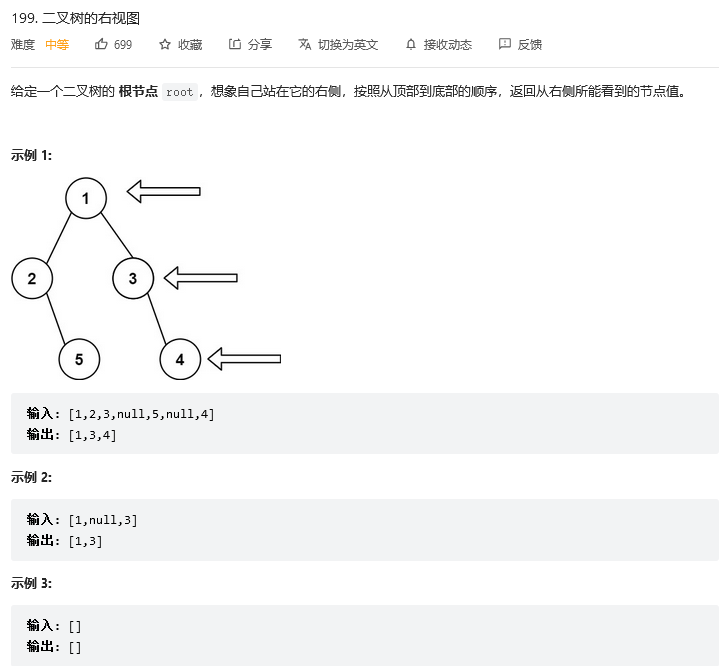
Ideas 1:BFS, Ergodic time , First add the right child node of the next layer to the queue , So when traversing to the next layer , The first node is the node that the current layer can see
class Solution {

    public List<Integer> rightSideView(TreeNode root) {

        List<Integer> ans=new ArrayList<>();
        if(root==null){

            return ans;
        }
        LinkedList<TreeNode> q=new LinkedList<>();
        q.offer(root);
        while(!q.isEmpty()){

            int sz=q.size();
            for(int i=0;i<sz;i++){

                TreeNode node=q.poll();
                if(i==0){
    // Because each layer adds the right child node first   So the first one is the node that the current layer can see
                    ans.add(node.val);
                }
                if(node.right!=null){
    // Add the right child node first
                    q.offer(node.right);
                }
                if(node.left!=null){

                    q.offer(node.left);
                }
            }
        }
        return ans;
    }
}
//O(n)
//O(n)
Ideas 2:DFS, Perform depth traversal in the order of right and left root , The current depth is the same as the number of elements in the collection , Then add the current node to the collection
class Solution {

    List<Integer> ans=new ArrayList<>();
    public List<Integer> rightSideView(TreeNode root) {

        dfs(root,0);
        return ans;
    }
    public void dfs(TreeNode root,int depth){

        if(root==null){

            return;
        }
        if(ans.size()==depth){
    // Because only one node will be added to each layer   So when depth and ans Add when the size is the same
            ans.add(root.val);
        }
        dfs(root.right,depth+1);// First access the right child node
        dfs(root.left,depth+1);

    }

}
//O(n)
//O(n)
513. Find the value in the lower left corner of the tree

Ideas 1: DFS, Use a formal parameter to represent the number of layers currently traversed , Another variable is used to indicate the number of updates , Only the first node on the left of each layer will be updated , Therefore, only when the number of updates is the same as the number of layers
class Solution {

    int ans;
    int d;
    public int findBottomLeftValue(TreeNode root) {

        dfs(root,0);
        return ans;
    }
    public void dfs(TreeNode root,int depth){

        if(root==null){

            return;
        }
        if(depth==d){
    // Only take the first value of each layer
            ans=root.val;
            d++;
        }
        dfs(root.left,depth+1);
        dfs(root.right,depth+1);
    }
}
//O(n)
//O(n)
Ideas 2:BFS, When traversing a layer, only the first node of the layer is updated each time
class Solution {


    public int findBottomLeftValue(TreeNode root) {

       int ans=0;
       LinkedList<TreeNode> q=new LinkedList<>();
       q.offer(root);
       while(!q.isEmpty()){

           int sz=q.size();
           for(int i=0;i<sz;i++){

               TreeNode node=q.poll();
               if(i==0){
    // Update only the first node of each layer
                   ans=node.val;
               }
               if(node.left!=null){

                   q.offer(node.left);
               }
               if(node.right!=null){

                   q.offer(node.right);
               }
           }
       }
       return ans;
    }

}
//O(n)
//O(n)
671. The second smallest node in a binary tree
https://leetcode.cn/problems/second-minimum-node-in-a-binary-tree/
Ideas : The root node is the smallest node in the entire tree ,DFS If the current node is found node Is greater than or equal to ans Explain with node All values in the subtree of the root node are greater than or equal to ans, Go straight back to ; If there is no return , And there is the current node node.val>minVal, Update page 2 Small value ans
class Solution {

    int ans=-1;// The first 2 Small value
    int rootVal;
    public int findSecondMinimumValue(TreeNode root) {

        rootVal=root.val;//rootVal The smallest is the smallest
        dfs(root);
        return ans;
    }
    public void dfs(TreeNode root){

        if(root==null){

            return;
        }
        if(ans!=-1&&root.val>=ans){
    // The first 2 The small value has been updated and the current node value >=ans  Note the node values in the subtree with the current node as the root are greater than or equal to ans  Go straight back to
            return;
        }
        if(root.val>rootVal){
    // The current node value is greater than the minimum value   The current value is the th possible 2 Small value
            ans=root.val;
        }
        dfs(root.left);
        dfs(root.right);
    }
}
//O(n)
//O(n)
版权声明
本文为[[email protected]]所创,转载请带上原文链接,感谢
https://yzsam.com/2022/161/202206101701485715.html
边栏推荐
- pands pd. Detailed parsing of dataframe() function
- Importerror: libgl. so. 1: cannot open shared object file: no such file or directory
- 2022版IDEA图形界面GUI乱码解决方法超详细简单版
- 高数_第6章无穷级数__绝对收敛_条件收敛
- Leetcode String to integer(Atoi)
- 基于业务沉淀组件 =&gt; manage-table
- The short ticket hypothesis: finding sparse, trainable neural networks
- Nacos configuration management
- C#_ Serial port communication project
- 基于DeepFace模型设计的人脸识别软件
猜你喜欢

Why 0.1+0.2=0.3000000000000004
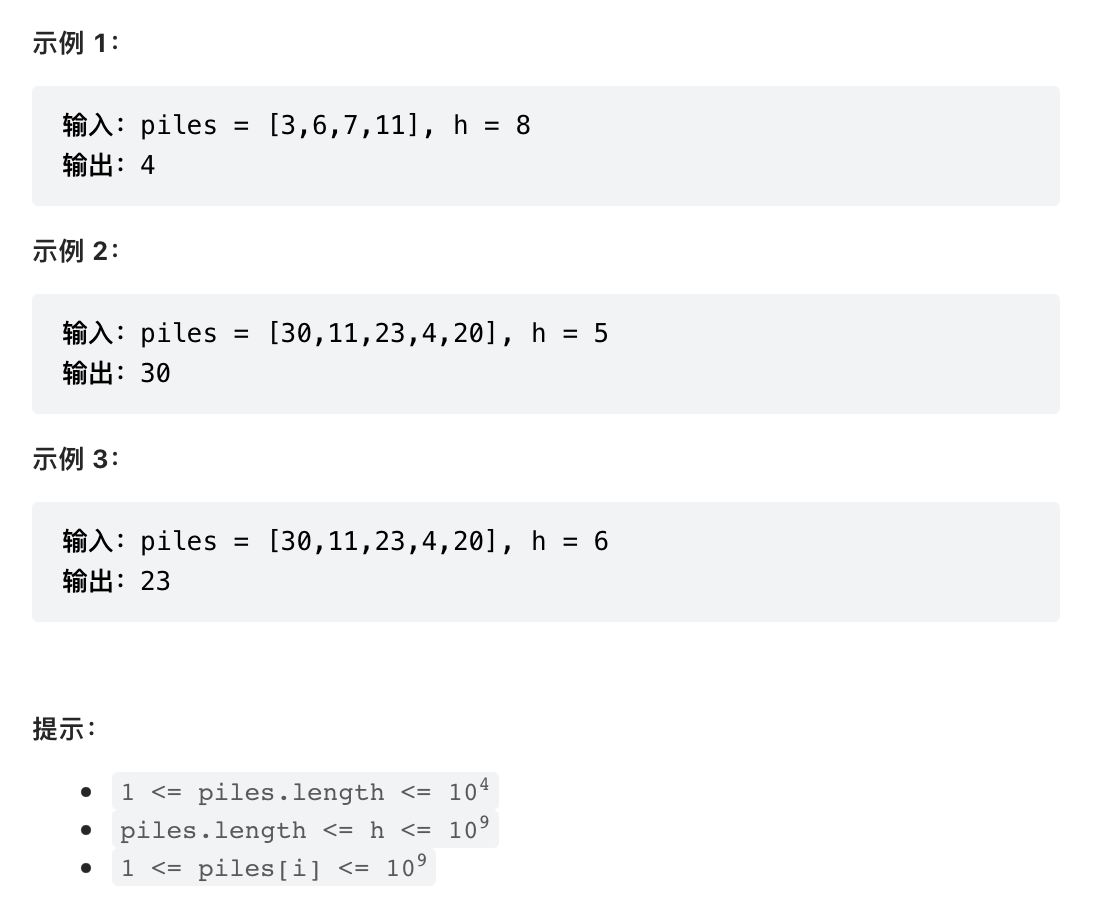
Leetcode 875. 爱吃香蕉的珂珂

Redis general instruction

IIS installation and deployment web site

Talk about message oriented middleware (1) and AMQP

嘿!ONES 新星请看过来|师兄师姐说

The short ticket hypothesis: finding sparse, trainable neural networks

【FAQ】运动健康服务REST API接口使用过程中常见问题和解决方法总结

The relationship between trees, forests and binary trees

Nacos registry
随机推荐
自定义视图:图形与图像的处理(一):使用简单图片
玩轉Pytorch的Function類
PCA主成分分析教程(origin分析&绘制,无须R语言)
丢失的遗传力--Missing heritability
Nacos注册中心
牛客网:表达式求值
苹果放大招!这件事干的太漂亮了……
if else的使用太简单?(看懂这篇你的逻辑会进一步提升)
Daily question -1287 Elements that appear more than 25% in an ordered array
树、森林和二叉树的关系
红色垂直左侧边菜单导航代码
期货账户资金安全吗?
厉害了,工信部推出 “一键解绑” 手机号绑定的互联网账号,堪称神器
Is the fund of futures account safe?
信息学奥赛一本通 1280:【例9.24】滑雪 | OpenJudge NOI 2.6 90:滑雪 | 洛谷 P1434 [SHOI2002] 滑雪
LeetCode树经典题目(一)
IPO治不了威马的杂症?
安全感
mmdetection之dataloader构建
使用Canvas实现的噪音线条h5js特效