当前位置:网站首页>牛客网:设计LRU缓存结构 设计LFU缓存结构
牛客网:设计LRU缓存结构 设计LFU缓存结构
2022-06-26 16:56:00 【lsgoose】
目录
1.设计LRU缓存结构

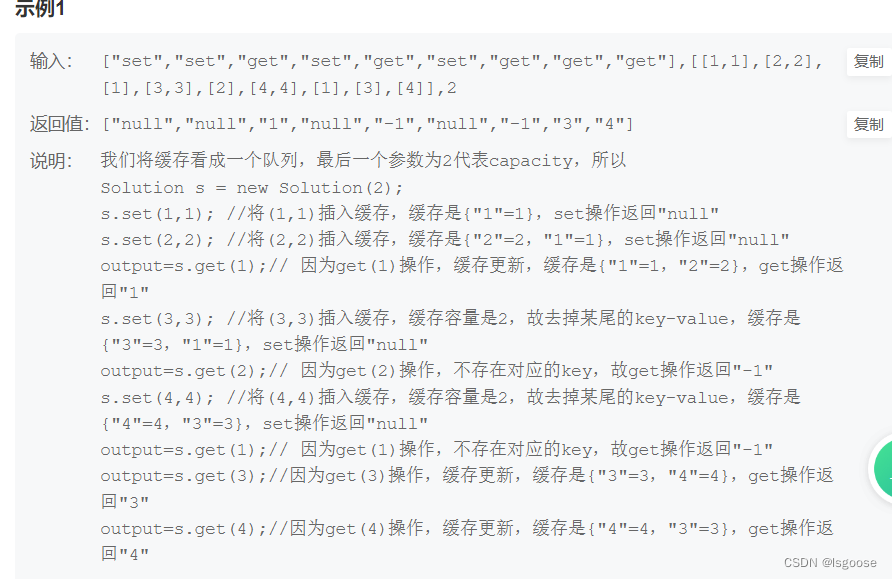
这题,说实话,一开始没看懂他的输入到底是什么...
看看说明,好像又是这么一回事,就是创建一个类然后直接调用里面的方法:
其实是维护一个双向链表,写过XV6操作系统的内存和锁那块的同学应该知道这个LRU到底是个啥。思路如下所示:
整个LRU维护一个链表和一个哈希表两个数据结构,链表可以直接用list双向链表,哈希表用unordered_map来设计,哈希表存的是key和在链表中的迭代器的对应关系。
Get
首先,对于get操作,功能是这样的:对于一个给定的key,我们要在链表中查看其是否存在,这里哈希可以实现O(1)的寻找时间代价,处理流程如下:
1.查找是否存在key对应的节点,没有则直接返回-1
2.否则,我们先根据key在哈希中取出对应的节点,然后将对应节点删除。
因为是LRU,所以我们要把最近使用的放在最前面(虽然用了哈希表但是按照LRU的思路还是得放最前面),所以我们把取出来的节点放到链表头部,然后再在哈希表中建立<key, list.begin()>的映射关系。
最后返回头部节点的value
Set
对于set操作,功能是这样的:对于一个给定的<key, value>,如果在链表中存在key的节点,那么修改并放到链表头,如果不存在,那么直接在前面添加节点当作链表头,还要考虑链表是不是会炸掉的问题,如果容量已经达到了,那么根据LRU的原则,我们先删除链表尾部
代码如下所示:
class Solution {
public:
    list<pair<int, int>> dlist;
    unordered_map<int, list<pair<int, int>>::iterator> map;
    int cap;

    Solution(int capacity){
        cap=capacity;
    }


    int get(int key) {
         // write code here
        if(map.count(key)){
            auto tmp=*map[key];
            dlist.erase(map[key]);
            dlist.push_front(tmp);
            map[key]=dlist.begin();
            return dlist.front().second;
        }
        return -1;
    }

    void set(int key, int value){
         if(map.count(key)){
            dlist.erase(map[key]);
         }else if(cap==dlist.size()){
            auto tmp=dlist.back();
             map.erase(tmp.first);
             dlist.pop_back();
         }
            dlist.push_front(pair<int, int>(key, value));
             map[key]=dlist.begin();
    }
};

/**
 * Your Solution object will be instantiated and called as such:
 * Solution* solution = new Solution(capacity);
 * int output = solution->get(key);
 * solution->set(key,value);
 */
当然,除了可以用标准库里的数据结构,我们也可以自己手撸一个双向链表,我们需要分离出以一个将节点移动到表头的函数,以便于当我们在进行get操作找到一个节点,或者set的时候将对应的节点放到表头。
代码如下所示,这里面有很多的细节要注意,主要是数据结构的更新和哈希的更新:
#include<bits/stdc++.h>
using namespace std;
struct Node{
    int key;
    int val;
    Node *prev;
    Node *next;
    Node(int key, int val) : key(key), val(val), next(NULL), prev(NULL) {}
};

class Solution {
public:
    unordered_map<int, Node*> hash;
    Node *head;
    Node *tail;
    int cap;
    int size;
    Solution(int capacity){
        head=NULL;
        tail=NULL;
        cap=capacity;
        size=0;
        hash.clear();
    }
    // 将某个节点放到表头
    // 如果位于尾部 需要更新尾节点
    // 移到头部后需要更新指针指向以及更新头节点
    void removeToHead(Node *p){
        // 首先修改
        if(p==head){
            return;
        }
        p->prev->next=p->next;
        if(p==tail){
            tail=p->prev;
        }else{
            p->next->prev=p->prev;
        }
        p->prev=NULL;
        p->next=head;
        head->prev=p;
        head=p;
        return;
    }

    int get(int key) {
        if(hash.find(key)==hash.end()){
            return -1;
        }
        removeToHead(hash[key]);
        return hash[key]->val;
    }

    void set(int key, int value){
        if(hash.find(key)!=hash.end()){
            hash[key]->val=value;
            removeToHead(hash[key]);
        }else if(size>=cap){
            //将尾节点更新为当前节点 移动到头部
            //更新哈希表 删除原来的 增加新的
            int k=tail->key;
            hash.erase(k);
            tail->key=key;
            tail->val=value;
            removeToHead(tail);
            hash[key]=head;
        }else{
            //不存在节点 且容量还没满 直接在头部插入
            Node *node=new Node(key, value);
            if(head==NULL){
                head=tail=node;
            }else{
                node->next=head;
                node->prev=NULL;
                head->prev=node;
                head=node;
            }
            hash[key]=head;
            size++;
        }

    }
};
2.设计LFU缓存结构
上面的LRU是最近最少使用的策略,LFU是least frequently used,从字面上来看貌似也是最近最少使用策略嘛,但是从题目来看,是还让我们记录使用set和get的次数的。
我们这里用一个双哈希表来解决这个题目,同时在题解中看到了一个画的很好的图:

这就是我们要维护的数据结构。首先,对于每个频率,我们维护一个双向链表,这个双向链表代表了对应频率的节点的集合,存储的是{freq, key, value},这样就形成了频率和链表的哈希表。我们根据这个哈希表可以轻松根据频率找到双向链表,在容量不足的时候用来找删除的节点时十分迅速。其次也方便一些删除插入的更新操作。也由于要在容量不足的时候删除节点,我们需要用一个变量来存储freq最小的节点。
第二个哈希表是key和链表节点的哈希表,这个哈希表对于get操作是十分必须的。
接下来解析一下get和set操作的流程:
Get
get操作的功能是根据key找value,有了哈希表之后,我们可以直接根据key找到对应节点,然后找到value,如果没有找到则返回-1。
Set
set操作的功能是设置<key, value>,处理流程如下:
1.如果之前存在这个映射关系,那么我们更新一下这个映射,关于更新是什么,之后说。
2.如果不存在,我们就要插入这个新的映射,当然,还要考虑当前的链表是否已经满了,因此我们还需要维护一个记录剩余空间的变量。
a.如果已经满了,我们需要做一些事情:
首先要找到频率最低的且最少使用的节点,对于频率最低的节点,由于我们维护了频率和对应节点的集合的哈希,我们很快可以找到,对于最少使用,我们每次更新的时候是放到表头,所以最少使用的就是最后一个节点。
找到节点之后我们要删除这个节点,删除之后我们还得检查这个链表是否为空,是空的话还得直接删除这个映射项。
b.如果没有满,我们维护一下剩余的容量
之后直接向freq=1的双向链表头部插入新的<freq=1, key, value>,之后也要更新对应的<key,value>映射。
Update
更新操作用于在set中已经存在对应的key或者对已存在节点使用了get时,更新其频率。
首先,我们根据key取出链表节点,然后根据链表节点中的freq找到对应的链表,之后直接在链表中删除对应节点。
如果删除后这个链表变成空了:
删除对应映射关系,再看是否需要更新最小频率,如果被删除链表是最小频率对应的链表,那么需要更新
最后将新的<freq+1,key,value>插入对应链表,如果是set还需要更新map
具体代码如下所示:
class Solution {
public:
    /**
     * lfu design
     * @param operators int整型vector<vector<>> ops
     * @param k int整型 the k
     * @return int整型vector
     */
    // 存频率和频率对应节点链表的字典
    unordered_map<int, list<vector<int>>> freq_mp;
    // 存对应键值和节点
    unordered_map<int, list<vector<int>>::iterator> mp;
    // 记录最小频率 用来使用LFU策略找节点
    int min_freq=0;
    // 存剩余容量
    int size=0;

    vector<int> LFU(vector<vector<int>>& operators, int k){
        vector<int> res;
        size=k;
        for(int i=0;i<operators.size();++i){
            if(operators[i][0]==1){
                set(operators[i][1], operators[i][2]);
            }else{
                res.push_back(get(operators[i][1]));
            }
        }
        return res;
    }

    void update(list<vector<int>>::iterator iter, int key, int value){
        //取出双向链表中的一个节点 即 vector<int>
        int freq=(*iter)[0];
        freq_mp[freq].erase(iter);
        //如果该频率中已经没有节点
        //删除频率双向链表中的对应链表
        //查看是否需要更新最小频率
        if(freq_mp[freq].empty()){
            freq_mp.erase(freq);
            if(freq == min_freq){
                min_freq++;
            }
        }
        //向freq+1的双向链表头部中插入
        //由于原来的节点已经不存在 需要重新设置<key,value>的存储
        freq_mp[freq+1].push_front({freq+1, key, value});
        mp[key]=freq_mp[freq+1].begin();
    }

    void set(int key, int value){
        auto it=mp.find(key);
        if(it!=mp.end()){
            //链表中存在节点 更新value和频率
            update(it->second, key, value);
        }else{
            //哈希表中没有该节点
            //如果链表已满 删除频率最低而且最早的删掉
            //频率表中删除最后一个节点
            //删除对应<key,value>的节点
            if(size==0){
                int oldkey=freq_mp[min_freq].back()[1];
                freq_mp[min_freq].pop_back();
                if(freq_mp[min_freq].empty()){
                    freq_mp.erase(min_freq);
                }
                mp.erase(oldkey);
            }else{
                //容量未满 可以直接加入
                size--;
            }
            min_freq=1;
            freq_mp[1].push_front({1, key, value});
            mp[key]=freq_mp[1].begin();
        }
    }

    //get操作:没有找到则返回-1
    //找到则更新频率并且取出value返回
    int get(int key){
        int res=-1;
        auto it = mp.find(key);
        if(it==mp.end()){
            return res;
        }
        auto iter = it->second;
        res=(*iter)[2];
        update(iter, key, res);
        return res;
    }
};
不得不说,数据结构和相应的存储结合真是一件巧妙的事情~
边栏推荐
- 合约量化系统开发方案详细,量化合约系统开发技术说明
- 玩转Linux,轻松安装配置MySQL
- Find all primes less than or equal to Lim, store them in AA array, and return the number of primes
- Use FST JSON to automatically generate faster JSON serialization methods
- Various types of gypsum PBR multi-channel mapping materials, please collect them quickly!
- [matlab project practice] prediction of remaining service life of lithium ion battery based on convolutional neural network and bidirectional long short time (cnn-lstm) fusion
- What is the difference between digital collections and NFT
- Concurrent thread safety
- Some explanations for latex CJK
- Programmer's essential toolkit, please collect!
猜你喜欢

Necessary decorator mode for 3 years' work

Romance of the Three Kingdoms: responsibility chain model

C language --- basic function realization of push box 01

经典同步问题
Today, I met a "migrant worker" who took out 38K from Tencent, which let me see the ceiling of the foundation
![[suggested collection] 11 online communities suitable for programmers](/img/6b/d5c68e93384fd314d0cb27d9df1cb9.jpg)
[suggested collection] 11 online communities suitable for programmers

Platform management background and merchant menu resource management: Design of platform management background data service

Distributed Architecture Overview

When I was in the library, I thought of the yuan sharing mode

Microservice architecture practice: business management background and SSO design, SSO client design
随机推荐
Leetcode topic [array] -268- missing numbers
Platform management background and merchant menu resource management: merchant registration management design
Teach you to learn dapr - 8 binding
Programmer's essential toolkit, please collect!
R329 (maix-ii-a (M2A) data summary
y=1/100*100+1/200*200+1/300*300+.....+ 1/m*m
Constructors and Destructors
7 views on NFT market prospect
Use middleware to record slow laravel requests
Use the array to calculate the average of N numbers, and output the numbers greater than the average
[qt learning notes]qt inter thread data communication and data sharing
Demonstrate to Xiaobai the case of sub database and sub table
Redis 概述整理
Deployment and operation of mongodb partitioned cluster
Apache APIs IX has the risk of rewriting the x-real-ip header (cve-2022-24112)
ACL 2022 | zero sample multilingual extracted text summarization based on neural label search
玩转Linux,轻松安装配置MySQL
Leetcode 1170. Frequency of occurrence of the minimum letter of the comparison string (yes, solved)
Cloud native 02: Alibaba cloud cloud efficient flow pipeline
Byte interview: two array interview questions, please accept