当前位置:网站首页>吴恩达逻辑回归2
吴恩达逻辑回归2
2022-07-25 16:14:00 【starmultiple】
正则化逻辑回归
在这部分练习中,您将实现正则化逻辑回归
预测来自制造厂的微芯片是否通过质量保证
import numpy as np
import pandas as pd
import matplotlib.pyplot as plt
1. 数据可视化
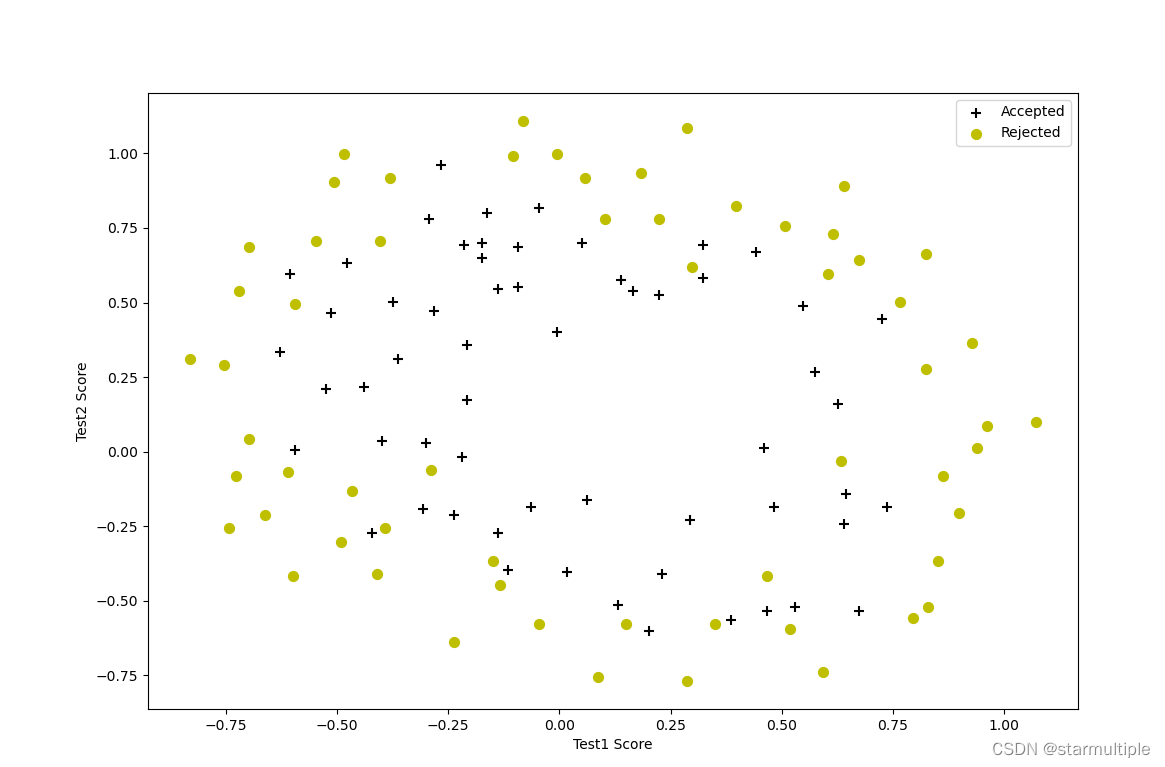
plotData 用于生成一个
如图 所示,其中轴是两个测试分数,而正(y = 1,接受)和否定(y = 0,拒绝)示例显示为不同的标记。
path = 'ex2data2.txt'
df = pd.read_csv(path, header=None, names=['Microchip Test1', 'Microchip Test2', 'Accepted'])
df.head()

df.describe()

pos = df[df['Accepted'].isin([1])]
neg = df[df['Accepted'].isin([0])]

fig, ax = plt.subplots(figsize=(12, 8))
ax.scatter(pos['Microchip Test1'], pos['Microchip Test2'], s=50, c='black', marker='+', label='Accepted')
ax.scatter(neg['Microchip Test1'], neg['Microchip Test2'], s=50, c='y', marker='o', label='Rejected')
ax.legend()
ax.set_xlabel('Test1 Score')
ax.set_ylabel('Test2 Score')
plt.show()
特征映射
更好地拟合数据的一种方法是从每个数据点创建更多特征。在提供的函数 mapFeature.m 中,我们将特征映射到 x 1 和 x 2 的所有多项式项,直到六次方。
def feature_mapping(x, y, power, as_ndarray=False):
    data = {
    'f{0}{1}'.format(i-p, p): np.power(x, i-p) * np.power(y, p)
                for i in range(0, power+1)
                for p in range(0, i+1)
           }
    if as_ndarray:
        return pd.DataFrame(data).values
    else:
        return pd.DataFrame(data)

x1 = df.Test1.values
x2 = df.Test2.values
Y = df.Accepted

data = feature_mapping(x1, x2, power=6)
# data = data.sort_index(axis=1, ascending=True)
data.head()

data.describe()
三
成本函数和梯度。现在您将实现代码来计算成本函数和梯度
正则化逻辑回归。 完成 costFunctionReg.m 中的代码
返回成本和梯度。
回想一下,逻辑回归中的正则化成本函数是
theta = np.zeros(data.shape[1])
X = feature_mapping(x1, x2, power=6, as_ndarray=True)
X.shape, Y.shape, theta.shape

def sigmoid(z):
    return 1 / (1 + np.exp(-z))

def cost(theta, X, Y):
    first = Y * np.log(sigmoid([email protected].T))
    second = (1 - Y) * np.log(1 - sigmoid([email protected].T))
    return -1 * np.mean(first + second)
def regularized_cost(theta, X, Y, l=1):
    theta_1n = theta[1:]
    regularized_term = l / (2 * len(X)) * np.power(theta_1n, 2).sum()
    return cost(theta, X, Y) + regularized_term

cost(theta, X, Y)

regularized_cost(theta, X, Y, l=1)


def gradient(theta, X, Y):
    return (1/len(X) * X.T @ (sigmoid(X @ theta.T) - Y))


def regularized_gradient(theta, X, Y, l=1):
    theta_1n = theta[1:]
    regularized_theta = l / len(X) * theta_1n
    # regularized_theta[0] = 0
    regularized_term = np.concatenate([np.array([0]), regularized_theta])

    return gradient(theta, X, Y) + regularized_term
# return gradient(theta, X, Y) + regularized_theta

gradient(theta, X, Y)
regularized_gradient(theta, X, Y)

import scipy.optimize as opt
res = opt.minimize(fun=regularized_cost, x0=theta, args=(X, Y), method='Newton-CG', jac=regularized_gradient)
res

def predict(theta, X):
    probability = sigmoid(X @ theta.T)
    return probability >= 0.5
    return [1 if x>=0.5 else 0 for x in probability]

from sklearn.metrics import classification_report
Y_pred = predict(res.x, X)
print(classification_report(Y, Y_pred))

# 得到theta
def find_theta(power, l):
    ''' power: int raise x1, x2 to polynomial power l: int lambda constant for regularization term '''
    path = 'ex2data2.txt'
    df = pd.read_csv(path, header=None, names=['Test1', 'Test2', 'Accepted'])
    df.head()

    Y = df.Accepted
    x1 = df.Test1.values
    x2 = df.Test2.values
    X = feature_mapping(x1, x2, power, as_ndarray=True)
    theta = np.zeros(X.shape[1])

# res = opt.minimize(fun=regularized_cost, x0=theta, args=(X, Y, l), method='Newton-CG', jac=regularized_gradient)
    res = opt.minimize(fun=regularized_cost, x0=theta, args=(X, Y, l), method='TNC', jac=regularized_gradient)
    return res.x


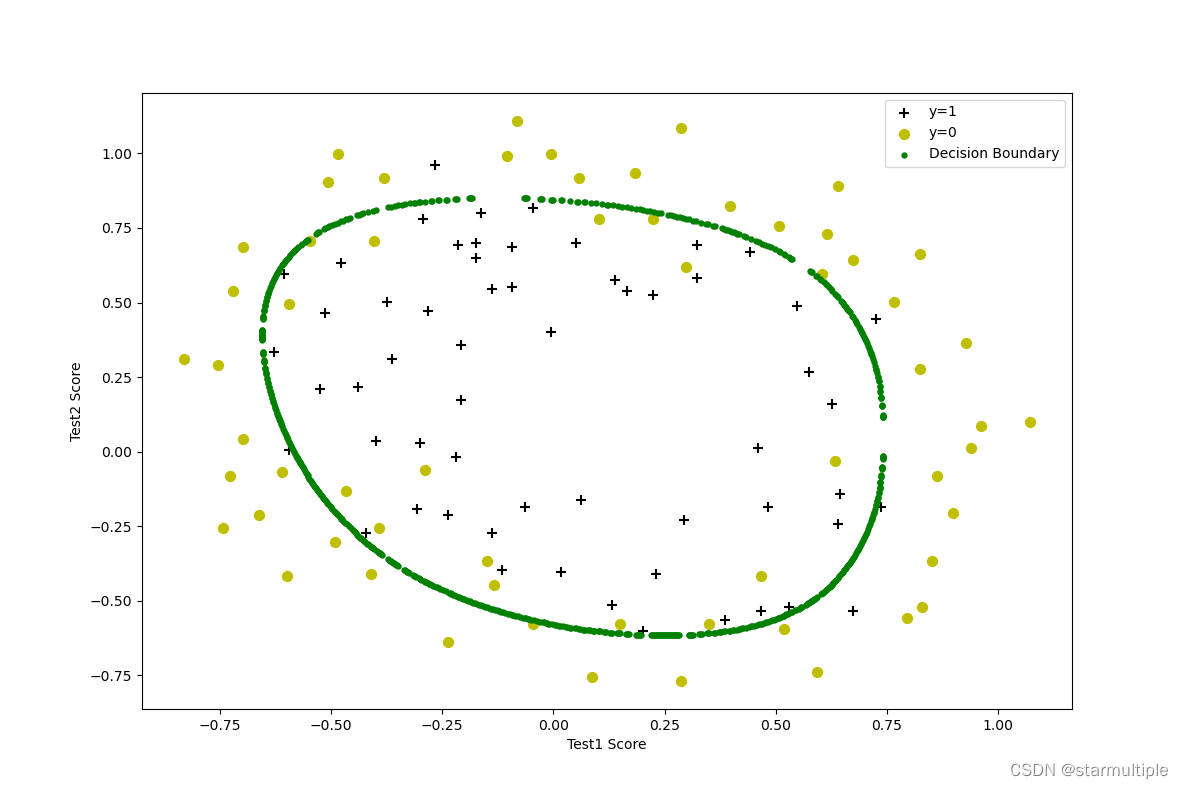
# 决策边界,thetaX = 0, thetaX <= threshhold
def find_decision_boundary(density, power, theta, threshhold):
    t1 = np.linspace(-1, 1.2, density)
    t2 = np.linspace(-1, 1.2, density)
    cordinates = [(x, y) for x in t1 for y in t2]
    x_cord, y_cord = zip(*cordinates)
    mapped_cord = feature_mapping(x_cord, y_cord, power)

    pred = mapped_cord.values @ theta.T
    decision = mapped_cord[np.abs(pred) <= threshhold]

    return decision.f10, decision.f01


# 画决策边界
def draw_boundary(power, l):
    density = 1000
    threshhold = 2 * 10 ** -3

    theta = find_theta(power, l)
    x, y = find_decision_boundary(density, power, theta, threshhold)
    pos = df[df['Accepted'].isin([1])]
    neg = df[df['Accepted'].isin([0])]

    fig, ax = plt.subplots(figsize=(12, 8))
    ax.scatter(pos['Test1'], pos['Test2'], s=50, c='black', marker='+', label='y=1')
    ax.scatter(neg['Test1'], neg['Test2'], s=50, c='y', marker='o', label='y=0')
    ax.scatter(x, y, s=50, c='g', marker='.', label='Decision Boundary')
    ax.legend()
    ax.set_xlabel('Test1 Score')
    ax.set_ylabel('Test2 Score')

    plt.show()
draw_boundary(6, l=1)
边栏推荐
- 开发者如何为React Native选择合适的数据库
- 可验证随机函数 VRF
- What is the shortcut key for win11 Desktop Switching? Win11 fast desktop switching method
- 百度富文本编辑器UEditor单张图片上传跨域
- 百奥赛图与LiberoThera共同开发全人GPCR抗体药物取得里程碑式进展
- 使用 Terraform 在 AWS 上快速部署 MQTT 集群
- Food safety - do you really understand the ubiquitous frozen food?
- Gap locks
- Permission management - delete menu (recursive)
- Exclusive lock
猜你喜欢

0x80131500 solution for not opening Microsoft Store
狂神redis笔记12

优必选大型仿人服务机器人Walker X的核心技术突破

Cookie、cookie与session区别

【图像隐藏】基于混合 DWT-HD-SVD 的数字图像水印方法技术附matlab代码

哪个led显示屏厂家更好

I interviewed 8 companies and got 5 offers in a week. Share my experience

百度富文本编辑器UEditor单张图片上传跨域

2W word detailed data Lake: concept, characteristics, architecture and cases

Equivalent change of resistance circuit (Ⅱ)
随机推荐
MySQL intent lock
Gap locks
[wechat applet] detailed explanation of applet host environment
doGet与doPost
MySQL tutorial 67- filter duplicate data using distinct
终极套娃 2.0 | 云原生交付的封装
[fault diagnosis] bearing fault diagnosis based on Bayesian optimization support vector machine with matlab code
百奥赛图与LiberoThera共同开发全人GPCR抗体药物取得里程碑式进展
意向锁(Intention Lock)
mysql 查看是否锁表
Record Locks(记录锁)
Dpdk packet receiving and sending problem case: non packet receiving problem location triggered by mismatched packet sending and receiving function
Talk about how to use redis to realize distributed locks?
fastadmin tp 安装使用百度富文本编辑器UEditor
没错,请求DNS服务器还可以使用UDP协议
01. A simpler way to deliver a large number of props
Gap Locks(间隙锁)
如何构建面向海量数据、高实时要求的企业级OLAP数据引擎?
食品安全丨无处不在的冷冻食品,你真的了解吗?
开发者如何为React Native选择合适的数据库