当前位置:网站首页>Convolutional neural network model -- googlenet network structure and code implementation
Convolutional neural network model -- googlenet network structure and code implementation
2022-07-23 16:42:00 【1 + 1= Wang】
List of articles
GoogLeNet Network profile
GoogLeNet Original address :Going Deeper with Convolutions:https://www.cv-foundation.org/openaccess/content_cvpr_2015/papers/Szegedy_Going_Deeper_With_2015_CVPR_paper.pdf
GoogLeNet stay 2014 Year by year Christian Szegedy Put forward , It is a new deep learning structure .
GoogLeNet The main innovation of the network is :
Put forward Inception The structure is convoluted and repolymerized simultaneously on multiple sizes ;

Use 1X1 The convolution of is used for dimension reduction and mapping ;
Add two auxiliary classifiers to help train ;
Auxiliary classifier is to use the output of a certain middle layer as a classification , And add a smaller weight to the final classification result .Use the average pool layer instead of the full connection layer , Greatly reduced the number of parameters .
GoogLeNet Network structure
GoogLeNet The complete network structure of is as follows :
Next, we will explain it layer by layer and combine it with code analysis
Inception Previous layers
When entering Inception Before the structure ,GoogLeNet The network first stacks two convolutions ( But in fact 3 individual , There is one 1X1 Convolution of ) And two maximum pooling layers .

# input(3,224,224)
self.front = nn.Sequential(
    nn.Conv2d(3, 64, kernel_size=7, stride=2, padding=3),   # output(64,112,112)
    nn.ReLU(inplace=True),

    nn.MaxPool2d(kernel_size=3,stride=2,ceil_mode=True),    # output(64,56,56)

    nn.Conv2d(64,64,kernel_size=1),
    nn.Conv2d(64,192,kernel_size=3,stride=1,padding=1),     # output(192,56,56)
    nn.ReLU(inplace=True),

    nn.MaxPool2d(kernel_size=3,stride=2,ceil_mode=True),    # output(192,28,28)
)
Inception structure

Inception The module will only change the number of channels of the characteristic graph , Without changing the size .
Inception The structure is relatively complex , We recreate a class to build this structure , The number of channels in each layer is controlled by different parameters .
class Inception(nn.Module):
    ''' in_channels:  Enter the number of channels  out1x1: Branch 1 Number of output channels  in3x3: Branch 2 Of 3x3 Number of input channels for convolution  out3x3: Branch 2 Of 3x3 The number of output channels of convolution  in5x5: Branch 3 Of 5x5 Number of input channels for convolution  out5x5: Branch 3 Of 5x5 The number of output channels of convolution  pool_proj: Branch 4 Maximum number of pooled layer output channels  '''
    def __init__(self,in_channels,out1x1,in3x3,out3x3,in5x5,out5x5,pool_proj):
        super(Inception, self).__init__()

        self.branch1 = nn.Sequential(
            nn.Conv2d(in_channels, out1x1, kernel_size=1),
            nn.ReLU(inplace=True)
        )
        self.branch2 = nn.Sequential(
            nn.Conv2d(in_channels,in3x3,kernel_size=1),
            nn.ReLU(inplace=True),
            nn.Conv2d(in3x3,out3x3,kernel_size=3,padding=1),
            nn.ReLU(inplace=True)
        )
        self.branch3 = nn.Sequential(
            nn.Conv2d(in_channels, in5x5, kernel_size=1),
            nn.ReLU(inplace=True),
            nn.Conv2d(in5x5, out5x5, kernel_size=5, padding=2),
            nn.ReLU(inplace=True)
        )

        self.branch4 = nn.Sequential(
            nn.MaxPool2d(kernel_size=3,stride=1,padding=1),
            nn.Conv2d(in_channels,pool_proj,kernel_size=1),
            nn.ReLU(inplace=True)
        )

    def forward(self,x):
        branch1 = self.branch1(x)
        branch2 = self.branch2(x)
        branch3 = self.branch3(x)
        branch4 = self.branch4(x)

        outputs = [branch1,branch2,branch3,branch4]
        return torch.cat(outputs,1)	#  Stack by channel number
Inception3a modular

# input(192,28,28)
self.inception3a = Inception(192, 64, 96, 128, 16, 32, 32)		# output(256,28,28)
Inception3b + MaxPool

# input(256,28,28)
self.inception3b = Inception(256, 128, 128, 192, 32, 96, 64)		# output(480,28,28)
self.maxpool3 = nn.MaxPool2d(3, stride=2, ceil_mode=True)			# output(480,14,14)
Inception4a

# input(480,14,14)
self.inception4a = Inception(480, 192, 96, 208, 16, 48, 64)		# output(512,14,14)
Inception4b
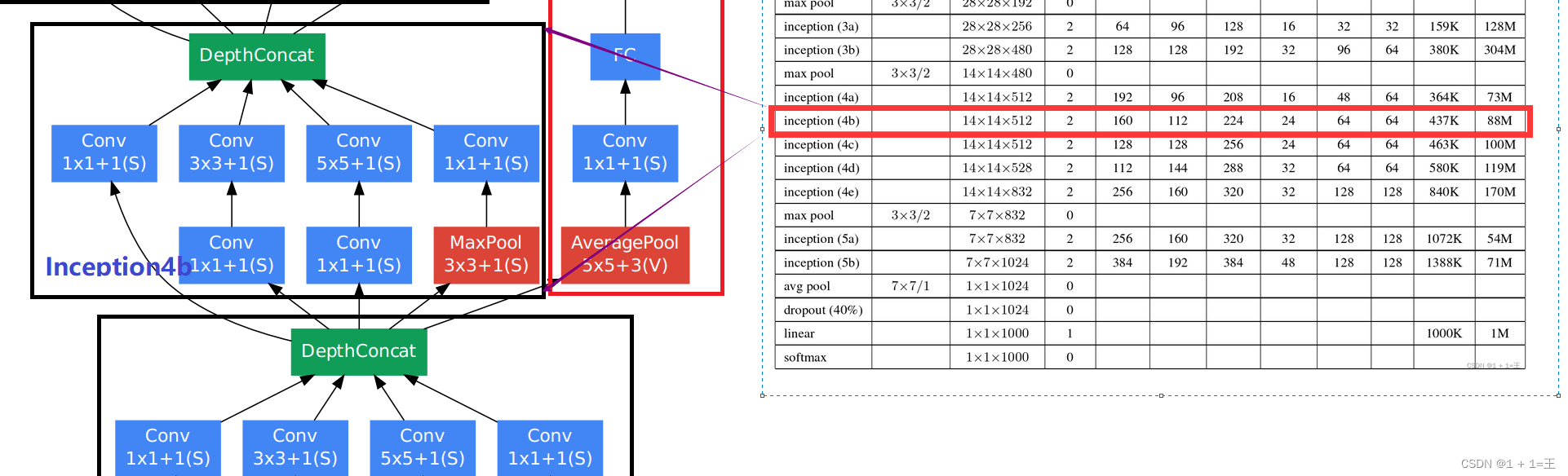
# input(512,14,14)
self.inception4b = Inception(512, 160, 112, 224, 24, 64, 64)		# output(512,14,14)
Inception4c

# input(512,14,14)
self.inception4c = Inception(512, 160, 112, 224, 24, 64, 64)		# output(512,14,14)
Inception4d

# input(512,14,14)
self.inception4d = Inception(512, 112, 144, 288, 32, 64, 64)		# output(528,14,14)
Inception4e+MaxPool
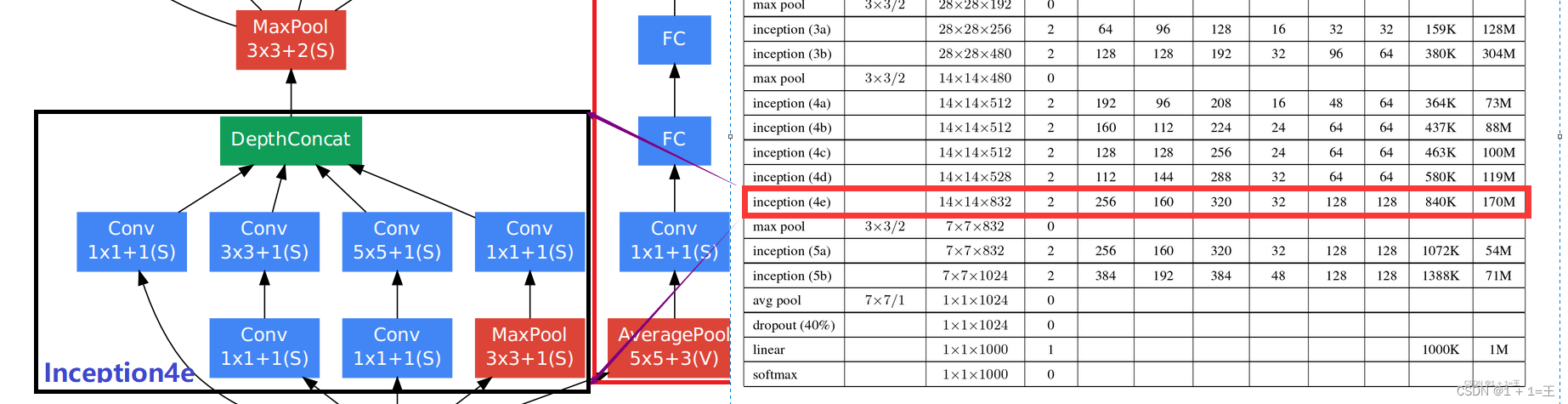
# input(528,14,14)
self.inception4e = Inception(528, 256, 160, 320, 32, 128, 128)	# output(832,14,14)
self.maxpool4 = nn.MaxPool2d(3, stride=2, ceil_mode=True)		# output(832,7,7)
Inception5a

# input(832,7,7)
self.inception5a = Inception(832, 256, 160, 320, 32, 128, 128)		# output(832,7,7)
Inception5b

# input(832,7,7)
self.inception5b = Inception(832, 384, 192, 384, 48, 128, 128)		# output(1024,7,7)
Inception The next several layers

Auxiliary classification module
In addition to the above backbone network structure ,GoogLeNet It also provides two auxiliary classification modules , Used to use the output of an intermediate layer as a classification , And press a smaller weight (0.3) Add to the final classification result .
And Inception The modules are the same , We also re create a class to build the auxiliary classification module structure .
class AccClassify(nn.Module):
	# in_channels:  Input channel
	# num_classes:  Number of categories
    def __init__(self,in_channels,num_classes):
        self.avgpool = nn.AvgPool2d(kernel_size=5, stride=3)
        self.conv = nn.MaxPool2d(in_channels, 128, kernel_size=1)  # output[batch, 128, 4, 4]
        self.relu = nn.ReLU(inplace=True)

        self.fc1 = nn.Linear(2048, 1024)
        self.fc2 = nn.Linear(1024, num_classes)

    def forward(self,x):
        x = self.avgpool(x)
        x = self.conv(x)
        x = self.relu(x)
        x = torch.flatten(x, 1)
        x = F.dropout(x, 0.5, training=self.training)
        x = F.relu(self.fc1(x), inplace=True)
        x = F.dropout(x, 0.5, training=self.training)
        x = self.fc2(x)

        return x
Auxiliary classification module 1
The first m-server output is located at Inception4a after , take Inception4a The output of is average pooled ,1X1 After convolution and full connection, wait until the classification result .
self.acc_classify1 = AccClassify(512,num_classes)
Auxiliary classification module 2

self.acc_classify2 = AccClassify(528,num_classes)
Overall network structure
pytorch Build complete code
""" #-*-coding:utf-8-*- # @author: wangyu a beginner programmer, striving to be the strongest. # @date: 2022/7/5 18:37 """
import torch.nn as nn
import torch
import torch.nn.functional as F


class GoogLeNet(nn.Module):
    def __init__(self,num_classes=1000,aux_logits=True):
        super(GoogLeNet, self).__init__()
        self.aux_logits = aux_logits

        # input(3,224,224)
        self.front = nn.Sequential(
            nn.Conv2d(3, 64, kernel_size=7, stride=2, padding=3),   # output(64,112,112)
            nn.ReLU(inplace=True),

            nn.MaxPool2d(kernel_size=3,stride=2,ceil_mode=True),    # output(64,56,56)

            nn.Conv2d(64,64,kernel_size=1),
            nn.Conv2d(64,192,kernel_size=3,stride=1,padding=1),     # output(192,56,56)
            nn.ReLU(inplace=True),

            nn.MaxPool2d(kernel_size=3,stride=2,ceil_mode=True),    # output(192,28,28)
        )

        # input(192,28,28)
        self.inception3a = Inception(192, 64, 96, 128, 16, 32, 32)  # output(64+128+32+32=256,28,28)
        self.inception3b = Inception(256, 128, 128, 192, 32, 96, 64)  # output(480,28,28)
        self.maxpool3 = nn.MaxPool2d(3, stride=2, ceil_mode=True)  # output(480,14,14)

        self.inception4a = Inception(480, 192, 96, 208, 16, 48, 64)  # output(512,14,14)
        self.inception4b = Inception(512, 160, 112, 224, 24, 64, 64)  # output(512,14,14)
        self.inception4c = Inception(512, 128, 128, 256, 24, 64, 64)  # output(512,14,14)
        self.inception4d = Inception(512, 112, 144, 288, 32, 64, 64)  # output(528,14,14)
        self.inception4e = Inception(528, 256, 160, 320, 32, 128, 128)  # output(832,14,14)
        self.maxpool4 = nn.MaxPool2d(3, stride=2, ceil_mode=True)  # output(832,7,7)

        self.inception5a = Inception(832, 256, 160, 320, 32, 128, 128)  # output(832,7,7)
        self.inception5b = Inception(832, 384, 192, 384, 48, 128, 128)  # output(1024,7,7)

        if self.training and self.aux_logits:
            self.acc_classify1 = AccClassify(512,num_classes)
            self.acc_classify2 = AccClassify(528,num_classes)

        self.avgpool = nn.AdaptiveAvgPool2d((1,1))        # output(1024,1,1)
        self.dropout = nn.Dropout(0.4)
        self.fc = nn.Linear(1024,num_classes)


    def forward(self,x):
        # input(3,224,224)
        x = self.front(x)       # output(192,28,28)

        x= self.inception3a(x)  # output(256,28,28)
        x = self.inception3b(x)
        x = self.maxpool3(x)

        x = self.inception4a(x)

        if self.training and self.aux_logits:
            classify1 = self.acc_classify1(x)

        x = self.inception4b(x)
        x = self.inception4c(x)
        x = self.inception4d(x)

        if self.training and self.aux_logits:
            classify2 = self.acc_classify2(x)

        x = self.inception4e(x)
        x = self.maxpool4(x)

        x = self.inception5a(x)
        x = self.inception5b(x)

        x = self.avgpool(x)
        x = torch.flatten(x,dims=1)
        x = self.dropout(x)
        x= self.fc(x)

        if self.training and self.aux_logits:
            return x,classify1,classify2

        return x


class Inception(nn.Module):
    ''' in_channels:  Enter the number of channels  out1x1: Branch 1 Number of output channels  in3x3: Branch 2 Of 3x3 Number of input channels for convolution  out3x3: Branch 2 Of 3x3 The number of output channels of convolution  in5x5: Branch 3 Of 5x5 Number of input channels for convolution  out5x5: Branch 3 Of 5x5 The number of output channels of convolution  pool_proj: Branch 4 Maximum number of pooled layer output channels  '''
    def __init__(self,in_channels,out1x1,in3x3,out3x3,in5x5,out5x5,pool_proj):
        super(Inception, self).__init__()

        # input(192,28,28)
        self.branch1 = nn.Sequential(
            nn.Conv2d(in_channels, out1x1, kernel_size=1),
            nn.ReLU(inplace=True)
        )
        self.branch2 = nn.Sequential(
            nn.Conv2d(in_channels,in3x3,kernel_size=1),
            nn.ReLU(inplace=True),
            nn.Conv2d(in3x3,out3x3,kernel_size=3,padding=1),
            nn.ReLU(inplace=True)
        )
        self.branch3 = nn.Sequential(
            nn.Conv2d(in_channels, in5x5, kernel_size=1),
            nn.ReLU(inplace=True),
            nn.Conv2d(in5x5, out5x5, kernel_size=5, padding=2),
            nn.ReLU(inplace=True)
        )

        self.branch4 = nn.Sequential(
            nn.MaxPool2d(kernel_size=3,stride=1,padding=1),
            nn.Conv2d(in_channels,pool_proj,kernel_size=1),
            nn.ReLU(inplace=True)
        )

    def forward(self,x):
        branch1 = self.branch1(x)
        branch2 = self.branch2(x)
        branch3 = self.branch3(x)
        branch4 = self.branch4(x)

        outputs = [branch1,branch2,branch3,branch4]
        return torch.cat(outputs,1)


class AccClassify(nn.Module):
    def __init__(self,in_channels,num_classes):
        self.avgpool = nn.AvgPool2d(kernel_size=5, stride=3)
        self.conv = nn.MaxPool2d(in_channels, 128, kernel_size=1)  # output[batch, 128, 4, 4]
        self.relu = nn.ReLU(inplace=True)

        self.fc1 = nn.Linear(2048, 1024)
        self.fc2 = nn.Linear(1024, num_classes)

    def forward(self,x):
        x = self.avgpool(x)
        x = self.conv(x)
        x = self.relu(x)
        x = torch.flatten(x, 1)
        x = F.dropout(x, 0.5, training=self.training)
        x = F.relu(self.fc1(x), inplace=True)
        x = F.dropout(x, 0.5, training=self.training)
        x = self.fc2(x)

        return x

# print(GoogLeNet())
chart

边栏推荐
猜你喜欢







随机推荐
C#入门系列(二十八) -- LINQ的查询语法
[note] linear regression
AWS Part 1
[taro] applet picker dynamically obtains data
pytest接口自动化测试框架 | pytest常用运行参数
20220721 beaten content
国产AI蛋白质结构预测再现突破,用单条序列解决3D结构,彭健团队:“AlphaFold2以来最后一块拼图补齐了”...
O3DF执行董事Royal O’Brien:开源没有边界,所有共享的声音都会变成实际方向
低佣金账户怎么开?安全吗?
pytest接口自动化测试框架 | 如何获取帮助
Nifi 1.16.3 cluster setup +kerberos+ user authentication
Flutter | 给 ListView 添加表头表尾最简单的方式
Fastadmin, non super administrator, has been granted batch update permission, but it still shows no permission
阿里二面:MySQL 啥时候用表锁,啥时候用行锁?
The new business form of smart civil aviation has emerged, and Tupo digital twin has entered the civil aviation flight network of the Bureau
fio性能测试工具
网络协议与攻击模拟:wireshark使用、ARP协议
【Taro】小程序picker动态获取数据
Network protocol and attack simulation: Wireshark use, ARP Protocol
Backup and restore of database