当前位置:网站首页>[concurrent programming JUC] four ways to create threads
[concurrent programming JUC] four ways to create threads
2022-06-10 10:22:00 【Looking at the stars】
List of articles
1 Inherit Thread Create thread
- Inherit Thread class , rewrite run() Method .
- Create an instance of the subclass
- Use start() Method to start the thread .
public class MyThread extends Thread{

    @Override
    public void run() {

        System.out.println(Thread.currentThread().getName() + ": Running!");
    }

    public static void main(String[] args) {

        MyThread t = new MyThread();
        t.setName("t1");
        t.start();
    }
}
How to write anonymous inner class
public class MyThread{

    public static void main(String[] args) {

        Thread t = new Thread() {

            @Override
            public void run() {

                System.out.println(Thread.currentThread().getName() + ": Running!");
            }
        };
        t.setName("t1");
        t.start();
    }
}
2 adopt Runable Create thread
- Definition Runnable Implementation class of interface , rewrite run Method ( Executor )
- establish Runnable Instance of implementation class , Take this example as Thread Of target objects creating Thread object .
- call start() Start the thread .
hold 【 Threads 】 and 【 Mission 】( Code to execute ) Separate
public class MethodA implements Runnable{

    @Override
    public void run() {

        System.out.println(Thread.currentThread().getName() + ": Running!");
    }

    public static void main(String[] args) {

        Runnable r = new MethodA();
        Thread t1 = new Thread(r);
        t1.setName("t1");
        t1.start();
    }
}
How to write anonymous inner class
public class MyThread{

    public static void main(String[] args) {

        Thread t = new Thread(new Runnable() {

            @Override
            public void run() {

                System.out.println(Thread.currentThread().getName() + ": Running!");
            }
        });
        t.setName("t1");
        t.start();
    }
}
Lambda Expression simplification
public class MyThread{

    public static void main(String[] args) {

        Thread t = new Thread(() -> System.out.println(Thread.currentThread().getName() + ": Running!"));
        t.setName("t1");
        t.start();
    }
}
Thread And Runnable The relationship between
Thread Realized Runnable
class Thread implements Runnable {
    ...}
therefore , stay Thread Internal to achieve Runnable Methods in the interface run(). You can see , When target Isn't empty , stay run() Method target.run().
@Override
public void run() {

    if (target != null) {

        target.run();
    }
}
So let's take a look at target What is it? , In the initialization method init() in .
private void init(ThreadGroup g, Runnable target, String name,
                      long stackSize, AccessControlContext acc,
                      boolean inheritThreadLocals) {

	...
	this.target = target;
	...
}
therefore ,target It's an implementation Runnable Interface .
therefore , If you create a Runnable The object is to Thread, that Thread Running is a Runnable Object run Method ; If you don't create Runnable object , It needs to be rewritten run Method ,Thread Will run this rewritten run Method .
3 adopt Callable and FutureTask Create thread
- establish Callable Implementation class of interface , Realization call Method ( Executor , There is a return value ), And create Callable Objects that implement classes .
- Use FutureTask Class to packaging Callable object , The FutureTask Object encapsulates the Callable Object's call() Return value of method .
- Use FutureTask Object as Thread Object's target Create and start the thread .
- call FutureTask Object's get() Method to get the return value after the execution of the child thread .
And 【Runnable】 comparison , You can have a return value , adopt get() Method to get the return value after the execution of the child thread .
public class MyThread{

    public static void main(String[] args) throws ExecutionException, InterruptedException {

        //  establish Callable Implementation class object of interface
        Callable<Integer> callable = new Callable<Integer>() {

            @Override
            public Integer call() throws Exception {

                System.out.println(Thread.currentThread().getName() + ": Running!");
                return 1;
            }
        };
        //  Use FutureTask Class to packaging Callable object
        FutureTask<Integer> task = new FutureTask<>(callable);

        //  Use FutureTask Object as Thread Object's target Create and start the thread
        Thread thread = new Thread(task, "t1");
        thread.start();

        //  Block to get results
        System.out.println("call Return value of method : " + task.get());

    }
}
4 Thread pool creates threads
4.1 Thread parameter description
/** *  Create a new... With the given initial parameters ThreadPoolExecutor. */
public ThreadPoolExecutor(int corePoolSize,// Number of core threads in thread pool
                          int maximumPoolSize,// The maximum number of threads in the thread pool
                          long keepAliveTime,// When the number of threads is greater than the number of core threads , The maximum time an extra idle thread can survive
                          TimeUnit unit,// Time unit
                          BlockingQueue<Runnable> workQueue,// Task queue , Used to store a queue of waiting tasks
                          ThreadFactory threadFactory,// Thread factory , Used to create threads , General default
                          RejectedExecutionHandler handler// Refusal strategy , When too many tasks are submitted that cannot be processed in time , We can customize strategies to handle tasks
                         ) {

    if (corePoolSize < 0 ||
        maximumPoolSize <= 0 ||
        maximumPoolSize < corePoolSize ||
        keepAliveTime < 0)
        throw new IllegalArgumentException();
    if (workQueue == null || threadFactory == null || handler == null)
        throw new NullPointerException();
    this.corePoolSize = corePoolSize;
    this.maximumPoolSize = maximumPoolSize;
    this.workQueue = workQueue;
    this.keepAliveTime = unit.toNanos(keepAliveTime);
    this.threadFactory = threadFactory;
    this.handler = handler;
}
Important parameter
- corePoolSize: Number of core threads , Its number determines that the added task is to open up new threads to execute , Or put it in workQueue In the task queue .
- maximumPoolSize: Maximum number of threads , This parameter will be based on what you use workQueue Type of task queue , Determine the maximum number of threads that the thread pool will open .
- keepAliveTime: The number of idle threads in the current thread pool exceeds corePoolSize when , How long will extra threads be destroyed .
- unit:keepAliveTime The unit of
- workQueue: Task queue , Used to store queues waiting for tasks to be executed ; It is generally divided into direct submission queues 、 Bounded task queue 、 Boundless task queue 、 Priority queue .
- threadFactory: Thread factory , Used for thread creation , General default .
- handler: Refusal strategy ; When there are too many tasks to handle , You can customize policies to handle tasks .
🧭 Number of core threads and maximum number of threads
Fewer new tasks have been submitted corePoolSize, Even if other worker threads are idle , New threads will also be created to handle .
The new task submitted is greater than corePoolSize, Less than maximumPoolSize, New threads are created only when the queue is full
By setting corePoolSize and maximumPoolSize identical , You can create a fixed size thread pool .
take maximumPoolSize Set to Integer.MAX_VALUE, Can accommodate any number of concurrent numbers .
have access to setCorePoolSize and setMaximumSize Make dynamic changes .
When the number of threads reaches maximumPoolSize When the queue is full, the rejection policy will be executed .
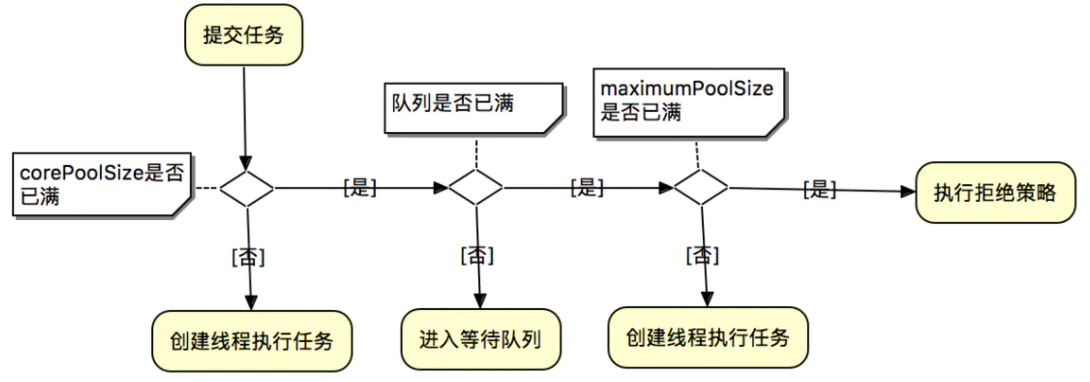
Task queue workQueue
- Direct submission queue ,SynchronousQueue It's a special one BlockingQueue, He has no capacity , Submitted tasks will not be saved , Always submit for execution right away , Every insert operation will block , You need to perform another delete operation to wake up , On the contrary, each delete operation also needs to wait for the corresponding insert operation .
- Bounded task queues ,ArrayBlockingQueue, If a new task needs to be performed , The thread pool will create new threads , Until the creation quantity reaches corePoolSzie when , New tasks will be added to the waiting queue . If multiple columns are full , The number of threads to be created continues to reach maximumPoolSize, If the number of threads is greater than maximumuPoolSize, A reject policy is executed .
- Boundless task queue ,LinkedBlockingQueue, The task queue can add new tasks without restriction , The maximum number of thread pools created is corePoolSize,maximumPoolSize This parameter is invalid .( When the capacity is not set , The default size is Integer.MAX_VALUE, It can be regarded as boundless )
- Priority task queue ,ProrityBlockingQueue, Special unbounded queue , The maximum number of thread pools created is corePoolSize,maximumPoolSize This parameter is invalid . Generally, queues process tasks according to the first in first out rule , The queue can be customized to execute rules according to priority .
Refusal strategy
When the queue is full and the number of threads created by the thread pool reaches the maximum number of threads , You need to specify a denial policy to handle thread pool overload .
- AbortPolicy Strategy : Throw an exception directly , Prevent the system from working properly .
- CallerRunsPolicy Strategy : If the number of threads in the thread pool reaches the maximum , This policy will run the tasks in the task queue in the caller thread .
- DiscardOldestPolicy Strategy : Discard the oldest task in the task queue , And try to submit again .
- DiscardPolicy Strategy : Discard the task directly .
Close thread pool
shutdownNow(): Close thread pool now ( violence ), Ongoing and queued tasks will be interrupted , At the same time, this method will return the task list in the interrupted queue
shutdown(): Smoothly close the thread pool , The tasks in progress and in the queue can be completed , Subsequent incoming tasks will be rejected
isTerminated(): When the task being executed and all the tasks in the column are executed ( Empty ) It will return to true
4.2 Create thread
Thread pools can be created automatically or manually , Automatic creation is reflected in Executors In the tool class , Common can create newFixedThreadPool、newCachedThreadPool、newSingleThreadExecutor、newScheduledThreadPool;
Manual creation is reflected in the flexible setting of various parameters of thread pool , Embodied in the code, that is ThreadPoolExecutor The difference of each argument on the class constructor .
4.2.1 newFixedThreadPool()
Create a fixed-size thread pool
Executors.newFixedThreadPool(2)
Test code :
public class MyThread{


    public static void main(String[] args) {

    	//  Create up to 2 Thread pool with a number of threads .
        ExecutorService executorService = Executors.newFixedThreadPool(2);
        for (int i = 0; i < 10; i++) {

            executorService.execute(new MethodA());
        }
    }
}
The construction method used is
new ThreadPoolExecutor(var0, var0, 0L, TimeUnit.MILLISECONDS, new LinkedBlockingQueue())
Set up corePoolSize=maxPoolSize,keepAliveTime=0( This parameter has no effect at this time ), Unbounded queue , Tasks can be put into , When there are too many requests ( The task processing speed cannot keep up with the task submission speed, resulting in request accumulation ) It may cause excessive memory consumption or directly cause OOM abnormal
4.2.2 newSingleThreadExecutor()
Create a thread pool with only one thread
Executors.newSingleThreadExecutor()
Test code :
public class MyThread{


    public static void main(String[] args) {

        ExecutorService executorService = Executors.newSingleThreadExecutor();
        for (int i = 0; i < 10; i++) {

            executorService.execute(new MethodA());
        }
    }
}
The construction method used is
new ThreadPoolExecutor(1, 1, 0L, TimeUnit.MILLISECONDS, new LinkedBlockingQueue(), var0)
Basically the same newFixedThreadPool, But set the number of threads to 1, Single thread , Disadvantages and newFixedThreadPool Agreement .
4.2.3 newCachedThreadPool()
Create a thread pool with unlimited threads , Any submitted tasks will be executed immediately
Executors.newCachedThreadPool();
Test code :
public class MyThread{


    public static void main(String[] args) {

        ExecutorService executorService = Executors.newCachedThreadPool();
        for (int i = 0; i < 10; i++) {

            executorService.execute(new MethodA());
        }
    }
}
The construction method used is
new ThreadPoolExecutor(0, Integer.MAX_VALUE, 60L, TimeUnit.SECONDS, new SynchronousQueue())
corePoolSize=0,maxPoolSize For a large number , Synchronous handover queue , That is, resident threads are not maintained ( Core thread ), Each time a request is made, a new thread is created directly to handle the task , Queue buffering is also not used , Will automatically recycle redundant threads , Because will maxPoolSize Set to Integer.MAX_VALUE, When there are many requests, it is possible to create too many threads , Lead to exhaustion of resources OOM
4.2.4 newScheduledThreadPool()
Support regular periodic execution , Note that you are using a delay queue
Executors.newScheduledThreadPool(2)
Test code :
public class MyThread{


    public static void main(String[] args) {

        ExecutorService executorService = Executors.newScheduledThreadPool(2);
        for (int i = 0; i < 10; i++) {

            executorService.execute(new MethodA());
        }
    }
}
The construction method used is
new ThreadPoolExecutor(var1, Integer.MAX_VALUE, 0L, TimeUnit.NANOSECONDS, new ScheduledThreadPoolExecutor.DelayedWorkQueue())
Support regular periodic execution , Note that you are using a delay queue , The disadvantages are the same as newCachedThreadPool Agreement
4.2.4 ThreadPoolExecutor()
边栏推荐
- 安装CocoaPods最新版教程
- 解决Typescript文件被识别为视频的问题
- 组合模式例子
- mdb转换为db文件
- PhpStorm配置数据库连接
- 八、链模式
- R language uses lmperm package to apply to the replacement method (replacement test and permutation tests) of linear model, uses LM model to build polynomial regression model, and uses LMP function to
- SQL server always on monitoring script and some misunderstandings
- Go practice | remember the optimization of reducing CPU utilization by 30% at a time
- Phpstrom télécharge le projet dans le cloud de code
猜你喜欢


随机推荐
[497. random points in non overlapping rectangles]
ES6 new feature class
Oracle dual table generates multi row pseudo records
微软再曝“丑闻”:在办公室看 VR 黄片,“HoloLens 之父”即将离职!
金融风控实战——异常检测(一)
Genius! Only use four integers to write a snake game!
Why is your next computer a computer? Explore different remote operations
12892. 子数整数(OJ,入门)
【图像特征提取】基于matlab脉冲耦合神经网络(PCNN)图像特征提取【含Matlab源码 1868期】
axure弹框设置
6、 Observer mode
万物生长,各自高贵
NFT铸造交易平台开发市场详情
Demand and business model innovation - demand 15- demand specification
[模型基础] RNN | LSTM
六、观察者模式
Fastadmin uses phpexcel to export tabular data to excel
Xcode8.3.2 automatic packaging script
随机生成数字字母(大写)组合
Neo hacker song's award-winning list has been announced. Who owns tens of thousands of dollars of gold?