1、 The problem background :
The application scenario of the customer camera is to identify vehicles on the highway , feedback The captured picture of the moving vehicle is blurred 、 There's a drag , The customer asked for Increase the frame rate 、 And reduce exposure time to solve this problem , The following is a summary and analysis of the causes of motion blur , And whether the customer's requirements are reasonable , Can it solve the problem ;
2、 Problem analysis :
Take pictures of vehicles on the highway , Generally, it should be the following two cases :
a、 The speed is too fast , The camera failed to capture the vehicle ;
b、 Can capture the vehicle , But the photos are pasted ;
If it's a problem a, Then we need to increase the frame rate to achieve , If it's a problem b, It is necessary to confirm what causes the motion blur ( Also called Montion artefact), Too long exposure time will cause blurring 、 The generation of drag shadow , And increasing the frame rate can really reduce the exposure time , But increasing the frame rate has a great impact (mipi Rate increase , There are requirements for platform performance 、 The brightness darkens and the noise increases under low illumination ), So you can not consider adjusting the frame rate for the time being , Confirm the specific reasons before making modifications .
3、 Motion blur / Analysis of the causes of smear ;
1) Exposure time is too long
Reasons for appearance : When shooting a moving object , Only if the exposure time is fast enough , An object is relatively stationary relative to the camera , Otherwise, the whole running process of the moving object is cmos Imaging on , So the picture will be blurred , There's a drag ;
measures :
a、 During debugging , First set the exposure time manual live , Reduce exposure time ( Integral time ), See if there is any improvement , Confirm whether the exposure time is too long ;
b、 If the set maximum exposure time is reached in this scene , The maximum exposure time can be reduced , The maximum exposure time setting in the general drive ( Integral time ) yes :VTS - frame_offset ;
c、 If the scene is not very dark , The exposure time did not reach the maximum , It is also possible to reduce the maximum exposure time to a suitable value , But at this time, due to the reduction of exposure time , The image darkens , Only by adjusting sensor Gain to compensate , The noise is bound to be serious ;
d、 The other better way is , It can be changed to high sensitivity sensor、 Large aperture lens ( It is because of insufficient exposure , So the exposure time is long );
e、 In addition, it is feasible to increase the frame rate , In this way, the exposure time per frame per unit time will be reduced , But the image will darken under low illumination , It will bring noise ;
2) Motion blur caused by relative motion
Reasons for appearance :
It is quite common when we take pictures with mobile phones , His hands shook for a while , The picture will be blurred , Especially in recent cases , The camera and the subject produce relatively large relative motion , That is, the whole motion process is imaged in sensor Yes , Cause blurred imaging ;
3) Excessive noise reduction intensity in time domain
Reasons for appearance :
commonly ISP Modules that can reduce noise in time domain , The greater the noise reduction intensity in the time domain , The more obvious the drag of moving objects ; The actual time domain noise is just a kind of noise , It is ordinary airspace noise , Because some noise is position independent , So there will be noise jitter when watching the video ( That is, the noise level at the same position between frames is different ), Time domain noise reduction can be understood as the superposition of multiple frames before and after , So for moving objects , The drag is obvious ( The position of a moving object varies greatly from frame to frame );
notes : Time domain noise reduction is not only the superposition of multiple frames , Otherwise, the jitter noise will also affect the definition , Noise reduction module , There is also a corresponding motion detection module , The moving part of the picture is denoised in time domain , Do airspace noise reduction without exercise ;
measures :
a、 May first bypass Time domain noise reduction module , See if the shadow is gone ;
b、 It is confirmed that it is caused by time domain noise , Determine the current ambient brightness , Because the noise reduction intensity in time domain is adjusted according to the gain value ( The darker the environment , The greater the gain , The more obvious the noise , The greater the degree of noise removal ), If the environment is still very bright , First, check whether the exposure parameters are correct ;
c、 The wrong exposure parameters are excluded , The next level of intensity time domain de-noising is called, resulting in , Then we can properly reduce the intensity of time domain noise reduction , But pay attention to the trade-off of dynamic noise ;
4) Dual frame fusion in wide dynamic mode
Reasons for appearance : When sensor choice HDR Mode time , Two frames of long and short exposure will be output ( The corresponding is dol Of hdr,digital overlap That is, the long exposure has not yet readout End , The short exposure starts to expose ),ISP Do double frame fusion , Output an image with a high dynamic range ;sensor During long and short exposures , There will be a time interval , When imaging a moving object , There is a time difference between the two images , So the captured pictures are different , When isp Fuse the two frames , There will be a similar phenomenon in the figure above , But this drag is not very long , And it is obvious in the highlight , So it can be used to distinguish ;
measures : This multi frame exposure time system sensor, Due to the difference in sampling time between frames , It is impossible to avoid this kind of multi frame fusion Montion artefact, It can be replaced by DCG (dual conversion gain) Of sensor To avoid , It's through height gain The way , Output two different exposures , There is no time difference between frames ;
5) The jelly effect ;
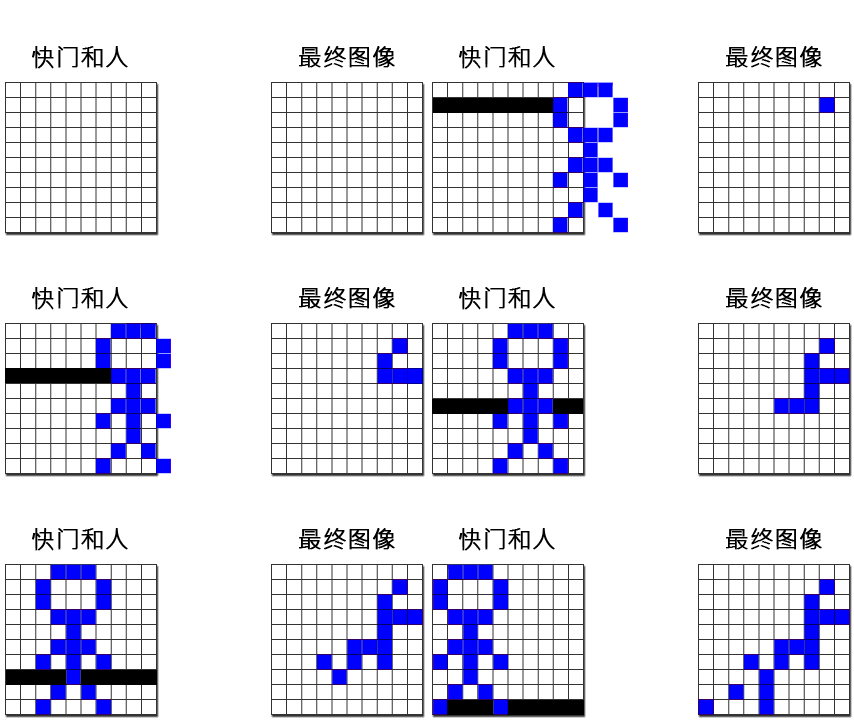
Reasons for appearance : Use line by line exposure sensor Caused by , because sensor It is exposed line by line , There is a time difference between lines , When shooting fast moving objects , It will cause the imaging object to be distorted , Elongated , Pay attention to distinguish it from the smear caused by exposure time , If the exposure time is too long, there will be a smear , But it will not cause the imaged object to deform ;
measures :
a. By increasing the frame rate 、 Reducing the time of one line can reduce the exposure time , It can alleviate the jelly effect .
b. Change global shutter (Global Shutter) Of sensor, It can completely solve the jelly effect , Global shutter sensor It allows all pixels to start and end exposure at the same time , After exposure, read out in sequence . Because all pixels are exposed at the same time , There will be no time difference , So there will be no jelly effect when shooting fast moving objects .
notes :global shutter and rolling shutter How to choose your camera ?
--- global shutter Shorter exposure time , But it will increase RMS Read out noise ,Rolling shutter Can achieve higher frame rate ??, But when the exposure is improper or the object moves quickly , Partial exposure will occur (partial exposure)、 Slope graphics (skew)、 The shaking (wobble) And so on ; Applications with short exposure time ( Such as <500μs) fit global shutter, Long exposure time ( If it is greater than 500μs) when , choice rolling shutter Can have lower noise and frame rate ??;
--- For example, it is used in vehicle 、 In machine vision Camera, For vehicles 、 Face 、 The detection and recognition of characters have high requirements , Jelly effect has a fatal impact on the detection and recognition of back-end algorithms , So we use global shutter, Security 、 Mobile phones and some consumer cameras , It's mainly for rolling shutter , They do not require high frame rate ( Security monitoring is generally 25fps/30fps), There are certain requirements for noise under low illumination 、 The exposure time is relatively long ;
--- in addition global shutter It's usually CCD sensor, It costs more than cmos sensor high , And global shutter All pixels are exposed at the same time , A lot of data needs to be processed , There are also requirements for the performance of the platform , This aspect should also be taken into account ;




![[untitled]](/img/75/599c5b13dd483fad50f73ddb431989.jpg)


