当前位置:网站首页>Repoptimizer: it's actually repvgg2
Repoptimizer: it's actually repvgg2
2022-06-25 23:24:00 【Tom Hardy】
Click on the above “ Computer vision workshop ”, choice “ Star standard ”
The dry goods arrive at the first time

The author 丨 zzk
Source GiantPandaCV
Preface
In the design of neural network structure , We often introduce some prior knowledge , such as ResNet Residual structure of . However, we still use the conventional optimizer to train the network .
In this work , We propose to use prior information to modify gradient values , It is called gradient reparameterization , The corresponding optimizer is called RepOptimizer. We focus on VGG The straight cylinder model of , Train to get RepOptVGG Model , He has high training efficiency , Simple and direct structure and extremely fast reasoning speed .
Official warehouse :RepOptimizer
Thesis link :Re-parameterizing Your Optimizers rather than Architectures
And RepVGG The difference between
RepVGG A structural prior is added ( Such as 1x1,identity Branch ), And use the regular optimizer to train . and RepOptVGG It is Add this prior knowledge to the optimizer implementation
Even though RepVGG In the reasoning stage, the branches can be fused , Become a straight tube model . however There are many branches in the training process , Need more memory and training time . and RepOptVGG But really - Straight cylinder model , From the training process is a VGG structure
We do this by customizing the optimizer , The equivalent transformation of structural reparameterization and gradient reparameterization is realized , This transformation is universal , It can be extended to more models
 Introducing structural prior knowledge into the optimizer
 We noticed a phenomenon , In special circumstances , Each branch contains a linearly trainable parameter , Add a constant scaling value , As long as the scaling value is set reasonably , The performance of the model will still be very high . We call this network block Constant-Scale Linear Addition(CSLA)
Let's start with a simple CSLA Start with examples , Consider an input , after 2 A convolution branch + Linear scaling , And added to an output :

We consider equivalent transformation into a branch , The equivalent transformation corresponds to 2 A rule :
Initialization rules
The weight of fusion shall be :

update rule
For the weight after fusion , The update rule is : For this part of the formula, please refer to appendix A in , There is a detailed derivation
A simple example code is :
import torch
import numpy as np

np.random.seed(0)
np_x = np.random.randn(1, 1, 5, 5).astype(np.float32)
np_w1 = np.random.randn(1, 1, 3, 3).astype(np.float32)
np_w2 = np.random.randn(1, 1, 3, 3).astype(np.float32)
alpha1 = 1.0
alpha2 = 1.0
lr = 0.1

conv1 = torch.nn.Conv2d(1, 1, kernel_size=3, padding=1, bias=False)
conv2 = torch.nn.Conv2d(1, 1, kernel_size=3, padding=1, bias=False)
conv1.weight.data = torch.nn.Parameter(torch.tensor(np_w1))
conv2.weight.data = torch.nn.Parameter(torch.tensor(np_w2))

torch_x = torch.tensor(np_x, requires_grad=True)
out = alpha1 * conv1(torch_x) + alpha2 * conv2(torch_x)

loss = out.sum()
loss.backward()

torch_w1_updated = conv1.weight.detach().numpy() - conv1.weight.grad.numpy() * lr
torch_w2_updated = conv2.weight.detach().numpy() - conv2.weight.grad.numpy() * lr

print(torch_w1_updated + torch_w2_updated)
import torch
import numpy as np
np.random.seed(0)
np_x = np.random.randn(1, 1, 5, 5).astype(np.float32)
np_w1 = np.random.randn(1, 1, 3, 3).astype(np.float32)
np_w2 = np.random.randn(1, 1, 3, 3).astype(np.float32)
alpha1 = 1.0
alpha2 = 1.0
lr = 0.1
fused_conv = torch.nn.Conv2d(1, 1, kernel_size=3, padding=1, bias=False)
fused_conv.weight.data = torch.nn.Parameter(torch.tensor(alpha1 * np_w1 + alpha2 * np_w2))
torch_x = torch.tensor(np_x, requires_grad=True)
out = fused_conv(torch_x)
loss = out.sum()
loss.backward()
torch_fused_w_updated = fused_conv.weight.detach().numpy() - (alpha1**2 + alpha2**2) * fused_conv.weight.grad.numpy() * lr
print(torch_fused_w_updated)stay RepOptVGG in , Corresponding CSLA Blocks are RepVGG In the block 3x3 Convolution ,1x1 Convolution ,bn The layer is replaced by With learnable scaling parameters 3x3 Convolution ,1x1 Convolution
Further expand to multi branch , hypothesis s,t Namely 3x3 Convolution ,1x1 Scaling coefficient of convolution , Then the corresponding update rule is :

The first formula corresponds to the input channel == Output channel , There is a total of 3 Branches , Namely identity,conv3x3, conv1x1
The second formula corresponds to the input channel != Output channel , At this time only conv3x3, conv1x1 Two branches
The third formula corresponds to other situations
It should be noted that CSLA No, BN This nonlinear operator during training (training-time nonlinearity), There is no non sequency (non sequential) Trainable parameter ,CSLA Here is just a description RepOptimizer Indirect tools for .
So there's one question left , That is, how to determine the scaling factor
HyperSearch
suffer DARTS inspire , We will CSLA Constant scaling factor in , Replace with trainable parameters . In a small data set ( Such as CIFAR100) Training on , After training on small data , We fix these trainable parameters as constants .
For specific training settings, please refer to the paper
experimental result

The experimental results look very good , There are no multiple branches in the training , Trainable batchsize It can also increase , The throughput of the model is also improved .
Before RepVGG in , Many people roast that it is difficult to quantify , So in RepOptVGG Next , This straight cylinder model is very friendly to quantification : The code is easy to read
We mainly look at repoptvgg.py This file , The core class is RepVGGOptimizer
stay reinitialize In the method , What it does is repvgg The job of , take 1x1 Convolution weight sum identity Branch into 3x3 The convolution :
if len(scales) == 2:
    conv3x3.weight.data = conv3x3.weight * scales[1].view(-1, 1, 1, 1) \
                          + F.pad(kernel_1x1.weight, [1, 1, 1, 1]) * scales[0].view(-1, 1, 1, 1)
else:
    assert len(scales) == 3
    assert in_channels == out_channels
    identity = torch.from_numpy(np.eye(out_channels, dtype=np.float32).reshape(out_channels, out_channels, 1, 1))
    conv3x3.weight.data = conv3x3.weight * scales[2].view(-1, 1, 1, 1) + F.pad(kernel_1x1.weight, [1, 1, 1, 1]) * scales[1].view(-1, 1, 1, 1)
    if use_identity_scales:     # You may initialize the imaginary CSLA block with the trained identity_scale values. Makes almost no difference.
        identity_scale_weight = scales[0]
        conv3x3.weight.data += F.pad(identity * identity_scale_weight.view(-1, 1, 1, 1), [1, 1, 1, 1])
    else:
        conv3x3.weight.data += F.pad(identity, [1, 1, 1, 1])
Then let's take a look at GradientMask Generative logic , If only conv3x3 and conv1x1 Two branches , According to the preceding CSLA Equivalent transformation rule ,conv3x3 Of mask Corresponding to :
mask = torch.ones_like(para) * (scales[1] ** 2).view(-1, 1, 1, 1)and conv1x1 Of mask, You need to multiply by the square of the corresponding scaling factor , And add to conv3x3 middle :
mask[:, :, 1:2, 1:2] += torch.ones(para.shape[0], para.shape[1], 1, 1) * (scales[0] ** 2).view(-1, 1, 1, 1)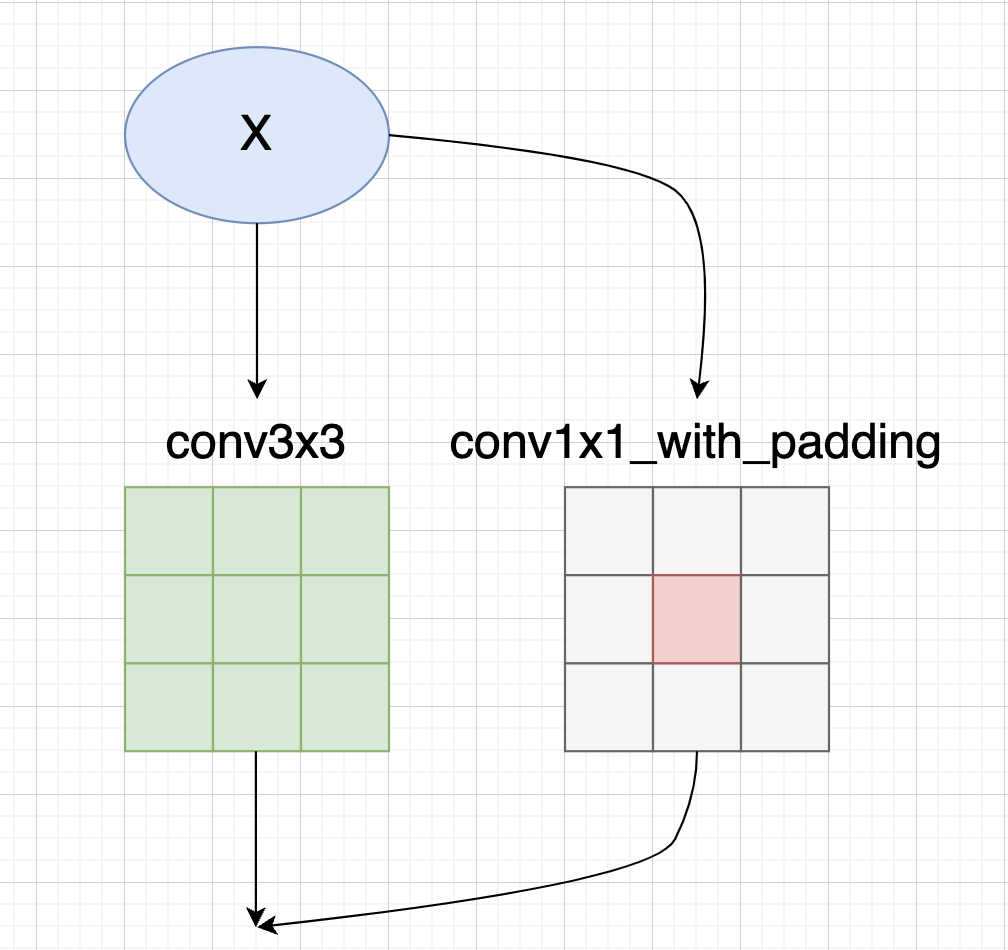 If there is Identity Branch , We need to add... To the diagonal 1.0(Identity Branches have no learnable scaling factor )
mask[ids, ids, 1:2, 1:2] += 1.0If you don't understand Identity Why do branches correspond to diagonals , Refer to the author's diagram RepVGG
summary
This article has been out for some time , But it seems that not many people pay attention to . In my opinion, this is a very practical job , Solved the problem of the previous generation RepVGG The small hole left , The model of completely straight cylinder during training is really realized , And quantify , Pruning friendly , Very suitable for actual deployment .
This article is only for academic sharing , If there is any infringement , Please contact to delete .
Dry goods download and learning
The background to reply : Barcelo that Autonomous University courseware , You can download the precipitation of foreign universities for several years 3D Vison High quality courseware
The background to reply : Computer vision Books , You can download it. 3D Classic books in the field of vision pdf
The background to reply :3D Visual courses , You can learn 3D Excellent courses in the field of vision
Computer vision workshop boutique course official website :3dcver.com
1. Multi sensor data fusion technology for automatic driving field
2. For the field of automatic driving 3D Whole stack learning route of point cloud target detection !( Single mode + Multimodal / data + Code )
3. Thoroughly understand the visual three-dimensional reconstruction : Principle analysis 、 Code explanation 、 Optimization and improvement
4. China's first point cloud processing course for industrial practice
5. laser - Vision -IMU-GPS The fusion SLAM Algorithm sorting and code explanation
6. Thoroughly understand the vision - inertia SLAM: be based on VINS-Fusion The class officially started
7. Thoroughly understand based on LOAM Framework of the 3D laser SLAM: Source code analysis to algorithm optimization
8. Thorough analysis of indoor 、 Outdoor laser SLAM Key algorithm principle 、 Code and actual combat (cartographer+LOAM +LIO-SAM)
10. Monocular depth estimation method : Algorithm sorting and code implementation
11. Deployment of deep learning model in autopilot
12. Camera model and calibration ( Monocular + Binocular + fisheye )
13. blockbuster ! Four rotor aircraft : Algorithm and practice
14.ROS2 From entry to mastery : Theory and practice
15. The first one in China 3D Defect detection tutorial : theory 、 Source code and actual combat
blockbuster ! Computer vision workshop - Study Communication group Established
Scan the code to add a little assistant wechat , You can apply to join 3D Visual workshop - Academic paper writing and contribution WeChat ac group , Aimed at Communication Summit 、 Top issue 、SCI、EI And so on .
meanwhile You can also apply to join our subdivided direction communication group , At present, there are mainly ORB-SLAM Series source code learning 、3D Vision 、CV& Deep learning 、SLAM、 Three dimensional reconstruction 、 Point cloud post processing 、 Autopilot 、CV introduction 、 Three dimensional measurement 、VR/AR、3D Face recognition 、 Medical imaging 、 defect detection 、 Pedestrian recognition 、 Target tracking 、 Visual products landing 、 The visual contest 、 License plate recognition 、 Hardware selection 、 Depth estimation 、 Academic exchange 、 Job exchange Wait for wechat group , Please scan the following micro signal clustering , remarks :” Research direction + School / company + nickname “, for example :”3D Vision + Shanghai Jiaotong University + quietly “. Please note... According to the format , Otherwise, it will not pass . After successful addition, relevant wechat groups will be invited according to the research direction . Original contribution Please also contact .

▲ Long press and add wechat group or contribute
▲ The official account of long click attention
3D Vision goes from entry to mastery of knowledge : in the light of 3D In the field of vision Video Course cheng ( 3D reconstruction series 、 3D point cloud series 、 Structured light series 、 Hand eye calibration 、 Camera calibration 、 laser / Vision SLAM、 Automatically Driving, etc )、 Summary of knowledge points 、 Introduction advanced learning route 、 newest paper Share 、 Question answer Carry out deep cultivation in five aspects , There are also algorithm engineers from various large factories to provide technical guidance . meanwhile , The planet will be jointly released by well-known enterprises 3D Vision related algorithm development positions and project docking information , Create a set of technology and employment as one of the iron fans gathering area , near 4000 Planet members create better AI The world is making progress together , Knowledge planet portal :
Study 3D Visual core technology , Scan to see the introduction ,3 Unconditional refund within days

There are high quality tutorial materials in the circle 、 Answer questions and solve doubts 、 Help you solve problems efficiently
Feel useful , Please give me a compliment ~
边栏推荐
- Xampp重启后,MySQL服务就启动不了。
- 小程序-视图与逻辑
- [modulebuilder] GP service realizes the intersection selection of two layers in SDE
- How to use JMeter for interface testing
- leetcode_ 136_ A number that appears only once
- Technology blog site collection
- CDN加速是什么
- Flex & Bison 开始
- STM32 development board + smart cloud aiot+ home monitoring and control system
- 元宇宙标准论坛成立
猜你喜欢
Baidu: in 2022, the top ten hot spots will rise and the profession will be released. There is no suspense about the first place!

String deformation (string case switching and realization)

Set up your own website (15)

Idea FAQ collection

As a programmer, how can we learn, grow and progress happily? (personal perception has nothing to do with technology)

Multi modal data can also be Mae? Berkeley & Google proposed m3ae to conduct Mae on image and text data! The optimal masking rate can reach 75%, significantly higher than 15% of Bert
多模态数据也能进行MAE?伯克利&谷歌提出M3AE,在图像和文本数据上进行MAE!最优掩蔽率可达75%,显著高于BERT的15%...
元宇宙标准论坛成立
Fegin client entry test
Utilisation de la classe Ping d'Unity
随机推荐
干货丨产品的可行性分析要从哪几个方面入手?
[opencv450 samples] inpaint restores the selected region in the image using the region neighborhood
Glory launched the points mall to support the exchange of various glory products
2022年河南省第一届职业技能大赛网络安全项目试题
ES6 const constants and array deconstruction
【opencv450-samples】读取图像路径列表并保持比例显示
Determine whether the appointment time has expired
多台云服务器的 Kubernetes 集群搭建
Sword finger offer 46 Translate numbers to strings (DP)
The wisdom of questioning? How to ask questions?
ES6-Const常量与数组解构
Baidu: in 2022, the top ten hot spots will rise and the profession will be released. There is no suspense about the first place!
STM32开发板+机智云AIoT+家庭监测控制系统
Why is BeanUtils not recommended?
首个大众可用PyTorch版AlphaFold2复现,哥大开源OpenFold,star量破千
Xampp重启后,MySQL服务就启动不了。
小程序绘制一个简单的饼图
Fegin client entry test
[eosio] eos/wax signature error is_ Canonical (c): signature is not canonical
Common MySQL database functions and queries