当前位置:网站首页>Data consistency between redis and database
Data consistency between redis and database
2022-07-01 05:05:00 【Cicada bathes in the wind】
official account 「 Cicadas bathe in the wind 」, You are welcome to pay attention to exchanges
Catalog
It is used as a cache when data is read more and written less , Probably Redis Use the most common scenario . When using Redis As a cache , This is the general process .
- If the cache is in Redis in , Cache hit , Then directly return the data
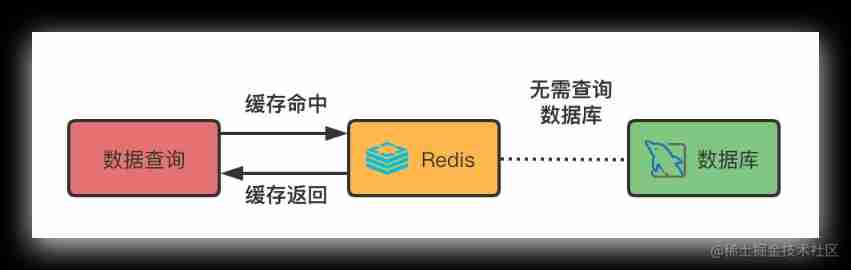
- If Redis There is no corresponding cache in , You need to query the database directly , Then deposit Redis, Finally, return the data to

Usually , We will set a for a cache key value , And aim at key Value to set an expiration time , If the queried data corresponds to key Out of date , Then query the database directly , And store the queried data in Redis, Then reset the expiration time , Finally, return the data to , The pseudocode is as follows :
/** *  Get user details according to user name  * @author  official account 【 Cicadas bathe in the wind 】 */
public User getUserInfo(String userName) {

      User user = redisCache.getName("user:" + userName);
      if (user != null) {

          return user;
      }

      //  Search directly from the database
      user = selectUserByUserName(userName);
      //  Write data to Redis, And set expiration time
      redisCache.set("user:" + userName, user, 30000);
      //  Return the data
      return user;
}
Consistency issues
however , stay Redis Of key If the value does not expire , The user has modified his personal information , At this time, we need to operate the database data , Also operate Redis data . Now we have two choices :
- Do it first Redis The data of , Then operate the data of the database
- First operate the data of the database , Then operate Redis The data of
As for which method to choose , Ideally , Either the two operations succeed at the same time , Or fail at the same time , Otherwise, it will appear Redis Inconsistent with the database data .
Unfortunately , At present, there is no framework to guarantee Redis Complete consistency between the data of and the data of the database . We can only take certain measures to reduce the probability of data inconsistency according to the scenario and the code we need to pay , Achieve a compromise between consistency and performance .
Now let's discuss about Redis Some schemes of data consistency between and database .
Options
Delete cache or update cache ?
When the database data changes ,Redis The data also needs to be operated accordingly , So this 「 operation 」 What is to use 「 to update 」 Or use it 「 Delete 」 Well ?
「 to update 」 Call Redis Of set Method , Replace old value with new value ;「 Delete 」 Directly delete the original cache , Re read the database the next time you query , Then update Redis.
Conclusion : Direct use is recommended 「 Delete 」 operation .
Because use 「 to update 」 operation , You will face two choices
Update cache first , Update the database- Update the database first , Update the cache again
The first 1 Don't think about it , Let's talk about it 「 Update the database first , Update the cache again 」 This program .

If the thread 1 And thread 2 Update at the same time , But the execution order of each thread is shown in the figure above , This will lead to inconsistent data , Therefore, from this point of view, we recommend deleting the cache directly .
Besides , Recommended 「 Delete cache 」 There are two other reasons .
- If there are more scenarios of writing database than reading data , Using this scheme will cause the cache to be written frequently , Waste performance ;
- If the cache needs a series of complex calculations to get , So every time you write to the database , It is also a waste of performance to calculate the written cache again .
After clarifying this problem , There are only two choices in front of us :
- Update the database first , Delete the cache
- So let's delete the cache , Update the database
Update the database first , Delete the cache
There may be two exceptions in this way
- Database update failed , At this time, you can catch exceptions through the program , Direct return , No longer delete cache , So there will be no data inconsistency
- Update database successful , Delete cache failed . Cause the database to be the latest data , What's in the cache is old data , Data inconsistency
The first 2 What should we do in this case ? We have two ways : Failure to retry and Asynchronous update .
Failure to retry
If delete cache fails , We can catch this exception , Delete the key Send to message queue . Create a consumer consumption , Try to delete this... Again key, Until the deletion is successful .
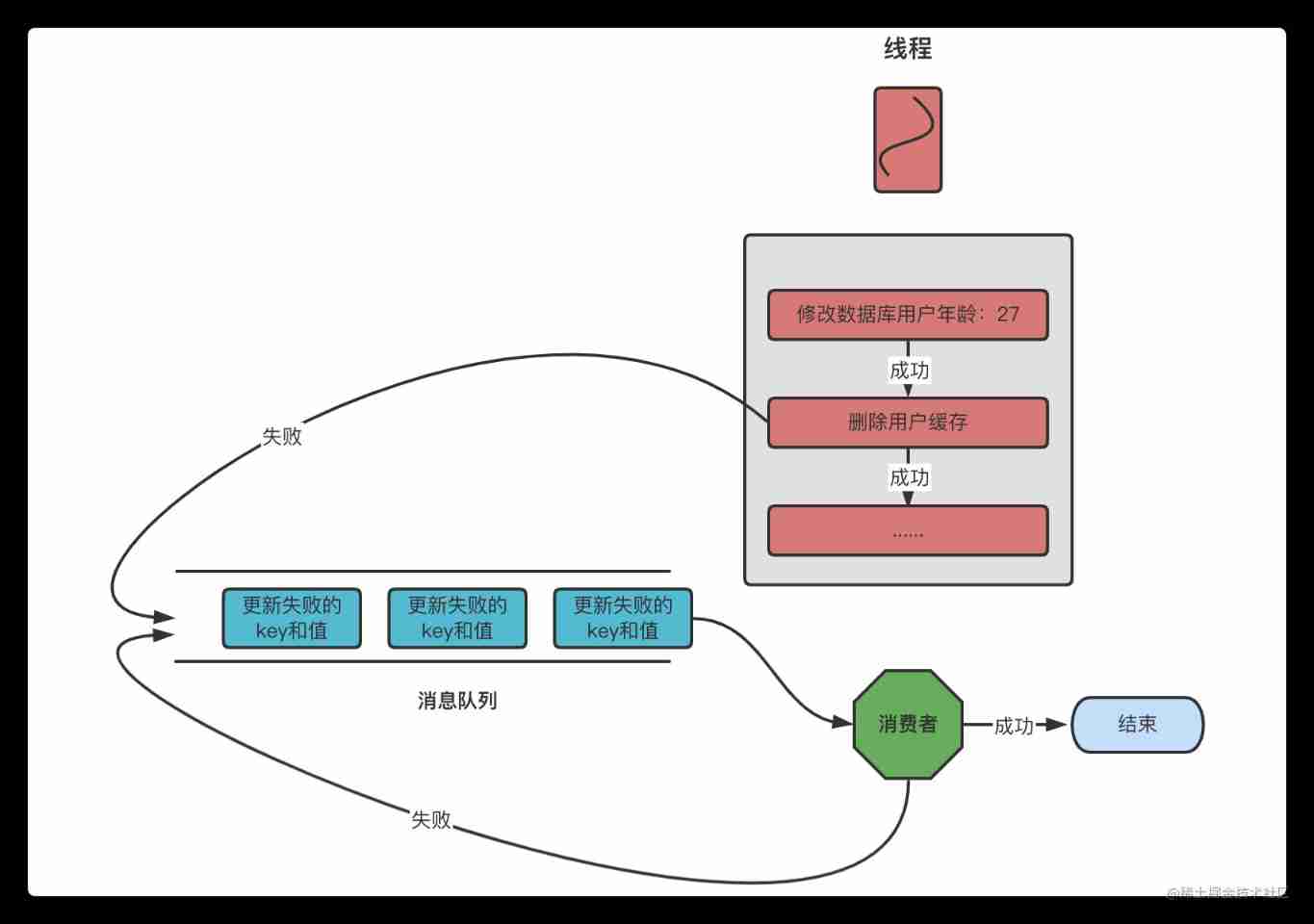
There is a drawback to this approach , First, it will invade the business code , Secondly, message queue is introduced , It increases the uncertainty of the system .
Update cache asynchronously
Because when you update the database, you go to binlog Write log in , So we can start a monitor binlog Changing services ( For example, use Ali's canal Open source components ), Then delete it on the client side key The operation of . If the deletion fails , And send it to the message queue .
summary
All in all , In case of cache deletion failure , Our approach is to constantly retry the deletion operation , Until success . Whether it's retry or asynchronous deletion , It's all about ultimate consistency .
So let's delete the cache , Update the database
There may be two exceptions in this way
- Delete cache failed , At this time, you can catch exceptions through the program , Direct return , Do not continue to update the database , So there will be no data inconsistency
- Delete cache succeeded , Database update failed . Data inconsistency may occur in multithreading
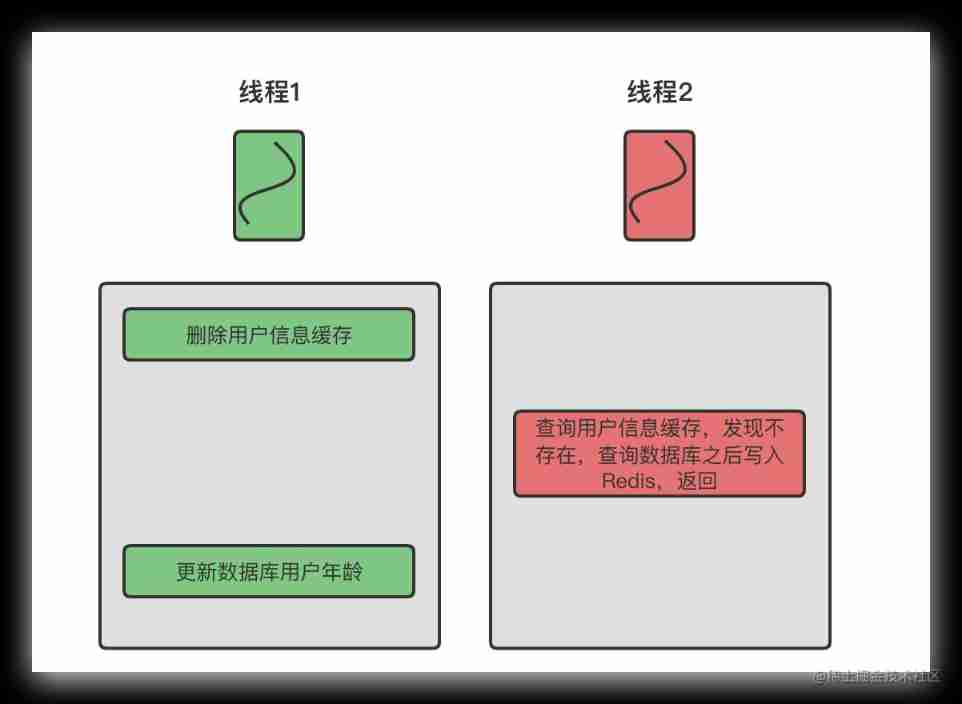
At this time ,Redis Old data stored in , The value of the database is new data , Leading to data inconsistency . Now we can use Delay double delete The strategy of , That is, after updating the database data , Delete the cache again .
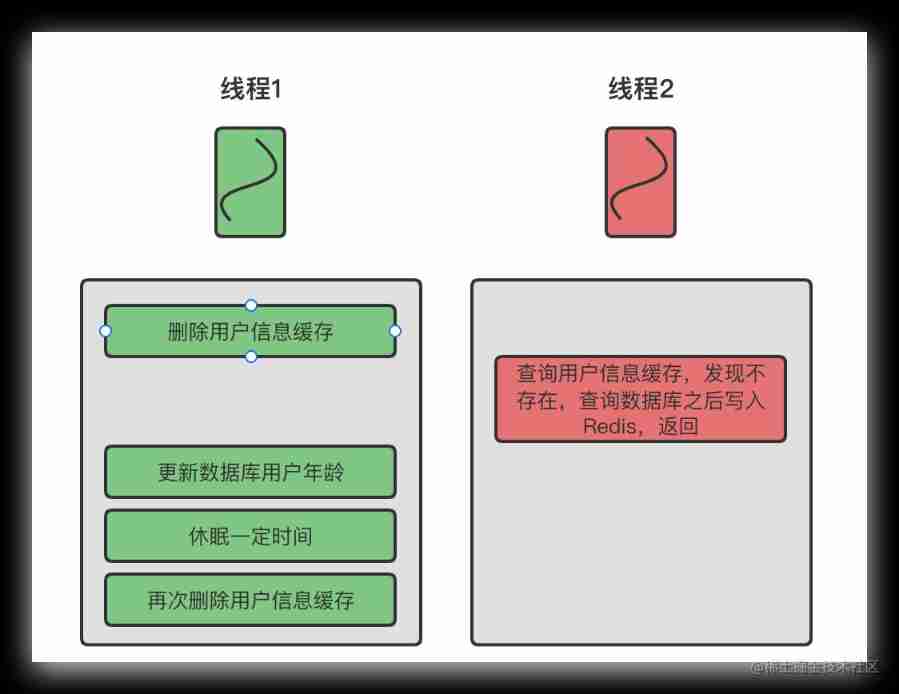
In pseudocode, that's :
/** *  Delay double delete  * @author  official account 【 Cicadas bathe in the wind 】 */
public void update(String key, Object data) {

    //  First delete the cache
    redisCache.delKey(key);
    //  Update the database
    db.updateData(data);
    //  Sleep for a while , The time depends on the time taken to read the data
    Thread.sleep(500);
    //  Delete cache again
    redisCache.delKey(key);
}
Finally, leave two questions for readers :
- Why?
Update cache first , Update the databaseIt won't work ? - Why should the method of delayed double deletion sleep for a period of time ?
Welcome to comment area .
Recommended reading
official account 「 Cicadas bathe in the wind 」, You are welcome to pay attention to exchanges
边栏推荐
- STM32扩展板 温度传感器和温湿度传感器的使用
- Global and Chinese markets for soft ferrite cores 2022-2028: Research Report on technology, participants, trends, market size and share
- Solution: drag the Xib control to the code file, and an error setvalue:forundefined key:this class is not key value coding compliant for the key is reported
- Quelques outils dont les chiens scientifiques pourraient avoir besoin
- 分布式全局唯一ID解决方案详解
- 解决:Thread 1:[<*>setValue:forUndefinedKey]:this class is not key value coding-compliant for the key *
- Neural network convolution layer
- Serialization and deserialization of objects
- How to use common datasets in pytorch
- 对象的序列化与反序列化
猜你喜欢

Distributed transactions - Solutions

Manually implement a simple stack
![解决:Thread 1:[<*>setValue:forUndefinedKey]:this class is not key value coding-compliant for the key *](/img/88/0b99d1db2cdc70ab72d2b3c623dfaa.jpg)
解决:Thread 1:[<*>setValue:forUndefinedKey]:this class is not key value coding-compliant for the key *

Neural networks - use of maximum pooling

Common methods in transforms

分布式数据库数据一致性的原理、与技术实现方案
![[summer daily question] Luogu p5886 Hello, 2020!](/img/ac/4be05f80aab7fb766674e6e2d16fbc.png)
[summer daily question] Luogu p5886 Hello, 2020!

分布式-总结列表

Basic skeleton of neural network nn Use of moudle

Oracle views the creation time of the tablespace in the database
随机推荐
Oracle views the creation time of the tablespace in the database
Pytoch (IV) -- visual tool visdom
Thread safety issues
Serialization and deserialization of objects
Print stream and system setout();
洗个冷水澡吧
Distributed architecture system splitting principles, requirements and microservice splitting steps
AcWing 886. Finding combinatorial number II (pretreatment factorial)
Use and modification of prior network model
Copy baby prompt: material cannot be empty. How to solve it?
Neural network - nonlinear activation
Distributed transactions - Solutions
The longest increasing subsequence and its optimal solution, total animal weight problem
LeetCode_ 58 (length of last word)
Basic skeleton of neural network nn Use of moudle
[NLP Li Hongyi] notes
Technology sharing | broadcast function design in integrated dispatching
分布式架构系统拆分原则、需求、微服务拆分步骤
Tcp/ip explanation (version 2) notes / 3 link layer / 3.2 Ethernet and IEEE 802 lan/man standards
分布式数据库数据一致性的原理、与技术实现方案