当前位置:网站首页>C language implements sequential queue, circular queue and chain queue
C language implements sequential queue, circular queue and chain queue
2022-06-30 07:25:00 【Three stinky ginger】
C The language implements sequential queues 、 Circular queues and chained queues
List of articles
One . Sequential queue
The implementation of sequential queue is relatively simple , Use the array to store . Because this method is static storage , That is, once the memory size is specified, it cannot be changed , Therefore, overflow may occur , Therefore, it is not of great value in practical use . So I only do a simple implementation here , Realize the basic functions of entering and leaving the team, and judge whether the team is empty or full .
Definition of sequential queue
#define MaxSize 5 // Sequential queue uses sequential storage , Manually specify the maximum capacity
typedef int ElemType;
//------  Structure definition  -------//
typedef struct SqlQueue
{

	ElemType data[MaxSize];// Storing data in an array
	int front,rear;// Team leader and team leader
}SqlQ;
The initial state ( Team air condition ):Q->front == Q->rear == 0;
The team : When the team is dissatisfied , First send the value to the end of the queue element , Then put the tail pointer +1;
Out of the team : When the team is not empty , Take the value of the team head element first , Then put the team head pointer +1;
( Here, please refer to Wang Dao's postgraduate entrance examination textbook )
Sequence queue all codes
#include<stdio.h>
#include<stdlib.h>
#include<stdbool.h> // according to C99 standard ,C Language use bool Type needs to add this header file
#define MaxSize 5 // Sequential queue uses sequential storage , Manually specify the maximum capacity

typedef int ElemType;

//------  Structure definition  -------//
typedef struct SqlQueue
{

	ElemType data[MaxSize];// Storing data in an array
	int front,rear;// Team leader and team leader
}SqlQ;
//------  Structure definition  -------//

//---------  Function declaration  ---------//
void MainMenu();// The main menu , Used for display
void InitQueue(SqlQ *Q);// Initialization of the queue
bool EnQueue(SqlQ *Q, ElemType e);	// The team
bool DeQueue(SqlQ *Q, ElemType *x);// Out of the team
bool GetFront(SqlQ *Q, ElemType *head);// Get team leader elements
//---------  Function declaration  ---------//

int main()
{

	SqlQ Q;// Declare a queue
	InitQueue(&Q);// initialization
	ElemType element;
	int ch;
	ElemType x;// Get out of the team elements , Easy to return
	ElemType head;// Get team leader elements

	while(1)
	{

		MainMenu();
		printf(" Please enter the action you want to perform :");
		scanf("%d",&ch);

		switch(ch)
		{

			case 0:		printf(" Thank you for using , Exited !");	exit(0);	break;
			case 1:		printf(" Please enter the element you want to join the team :\n");
						scanf("%d",&element);
						if(EnQueue(&Q,element))
							printf(" Team success !\n");
						else
							printf(" Team entry failure ! The team is full !\n");
						break;
			case 2:
						if(DeQueue(&Q,&x))
							printf(" Team out success ! The element of leaving the team is :%d\n",x);
						else
							printf(" Failure to leave the team ! The team is empty !\n");
						break;
			case 3:
						if(GetFront(&Q,&head))
							printf(" Get the team head element successfully ! The current team head element is :%d\n",head);
						else
							printf(" Failed to get queue header element ! The team is empty !\n");
						break;
			default:	printf(" The operation instruction you entered is incorrect ! Please re-enter !");
		}
	}

	return 0;
}

// The main menu , Show
void MainMenu()
{

	printf("\n\n\n");
	printf("\t ************* Implementation of sequential queue ************\n\n");
	printf("\t ------- 0. sign out  \n\n");
	printf("\t ------- 1. Queue data \n\n");
	printf("\t ------- 2. Perform an out of line operation \n\n");
	printf("\t ------- 3. Get the current team header element \n\n");
	printf("\t *************************************\n");
}


void InitQueue(SqlQ *Q)// Initialization of the queue
{

	Q->front = Q->rear = 0;// Now the team is empty , Let the header pointer point to the header element , Let the tail pointer point to the next position of the tail element
}

// The team : When the team is dissatisfied , First send the value to the end of the queue element , Then put the tail pointer +1
bool EnQueue(SqlQ *Q, ElemType e)
{

	if(Q->rear == MaxSize)
		return false;
	Q->data[Q->rear] = e;
	Q->rear++;
	return true;
}

// Out of the team : When the team is not empty , Take the value of the team head element first , Then put the team head pointer +1
bool DeQueue(SqlQ *Q, ElemType *x)
{

	if(Q->front == Q->rear )
		return false;

	*x = Q->data[Q->front];
	Q->front++;
	return true;
}

// Get the team leader element
bool GetFront(SqlQ *Q, ElemType *head)
{

	if(Q->front == Q->rear)
		return false;
	*head = Q->data[Q->front];
	return true;
}
test :
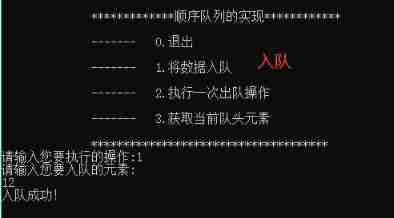
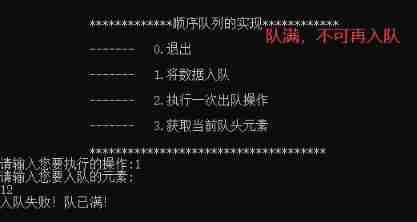


️ Be careful : This implementation will have some minor flaws , That is to say, when I have a full deposit and go out of the team in turn , here It's not a team in the real sense , Because no more elements can be queued . Of course, other methods can also be adopted , For example, modify the pointer , Then rejoin the team , Because this kind of sequential queue is not practical , So you only need to know the general process .
Two . Circular queue
The concept of circular queue
Circular queue is another implementation of sequential queue , Just think of the sequential queue as a ring . As shown in the figure below ( Refer to the data structure textbook of Wangdao postgraduate entrance examination ):

When the head of the team Q->front = MaxSize - 1 after , One more position will automatically arrive 0, This can be done using division and remainder operations (%) To achieve . Therefore, there are the following situations :
① At the beginning :Q->front = Q->rear = 0;
② The leader of the team scored one :Q->front = (Q->front+1)%MaxSize ;
③ At the end of the line, the pointer goes one :Q->rear = (Q->rear+1)%MaxSize
When you go out and join the team , The pointer moves one clockwise .
Then the conditions for team empty and team full are Q->front == Q->rear . So in order to distinguish between empty and full teams , Yes 3 Treatment methods :
1️⃣ Sacrifice a unit to distinguish between empty and full teams , Use one less queue unit when joining the team , This is a common practice , It is agreed that “ The head of the team pointer is at the next position of the tail of the team pointer as a sign that the team is full ”.
At this time there is :
Team full conditions :(Q->rear+1)%MaxSize == Q->front
Team air condition :Q->front == Q->rear
The queue length :(Q->rear - Q->front + MaxSize) % MaxSize
2️⃣ Add a data member representing the number of elements in the type . such , The condition for the team to be empty is :Q.size == 0; The condition of full team is Q.size == MaxSize. In both cases Q->front == Q->rear.
3️⃣ Added in type tag Data member , To distinguish whether the team is full or empty .tag be equal to 0 when , If... Is caused by deletion Q->front == Q->rear, The team is empty ; tag be equal to 1 when , If due to insertion Q->front == Q->rear The team is full .
Here I choose the second 2 Methods .
The relevant operation
1. initialization
void InitQueue(CirQ *Q)// Initialization of the queue
{

	Q->front = Q->rear = 0;// Now the team is empty , Let the header pointer point to the header element , Let the tail pointer point to the next position of the tail element
	Q->size = 0;// There are no elements stored at the beginning
}
2. The team
// The team
bool EnQueue(CirQ *Q, ElemType e)
{

	// Determine if the queue is full
	if(Q->size==MaxSize)
		return false;
	Q->data[Q->rear] = e; // Put values in

	Q->rear = (Q->rear + 1)% MaxSize;// Change the pointer
	Q->size++;// Number of elements in the queue +1
	return true;
}
3. Out of the team
// Out of the team
bool DeQueue(CirQ *Q, ElemType *x)
{

	if(Q->size == 0)// Determine whether the queue is empty
		return false;
	*x = Q->data[Q->front];// Get out of line elements
	Q->front = (Q->front + 1)% MaxSize;
	Q->size--;// Number of elements in the queue -1
	return true;
}
4. Get team leader elements
// Get the team leader element
bool GetFront(CirQ *Q, ElemType *head)
{

	if(Q->size == 0)// Determine whether the queue is empty
		return false;
	*head = Q->data[Q->front];// Get the team leader
	return true;
}
Loop queue full code
#include<stdio.h>
#include<stdlib.h>
#include<stdbool.h> // according to C99 standard ,C Language use bool Type needs to add this header file
#define MaxSize 5 // Circular queues are stored sequentially , Manually specify the maximum capacity

typedef int ElemType;

//------  Structure definition  -------//
typedef struct CircularQueue
{

	ElemType data[MaxSize];// Storing data in an array
	int front,rear;// Team leader and team leader
	int size;// Indicates the number of actual storage in the queue
}CirQ;
//------  Structure definition  -------//

//---------  Function declaration  ---------//
void MainMenu();// The main menu , Used for display
void InitQueue(CirQ *Q);// Initialization of the queue
bool EnQueue(CirQ *Q, ElemType e);	// The team
bool DeQueue(CirQ *Q, ElemType *x);// Out of the team
bool GetFront(CirQ *Q, ElemType *head);// Get team leader elements
//---------  Function declaration  ---------//

int main()
{

	CirQ Q;// Declare a queue
	InitQueue(&Q);// initialization
	ElemType element;
	int ch;
	ElemType x;// Get out of the team elements , Easy to return
	ElemType head;// Get team leader elements

	while(1)
	{

		MainMenu();
		printf(" Please enter the action you want to perform :");
		scanf("%d",&ch);

		switch(ch)
		{

			case 0:		printf(" Thank you for using , Exited !");	exit(0);	break;
			case 1:		printf(" Please enter the element you want to join the team :\n");
						scanf("%d",&element);
						if(EnQueue(&Q,element))
							printf(" Team success !\n");
						else
							printf(" Team entry failure ! The team is full !\n");
						break;
			case 2:
						if(DeQueue(&Q,&x))
							printf(" Team out success ! The element of leaving the team is :%d\n",x);
						else
							printf(" Failure to leave the team ! The team is empty !\n");
						break;
			case 3:
						if(GetFront(&Q,&head))
							printf(" Get the team head element successfully ! The current team head element is :%d\n",head);
						else
							printf(" Failed to get queue header element ! The team is empty !\n");
						break;
			default:	printf(" The operation instruction you entered is incorrect ! Please re-enter !");
		}
	}

	return 0;
}

// The main menu , Show
void MainMenu()
{

	printf("\n\n\n");
	printf("\t ************* Implementation of circular queue ************\n\n");
	printf("\t ------- 0. sign out  \n\n");
	printf("\t ------- 1. Queue data \n\n");
	printf("\t ------- 2. Perform an out of line operation \n\n");
	printf("\t ------- 3. Get the current team header element \n\n");
	printf("\t *************************************\n");
}


void InitQueue(CirQ *Q)// Initialization of the queue
{

	Q->front = Q->rear = 0;// Now the team is empty , Let the header pointer point to the header element , Let the tail pointer point to the next position of the tail element
	Q->size = 0;// There are no elements stored at the beginning
}

// The team
bool EnQueue(CirQ *Q, ElemType e)
{

	// Determine if the queue is full
	if(Q->size==MaxSize)
		return false;
	Q->data[Q->rear] = e; // Put values in

	Q->rear = (Q->rear + 1)% MaxSize;// Change the pointer
	Q->size++;// Number of elements in the queue +1
	return true;
}

// Out of the team
bool DeQueue(CirQ *Q, ElemType *x)
{

	if(Q->size == 0)// Determine whether the queue is empty
		return false;
	*x = Q->data[Q->front];// Get out of line elements
	Q->front = (Q->front + 1)% MaxSize;
	Q->size--;// Number of elements in the queue -1
	return true;
}

// Get the team leader element
bool GetFront(CirQ *Q, ElemType *head)
{

	if(Q->size == 0)// Determine whether the queue is empty
		return false;
	*head = Q->data[Q->front];// Get the team leader
	return true;
}
test :


3、 ... and . Chain queues ( Leading node )
The chain queue with chain storage is actually a single linked list with both the head pointer and the tail pointer , And follow the characteristics that the queue only goes out at the head of the queue and enters at the end of the queue .
Storage type definition
typedef struct Node
{

	ElemType data;
	struct LinkNode *next;// The subsequent pointer of the node
}LinkNode;

// Chain queue
typedef struct
{

	LinkNode *front,*rear;// The head and tail pointers of the queue
	int len;// Number of elements in the chain queue
}LinkQueue;
Above , Two structures are defined , One is the node , One is the queue .
The team
// The team
bool EnQueue(LinkQueue *Q, ElemType e)
{

	// First apply for a node
	LinkNode *s = (LinkNode *)malloc(sizeof(LinkNode));
	s->data = e;// Put the elements to be queued into the node
	s->next = NULL;// Because at the end of the team , So it doesn't point to any element

	// Modify the tail pointer
	Q->rear->next = s;
	Q->rear = s; // Because the end of the queue pointer has been specified to point to the last node

	Q->len++;

	return true;
}
When you join the team , You need to apply for a node first , Then insert this node into the end of the queue .
Out of the team
// Out of the team
bool DeQueue(LinkQueue *Q, ElemType *x)
{

	if(Q->len==0)// If the number of elements in the queue is 0, Description is empty
		return false;

	LinkNode *p = Q->front->next;// Points to the next node of the head node

	// Get the value of the extracted team element first
	*x = p->data;
	// Then modify the pointer
	Q->front->next = p->next;

	if(Q->rear==p)// If there is only one node left in the queue , Empty after deletion
		Q->rear = Q->front;
	free(p);
	Q->len--;
	return true;
}
When the team , Delete elements at the head of the team .
Chain queue all codes
Because of aesthetic fatigue , I changed the font to healthy green . Reference article :https://blog.csdn.net/qq_31975227/article/details/51758461
#include<stdio.h>
#include <windows.h>
#include<stdbool.h> // according to C99 standard ,C Language use bool Type needs to add this header file
#include<stdlib.h>

typedef int ElemType;

typedef struct Node
{

	ElemType data;
	struct LinkNode *next;// The subsequent pointer of the node
}LinkNode;

// Chain queue
typedef struct
{

	LinkNode *front,*rear;// The head and tail pointers of the queue
	int len;// Number of elements in the chain queue
}LinkQueue;

//---------  Function declaration  ----------//
void MainMenu();
void color(short x);
void InitQueue(LinkQueue *Q);// Initialization of the queue
bool EnQueue(LinkQueue *Q, ElemType e);	// The team
bool DeQueue(LinkQueue *Q, ElemType *x);// Out of the team
bool GetFront(LinkQueue *Q, ElemType *head);// Get team leader elements
//---------  Function declaration  ----------//

int main()
{

	int ch;
	ElemType element,head,x;

	LinkQueue Q;// Create a chain queue
	InitQueue(&Q);
	while(1)
	{

		MainMenu();
		printf(" Please enter the action you want to perform :");
		scanf("%d",&ch);

		switch(ch)
		{

			case 0:		printf(" Thank you for using , Exited !");	exit(0);	break;
			case 1:		printf(" Please enter the element you want to join the team :\n");
						scanf("%d",&element);
						if(EnQueue(&Q,element))
							printf(" Team success !\n");
						else
							printf(" Team entry failure !\n");
						break;
			case 2:
						if(DeQueue(&Q,&x))
							printf(" Team out success ! The element of leaving the team is :%d\n",x);
						else
							printf(" Failure to leave the team ! The team is empty !\n");
						break;
			case 3:
						if(GetFront(&Q,&head))
							printf(" Get the team head element successfully ! The current team head element is :%d\n",head);
						else
							printf(" Failed to get queue header element ! The team is empty !\n");
						break;
			default:	printf(" The operation instruction you entered is incorrect ! Please re-enter !");
		}
	}
	return 0;
}

// The main menu , Show
void MainMenu()
{

	color(2);// Set the font to green
	printf("\n\n\n");
	printf("\t ************* The implementation of chain queue ************\n\n");
	printf("\t ------- 0. sign out  \n\n");
	printf("\t ------- 1. Queue data \n\n");
	printf("\t ------- 2. Perform an out of line operation \n\n");
	printf("\t ------- 3. Get the current team header element \n\n");
	printf("\t *************************************\n");
}


void color(short x)	// The custom function changes the color according to the parameters
{

    if(x>=0 && x<=15)// Parameter in 0-15 Range color
    	SetConsoleTextAttribute(GetStdHandle(STD_OUTPUT_HANDLE), x);	// There is only one parameter , Change font color
    else// The default color is white
    	SetConsoleTextAttribute(GetStdHandle(STD_OUTPUT_HANDLE), 7);
}

// initialization
void InitQueue(LinkQueue *Q)
{

	// Apply for a head node space , And both the head pointer and the tail pointer are equal to it
	Q->front = Q->rear = (LinkNode *)malloc(sizeof(LinkNode));
	Q->front->next = NULL;// The initial value of the header pointer next It's empty , Because the element has not been inserted yet
	Q->len = 0;
}

// The team
bool EnQueue(LinkQueue *Q, ElemType e)
{

	// First apply for a node
	LinkNode *s = (LinkNode *)malloc(sizeof(LinkNode));
	s->data = e;// Put the elements to be queued into the node
	s->next = NULL;// Because at the end of the team , So it doesn't point to any element

	// Modify the tail pointer
	Q->rear->next = s;
	Q->rear = s; // Because the end of the queue pointer has been specified to point to the last node

	Q->len++;

	return true;
}

// Out of the team
bool DeQueue(LinkQueue *Q, ElemType *x)
{

	if(Q->front==Q->rear)// If the number of elements in the queue is 0, Description is empty
		return false;

	LinkNode *p = Q->front->next;// Points to the next node of the head node

	// Get the value of the extracted team element first
	*x = p->data;
	// Then modify the pointer
	Q->front->next = p->next;

	if(Q->rear==p)// If there is only one node left in the queue , Empty after deletion
		Q->rear = Q->front;
	free(p);
	Q->len--;
	return true;
}

// Get team leader elements
bool GetFront(LinkQueue *Q, ElemType *head)
{

	if(Q->len==0)// If the number of elements in the queue is 0, Description is empty
		return false;
	LinkNode *q = Q->front->next;// Points to the next node of the head node
	*head = q->data;

	return true;
}
test :


Reference material
Refer to the data structure textbook of Wangdao postgraduate entrance examination .
边栏推荐
- Basic knowledge of system software development
- halcon:读取摄像头并二值化
- 社招两年半10个公司28轮面试面经
- Running lantern effect JS text rotation effect realization
- 【已解决】MySQL异常:ERROR 1045 (28000): Unknown error 1045,忘记初始密码
- Raspberry pie trivial configuration
- Essence of signal slot macros signal and slot
- [introduction to Expo application] v Expert recommendation letter template
- 【最全】linux服务器上安装Mysql
- Promise async/await
猜你喜欢


随机推荐
How to use string branches for switch case
手机开户股票开户安全吗?开户需要准备什么?
网络安全-VLAN和Tunk方法详解
Record the problem that the system file cannot be modified as an administrator during the development process
实验一、综合实验【Process on】
[semidrive source code analysis] [x9 chip startup process] 33 - Analysis of related concepts of display module
Network security - single arm routing, DHCP relay and ICMP Protocol
Calculation and parameter quantity of neural network
Nested if statement in sum function in SQL Server2005
The maximum expression in Oracle database message list is 1000 error
Egret P2 physical engine (1) small ball falling demo
FreeRTOS timer group
Linux服務器安裝Redis
大学刚毕业不知道做什么工作怎么办?
grep命令用法
All errors reported by NPM
1、 Output debugging information: makefile file debugging information $(warning "tests" $(mkfile\u path)); makefile file path
02 - bare metal and RTOS development modes: five development modes of bare metal and the introduction of RTOS
网络安全-单臂路由、DHCP中继和ICMP协议
Pool de Threads - langage C