当前位置:网站首页>Deep feature synthesis and genetic feature generation, comparison of two automatic feature generation strategies
Deep feature synthesis and genetic feature generation, comparison of two automatic feature generation strategies
2022-06-12 19:37:00 【deephub】
Feature engineering is the process of creating new features from existing features , Through feature engineering, we can capture the additional relationship with the target column that the original feature does not have . This process is very important to improve the performance of machine learning algorithm . Although when data scientists apply specific domain knowledge to specific transformations , Feature engineering works best , But there are some methods that can be done in an automated way , Without prior domain knowledge .
In this paper , We will show you how to use... Through an example ATOM Package to quickly compare two automatic feature generation algorithms : Depth feature synthesis (Deep feature Synthesis, DFS) And genetic characteristics (Genetic feature generation, GFG).ATOM It's open source Python package , It can help data scientists speed up the exploration of machine learning pipeline .
Baseline model
For comparison , As a baseline for comparison, only the initial features are used to train the model . The data used here is from Kaggle A variant of the Australian weather dataset . The goal of this data set is to predict whether it will rain tomorrow , In target column RainTomorrow Train a binary classifier on .
import pandas as pd
from atom import ATOMClassifier

# Load the data and have a look
X = pd.read_csv("./datasets/weatherAUS.csv")
X.head()

Initialize the instance and prepare the modeling data . Only a subset of the dataset is used here (1000 That's ok ) demonstrate . The following code estimates the missing values and encodes the classification features .
atom = ATOMClassifier(X, y="RainTomorrow", n_rows=1e3, verbose=2)
atom.impute()
atom.encode()
The output is as follows .

have access to dataset Property to quickly check what the data looks like after conversion .
atom.dataset.head()

The data is now ready . This article will use LightGBM The model predicts . Use atom The training and evaluation model is very simple :
atom.run(models="LGB", metric="accuracy")

You can see that the test set has reached 0.8471 The accuracy of . Let's see if automatic feature generation can improve this .
DFS
DFS Put the standard mathematical operator ( Add 、 Subtraction 、 Multiplication, etc ) Apply to existing features , And combine these features . for example , On our dataset ,DFS You can create new features MinTemp + MaxTemp or WindDir9am x WindDir3pm.
In order to be able to compare models , Need to be for DFS The pipe creates a new branch . If you're not familiar with it ATOM Branch system of , Please check the official documents .
atom.branch = "dfs"
Use atom Of feature_generation Method runs on the new branch DFS. For the sake of , Here, only addition and multiplication are used to create new features ( Use div、log or sqrt The operator may return with inf or nan Characteristics of value , So it needs to be processed again ).
atom.feature_generation(
    strategy="dfs",
    n_features=10,
    operators=["add", "mul"],
)
ATOM It's using featuretools Package to run DFS Of . It's used here n_features=10, Therefore, ten features randomly selected from all possible combinations are added to the data set .
atom.dataset.head()

Train the model again :
atom.run(models="LGB_dfs")
It should be noted that
- Add a label after the acronym of the model _dfs To not cover the baseline model .
- It is no longer necessary to specify indicators for validation .atom The instance will automatically use the same metrics as any previous model training . In our case for accuracy.

look DFS Did not improve the model . The result is even worse . Let's see GFG How do you behave .
GFG
GFG Using genetic programming ( A branch of evolutionary programming ) To determine which features are valid and create new features based on these features . And DFS The blind attempt feature combination is different ,GFG Try to improve its characteristics in each generation of algorithm .GFG Use with DFS The same operator , But not just apply the transformation once , But to further develop them , Create a nested structure of feature combinations . Using operators add (+) and mul (x), The combination of features may be :
add(add(mul(MinTemp, WindDir3pm), Pressure3pm), mul(MaxTemp, MinTemp))
When used with DFS equally , First create a new branch ( From primitive master Branch will DFS exclude ), Then train and evaluate the model . Again , So here we create 10 A new feature .
Be careful :ATOM Use... At the bottom gplearn Package to run GFG.
atom.branch = "gfg_from_master"
atom.feature_generation(
    strategy="GFG",
    n_features=10,
    operators=["add", "mul"],
)

Can pass
generic_features
Property to access the newly generated feature 、 Their name and fitness ( Score obtained during genetic algorithm ) Overview .
atom.genetic_features

What needs to be noted here is , Because the description of features may become very long ( Look at the picture above ), Therefore, the new feature will be numbered and named, for example feature n, among n Represents the... In the dataset n Features .
atom.dataset.head()

Run the model again :
atom.run(models="LGB_gfg")

This time I got 0.8824 The accuracy of , Than the baseline model 0.8471 Much better !
Result analysis
All three models have been trained and can analyze the results . Use results Attribute to view the scores of all models on the training set and test set .
atom.results

Use atom Of plot The method can further compare the characteristics and performance of the model .
atom.plot_roc()
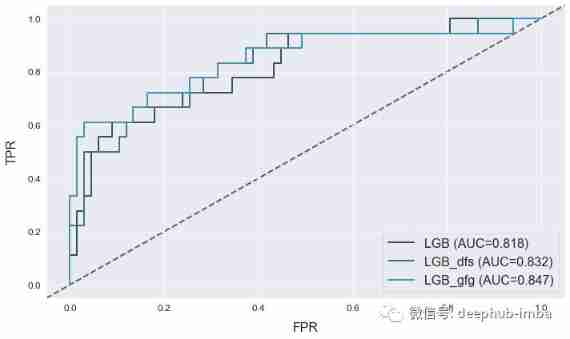
Use atom You can draw multiple adjacent graphs , See which features contribute most to the prediction of the model
with atom.canvas(1, 3, figsize=(20, 8)):
    atom.lgb.plot_feature_importance(show=10, title="LGB")
    atom.lgb_dfs.plot_feature_importance(show=10, title="LGB + DFS")
    atom.lgb_gfg.plot_feature_importance(show=10, title="LGB + GFG")

For two non baseline models , The generated features seem to be the most important features , This indicates that this is relevant to the new target column , And they make a great contribution to the prediction of the model .
Use decision diagrams , You can also view the impact of features on individual rows in the dataset .
atom.lgb_dfs.decision_plot(index=0, show=15)

summary
This paper compares the performance of new features generated by two automatic feature generation techniques for model prediction . The results show that using these techniques can significantly improve the performance of the model . In this article, I used ATOM The package simplifies the process of processing training and modeling , of ATOM For more information , Please check the documentation of the package .
https://www.overfit.cn/post/389b1d229dae4d0fb7b584cb37a350de
author :Marco vd Boom
边栏推荐
- API call display, detailed API of Taobao, tmall and pinduoduo commodity pages, and return of APP side original data parameters
- Transactions in redis
- Can't understand kotlin source code? Starting with the contracts function~
- Demand and business model analysis -6- five topics
- EFCore调优
- 【观察】华为下一代数据中心,为广西低碳高质量发展“添动能”
- Demand and business model analysis-2-business model types
- 【刷题笔记】线段树
- Research Report on global and Chinese cosmetics industry market sales scale forecast and investment opportunities 2022-2028
- Méthode de sauvegarde programmée basée sur la base de données distribuée elle - même
猜你喜欢

3D object detection

Demand and business model analysis-3-design

【观察】华为下一代数据中心,为广西低碳高质量发展“添动能”

Demand and business model innovation - demand 3- demand engineering process

RT thread simulator builds lvgl development and debugging environment

Reading small program based on wechat e-book graduation design (4) opening report

mysql的增删改查,mysql常用命令

解释器文件
![[image denoising] image denoising based on regularization with matlab code](/img/d9/74f4d9cdb4bfe157ba781ec8f6a184.png)
[image denoising] image denoising based on regularization with matlab code

选电子工程被劝退,真的没前景了?
随机推荐
What did 3GPP ran do in the first F2F meeting?
Demand and business model analysis -6- five topics
mysql的增删改查,mysql常用命令
基于分布式数据库本身的定时备份方法
Detailed explanation of yolox network structure
【生成对抗网络学习 其三】BiGAN论文阅读笔记及其原理理解
torch 网络模型转换onnx格式,并可视化
Wechat e-book reading applet graduation design completion works (3) background function
vc hacon 联合编程 GenImage3Extern WriteImage
Software usage of Tencent cloud TDP virt viewer win client
New product launch
Wechat e-book reading applet graduation design completion works (8) graduation design thesis template
Reading small program graduation design based on wechat e-book (5) assignment
[observation] Huawei's next generation data center "adds momentum" to Guangxi's low-carbon and high-quality development
今晚7:00 | PhD Debate 自监督学习在推荐系统中的应用
“即服务”,未来已来,始于现在 | IT消费新模式,FOD按需计费
Embedded development: 6 necessary skills for firmware engineers
负数取余问题
在 Traefik Proxy 2.5 中使用/开发私有插件(Traefik 官方博客)
Reading applet based on wechat e-book graduation design (2) applet function