当前位置:网站首页>Classic network learning RESNET code implementation
Classic network learning RESNET code implementation
2022-07-25 02:34:00 【csdn__ Dong】
Preface
Based on the previous theoretical analysis , Today, let's talk about learning ResNet Code implementation of , If you haven't seen << Classic online learning -ResNet>> It's suggested to take a look at . Before I write this , I also investigated other online implementations , Are all behind pytorch The official source code is well implemented , So the official version explains how to achieve resNet
ResNet framework
Here is still the architecture diagram in the paper :

Each layer in the figure is actually BasicBlock perhaps BotteNeck structure . Here is given ResNet-34 The structure diagram is shown in the figure , The dashed connecting line in the figure indicates that the number of channels is different , Channel adjustment required Use zero padding or 1x1 To achieve this goal .


The code is interpreted as :
conv->bn->relu->conv->bn->shortcut->relu
BasicBlock structure

#  be used for resnet18 and resnet34 Basic residual structure block
#downsample The residual structure corresponding to the dotted line
# # Downsampling is performed by conv3_1, conv4_1, and conv5_1 with a stride of 2
class BasicBlock(nn.Module):
    # Channel expansion factor , The base number is 64
    expansion: int = 1

    def __init__(
        self,
        in_channels: int,
        out_channels: int,
        stride: int = 1,
        downsample: Optional[nn.Module] = None,
        groups: int = 1,
        base_width: int = 64,
        dilation: int = 1,
        norm_layer: Optional[Callable[..., nn.Module]] = None,
    ) -> None:
        super().__init__()
        if norm_layer is None:
            norm_layer = nn.BatchNorm2d
        if groups != 1 or base_width != 64:
            raise ValueError("BasicBlock only supports groups=1 and base_width=64")
        if dilation > 1:
            raise NotImplementedError("Dilation > 1 not supported in BasicBlock")
        # Both self.conv1 and self.downsample layers downsample the input when stride != 1
        self.conv1 = conv3x3(in_channels, out_channels, stride)
        self.bn1 = norm_layer(out_channels)
        self.relu = nn.ReLU(inplace=True)
        self.conv2 = conv3x3(out_channels, out_channels)
        self.bn2 = norm_layer(out_channels)
        self.downsample = downsample
        self.stride = stride

    def forward(self, x: Tensor) -> Tensor:
        identity = x

        out = self.conv1(x)
        out = self.bn1(out)
        out = self.relu(out)

        out = self.conv2(out)
        out = self.bn2(out)

        # The dotted line of the model architecture in the paper , Down sampling is required
        if self.downsample is not None:
            identity = self.downsample(x)

        #shortcut Connect
        out += identity
        out = self.relu(out)

        return out
In code conv3x3 Definition
# Definition 3x3 belt padding Convolution of
def conv3x3(in_planes: int, out_planes: int, stride: int = 1, groups: int = 1, dilation: int = 1) -> nn.Conv2d:
    """3x3 convolution with padding"""
    return nn.Conv2d(
        in_planes,
        out_planes,
        kernel_size=3,
        stride=stride,
        padding=dilation,
        groups=groups,
        bias=False,
        dilation=dilation,
    )
- What needs to be noted is :
bias = False

therefore , After convolution , If you want to pick up BN operation , It is better not to set the offset , Because it doesn't work , And occupy the memory of the graphics card .
BottleNeck structure
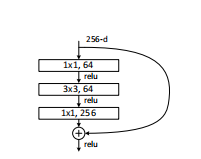
class Bottleneck(nn.Module):
    # pytorch  Realization  Bottleneck  Is in 3x3 Convolution (self.conv2) Set up stride = 2
    #  The original paper (https://arxiv.org/abs/1512.03385) To realize  Bottleneck  Is in 1x1 Convolution (self.conv1) Set up stride = 2
    #  This improves the accuracy .  This variant is also known as ResNet V1.5  Reference resources https://ngc.nvidia.com/catalog/model-scripts/nvidia:resnet_50_v1_5_for_pytorch.

    # Channel expansion factor
    expansion: int = 4

    def __init__(
        self,
        in_channels: int,
        out_channels: int,
        stride: int = 1,
        downsample: Optional[nn.Module] = None,
        groups: int = 1,
        base_width: int = 64,
        dilation: int = 1,
        norm_layer: Optional[Callable[..., nn.Module]] = None,
    ) -> None:
        super().__init__()
        if norm_layer is None:
            norm_layer = nn.BatchNorm2d
        width = int(out_channels * (base_width / 64.0)) * groups
        # Both self.conv2 and self.downsample layers downsample the input when stride != 1
        self.conv1 = conv1x1(in_channels, width)
        self.bn1 = norm_layer(width)
        self.conv2 = conv3x3(width, width, stride, groups, dilation)
        self.bn2 = norm_layer(width)
        self.conv3 = conv1x1(width, out_channels * self.expansion)
        self.bn3 = norm_layer(out_channels * self.expansion)
        self.relu = nn.ReLU(inplace=True)
        self.downsample = downsample
        self.stride = stride

    def forward(self, x: Tensor) -> Tensor:
        identity = x

        out = self.conv1(x)
        out = self.bn1(out)
        out = self.relu(out)

        out = self.conv2(out)
        out = self.bn2(out)
        out = self.relu(out)

        out = self.conv3(out)
        out = self.bn3(out)

        if self.downsample is not None:
            identity = self.downsample(x)

        out += identity
        out = self.relu(out)

        return out
ResNet Code implementation
class ResNet(nn.Module):
    def __init__(
        self,
        block: Type[Union[BasicBlock, Bottleneck]],
        layers: List[int],
        num_classes: int = 1000,
        zero_init_residual: bool = False,
        groups: int = 1,
        width_per_group: int = 64,
        replace_stride_with_dilation: Optional[List[bool]] = None,
        norm_layer: Optional[Callable[..., nn.Module]] = None,
    ) -> None:
        super().__init__()
        if norm_layer is None:
            norm_layer = nn.BatchNorm2d
        self._norm_layer = norm_layer

        self.in_channels = 64
        self.dilation = 1
        if replace_stride_with_dilation is None:
            # each element in the tuple indicates if we should replace
            # the 2x2 stride with a dilated convolution instead
            replace_stride_with_dilation = [False, False, False]
        if len(replace_stride_with_dilation) != 3:
            raise ValueError(
                "replace_stride_with_dilation should be None "
                f"or a 3-element tuple, got {
      replace_stride_with_dilation}"
            )
        self.groups = groups
        self.base_width = width_per_group
        self.conv1 = nn.Conv2d(3, self.in_channels, kernel_size=7, stride=2, padding=3, bias=False)
        self.bn1 = norm_layer(self.in_channels)
        self.relu = nn.ReLU(inplace=True)
        self.maxpool = nn.MaxPool2d(kernel_size=3, stride=2, padding=1)

        self.layer1 = self._make_layer(block, 64, layers[0])
        self.layer2 = self._make_layer(block, 128, layers[1], stride=2, dilate=replace_stride_with_dilation[0])
        self.layer3 = self._make_layer(block, 256, layers[2], stride=2, dilate=replace_stride_with_dilation[1])
        self.layer4 = self._make_layer(block, 512, layers[3], stride=2, dilate=replace_stride_with_dilation[2])
        self.avgpool = nn.AdaptiveAvgPool2d((1, 1))
        self.fc = nn.Linear(512 * block.expansion, num_classes)

        for m in self.modules():
            if isinstance(m, nn.Conv2d):
                nn.init.kaiming_normal_(m.weight, mode="fan_out", nonlinearity="relu")
            elif isinstance(m, (nn.BatchNorm2d, nn.GroupNorm)):
                nn.init.constant_(m.weight, 1)
                nn.init.constant_(m.bias, 0)

        # Zero-initialize the last BN in each residual branch( The last of each residual block BN Initialize with zero ),
        # so that the residual branch starts with zeros, and each residual block behaves like an identity.( So each residual block starts from zero , It's like identity)
        # This improves the model by 0.2~0.3% according to https://arxiv.org/abs/1706.02677 ( Improved accuracy 0.2~0.3)
        if zero_init_residual:
            for m in self.modules():
                if isinstance(m, Bottleneck):
                    nn.init.constant_(m.bn3.weight, 0)  # type: ignore[arg-type]
                elif isinstance(m, BasicBlock):
                    nn.init.constant_(m.bn2.weight, 0)  # type: ignore[arg-type]

    #  establish conv2_x,conv3_x,conv4_x,conv5_x layer
    # channel:conv2/3/4/5 The number of the first convolution kernel on the main branch of the residual structure corresponding to various depths / The channel number
    #  The number of residual structures of a convolution
    def _make_layer(
        self,
        # Residual block type : It can be BasicBlock perhaps Bottleneck
        block: Type[Union[BasicBlock, Bottleneck]],
        # The residual is faster than the input channel of the first convolution
        channels: int,
        # Number of residual blocks
        blocks: int,
        stride: int = 1,
        dilate: bool = False,
    ) -> nn.Sequential:
        norm_layer = self._norm_layer
        downsample = None
        previous_dilation = self.dilation
        if dilate:
            self.dilation *= stride
            stride = 1
        #  about resnet50/101/152 Layer structure , The first layer is the dotted line residual , Take the next sample
        #  about resnet18/34 Layer network will skip this judgment , Because input and output shape Agreement , No down sampling
        # conv2_x The first layer of lower sampling only needs to be increased channel, Don't change the height and width (stride = 1) Because input and output shape All for 64×64
        if stride != 1 or self.in_channels != channels * block.expansion:
            downsample = nn.Sequential(
                conv1x1(self.in_channels, channels * block.expansion, stride),
                norm_layer(channels * block.expansion),
            )

        layers = []
        layers.append(
            block(
                self.in_channels, channels, stride, downsample, self.groups, self.base_width, previous_dilation, norm_layer
            )
        )
        self.in_channels = channels * block.expansion
        for _ in range(1, blocks):
            layers.append(
                block(
                    self.in_channels,
                    channels,
                    groups=self.groups,
                    base_width=self.base_width,
                    dilation=self.dilation,
                    norm_layer=norm_layer,
                )
            )

        #Sequential Class to implement a simple sequential connection model
        return nn.Sequential(*layers)

    def _forward_impl(self, x: Tensor) -> Tensor:
        ''' Forward propagation implementation function '''

        x = self.conv1(x)
        x = self.bn1(x)
        x = self.relu(x)
        x = self.maxpool(x)

        x = self.layer1(x)
        x = self.layer2(x)
        x = self.layer3(x)
        x = self.layer4(x)

        # Global average pooling
        x = self.avgpool(x)
        x = torch.flatten(x, 1)
        #  The last full connection layer
        x = self.fc(x)

        return x

    def forward(self, x: Tensor) -> Tensor:
        '''  Positive communication  '''
        return self._forward_impl(x)
The above codes are from pytorch Source code , There are deletions for easy understanding , All the above have been put into github Warehouse
边栏推荐
- BMW I3 based on clar architecture is not a simple "oil to electricity" product
- Coal industry supply chain centralized mining system: digitalization to promote the transformation and upgrading of coal industry
- It7259q-13, it7259ex-24 feature wearable devices
- Explorer TSSD 2019 software installation package download and installation tutorial
- Actual combat in ThreadLocal project
- Arthas case: dynamic update application logger level
- Keepalivetime=0 description of ThreadPoolExecutor
- Nacos service discovery data model
- Four redis cluster schemes you must know and their advantages and disadvantages
- Consul cluster deployment
猜你喜欢

Explorer TSSD 2019 software installation package download and installation tutorial

Easy to master SSO single sign on, see this article
Introduction to web security telent testing and defense

Example demonstration of "uncover the secrets of asp.net core 6 framework" [02]: application development based on routing, MVC and grpc
![ASP. Net core 6 framework unveiling example demonstration [01]: initial programming experience](/img/26/18fd3106f887f503479f081e29dac3.jpg)
ASP. Net core 6 framework unveiling example demonstration [01]: initial programming experience

ICO objects in classification

What are you working for? Don't give up is our only choice, come on, everyone

Project management tool Zen

Explanation of C language file operation function

VRRP virtual redundancy protocol configuration
随机推荐
[C language] program compilation (preprocessing)
Windows Server 2022 received a non security update in July: fix the sticking problem caused by defender
Detailed explanation of MySQL, Oracle and PostgreSQL database index failure scenarios
High performance memory recovery technology for decrypting ark -- HPP GC
TS uses a third-party library, and there is no type declaration file error handling
It's still a synchronization problem
YuQue - a useful tool for document writing and knowledge precipitation
Text reading end judgment
Query the thread information of MySQL server (detailed explanation)
Anacona has too many environments?? How to view your current environment in jupyter
Sword finger offer 11. rotate the minimum number of the array
Permanently mount the image steps
Gerrit statistics script
BGP introduction
Redis unauthorized access vulnerability recurrence (www.hetianlab.com)
KVM virtualization jobs
Picgo configuring Alibaba cloud OSS
How to upload files to the server
Jedispoolconfig parameter configuration from the perspective of source code
Today in history: the kotlin language was published for the first time; The father of the IMAP agreement was born; CT imaging achieves a new breakthrough