当前位置:网站首页>Discussion on the open source GIS solution of our company
Discussion on the open source GIS solution of our company
2022-06-22 10:09:00 【Love is parallel to the world】
1. Preface
This week , I am right. GIS Open source solutions involved in the open source software and related technologies and processes to do some preliminary exploration , I also learned about the mature cases of other companies using open source solutions . Here I will summarize the pre research of some key technical points , At the same time, it makes an analysis of the successful open source cases of other companies , And I think the most suitable for the actual situation of the company at present GIS Open source solutions .
2. Pre research on key technology points
2.1 Spatial data storage (postgreSQL+postGIS)
utilize postGIS take shp Data import to postgreSQL in :


2.2 Spatial data editing (uDig)
Import postgreSQL Spatial data in , It can display and edit .

2.3SLD The making of style file
Can be used directly uDig Map layers and produce corresponding SLD file , And you can export :
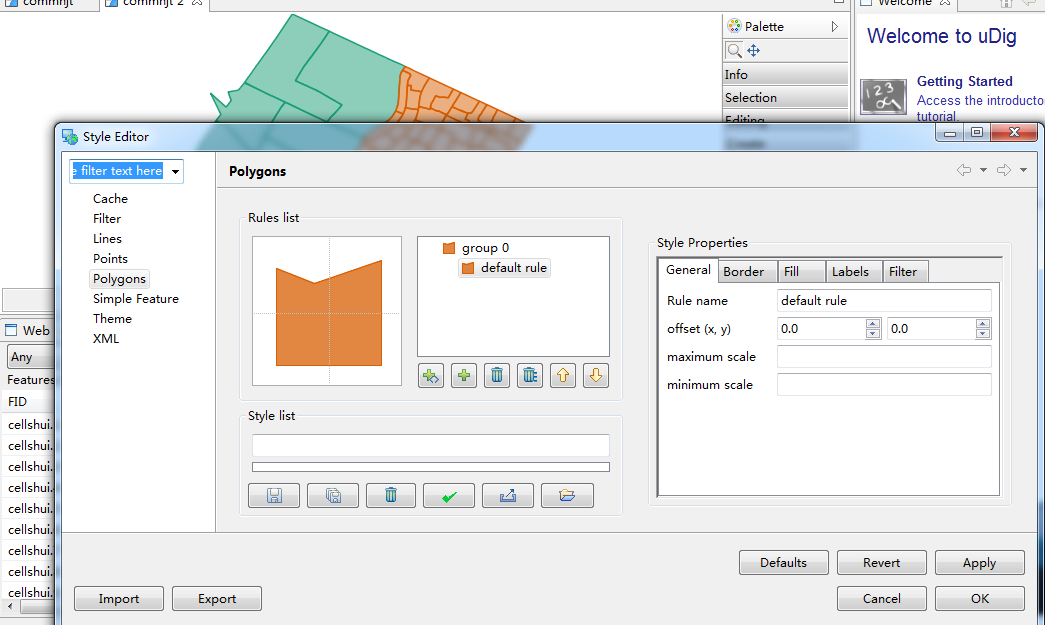

2.4 utilize geoserver Release postGIS Spatial data in
stay Geoserver Add stores choice postgis that will do :


2.5 utilize Geoserver Publish layer groups
Combine multiple layer services published separately into one layer group , The layers under all layer groups can be displayed in one request :

Layer groups that contain cell grids and communities :

2.6 utilize GeoWebCache Cut cache
Studied GeoWebCache There are two kinds of clipping strategies : One is class AGS Cut strategy , That is, cut in advance ; One is class AGS Dynamic cut strategy , That is, the first time the request cuts .
The configuration and result of the cut graph :


2.7 Yes, use postGIS Medium ST_Geometry Function for the pre research of spatial data management and spatial analysis
PostGIS Medium ST_Geometry Function and SDE It's basically the same in , But it includes some of its own extension functions . It has the following functions :

stay postgresql Test the basic spatial elements of the addition, deletion, search and change, as well as spatial elements of the area and length of access :

3. A case study on the maturity of other companies
The safety of a company XX( Security projects ) As the case object of this study , By communicating with their R & D staff , I get the following information :
3.1 Adopt a framework
Geoserver( Map server )+geoWebCache( Tile cache service )+JBOSS( middleware )+postgreSQL( Spatial database )+Oracle( Business database )+uDig( Spatial data editing tools ).
3.2 Some analysis points of the project are summarized
a. In this project Geoserver Released nearly 60 layers , No obvious instability .
b. Spatial data query in the project 、 Editing and spatial analysis functions involved , All use ST_Geometry Function implementation , Good efficiency .
c. Map tile cache used in the project geoWebCache Dynamic mapping strategy of . Nearly 60 layers are used as base maps , The time of the first request for drawing is about 20 More than a second ( Add in the cost of the Internet ).
d. Business data and spatial data are stored separately , Business data is stored in Oracle in , The spatial data is stored in postgresql in .
e. Project deployment , Research and development for them, after all the data are processed in advance , And then put the... That already contains the data Geoserver And the space library to the field engineers .
3.3 Personal evaluation of the project
3.3.1 advantage
a. The functions of drawing and spatial analysis are basically complete , Efficiency and stability are also good . Safety XX It is a relatively large project in itself , Experienced a better practice test .
b. The spatial analysis is applied to ST_Geometry+SQL To achieve , Not through Geoserver Provided by itself WFS service , There can be more customization requirements , And if there's a mistake, it's easy to check . If it's written properly , It can speed up data acquisition . meanwhile , Not GIS It's easier for professional developers to understand .
c. Separate spatial data from business data , This can ensure that the original business data used in other projects will not change much , Ensure the stability of the system .
3.3.2 shortcoming
a. The implementation of the project requires the participation of R & D personnel , Put data in storage and publish . And then we have to cooperate with the site to arrange the environment .
3.4 What remains to be proved
a. When used geoWebCache When making a cut , If the base map is complicated , Whether it can guarantee the cut without distortion .
b. When used GeoWebCache When making a cut , If the base map is a large image (GB above ), Whether it can guarantee the cut without distortion , And the efficiency of the first drawing .
c. When used Geoserver Publish more than 100 When you use a layer service ,Geoserver The stability of itself .
4. In line with the company's open source solutions
Through the above pre research of key technology points and the analysis of successful cases of other companies , Combined with the current overall structure of the company , I personally propose an open source solution that I think is more in line with the company :
GeoServer( Map service )+ Local tile service (ArcGIS Isometric diagram )+Tomcat( middleware )+Postgresql( Spatial database )+Oracle( Business database )+uDig( Spatial data editing tools ).
4.1 Detailed system architecture explanation
4.1.1 Underlay cache service
Companies can still use ArcGIS To make a cut ( The company has a genuine ), There are three benefits :
a. Project implementers are easy to operate .
b. It's easy to map .
c. It can ensure the quality and efficiency of cut .
The cut picture , We can use our existing offline tile strategy , Bypass GeoWebCache The adoption and configuration of . Of course , If you don't want to use ArcGIS Cutaway , I want to open source completely , We can also study the use of MapTiler This open source cutting tool , The efficiency and effect of the cut is quite good .
4.1.2 Dynamic drawing of components (WMS)
Adopt the company's existing technology based on GeoServer The function of .
4.1.3 Vector query (WFS)
Adopt the company's existing technology based on GeoServer The function of .
4.1.4 Spatial analysis function (WFS)
For those who have passed GeoServer Spatial analysis function of development , It can be based on the adoption of . For the undeveloped part , The proposal USES ST_Geometry Function to do .
4.1.5 Spatial database
use postgresql+postGIS.PostGIS Support batch warehousing , It also supports Chinese data , Very good stability and performance , It's easy to operate . meanwhile , There are also many development tutorials and community forums .
4.1.6 Data editor
use uDig To edit spatial data .uDig You can import shp Data or postgis Data in , Can also be shp Data import to postgresql in . It also supports data style editing and SLD File generation .
4.2 Implementation of the project
a. The cutting link project can be completed by itself .
b. The input of spatial data can also be realized through postGIS Do it yourself , Operation heel catalog It's just as easy to operate .
c. Publishing spatial data and associating basic styles of components , And the generation of business data , It can be realized by modifying the existing gadgets .
d. Configuration and release of complex styles , It can be done with the help of R & D .
边栏推荐
- 不要再傻傻分不清 hash、 chunkhash 和 contenthash 啦
- 6-44 traversal of binary tree
- 力扣 1108. IP 地址无效化
- TCP Congestion Identification
- Basic knowledge of AI Internet of things | community essay solicitation
- 10-2xxe漏洞原理和案例实验演示
- TCP异常连接
- MYSQL Skip Scan Range 小功能,解决大问题 ?
- Advanced Web Zone record of attack and defense world (I)
- PAT甲级 - 1013 Battle Over Cities(删点判连通块数量)
猜你喜欢

Catch up with this big guy

Basic knowledge of AI Internet of things | community essay solicitation

Summary of neural network training trick

西电AI专业排名超清北,南大蝉联全国第一 | 2022软科中国大学专业排名

px4代码学习之基于uavcan协议的时间同步消息中添加自定义字段

HMS core news industry solution: let technology add humanistic temperature

Introduction to right raising method and principle (interview)

php 数据库 mysql提问

使用pytorch mask-rcnn进行目标检测/分割训练

Cobalt Strike 从入门到入狱(三)
随机推荐
From in MySQL_ Unixtime and UNIX_ Timestamp processing database timestamp conversion - Case
Cobalt Strike 從入門到入獄(三)
How to transfer the values in the database to JSP pages through servlets and display them in El expressions?
PAT甲级 - 1015 Reversible Primes (进制转换&素数判断)
【backtrader源码解析51】observers中七个文件源代码简单解读(枯燥,仅供参考)
PowerDesigner技巧2 触发器模板
Summary of neural network training trick
M2 芯片解析:似乎是一个增强版的 A15?
信息系统项目典型生命周期模型
缓存穿透利器之「布隆过滤器」
C语言编写一个双向链表
工作中的帕累托定律:关注结果,而不是输出
APM 飞行模式切换--源码详解
大学生期末考试SQL语句
6-43 sum of ordered sparse polynomials
MySQL skip scan range small function to solve big problems?
Attack and defense world web practice area beginner level
6-8 integer array shift
PAT甲级 - 1013 Battle Over Cities(删点判连通块数量)
Learning serialization and deserialization from unserialize3