当前位置:网站首页>Detailed explanation of this and static
Detailed explanation of this and static
2022-06-11 09:20:00 【lwj_ 07】
static:
1、static Translated into " static state "
2、 be-all static Keywords are class related , Class level
3、 all static Embellished , All use " Class name ." Mode of access
4、static Decorated variable : Static variables
5、static The method of decoration : Static methodsClassification of variables :
Variables are divided according to the declared location :
The variables declared in the method body are called : local variable
Variables declared outside the method are called : Member variablesMember variables can be divided into :
Instance variables
Static variables
class VarTest{
	//  For the following example , Are object related , Use when visiting " quote ." Mode of access , It needs to be done first new object
	//  Strength related , Must have object first , Ability to visit , A null pointer exception may occur
	//  Instance variables in member variables
	int i;
	//  Example method
	public void m1(){
	}

	//  Static variables in member variables
	static int k;
	//  Static methods
	public static void m2(){

	}
}
When a variable is declared as an instance , When declared static ?
If a property value of all objects of this type is the same ,
It is not recommended to define as instance variable , Wasted memory space , The proposal is defined as
Class level features , It's defined as a static variable , Only one... Is left in the method area
Share , Save memory .An object is an instance variable
One copy of multiple objects is a static variable
public class staticTest02
{
	public static void main(String[] args){
		 Chinese c1 =new Chinese("123456","junker"," China ");
		 Chinese c2 =new Chinese("00000","jun"," China ");
		 System.out.println(c1.id);
		 System.out.println(c1.name);
		 System.out.println(c1.country);
		 System.out.println(c2.id);
		 System.out.println(c2.name);
		 System.out.println(c2.country);
}
}
//  Define a class : Chinese

class Chinese{
	//  ID number
	//  Everyone has a different ID number , So the ID number should be an instance variable , One object, one share
	String id;
	//  full name
	//  Name is also a person a name , The name should also be an instance variable
	String name;
	//  nationality
	//  about " Chinese " For this class , All nationalities " China ", It doesn't change with the change of the object
	//  Obviously nationality is not a characteristic of the object level
	//  Nationality is a characteristic of the whole class
	String country;

	//  No parameter
	public Chinese(){

	}

	//  With parameters
	public Chinese(String s1,String s2,String s3){
		id =s1;
		name =s2;
		country =s3;
	}
}
When variables country Not for static The static memory diagram is as follows :

When variables country by static The code walkthrough and memory diagram for static variables are as follows :
Code walkthrough 2:( by static Static variables , You should use " Class name ." Mode of access )
public class staticTest02
{
	public static void main(String[] args){

		//  Visiting Chinese nationality
		//  Nationality is static Static variables , You should use " Class name ." Mode of access
		 Chinese c1 =new Chinese("123456","junker");
		 System.out.println(Chinese.country);

		 //  Report errors [id,name Is instance variable , Should first new An object   adopt " quote ." Mode of access ]
		 //System,out.println(Chinese.id);

		 System.out.println(c1.id);
		 System.out.println(c1.name);

		 Chinese c2 =new Chinese("00000","jun");
		 System.out.println(c2.id);
		 System.out.println(c2.name);
		 System.out.println(Chinese.country);

}
}
//  Define a class : Chinese

class Chinese{
	//  ID number
	//  Everyone has a different ID number , So the ID number should be an instance variable , One object, one share
	String id;
	//  full name
	//  Name is also a person a name , The name should also be an instance variable
	String name;
	//  nationality
	//  Focus on five stars : Plus static Variables are called static variables
	//  Static variables are initialized when the class is loaded , Unwanted new object , The space for static variables is opened up
	//  Static variables are stored in the method area
	//  Static variables usually give a value
	static String country =" China ";

	//  No parameter
	public Chinese(){

	}

	//  With parameters
	public Chinese(String s1,String s2){
		id =s1;
		name =s2;
	}
}
Code walkthrough 3:
Example of : You have to use " quote ." To visit
Static : It is recommended to use " Class name ." To visit , But use " quote ." It's fine too , If you use " quote ." Visiting will make others confused : Programmers think it is an instance
public class staticTest02
{
	public static void main(String[] args){
		 Chinese c1 =new Chinese("123456","junker");

		 //  Report errors [id,name Is instance variable , Should first new An object   adopt " quote ." Mode of access ]
		 //System,out.println(Chinese.id);

		 System.out.println(c1.id);
		 System.out.println(c1.name);
	 //  Visiting Chinese nationality
	//  Nationality is static Static variables , You should use " Class name ." Mode of access
		 System.out.println(Chinese.country);

		 Chinese c2 =new Chinese("00000","jun");

		 System.out.println(c2.id);
		 System.out.println(c2.name);

		 //  Use " quote ." Is still accessed through
		 System.out.println(c2.country);	//  China

}
}
//  Define a class : Chinese

class Chinese{
	String id;

	String name;

	static String country =" China ";

	//  No parameter
	public Chinese(){

	}

	//  With parameters
	public Chinese(String s1,String s2){
		id =s1;
		name =s2;
	}
}
Null reference access static will not null pointer exception
public class staticTest02
{
	public static void main(String[] args){
		 Chinese c1 =new Chinese("123456","junker");
		 System.out.println(c1.id);
		 System.out.println(c1.name);
		 System.out.println(Chinese.country);

		 Chinese c2 =new Chinese("00000","jun");
		 System.out.println(c2.id);
		 System.out.println(c2.name);

		 // c2  It's a null reference
		 c2 =null;

		 //  There will be no null pointer exceptions
		 //  Because static variables do not require the existence of objects
		 //  In fact, the following code runs , still :System.out.println(Chinese.country);
		 System.out.println(c2.country);//  Still pass

		 //  A null pointer exception occurred   because name Is instance variable
		 // System.out.println(c2.name);

}
}
//  Define a class : Chinese

class Chinese{
	String id;

	String name;

	static String country =" China ";

	//  No parameter
	public Chinese(){

	}

	//  With parameters
	public Chinese(String s1,String s2){
		id =s1;
		name =s2;
	}
}
Add 【 master 】
public class staticTest03
{
	public static void main(String[] args){
		User u =new User();
		int i =u.getId();
		System.out.println(i);
	}
}


class User
{
	//  Instance variables are also called object variables
	private int id; // id Object level variables

	/*
	//  Will report a mistake
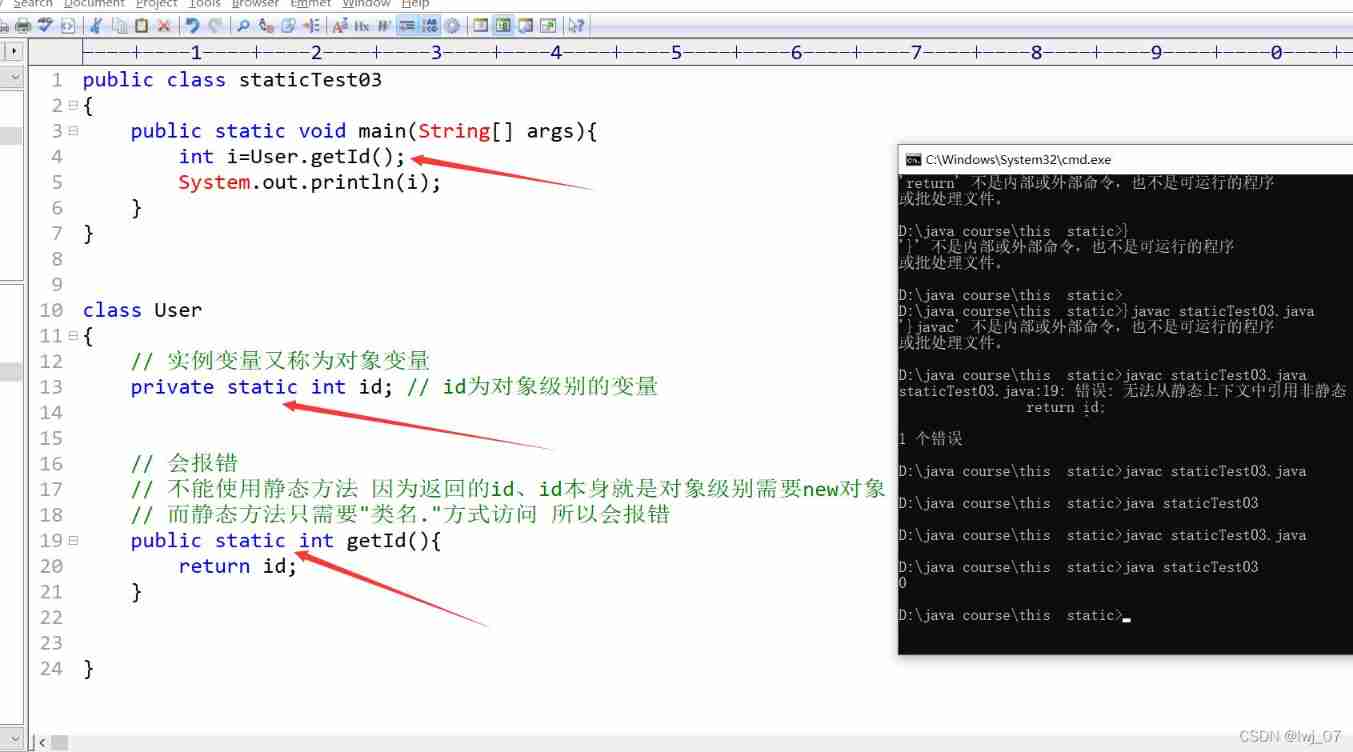
	//  Static methods cannot be used   Because the returned id、id It is an object level requirement new object
	//  The static method only needs " Class name ." Access to   So there's an error
	public static int getId(){
		return id;
	}
	*/
	public int getId(){
		return id;
	}

}
When a static method is used, the variables should also be static :
One 、 Static code block
1、 Use static Keywords can be defined : Static code block
2、 What is a static block of code , What is grammar ?
static{
java sentence ;
...
}3、static When do static code blocks execute ?
characteristic : When the class is loaded, execute , And only once
4、 Be careful : Static code blocks are executed when the class loads , And in main Method before execution5、 Static code blocks are generally executed in top-down order
6、 What do static code blocks do , What's the usage? ?
Specific business :
The project manager said : All the programs we write , As long as the class is loaded , Please record the log information of class loading
( In which year, month, day, hour and minute , Which class is loaded into JVM In the middle ) You need to use static code blocks
Code walkthrough :
public class staticTest04
{
	//  Static code block
	static{
		System.out.println("A");
	}
	//  Multiple static code blocks can be written in a class
	static{
		System.out.println("B");
	}
	static{
		System.out.println("C");
	}

	//  Program entrance
	public static void main(String[] args){
		System.out.println("come on~");
		}

	//  Write a static code block
	static{
		System.out.println("D");
	}
}
Running results :( Conclusion : Static code blocks are executed when the class is loaded )

Two 、 Code execution order
( Conclusion : Static code block 1 and Static code block 2 In order 、 Static code blocks and static variables also have order )
Code demonstration :
public class staticTest05
{
	//  When static variables are initialized ?	 When the class loading
	//  Where are static variables stored ?	 Method area
	static int i =100;

	//  When static code blocks are executed ?	 Class loading time
	static{
		System.out.println("i:"+i);
	}

	/*
	 Instance variables  k Variables are instance variables , In the construction method ( Hidden object methods ) Execution time (new When ) Memory space will be opened up
	 error :  Cannot reference non static from a static context   Variable  k
	int k =6;
	static{
		// static The static code block executes when the class is loaded ,k Is instance variable   So it will report a mistake
		System.out.println(k);

		System.out.println("name:"+name); //  An error is also reported here : Illegal forward reference
	}


	//  Report errors : Illegal forward reference
	//static{System.out.println("name:"+name);}
	//static String name ="junker";

	*/
	// Program entrance
	public static void main(String[] args){
		System.out.println("main begin~");
	}
}
3、 ... and 、this Memory structure

1、this It's a keyword , All lowercase
2、this What is it? , In terms of memory ?
One object, one this.
this It's a variable , It's a reference ,this Save the memory address of the current object , Point to their own ,
therefore , Strictly speaking ,this It stands for " The current object "
this Inside objects stored in heap memory
3、this Can only be used in instance methods , Who calls this instance method ,this Who is the
therefore this It stands for : The current object
4、this In most cases, it can be omitted5、 Why? this Cannot be used in static methods ???
this Represents the current object , There is no object in the static method
Code walkthrough :[ master ]
public class ThisTest01
{
	public static void main(String[] args){
	// new An object
	Customer c1 =new Customer("junker");
	Customer c2 =new Customer("jun");
	c1.shopping();
	c2.shopping();

	}
}


//  Customers
class Customer
{
	//  attribute
	//  Instance variables ( You have to use " quote ." Mode of access )
	String name;

	//  Construction method
	public Customer(){

	}
	public Customer(String s){
		name =s;
	}

	//  How customers shop
	//  Example method
	public void shopping(){
		//  there this Who is it ? this Is the current object
		// c1 call shopping();,this Namely c1
		// c2 call shopping();,this Namely c2
		System.out.println(name+" Shopping ");
		//  doubt : String name Is instance variable ( You have to use " quote ." Mode of access )
		//  Why is there (name+" Shopping "); No ( quote .name+" Shopping ") Well
		//  Why not in this program (c1.name+" Shopping "); Well ?
		// [ Be careful :new The citation that comes out c1  Is in ThisTest01 Method body   This is Customer Class body  ];

		//  answer : Actually (name+" Shopping "); The current object is hidden this ( See the memory diagram for details )
		//System.out.println(this.name+" Shopping ");
	}
}
Expand :
/*
	 analysis :i Variable in main Method ???
*/

public class ThisTest02{

	int i =100;	//  Instance variables are object level   Must first new Objects can only be used
	static String k;
	public static void main(String[] args){
		//  error :  Cannot reference non static from a static context
		//System.out.println(this.i);
		//System.out.println(i);	//  The same mistake   because i Is instance variable   and main The method is static

		//  If you really want to main Method to access instance variables   Then you need to manually new An object
		ThisTest02 t =new ThisTest02();
		System.out.println(t.i);
		//  Access static variables  " Class name ." Mode of access
		System.out.println(ThisTest02.k);
	}
}
this In which cases can not be omitted :
/*
1、this You can use in instance methods , Cannot be used in static methods .
2、this Keywords can be omitted in most cases , When can't we omit ?
*/

public class ThisTest06
{
	public static void main(String[] args){
		//  No arguments
		Student s1 =new Student();
		s1.setName("jun");
		s1.setNo(11111);
		System.out.println(s1.getNo());
		System.out.println(s1.getName());
		//  Ginseng
		Student s2 =new Student(22222,"junker");
		System.out.println(" Student number :"+s2.getNo());
		System.out.println(" full name "+s2.getName());


	}
}

//  Analyze what is not well written in the following code ?
//  The formal parameters are not clearly described
class Student
{
	private int no;
	private String name;

	//  Constructors
	public Student(){}
	public Student(int no,String name){
		this.no =no;
		this.name =name;
	}

	/*
	//  Report errors
	public Student(int no,String name){ //  Inside the formal parameters are local variables
		no =no;	//  Sinister no Is instance variable   Both virtual machines may think that the variables are the same , therefore
		name =name;//  Instance variables are object level variables   need " quote ." Form visit  this just : The current object
	}
	*/

	//  Construction method
	public int getNo(){
		return no;
	}
	public void setNo(int no){	//  Shape parameter n The meaning of the expression is not obvious   Some don't know no
		this.no =no;
	}

	public String getName(){
		return name;
	}
	public void setName(String name){
		this.name =name;
	}
}
Running results :

this In addition to being used in instance methods , It can also be used in construction methods
New syntax : Call another constructor of this class through the current constructor , You can use the following syntax format :
this( List of actual parameters );
Through a construction method 1 To call the constructor 2, Code reuse can be achieved
Be careful :" Construction method 1" and " Construction method 2" They are all in the same category
demand :
1、 Define a date class , It can represent the year, month and day information .
2、 Requirements in requirements :
If you call a parameterless constructor , The default creation date is :1970 year 1 month 1 Japan .
Of course , In addition to calling the parameterless constructor , You can also call a parameter constructor to create a date object .
public class ThisTest07
{
	public static void main(String[] args){
		//  No parameter
		Date d1 =new Date();
		d1.doSome();
		//  With parameters
		Date d2 =new Date(1949,3,6);
		d2.doSome();
	}
}

class Date
{
	private int year;
	private int month;
	private int day;

	/*
		 It is found that there are no parameter constructors and parameter constructors this.year this.month this.day  repeat
		 Then you can call a parameterized constructor with a parameterless constructor   grammar :this( List of actual parameters );
		 The actual parameter list corresponds to the parameters of the parameter construction method
	*/
	//  Parameterless constructor
	public Date(){
		/*
		this.year =1970;
		this.month =1;
		this.day =1;
		*/
		this(1970,1,1);
	}
	//  There are parameter constructors
	public Date(int year,int month,int day){
		this.year =year;
		this.month =month;
		this.day =day;
	}
	//  Set up checkpoints
	//  Reading data
	public int getYear(){
		return year;
	}
	public void setYear(int year){
		this.year =year;
	}


	public int getMonth(){
		return month;
	}
	public void setMonth(int month){
		this.month =month;
	}

	public int getDay(){
		return day;
	}
	public void setDay(int day){
		this.day =day;
	}

	public void doSome(){

		//System.out.println(year); //  Encapsulation in this class is invalid  1970( There is a default constructor to pass in 1970)
		//  When there is no constructor, the result is output int The type is 0 String-> null

		System.out.println(year+" year "+month+" month "+day+" Japan ");
	}
}
Running results :

边栏推荐
- PD chip ga670-10 for OTG while charging
- 【软件】大企业ERP选型的方法
- 【ROS】noedic-moveit安装与UR5模型导入
- CUMT学习日记——ucosII理论解析—任哲版教材
- Résumé de la méthode d'examen des mathématiques
- Flutter development log - route management
- Output image is bigger (1228800b) than maximum frame size specified in properties (1048576b)
- Device = depthai Device(““, False) TypeError: _init_(): incompatible constructor arguments.
- 报错ModularNotFoundError: No module named ‘find_version’
- Day41 process pool and thread pool
猜你喜欢

Redis source code analysis hash object (z\u hash)

考研数学 【数列极限证明题】题型方法总结
Résumé de la méthode d'examen des mathématiques

openstack详解(二十二)——Neutron插件配置

报错RuntimeError: BlobReader error: The version of imported blob doesn‘t match graph_transformer

Kubelet error getting node help

实现边充边OTG的PD芯片GA670-10
MSF基于SMB的信息收集

MSF给正常程序添加后门
![[C language - function stack frame] analyze the whole process of function call from the perspective of disassembly](/img/c5/40ea5571f187e525b2310812ff2af8.png)
[C language - function stack frame] analyze the whole process of function call from the perspective of disassembly
随机推荐
MSF adds back door to normal program
报错ModularNotFoundError: No module named ‘find_version’
Augmented reality experiment IV of Shandong University
机器学习笔记 - 卷积神经网络备忘清单
【芯片方案】红外人体测温仪方案设计
2161. 根据给定数字划分数组
openstack详解(二十四)——Neutron服务注册
Day41 process pool and thread pool
基于SIC32F911RET6设计的腕式血压计方案
Kubelet error getting node help
Fabric.js 动态设置字号大小
203. remove linked list elements
86. separate linked list
机器学习笔记 - Kaggle大师Janio Martinez Bachmann的故事
Day45 storage engine data type integer floating point character type date type enumeration and set type constraints table to table relationships
[scheme development] scheme of infrared thermometer
Openstack explanation (XXIII) -- other configurations, database initialization and service startup of neutron
【软件】大企业ERP选型的方法
2095. delete the intermediate node of the linked list
ERP体系能帮忙企业处理哪些难题?