当前位置:网站首页>八大排序(二)
八大排序(二)
2022-06-30 09:32:00 【萱萱不会秃头】
一、堆排序
1.大顶堆的构建
1.大顶堆的构建
(大、小顶堆)
堆排序运用到完全二叉树(完全二叉树:从上到下,从左到右依次铺满)
堆排序是利用了平衡二叉树的一些特点来实现完全二叉树
完全二叉树:
完全二叉树是一种特殊的二叉树,要求从上到下从左到右依次平铺
[5,7,4,2,0,3,1,6]

大顶堆:
在完全二叉树的基础之上,每个节点的值都大于或者等于左右孩子的值
小顶堆:
在完全二叉树的基础之上,每个节点的值都小于或者等于左右孩子的值
上述完全二叉树转换为大顶堆为

实际上是利用了完全二叉树的特点来构建大顶堆
任何一个节点的左子节点:arr[2i+1]
任何一个节点的右子节点:arr[2i+2]
任何一个节点的父子节点:arr[(i-1)/2]
构建大顶堆
1.parent游标从后往前移动,如果当前节点没有子树直接跳过
2.如果当前节点有字数,先让child游标执行左子树
3.判断该节点有没有左子树,如果有child游标指向左右子树当前最大的值
4.当前节点和child节点的值进行对比,如果当前节点大于child的值,parent游标继续向前移动
5.如果当前节点小于child的值,父子节点的值进行交换
5.1parent游标指向child游标的位置,child游标的地址:2*child+1
5.1.1如果child游标指向空,parent游标继续向前移动
5.1.2如果child游标指向不为空,那么重复第五步
构建大顶堆的代码如下:
public static void main(String[] args) {

	int[] arr=new int[] {
    5,7,4,2,0,3,1,6};
	for(int p=arr.length-1;p>=0;p--) {

		sort(arr,p);

	}

}

public static void sort(int[] arr,int parent) {

	//定义左子树
	int child=2*parent+1;
	while(child<arr.length-1) {

		//排序
		//判断有没有右子树,以及比较左右字数谁大,child指针指向大的
		int rchild=child+1;
		if(rchild<=arr.length-1 && arr[rchild]>arr[child]) {

			child++;
		}
		//父子节点进行对比交换
		if(arr[parent]<arr[child]) {

			//交换
			int temp=arr[parent];
			arr[parent]=arr[child];
			arr[child]=temp;

			parent=child;

			 child = 2 * child+1;

		}else {

			break;
		}

	}

}
2.堆顶元素和堆底元素互换
//堆底元素和堆顶元素进行互换,如何保证当前最大值不在参与构建
		//每次大顶堆排序结束之后,进行堆顶堆底元素交换,最后一个节点将不在进行下一次大顶堆的构建,要进行排序的数据长度减去1
		for(int a=arr.length-1;a>0;a--) {

			int temp=arr[0];
			arr[0]=arr[a];
			arr[a]=temp;
			sort(arr,0,a);
		}
综上可得堆排序的整体代码为:
public static void main(String[] args) {

		int[] arr = new int[] {
    2,6,8,5,4,7,9,3,1,0};
		//构建大顶堆
		for(int p=arr.length-1;p>=0;p--) {

			sort(arr,p,arr.length);
		}
		//堆底元素和堆顶元素进行互换,如何保证当前最大值不在参与构建
		//每次大顶堆排序结束之后,进行堆顶堆底元素交换,最后一个节点将不在进行下一次大顶堆的构建,要进行排序的数据长度减去1
		for(int a=arr.length-1;a>0;a--) {

			int temp=arr[0];
			arr[0]=arr[a];
			arr[a]=temp;
			sort(arr,0,a);
		}

		System.out.println("堆排序的输出结果是:");

		System.out.println(Arrays.toString(arr));
	}

	public static void sort(int[] arr,int parent,int length) {


		//因为有孩子一定是先有左孩子
		int Child = 2*parent + 1;
		//判断程序是否执行的条件
		while(Child<length) {


			//判断左右孩子谁更大
			//定义一个右孩子
			//判断有没有右子树,以及比较左右字数谁大,child指针指向大的
			int rChild = Child + 1 ;
			if(rChild < length && arr[rChild]>arr[Child]) {

				Child++;
			}
			//父子节点的值进行对比
			if(arr[parent] < arr[Child]) {

				//如果parent游标的值比Child游标的值小,就进行位置交换
				int temp=arr[parent];
				arr[parent] = arr[Child] ;
				arr[Child] = temp;

				//parent游标指向Child游标的位置
				parent=Child;
				//Child游标的地址是:2*Child+1
				Child=2*Child+1;
			}
			//为了避免出现死循环
			else {

				break;
			}
		}
	}
二、快速排序
在了解快速排序之前首先要了解递归的思想
1.方法1
1.1 递归
递归:方法调用自身的方法
递归可以用于一些循环,循环不一定都适用于递归
递归主要是包括递归关系和递归出口
例:
斐波那契数列
{1,1,2,3,5,8,13,…}
第三项等于前两项相加
递归出口:当n=1,n=2时,返回值均为1;
递归关系:其他情况下,返回前两项的和,即为F(n-1)+F(n-2);
代码:
public static int FI(int n) {

		if(n==1) {

			return 1;
		}
		else if(n==2) {

			return 1;//递归出口
		}
		else
			return FI(n-1)+FI(n-2);//递归关系


	}
1,2,3,4,5,…,n 求它的前n项和
利用循环方法:
int sun=0;
for(int i=1;i<n;i++){

	sun=sun+i;
}
递归出口:当n=1时,返回值为n;
递归关系:其他时候,返回值是(n-1)+1;
代码:
public static int run(int n) {

		if(n==1)
			return 1;//递归出口
		return run(n-1)+1;//递归关系
	}
1.2 快速排序的总体代码
public static void sort(int[] arr,int left,int right) {


		int l=left;
		int r=right;
		while(l< r) {


			if(arr[l]>=arr[l+1]) {

				int temp=arr[l];
				arr[l]=arr[l+1];
				arr[l+1]=temp;
				l++;
			}
			else if(arr[l]<arr[l+1]) {

				int temp=arr[l+1];
				arr[l+1]=arr[r];
				arr[r]=temp;
				r--;
			}
		}
		if(left<l-1) {

			sort(arr,left,l-1);
		}
		if(l+1<right) {

			sort(arr,l+1,right);
		}


	}
快速排序输出的结果: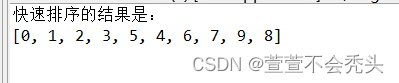
2.方法2
2.2 基本思想

①把左边第一个数当作基数;
②定义两个指针在第一个(i)和最后一个位置(j);
③j指针先移动,然后好到比基准数小的数后,停止;
④i指针向后移动,找到比基准数大的数后,停止;
⑤数据互换
⑥i和j相遇时 指针的位置与基准数进行互换,基准数到达其相应的位置
⑦ 进行递归直到排好序
①②:
③④:
⑤
⑥
2.2 代码
public static void main(String[] args) {

		int[] arr=new int[]{
    2,6,9,3,5,8,7,4,1,0};
		sort(arr,0,arr.length-1);
		System.out.println(Arrays.toString(arr));

	}

	public static void sort(int[] arr,int left,int right) {


		//递归出口
		if(left>=right) {

			return;
		}


		//1+ 定义一个数作为基准数
		int base=arr[left];
		//2+ 定义i和j两个游标
		int i=left;
		int j=right;
		//3+ i和j不相遇
		while(i!=j) {

			//j从后向前移动,去找比当前基准数小的数值
			while(arr[j]>=base && i<j) {

				j--;
			}
			//i游标向前移动去找比当前基准数大的数值
			while(arr[i]<=base && i<j) {

				i++;
			}
			//进行互换
			int temp=arr[i];
			arr[i]=arr[j];
			arr[j]=temp;
		}
		//基准数和相遇位置数进行交换
		arr[left]=arr[i];
		arr[i]=base;

		//递归关系
		sort(arr,left,i-1);
		sort(arr,i+1,right);

	}
三、归并排序
归并排序也用到了递归的思想对数据进行拆分
	public static void main(String[] args) {

		int[] arr=new int[] {
    1,5,9,6,3};
		sort(arr,0,arr.length-1);
		System.out.println("归并排序的输出结果是:");
		System.out.println(Arrays.toString(arr));
	}

	//采用递归进行拆分
	public static void sort(int[] arr,int left,int right) {

		//递归出口
		if(left>=right) {

			return;
		}
		int mid=(left+right)/2;
		//递归关系
		sort(arr,left,mid);
		sort(arr,mid+1,right);
		merage(arr,left,mid,right);

	}

	public static void merage(int[] arr,int left,int mid,int right) {


		//定义出临时数组
		int[] temp=new int[right - left+1];

		//定义s1,s2
		int s1=left;
		int s2=mid+1;
		//遍历临时数组
		int i=0;

		//将数据写入到临时数组中去
		while(s1<=mid && s2<=right) {

			//谁小谁往当前的数组当中去 arr[s1]小 所以s1到临时数组
			if(arr[s1]<=arr[s2]) {

				temp[i]=arr[s1];
				i++;
				s1++;
			}
			else {

				temp[i]=arr[s2];
				i++;
				s2++;
			}
		}

		//判断s1当中是否还有数据
		//当前还有数据
		while(s1<=mid) {

			temp[i] =arr[s1];
			i++;
			s1++;
		}
		//判断s2当中还有没有数据
		while(s2<=right) {

			temp[i]=arr[s2];
			i++;
			s2++;
		}
		//将临时数组中的数据放回到原来的数组当中去
		for(int j=0;j<temp.length;j++) {

			arr[j+left]=temp[j];
		}
	}
结果图:
边栏推荐
- Set, map and modularity
- ACM intensive training graph theory exercise 3 in the summer vacation of 2020 [problem solving]
- Clickhouse installation (quick start)
- Talk about how the kotlin collaboration process establishes structured concurrency
- Niuke rearrangement rule taking method
- Esp32 things (I): Preface
- Guilin robust medical acquired 100% equity of Guilin Latex to fill the blank of latex product line
- Solution to the sixth training competition of 2020 provincial competition
- Esp32 things (3): overview of the overall system design
- Distributed session
猜你喜欢

Raspberry pie 4B no screen installation system and networking using VNC wireless projection function

Using appbarlayout to realize secondary ceiling function

I'm late for school

4. use ibinder interface flexibly for short-range communication

Express の Hello World

Express の post request

Tutorial for beginners of small programs day01

ES6 learning path (III) deconstruction assignment

Microsoft. Bcl. Async usage summary -- in Net framework 4.5 project Net framework version 4.5 and above can use async/await asynchronous feature in C 5

仿照微信Oauth2.0接入方案
随机推荐
Deep Learning with Pytorch- A 60 Minute Blitz
Get to know handler again
Opencv learning notes -day8 (keyboard typing (waitkey()); Wait for typing) action: triggers some action when the appropriate character is typed using the keyboard)
Deeply understand the working principle of kotlin collaboration suspend (beginners can also understand it)
Opencv learning notes -day13 pixel value statistics calculation of maximum and minimum values, average values and standard deviations (use of minmaxloc() and meanstddev() functions)
What kind of experience is it to develop a "grandson" who will call himself "Grandpa"?
Esp32 things (I): Preface
Agp7.0|kts makes a reinforced plug-in
Terminal -- Zsh of terminal three swordsmen
Explanation on the use of password profiteering cracking tool Hydra
Express の post request
Dart basic notes
Deep understanding of continuation principle
Baidu map JS browsing terminal
qmlplugindump executable not found.It is required to generate the qmltypes file for VTK Qml
Distributed ID
Esp32 (7): I2S and I2C drivers for function development
Opencv learning notes -day2 (implemented by the color space conversion function cvtcolar(), and imwrite image saving function imwrite())
Opencv learning notes -day1 (image reading display imread, imshow, namedwindow)
Esp32 things (x): other functions