当前位置:网站首页>[STL source code analysis] summary notes (7): ingenious deque
[STL source code analysis] summary notes (7): ingenious deque
2022-06-11 07:16:00 【Janvis of the stark family】
00 Write it at the front
【STL Source analysis 】 Summary notes (6):iterator Design and magic traits
After mastering the basic design principles of iterators , Let's take a look at the implementation of the remaining sequential containers . At this time, we can focus more on the design of each container itself .
01 summary
deque It's a continuous linear space with two-way openings , That is, you can insert and delete at both ends . We know vector It's a continuous linear space with one-way openings , When the space is insufficient, you need to find a larger space and transplant it .
Why do you say deque Ingenious , because deque There is no concept of capacity , Can dynamically increase space .
But this continuity is just deque Create a kind of “ illusion ”, So let's see deque How to achieve continuity .

Not yet iterator, Just look at the middle part .
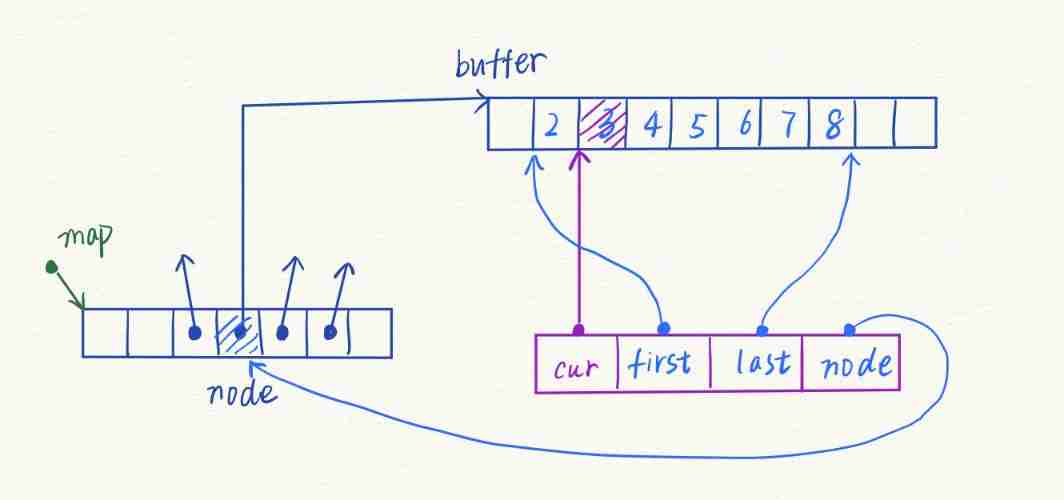
You can find map Where there are many pointers , And each pointer points to a piece buffer.
When adding elements , Only need buffer Add to . If you reach the boundary , Then expand map The pointer maintained in . That's why deque The reason why it can be expanded .
But it also means trying to maintain continuity “ illusion ”,iterator Will make a huge change ( heavy load ) To achieve, for example ++,– The operation of .
We will explain one by one later .
02 deque Structure
From the above figure, we have a brief understanding of deque Structure .
there map In fact, that is deque Control center ( Pay attention to this map No STL Medium map).map It is a small continuous space ( The bottom is actually vector), Each of them node Point to a large continuous space buffer, stay STL Its size can be specified in .
Look at the implementation directly :
template <class T,class Alloc=alloc,size_t BufSize=0>
class deque{
    public:
    	typedef T value_type;
    	typedef _deque_iterator<T,T&,T*,BufSiz>iterator;
    protected:
    	typedef pointer* map_pointer;
    protected:
    	iterator start;
    	iterator finish;
    	map_pointer map;//1
    	size_type map_size;//2
}
Look at this code from the above figure
First of all, pay attention to map,map Is a pointer to the space of the control center , And this includes pointers , therefore map The type of is a pointer to a pointer .(T**)
map_size Namely map Size , For example, the picture above shows 8.
We can think about it deque How many bytes is the size of .
map Is a pointer structure :4 byte .map_size 4 byte . Also need to know iterator Size .
And in the iterator There are four parts shown in the figure above :cur,first,last,node. Is the total 16 byte .
therefore deque Its size is 16+16+4+4=40 byte
03 deque The iterator
Then we can study it carefully deque The iterator of , This is also deque Soul . because deque The partition of the internal buffer , If you want to make it continuous ,iterator It must be possible to accurately find the previous or next buffer The location of , It is necessary to make some special judgment .
iterator Structure
Because the lines in the above figure are intricate , So here we put iterator Take it out and explain .
template <class T,class Ref,class Ptr,size_t BufSiz>
struct _deque_iterator{
    typedef random_access_iterator_tag iterator_category;//1
    typedef T value_type;//2
    typedef Ptr pointer;//3
    typedef Ref reference;//4
    typedef size_t size_type;
    typedef ptrdiff_t difference_type;//5
    typedef T** map_pointer;
    typedef _deque_iterator self;

    T* cur;
    T* first;
    T* last;
   	map_pointer node;
    ...
};
First of all, I was in iterator We mentioned in iterator Must be able to answer five questions .
The main concern here is iterator The pointers defined at the bottom .
- iterator One of the most basic functions is to point to the current element ,cur That's what it does .
- first Point to the header of the buffer segment ( Including spare space )
- last Point to the next position at the end of the buffer segment ( Including spare space ) Note that both of these pointers refer to the segment buffer .
- node Point to the control center , Used to distinguish which is currently in the control center node Control this buffer ( The pointer to the pointer )
Go back to the top and have a look start and finish, here start It refers to the above pointer of the first buffer ,finish Refers to the above pointer of the last buffer .
therefore begin() and end() It's settled. .
iterator begin(){return start;}
iterator end(){return finish;}
insert() Realization
Take up a insert() Example , Take a look at iterator How is the buffer Jumping between .
insert(position,x) Allows you to insert an element at a certain point . about deque Come on , It is necessary to judge where this point is closer to the left and right ends , This moves fewer elements .
iterator insert(iterator position,const value_type& x){
    if(position.cur==start.cur){// First, judge whether it is at the head end , If yes, give it to push_front() To deal with it
        push_front(x);
        return start;
    }
    else if(position.cur==finish.cur){// Then judge whether it is at the end , If yes, give it to push_back() To deal with it
        push_back(x);
        iterator tmp=finish;
        --tmp;
        return tmp;
    }
    else{
        return insert_aux(position,x);
    }
}
Let's see inert_aux() What did you do .
template <class T,class Alloc,size_t BufSize>
typename deque<T,Alloc,BufSize>::iterator
deque<T,Alloc,BufSize>::insert_aux(iterator pos,const value_type& x){
    difference_type index=pos-start;
    value_type x_copy=x;

    if(index<size()/2){
        push_front(front());// Add an element with the same value as the first element to the front .
        iterator front1=start;
        ++front1;
        iterator front2=front1;
        ++front2;
        pos=start+index;
        iterator pos1=pos;
        ++pos1;
        copy(front2,pos1,front1);// Move elements
    }
    else{
        push_back(back());// Add an element with the same value as the last element at the last end .
        iterator back1=finish;
        --back1;
        iterator back2=back1;
        --back2;
        pos=start+index;
        copy_backward(pos,back2,back1);// Move elements
    }
    *pos=x_copy;
    return pos;

}
insert_aux() First of all, I figured out which side this insertion point is close to .
If it's close to the left , Then push the element on the left .( We don't need to look at the specific implementation of the mobile operation first , Copy a header element in the header , Then the following use copy Move )
If it's close to the right , Then push the element on the right to insert .
Clever overloading
Back in size() when ,deque This is how it works :
size_type size() const {
    return finish-start;
}
It looks very consistent with the continuous space , In fact, these are overloads operator- Later results .
Let's see deque In order to achieve a continuous look , How operators are overloaded .
++/– operation
stay deque In this structure , The most important thing to consider is whether it is in the same buffer .
++ The operation is divided into two parts ++ And post ++, The difference between them can be found in list Found in that article .
In front of ++
The general implementation process is to implement the pre implementation first ++, Then use the overloaded prefix ++ To implement post ++
self& operator++(){
    ++cur;// Move to the next element
    if(cur==last){// If you reach the end
        set_node(node+1);// Change to the next buffer
        cur=first;
    }
    return *this;
}
Note that this is the first step + Compare later . because last The position of is the next position of the last element .
After ++
After ++ It depends on the front ++ To achieve .
self operator++(int){
    self tmp=*this;// Record original value
    ++*this;// Add
    return tmp;// Return the original value
}
– operation
– The operation is the same .
self& operator--(){// In front of --
    if(cur==first){
        set_node(node-1);
        cur=last;
    }
    --cur;
    return *this;
}

self operator--(int){// After --
    self tmp=*this;
    -- *this;
    return tmp;
}
+=/-= operation
deque It supports random access , For example, let the iterator jump several positions directly . The focus of consideration is still the problem of regional jump
+=
self& operator+=(differenc_type n){
    difference_type offset=n+(cur-first);
    if(offset>=0 && offset<difference_type(buffer_size()))
        cur+=n;
    else{
        difference_type node_offset=offset>0?offset/difference_type(buffer_size()):-difference_type((-offset-1)/buffer_size())-1;
        set_node(node+node_offset);
        cur=first+(offset-node_offset*difference(buffer_size()));
    }
    return *this;

}
First calculate the jumping distance , If not more than one buffer The length of , Then directly cur Move .
If more than one buffer The length of , I'm going to jump to the number from now on buffer, Adjust at the same time cur Point to .
Because the buffer size is fixed , So you can find the number of buffers by division .
-=
-= The operation is through += To complete .
self& operator-=(difference_type n){
    return *this+=-n;
}
+=-n This operation is also very clever .
+ and -
+ and - The operations of are respectively through += and -= Realized .
self operator+(difference_type n) const {//+
    self tmp=*this;
    return tmp+=n;
}

self operator-(difference_type n) const {//-
    self tmp=*this;
    return tmp-=n;
}
04 deque Structure and memory management of
Last but not least deque Memory structure , This part is quite long in the book , Let's simplify the key points of implementation .
deque Two dedicated space configurators are defined , Used to configure element size and map size
typedef simple_alloc<value_type,Alloc>data_allocator;// Configure element size
typedef simple_alloc<pointer,Alloc>map_allocator;// Configure pointer size
constructor as follows :
deque(int n,const value_type& value):statr(),finish(),map(0),map_size(0){
    fill_initialize(n,value);
}
fill_initialize Responsible for generating and arranging deque Structure .
fill_initialize Internal create_map_and_node() Responsible for arrangement deque Structure
void deque<T,Alloc,BufSize>::create_map_and_nodes(size_type num_elements){
     Number of nodes required =( Element number / The elements that each buffer can hold )+1;
     To configure map;
     take map Stay in the middle , The expandability of both ends of the head and tail is the same ;

}
Let's first look at when a buffer is full , Need to configure a new buffer
This part is implemented in the operation function , such as push_back()
void push_back(const value_type& t){
     If the buffer has two or more spare spaces , Continue construction ;
     There's only one spare space left , call push_back_aux();
}

void deque< T, Alloc,BufSize>::push_back_aux(const value_type& t){
     Call if it meets the condition reserve_map_at_back();
     Configure new buffer ;
}
There is also a case of map It needs to be expanded map
At this time, it involves the above mentioned reserve_map_at_back(), And the corresponding reserve_map_at_front(), stay push_front() in .
If map In the store map The position of the pointer is not enough , Will reallocate space .
In fact, the implementation depends on reallocate_map()
front and back The difference is that map Keep in the middle position ,front than back Make more space in front of you .
And expanding map It is also used to allocate more space , Copy and release , Namely vector Construction process of .
05 stack and queue
Stack and queue are the key contents when we learn data structure , The FIFO and FIFO structures can facilitate the operation of many data .
stay STL In the implementation of ,stack and queue In fact, it is done through the bottom container , So it is not called a container , It's called “ Container adapter ”(container adapter).
Adapter yes STL One of the six major components .
We need to pay attention to
stack and queue It specifies the way of data access , Therefore, traversal is not provided , It means that... Is not provided iterator.
So the two can only manipulate elements through their exits .
stack

stack It's a first in and last out structure , With deque As an underlying implementation, the head end opening needs to be closed .
template <class T,class Sequence = deque<T>>
class stack{
    protected:
    	Sequence c;
    public:
    	bool empty() const{return c.empty()};
    	...
}
It can be seen that all operations are calls deque Of .
According to our container knowledge , It can also be understood that stack You can also use list as well as vector As the bottom layer .
queue

queue It's a first in first out structure , That is, the top is added , Take out the bottom end .
In the same way, through deque Realized .
template <class T,class Sequence = deque<T>>
class queue{
    protected:
    	Sequence c;
    public:
    	bool empty() const{return c.empty();}
    	reference front(){return c.front();}
    	void push(const value_type& x){c.push_back();}
    	void pop(){c.pop_front();}
    	...
}
According to our container knowledge , It can also be understood that stack You can also use list As the bottom layer , But it can't be used. vector, because vector Cannot manipulate header elements .
06 summary
deque This structure is commonly used by us stack and queue The bottom of the , Need to master its ingenious design method .
deque The control center of is the core of the whole , And in each map Switching between is also the key point .
边栏推荐
- MySQL设置管理员密码无法生效的案例一则
- Modular notes
- big.js--使用/实例
- Promise. All capture error
- Xunwei dry goods | Ruixin micro rk3568 development board TFTP & NFS writing (Part 1)
- webserver
- 并发工具类
- Use definite integral to calculate triangle area
- [Xunwei dry goods] opencv test of Godson 2k1000 development board
- Shangtang technology has actively resumed work and will vigorously invest in the capacity and deployment of the digital sentry
猜你喜欢


随机推荐
Janus feature draft
Leetcode-647.Palindromic Substrings
Prototype and prototype chain
Use definite integral to calculate triangle area
自动化测试的生命周期是什么?
matplotlib的cmap
【LeetCode】-- 17.电话号码的字母组合
1190. invert the substring between each pair of parentheses
Gobang interface of mobile console (C language)
. Net C Foundation (6): namespace - scope with name
2022低压电工考题及在线模拟考试
No response from win10 explorer when dragging files
Mistakes in Niuke JS exercise
1266_ Implementation analysis of FreeRTOS scheduler startup code
Leetcode-647. Palindromic Substrings
1300. the array closest to the target value after transforming the array and
【CF#693 (Div. 3)】B. Fair Division
[deploy private warehouse based on harbor] 4 push image to harbor
Calculate the day of the week for a specific month, year and day
big. Js-- use / instance