当前位置:网站首页>Here document interaction free and expect automatic interaction
Here document interaction free and expect automatic interaction
2022-06-26 13:22:00 【C chord~】
Catalog
One .Here Document No interaction
2. No interactive way to achieve the number of rows statistics
3. adopt read Commands receive input and print
4. Set the password for the user
5. Support variable replacement
6. Turn off the function of variable replacement
7. Remove the front of each line TAB character
Two 、Expect Automated interaction
introduction
In our work, we need to realize shell Automation of scripts , This will reduce our workload , And in the shell We need to use interaction in the script .
One .Here Document No interaction
- Use I/0 The list of commands is provided to the interactive program by redirection
- Is a substitute for standard input
1. Grammar format
 command  << Mark
      ......
      ......

 Mark

 notes : The tag can be any character ( Usually use EOF), There can be spaces before and after the opening mark ( Will be ignored ), The ending mark must be written in the top case , There can't be any characters in front of it ( Including Spaces )
2. No interactive way to achieve the number of rows statistics
Put the content to be counted in the tag “EOF” Between , Direct the content to wc -l To statistics

3. adopt read Commands receive input and print
The input value is two EOF The part between the marks , As a variable i Value

4. Set the password for the user
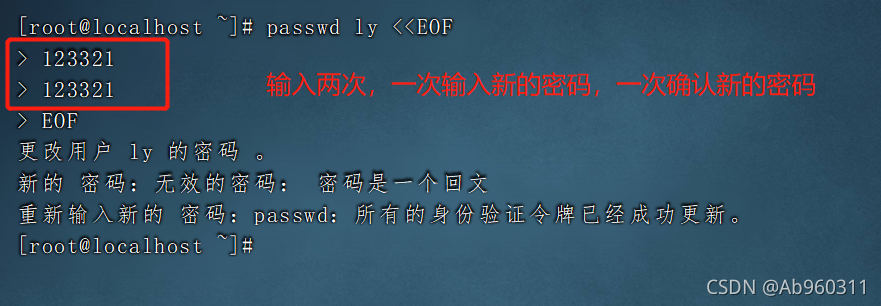
5. Support variable replacement
When you write to a file, you first replace the variable with the actual value , combining cat Command complete write


6. Turn off the function of variable replacement
Output the characters as they are , Without any modification or replacement
Not closed :

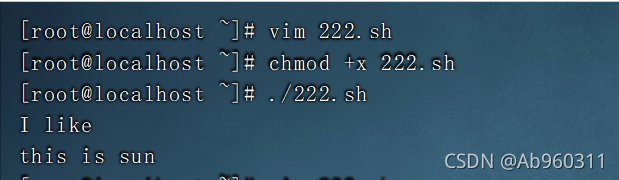
closed :


7. Remove the front of each line TAB character


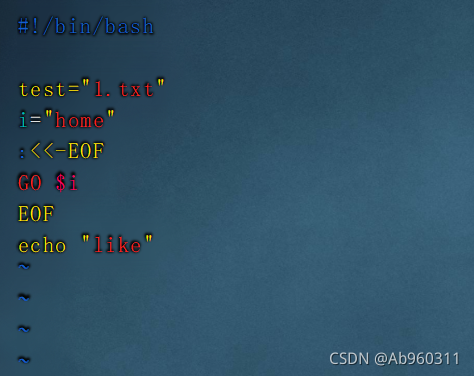
8. Multiline comment
- Bash The default comment for is “#”, This annotation method only supports single line annotations :Here Document It solves the problem of multi line annotation .
- ":" It's an empty order to do nothing . The contents of the middle marked area are not executed , Will be bash Ignore , So it can achieve the effect of batch annotation .
 Two 、Expect Automated interaction
- tand at tcl A tool based on language , It is often used for automatic control and testing , solve shell Interaction related issues in scripts
rpm -q expect
rpm -q tcl
yum -y install tcl expect 			#yum Or CD-ROM installation
1、 Basic commands
Script interpreter :
- expect The script first introduces the file , Indicate which one is used shell.
#!/usr/bin/expect
- spawn Usually followed by a Linux Carry out orders , Open a conversation 、 Start the process , And track subsequent interaction information .
example : spawn passwd root ## Track and start the process of changing user password
Interactive information
expect:
- Judge whether the last output result contains the specified string , If so, return immediately , Otherwise, it will wait for the timeout to return ;
- Used to receive output after command execution , And then match the expected string .
- Can only be captured by spawn The output of the started process ;
send:
- Send string to process , Used to simulate user input ; This command does not automatically enter to wrap lines , Generally, we need to add \r( enter ) perhaps \n.
 Mode one :
expect " password " {send "abc123\r"}  # The same line send There should be {}

 Mode two :
expect " password "
send "abc123\r"       # Line break send Part of it doesn't need to have {}

 Mode three :
expect Supports multiple branches

expect     # Just match one of the cases , Execute corresponding send Statement to exit the expect sentence
{
" password 1" {send "abc123\r"}
" password 2" {send "123456\r"}
" password 3" {send "123123\r"}
}
Terminator :
- expect eof
 Indicates the end of the interaction , Waiting for execution to end , Return to the original user , And spawn Corresponding .
 For example, switch to root user ,expect The script default is to wait 10s, When the command is finished , Default stay 10s after , Automatically switched back to the original user
interact
1、 Keep interactive after execution , Give control to the console , Will stay at the target terminal without returning to the original terminal , At this time, it can be operated by hand .
interact The last order doesn't work , such as interact Add exit, It's not going to quit root user .
 And if not interact Will exit after login , Instead of staying on the remote terminal .

2、 Use interact Will remain in the terminal and will not return to the original terminal , For example, switch to root user , Will always be root In user state ;
 such as ssh To another server , Will always be on the target server terminal , Instead of switching back to the original server .

3、 Be careful :expect eof  And  interact  You can only choose one .
set
- expect The default timeout is 10 second , adopt set Command to set the session timeout , If the timeout is not limited, it should be set to -1.
exp_continue
- exp_continue Attached to a expect After the judgment , After the item is matched , Can continue to match the expect Determine other items in the statement .
- exp_continue Similar to... In a control statement continue sentence . It means to allow expect Continue down the instruction .
send_user
- send_ user Represents the echo command , amount to echo
Receiving parameters
- expect Scripts can accept from bash Parameters passed from the command line , Use [lindex $argv n] get , among n from 0 Start , They are the first , the second , Third …
set hostname [ lindex $argv 0]
amount to hostname=$1
set password [ lindex $argv 1]
amount to password=$2
 example 1:ssh No interactive login to the remote server

[[email protected] ~]# vim expect.sh

#!/usr/bin/expect   // You need to use expect Own interpreter , Be careful not to write bash Otherwise, I can't recognize

spawn ssh [email protected]   // Open a program , This program is ssh Remote login


expect {               // Capture content , When there is a password When , Will send the password to the program , The default is no line break , So we need to \r Carriage returns , Multiple conditions need to be enclosed in curly braces !
        "password:"
        { send "123456\r"; }
}

interact   // Interaction , Otherwise, it will exit the remote server directly

[[email protected] ~]# chmod +x expect.sh  // Need to add Execution Authority
[[email protected] ~]# ./expect.sh
spawn ssh [email protected]
[email protected]'s password:
Last login: Mon Jul 27 23:31:00 2020 from 192.168.100.120
 If you want to do something on the other server before exiting, you can execute the following script
[[email protected] ~]# vim expect.sh
#!/usr/bin/expect

spawn ssh [email protected]

expect {
        "password:"
        { send "123456\r"; }
}


expect "#"       // When you catch # When
send "ls\r"    // perform ls command
send "ifconfig ens33\r"   // perform ifconfig ens33 command
send "exit\r"   // After execution exit Exit login

expect eof    // No need for interaction , It means the end expect Program , If you don't write, you won't execute the operation and exit directly ; If you don't write , Write interact You can't execute commands on the other machine ,eof Can replace

 Define and reference variables
 use set Keywords define variables , The variable name and the value of the variable are separated by a space , Other usage and shell The script is consistent
#!/usr/bin/expect
set user root
set ip 192.168.245.211
set pass 123456


 Reference location variable
#!/usr/bin/expect
set user root
set ip [lindex $argv 0]    // Set the first position variable to ip
set pass [lindex $argv 1]   // Set the second location variable to login password

spawn ssh [email protected]$ip

expect {
        "password:"
        { send "$pass\r"; }
}


expect "#"
send "ls\r"
send "ifconfig ens33\r"
send "exit\r"

expect eof

[[email protected] ~]# ./expect.sh 192.168.245.211 123456   // Position variables need to be added during execution


 You can also define other parameters , For example, time-out , Log etc.
# Timeout time
set timeout 20   // Login timeout how many seconds to exit
# Open the log file
log_file test.log   // Logging operations
# display information
log_user 1   //1 Output information for the screen ,0 Is not output
stay shell Call in script expect
 Create user and set user password
 Case study 1:
#!/bin/bash
username=$1

useradd $username

/usr/bin/expect <<-EOF

spawn passwd $username
expect {
" password "     // Be careful : The obtained content and the sent content cannot be on the same line, otherwise the execution will not succeed
{send "123321\r";exp_continue}
" The new code "
{send "123321\r";}
}
EOF
The verification results :
[[email protected] ~]# . user.sh ab
spawn passwd ab
Change user ab Password .
new password :
Invalid password : The password is less than 8 Characters
Reenter the new password :
passwd: All authentication tokens have been successfully updated .summary :
Use expect Commands that handle interactions , It can improve the work efficiency of system managers , Reduce the pressure of our work , It can be said that it is a good helper for our operation and maintenance personnel .
边栏推荐
- Summary of wechat applet test points
- Electron official docs series: Testing And Debugging
- Uva11582 [fast power]colossal Fibonacci numbers!
- Word document export (using fixed template)
- What should the software test report include? Interview must ask
- tauri vs electron
- Beifu PLC model selection -- how to see whether the motor is a multi turn absolute value encoder or a single turn absolute value encoder
- Thinking caused by the error < note: candidate expectations 1 argument, 0 provided >
- Aesthetic experience (episode 238) Luo Guozheng
- 原型模式(prototype)
猜你喜欢
What should the software test report include? Interview must ask

MySQL数据库讲解(三)

组合模式(Composite )

【Spark】. Explanation of several icons of scala file in idea

Basic methods for network diagnosis and hardware troubleshooting of Beifu EtherCAT module

shell脚本详细介绍(四)
![8. [STM32] timer (TIM) -- interrupt, PWM, input capture experiment (proficient in timer)](/img/e7/2fd8ec8d5e5473c7f84f3e3bcedca8.png)
8. [STM32] timer (TIM) -- interrupt, PWM, input capture experiment (proficient in timer)

ES基于Snapshot(快照)的数据备份和还原

Electron official docs series: Processes in Electron

mysql讲解(一)

随机推荐
[how to connect the network] Chapter 2 (middle): sending a network packet
Aesthetic experience (episode 238) Luo Guozheng
Generate JDE dot train
E - Apple Catching
Chapter 10 setting up structured logging (2)
es常用语法一
[shell] generate strings between specified dates
Electron official docs series: Testing And Debugging
Uva5009 error curves three points
7-2 a Fu the thief
首批通过!百度智能云曦灵平台获信通院数字人能力评测权威认证
组合模式(Composite )
D - 滑雪
三维向量的夹角
HDU 3709 Balanced Number
MediaPipe手势(Hands)
Mode pont
A primary multithreaded server model
LAMP编译安装
解中小企业之困,百度智能云打个样