当前位置:网站首页>Message queue -- the problem introduced: repeated consumption & sequential consumption & distributed transactions
Message queue -- the problem introduced: repeated consumption & sequential consumption & distributed transactions
2022-07-26 20:34:00 【Qihai Jianren】
Last article 《 Getting started with message queuing 》 Mentioned inside , Technology is a double-edged sword ! We use message queue because it brings us many benefits : Decoupling between systems 、 Asynchronous execution 、 Peak clipping and current limiting , But using message queuing may bring some problems : Messages in the message queue are consumed repeatedly 、 The order of messages is guaranteed 、 Data inconsistency caused by asynchronous execution ;
This article will introduce these possible problems after the introduction of consumption queues , And common solutions ;
1. The problem of repeated consumption of news
Message re consumption is after using message queue , A question that must be considered , It is also a serious and common problem ;
for example , For order scenarios , The notification of order results is generally asynchronous , The order center receives the receipt from the third party payment channel , Then it is encapsulated into business order results and delivered to the business party ; At present, the delivery methods I contact are HTTP/DUBBO Callbacks and message queues MQ;
Considering the consumption capacity of downstream business parties ( Consumption speed ), Using message queuing is a better choice ; For example, a page of cumulative consumption activities , Once your order is completed, take a look at the activity page , Sometimes the cumulative amount is immediately added , Sometimes it's delayed for a long time , Why? ? This speed depends on the consumption rate of the message queue , If the consumption is slow and blocked, I will see it later ;
Generally speaking , The receiving mode of message queue is often confirmed manually , This means that if an exception is thrown in the consumer's processing logic , The message will be re delivered ;
Besides , There are usually multiple downstream listening services for payment result messages , When a downstream business party is unavailable for a short time , When it recovers, you may want the message to be delivered again in a certain time interval , At this time, other systems will also receive these consumed messages , You need to consider when other systems receive repeated messages , Whether dirty data will be generated ? Like a message of successful payment, it was delivered twice , Will there be two prizes ;
in fact , Message resending is very common , Service The network jitter , Developer code Bug Etc. may fail to handle , And ask for message resending ; This requires our interface to have a feature —— idempotent ;
idempotent (idempotent、idempotence) It is a concept of mathematics and computer science , Common in abstract algebra ;
The characteristic of an idempotent operation in programming is that any multiple execution has the same effect as one execution ;
Idempotent function , Or idempotent method , It means that the same parameters can be used for repeated execution , And can get the same result function ; These functions do not affect the state of the system , You don't have to worry about repeated execution that will change the system ;
How to realize idempotent ?
General idempotent , It needs to be considered in different scenarios , See if it's a strong check or a weak check ; For example, scenes related to money are crucial , Just do a strong check , Don't use scenes that are not very important, such as message frequency control ( Fatigue control ), You can do weak verification ;
(1) Strong check : For example, you can monitor the success of user payment , Then execute the business order update 、 Distribution of rights and interests 、 Downstream message local persistence DB operation , These operations can be placed in a transaction ;
Every time a message comes, you should take the unique identifier such as the business order number to check the order flow table , See if you have handled this running water , After processing, directly terminate the process and return , Don't go through the following process , If not, the subsequent post-processing logic will be executed ;
(2) Weak check : This simple , Some unimportant scenes , For example, the processing of SMS sending messages , You can put { The receiver ID+ Business scenario ID} As a unique identifier, as Redis Of key Put it in the cache , Set the expiration time ( Do fatigue control ), Go every time you receive an executive SMS message Redis Judge , See if you still need to send text messages to users ;
The reason is weak verification , It's because of the use of KV Even if the Redis It doesn't matter if the internal data is cleared , The most is to spend more and send one more text message at a time , Business is also irrelevant ;
2. Message order consumption problem
About sequential consumption , There are not many such scenarios in the development process , There are more introductions on the Internet binlog Synchronization of , It seems that more scenes are gone ; The normal business scenario is to follow the steps , Natural timing , It is difficult to deliver messages in parallel ;
for instance , We all know that when there is a large amount of data , The pressure of data synchronization is still great , Sometimes a table with a large amount of data needs to synchronize hundreds of millions of data to the downstream , In this case, the data that needs to be synchronized can be connected to the queue , Then the downstream slowly consumes ;
At this time, it is possible to increase a piece of data in the library at the same time 、 Change 、 Delete three operations , But when you send the message, it becomes a change 、 Delete 、 increase , So the data is wrong ;
How to solve the message sequence consumption ?
Several different MQ Refer to this article for the way to implement sequential messages 《 several MQ Implementation of sequential messages 》; Here is a brief introduction RocketMQ A simple implementation inside ;
RocketMQ Of Official documents It gives " Message ordering " The definition of ——
Message ordering refers to a kind of message consumption , Can be consumed in the order in which they are sent ;
for example : An order generates three messages: order creation 、 Order payment 、 Order complete , Consumption can only be meaningful if it is consumed in this order , But at the same time, orders can be consumed in parallel ;RocketMQ Can strictly guarantee the orderly information ;
Sequential messages are divided into Global sequential messages And Partition order messages , Global order refers to a Topic All messages in the following order should be guaranteed ; Partial sequential messages only need to ensure that each group of messages is consumed sequentially .
- Global order For a given Topic, All messages are strictly FIFO (FIFO) Publish and consume in the same order ; Applicable scenario : Low performance requirements , All messages are strictly in accordance with FIFO Principles for news release and consumption scenarios ;
- Division order For a given Topic, All information is based on sharding key Block partition ; Messages in the same partition follow strict FIFO Publish and consume in sequence ;Sharding key It's the key field in the sequential message to distinguish different partitions , And regular news Key It's a completely different concept ; Applicable scenario : High performance requirements , With sharding key As a partition field , In the same block, strictly according to FIFO Principles for news release and consumption scenarios .
If you want to implement global sequential messages , Then only one queue can be used , And individual producers , This can seriously affect performance ;

therefore , We often say sequential messages are only partial sequential messages , In the case of the above example , We don't care about different orders ID The overall consumption order between messages , Just guarantee the same order ID The message can be created according to the order 、 Order payment 、 It's OK to consume in the order of order completion ;
Sequential consumption actually has two core points , One is Producers store in order , The other is Consumers consume in an orderly way ;
(1) Producers send in order
We know RocketMQ Messages produced by producers in will be placed in a queue , Based on queues FIFO The first in first out feature naturally ensures that the order of messages stored in the queue is consistent with the order of messages pulled , therefore , We just need to ensure that a set of the same messages are stored in a given order Into the same queue , It can ensure the orderly storage of producers ;
In the normal mode of sending messages , One topic There are multiple queues under , Producers will use polling to distribute consumption evenly to different queues , And then consumed by different consumers ; Because a group of messages are in different queues , At this time, the natural of queues cannot be used FIFO Features to ensure the ordering of messages ;
RocketMQ Support producers to customize the delivery strategy when delivering messages , That is, select the queue for the current message ;RocketMQ Provide MessageQueueSelector Queue selection mechanism , He has three realizations :
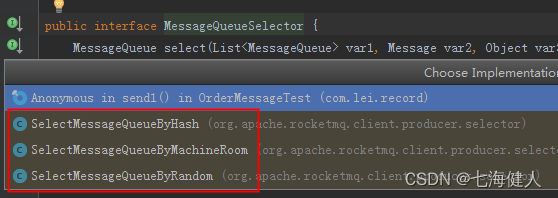
We achieve one MessageQueueSelector Interface ( Use Hash Take the mold ), To ensure that the same order is in the same queue , That is, by order ID% The number of queues gets this ID The index of the queue on which the order is placed in the queue list , Then all messages of the order will be put into the queue ;
in addition , For message producers , Sequential messages must be sent synchronously to ensure that the messages sent by producers are in order , This is also very easy to understand ;
for instance , Yes 2 A queue , Then order ID by 1,2,3 Of the three groups of messages ,1、3 Group messages are based on Hash The module results are stored in the first queue , and 2 Group messages are stored in the second queue , The following figure shows a possible message storage sequence :

Be careful : actually , There are sometimes problems with the queue selector approach ; Our goal is to send messages to the same queue , Imagine if someone broker Hang up , Then the number of queues will be reduced , If the Hash Deliver the surplus , It may cause different messages in the same business before and after the number of queues changes , They are sent to different queues , It leads to the disorder of some short messages ; alike , If you increase the number of queue servers , It will also cause temporary disorder of some messages ;
(2) Consumers consume in an orderly way
The orderly storage of producers realizes , So how to realize the orderly consumption of consumers ?
RockerMQ Of MessageListener The callback function provides two consumption modes , Orderly consumption pattern MessageListenerOrderly And concurrent consumption patterns MessageListenerConcurrently;
Consumers can register MessageListenerOrderly Type callback interface to realize sequential consumption ; If consumers adopt Concurrently Parallel consumption , The order of message consumption is still not guaranteed ;
actually , Every consumer uses thread pool to realize multi-threaded consumption , That is, the consumer side is multi-threaded consumption ; although MessageListenerOrderly It is called orderly consumption pattern , But the thread pool is still used to consume messages ;
MessageListenerConcurrently It is to pull new messages and submit them to the thread pool for consumption , and MessageListenerOrderly It is through Add distribution lock and Local lock Ensure that there is only one thread consuming data on a queue at the same time ;
MessageListenerOrderly The locking mechanism :
- When pulling messages from a queue, consumers first ask Broker The server requests a queue lock , If you apply for a lock , Then pull the message , Otherwise, give up the message pull , Wait until the next queue load cycle (20s) Try again ; This lock makes a MessageQueue You can only be consumed by one consumer client at a time ;
- Suppose the consumer is right messageQueue The locking of has been successful , Then it will start to pull messages , After pulling the message, it will also be submitted to the thread pool on the consumer side for consumption ; But before local consumption , Will get the first messageQueue Corresponding lock object , every last messageQueue Corresponding to a lock object , After obtaining the lock object , Use synchronized Blocking application thread level exclusive lock ; This lock makes it come from the same messageQueue Messages of can only be consumed by one thread in a consuming client at a local time ;
- Add locally synchronized After locking successfully , And judge : If it's broadcast mode , Then directly consume , If it's cluster mode , Then judge if messagequeue Not locked or expired ( Default 30000ms), So delay 100ms Then try again to Broker Apply for lock messageQueue, Resubmit the consumption request after locking successfully ;
For the moment , Consumer use MessageListenerOrderly There are two problems with sequential consumption :
- Used a lot of locks , Reduced throughput ;
- When the previous message consumption is blocked, subsequent messages will be blocked ; If you encounter the message of consumption failure , The current message will be retried automatically ( The interval time is 1 second ), Cannot automatically skip , The maximum number of retries is Integer.MAX_VALUE, This will cause the current queue consumption to pause , Therefore, it is usually necessary to set a maximum number of consumption , And deal with all possible exceptions ;
3. Messages and distributed transactions
What is business ?
A transaction is a series of operations , Or at the same time , Or fail at the same time ; Transaction is to ensure that a series of operations can be performed normally , It must satisfy at the same time ACID characteristic ;
What is distributed transaction ?
Think about it , Your order process may involve 10 Multiple links , You've paid for your order , But your coupon deduction failed , Failed to add points , The former company will be collected , The latter users will be unhappy , But these are all in different services, how to ensure everyone's success ?—— Use distributed transactions ;
The implementation of distributed transactions can be roughly divided into :
- 2pc( Two paragraph submission )
- 3pc( Three paragraph submission )
- TCC(Try、Confirm、Cancel)
- Best effort notification
- XA
- Local message table (ebay Developed by )
- Half the news / Final consistency (MQ)
The introduction of distributed transaction is to solve the transaction problem of a business scenario in a distributed environment , Of course, there are all kinds of disadvantages , for example :
(1) Lock database resources for a long time , This leads to a slow response of the system , It's not going up at the same time .
(2) Network jitter appears brain crack situation , Cause the participants of things , Can't execute the coordinator's instructions very well , Leading to data inconsistency .
(3) A single point of failure , For example, the coordinator of things , At some point, it goes down , Although new... Can be produced through the electoral mechanism Leader, But in the process , There are bound to be problems ;
Here is the simplest 2pc( Two-stage type ) programme , And the combination under the order scenario MQ The final consistency scheme commonly used in middleware , The purpose is to understand distributed transactions and the role of message oriented middleware ;
2pc( Two paragraph submission )

2pc( Two paragraph submission ) It can be said that it is the beginning of distributed transaction ; Pictured , Coordinate multiple systems through message oriented middleware , When both systems operate transactions, they lock resources but do not commit transactions , When both are ready , Tell message middleware , Then separately commit the transaction ;
But the problem is also very detailed , If A System transaction commit succeeded , however B The system fails to submit due to network fluctuation or various reasons , In fact, it will cause the transaction to fail ;
Final consistency

Pictured , In the whole process , We can guarantee that it is :
- The local transaction submission of the business pusher failed , The business receiver will not receive the delivery of the message ;
- As long as the local transaction of the business initiator is executed successfully , Then the message service will deliver the message to the downstream business passive party , And ultimately ensure that the business passive party can successfully consume the message ( Success or failure of consumption , That is, there must be a final state );
That's how technology works , We need to consider all kinds of extreme situations , It's hard to have a perfect plan , That's why there are so many three-stage solutions 、TCC、 Best effort notification and other distributed transaction schemes , You just need to know why , What's the advantage of doing it , What's the harm , In the actual development, pay attention to it , The system is designed according to business scenarios , Technology that leaves the business doesn't make sense , There is no foundation to leave the business of technology ;
Reference resources :
《 Business needs sequential consumption , How to ensure timing ?》
《RocketMQ The order of the message ( Sequential consumption )》 Most of the figures in this article come from this article , Write very well !
边栏推荐
猜你喜欢





随机推荐
Quick start to connection pooling
MPLS multi protocol label switching technology
文件上传的方式和下载
BGP的路由黑洞和防环
Gartner发布最新《中国AI初创企业市场指南》,弘玑Cyclone再次被评为代表性企业
破题数据中心绿色可持续发展
The Sandbox 和艺术家 Alec Monopoly 达成合作
韩国计划每年砸1万亿韩元,研发半导体材料及设备
数字化工厂的优势有哪些
深度可分离卷积(DepthwiseSeparableConvolution):Depthwise卷积与Pointwise卷积
HM中如何获取CU块划分信息并用Matlab绘图
小场景带来大提升!百度飞桨EasyDL助力制造业流水线AI升级
Leetcode's question brushing -- List summary
confd+etcd实现高可用自动发现
[experiment sharing] CCIE BGP routing black hole experiment]
谷歌的新编程语言被称为 Carbon
如何优雅地赞美他人?不妨尝试下这几种方式
游戏合作伙伴专题:BreederDAO 与 Ultiverse 建立了一个新的元宇宙
Gartner released the latest market guide for Chinese AI start-ups, and Hongji cyclone was once again rated as a representative enterprise
查询字段较多时可以添加普通查询和高级查询两种情况