当前位置:网站首页>[paper reading] tganet: text guided attention for improved polyp segmentation
[paper reading] tganet: text guided attention for improved polyp segmentation
2022-06-11 01:10:00 【xiongxyowo】
[ Address of thesis ][ Code ][MICCAI 22]
Abstract
Colonoscopy is a gold standard , But highly dependent on the operator . Automatic polyp segmentation can minimize the missed diagnosis rate , And in the early stage of timely treatment of colon cancer . Even if there are deep learning methods developed for this task , But the change of polyp size will affect the training of the model , Thus, it is limited to the size attribute of most samples in the training data set , May provide suboptimal results for polyps of different sizes . In this work , In the training process, we use the features related to the size and the number of polyps in the form of text attention . We introduce an auxiliary classification task , Weighting text-based embedding , Enable the network to learn additional feature representations , It can obviously adapt to polyps of different sizes , And can adapt to the situation with multiple polyps . Our experimental results show that , Compared with the most advanced segmentation methods , These additional text embeddings improve the overall performance of the model . We explored four different datasets , And the improvement suggestions for specific dimensions are provided . We propose a text guided attention network (TGANet) Polyps of different sizes in different data sets can be well summarized .
I. Network Architecture

The polyp segmentation network in this paper is a complex class . say concretely , The following modules are introduced :
Next, we analyze them separately .
II. Encoder
Use pre trained resnet50 As backbone( Not common in polyp segmentation tasks res2net). It should be noted that , This article seems to remove resnet the last one encoder block; Besides , The encoder Two additional tasks were undertaken . One is a dichotomy , Determine the number of polyps in the image ( Single / Multiple ); The other is three categories , Determine the size of polyps in the image ( Small , in , Big ).
however , This article does not clarify where the labels needed to supervise the classification task are obtained , The author speculates that manual annotation may be required , Interested readers can study their open source code for analysis .
III. Feature Enhancement Module
Yes encoder The obtained features are further enhanced . This module is very common , Basically, every partition should be designed with a similar attention Things that deal with features :
IV. Label Attention
This module is the core of this paper . say concretely , Is this part of the text :
In fact, the structure is quite complicated , So we only introduce ideas here . First, we introduce a semantic category (Semantic Class) The concept of , namely , If you perform a classification task on polyps , Then the images can be roughly divided into five categories : Single polyp , Polyp , Small polyp , Middle polyp , Large polyps . This category can be obtained from the above classification . Now? , In fact, there is an implicit category imbalance problem . If a model performs well on large polyps , But it doesn't perform well on small polyps , There may be many reasons , For example, the characteristics of small polyps are difficult to learn , Or the sample size of small polyps is very small … So at this point , We can use it attention thought , Right " Lack of study at present " Focus on the characteristics of , So as to improve the overall performance . The semantic category statistics of image samples obtained before can provide guidance for this process , So called "Text-Guided Attention".
V. Multi-Scale Feature Aggregation
It is also a classic multi-level feature fusion in segmentation tasks , I won't elaborate here :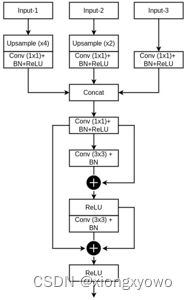
VI. Experiment
It should be noted that , The data set and " Mainstream polyp segmentation papers " Is not the same , by Kvasir-SEG,CVCClinicDB,BKAI,Kvasir-Sessile. Be careful Kvasir-Sessile It's actually Kvasir-SEG A subset of , So actually only three data sets are used . Besides , The comparison method is also the older method , As an article 2022 Year paper , No comparison 21 Year of sota Polyp segmentation method .
边栏推荐
- 【ROS入门教程】---- 03 单片机、PC主机、ROS通信机制
- Pirate OJ 448 luck draw
- WPF basic controls
- A simple understanding of B tree
- [introduction to ROS] - 03 basic concepts and instructions of ROS
- lucene思维导图,让搜索引擎不再难懂
- Datatemplate in WPF
- The best creative drum tool: groove agent 5
- QT thread and interface
- "Past and present" of permission management
猜你喜欢
AQS explanation of concurrent programming
Alicloud configures SLB (load balancing) instances

How to solve the deep paging problem in large factories (easy to understand)

【VBA脚本】提取word文档中所有批注的信息和待解决状态

Detailed explanation of five types of load balancing principle scenarios

NVIDIA Jetson之PWM风扇自定义控制

Dynamic programming classical topic triangle shortest path
![[persistent problems of NVIDIA driver] - - /dev/sdax:clean, xxx/xxx files, xxx/xxx blocks - the most complete solution](/img/0e/8c79f7c77f61dfa9a155ab33b77081.png)
[persistent problems of NVIDIA driver] - - /dev/sdax:clean, xxx/xxx files, xxx/xxx blocks - the most complete solution
[ROS tutorial] - 02 ROS installation

中小企业数字化转型为什么这么难?
![[ROS tutorial] - 02 ROS installation](/img/a9/8827524b9d7d076fc73754dd6cde83)
随机推荐
Kubeflow 1.2.0 installation
What are the advantages of increased life insurance products? Is the threshold high?
Synchronized keyword for concurrent programming
SLAM卡尔曼滤波&&非线性优化
Loop structure statement
配置化自定义实现1.实现接口,2.自定义配置3.默认配置
WSL automatically updates the IP hosts file
Pirate OJ 146 character string
Embedded learning materials and project summary
ViewPager和底部无线循环的小圆点
【ROS入门教程】---- 01 ROS介绍
LeetCode 8. String to integer (ATOI) (medium, string)
Dynamic programming classical topic triangle shortest path
为什么使用 Golang 进行 Web 开发
用data和proc怎么写出这个,不用sql
Block queue - delayedworkqueue Source Analysis
Josephus problem_ Unidirectional circular linked list_ code implementation
SQL audit | "cloud" users can use the SQL audit service with one click
A simple understanding of B tree
CentOS7 实战部署MySQL8(二进制方式)