当前位置:网站首页>25: Chapter 3: developing pass service: 8: [registration / login] interface: receiving and verifying "mobile number and verification code" parameters; (it is important to know the application scenario
25: Chapter 3: developing pass service: 8: [registration / login] interface: receiving and verifying "mobile number and verification code" parameters; (it is important to know the application scenario
2022-06-30 20:10:00 【Small withered forest】
explain :
(1) The content of this blog : Start developing 【 One click registration / Sign in 】 Interface ;
● then , The development part of this blog is : The user is clicking 【 One click registration / Sign in 】 After button , The back end will verify 【 Whether the user has entered the mobile phone number or verification code 】、【 Whether the verification code entered by the user matches 】;
(2) The points needing attention in this blog :
● Created BO Entity class , To accept the data submitted by the front-end form ;
● Used 【@Valid annotation 】 Parameter checking ;
● Some common methods , Can be defined in 【imooc-news-dev-service-api】 Interface Engineering BaseController Class ;
● Pay attention to the overall process of parameter verification ;
Catalog
1. stay 【imooc-news-dev-service-api】 Interface Engineering PassportControllerApi Interface , Definition 【 register / Sign in 】 Interface ;
    /**
     * 【 One click registration / Sign in , Interface 】
     * @param registLoginBo
     * @param result
     * @return
     */
    @ApiOperation(value = " One click registration / Login interface ", notes = " One click registration / Login interface ", httpMethod = "POST")
    // The request interface on the front end is already “getSMSCode” 了 , So I am writing back-end interface url When , Don't write ;
    @PostMapping("/doLogin")
    public GraceJSONResult doLogin(@RequestBody @Valid RegistLoginBo registLoginBo,
                                   BindingResult result);
explain :
(1) The interface request mode is POST, Because the front end is actually a form , The corresponding form submission generally uses POST The way ;
(2) Generally speaking , When receiving form data , We can use objects to take parameters ;
● So we are 【imooc-news-dev-model】 In model engineering , establish bo package , establish RegistLoginBo Entity class ;(BO It means , Objects passed from the page view layer , It can also be understood as Bussiness Object)( In this project ,BO Entity classes are passed from the front end to the back end ,VO Entity classes are passed from the back end to the front end )
package com.imooc.bo;

import javax.validation.constraints.NotBlank;
import javax.validation.constraints.NotNull;

/**
 * BO Entity class : Undertaking 【 One click registration / Sign in 】 Interface parameters ;
 */
public class RegistLoginBo {

    @NotBlank(message = " Cell phone number cannot be empty ")
    private String mobile;
    @NotBlank(message = " SMS verification code cannot be empty ")
    private String smsCode;

    public String getMobile() {
        return mobile;
    }

    public void setMobile(String mobile) {
        this.mobile = mobile;
    }

    public String getSmsCode() {
        return smsCode;
    }

    public void setSmsCode(String smsCode) {
        this.smsCode = smsCode;
    }

    @Override
    public String toString() {
        return "RegistLoginBo{" +
                "mobile='" + mobile + '\'' +
                ", smsCode='" + smsCode + '\'' +
                '}';
    }
}
● Here we use 【@Valid annotation 】 Parameter checking ; You can refer to 【Spring Boot E-commerce projects 24: Commodity classification module III : Use 【@Valid annotation 】 Check the input parameters ;】;
● among 【@NotNull】 annotation , Only the completely empty case can be verified , If the front-end input a value such as 【" "】 Empty string for , This annotation cannot be verified ;;; and 【@NotBlank】 The annotation can not only check the case that it is completely empty , It can also be verified as 【" "】 Empty string for ;
● then , Remember in the interface RegistLoginBo There are parameters , To use 【@Valid】 annotation , To enable parameter verification ;
● If we use... On entity classes lombok After the comments , You can omit get and set Such method ;;; however , Many companies do not recommend using lombok Of ( Because when it is combined with some third-party libraries , There may be some small bug)
● then , If we use bean When receiving parameters , Need to use 【@RequestBody】 annotation ;;; The main meaning of this note is 【 From the front JSON】 and 【 hinder RegistLoginBo registLoginBo】 Is the corresponding , In order to accept parameters ;
● Once the verification fails , There is an error message , We can go through 【BindingResult result】 To get the corresponding error information ; therefore , Here in the parameter , It has also been introduced. 【BindingResult result】;
● The content here , I've met before N Time , It's not particularly complicated , It's just a little more ;


2. stay 【imooc-news-dev-service-user】 User microservices PassportController Class , Realization 【 register / Sign in 】 Interface ;
 /**
     * 【 One click registration / Sign in , Interface 】
     * @param registLoginBo
     * @param result
     * @return
     */
    @Override
    public GraceJSONResult doLogin(@Valid RegistLoginBo registLoginBo, BindingResult result) {
        //0. Judge BindingResult Whether the error message of validation failure is saved in , If there is , It indicates that there is a problem with the input of the front end ( Mobile phone number or verification code , At least one has not been entered );
        //  that , We get this error message , And build a GraceJSONResult Unified return object , return ;
        if (result.hasErrors()) {
            Map<String, String> map = getErrorsFromBindingResult(result);
            return GraceJSONResult.errorMap(map);
        }
        //1. Check whether the verification code matches ;
        //1.1  Get the mobile phone number and verification code entered by the user in the front end ;
        String mobile = registLoginBo.getMobile();
        String smsCode = registLoginBo.getSmsCode();
        //1.2  According to the mobile phone number entered by the user in the front end , Try to go redis Get the corresponding verification code in ;
        String redisSMSCode = redisOperator.get(MOBILE_SMSCODE + ":" + mobile);
        //1.3 If the verification code entered by the front end , stay redis Does not exist in the ( explain : We are not targeting 【 The mobile phone number entered by the user 】 Sent verification code ;
        //  Or after the user receives the verification code text message , After that 30min Before use ,redis The verification code stored in the has expired ),
        //  Or the front-end input verification code and redis The difference between ( explain : The user's verification code is entered incorrectly );
        //  that , Go back to the corresponding , With error messages GraceJSONResult Unified return object ;
        //  among , Here we use 【org.apache.commons.lang3】 Medium StringUtils The utility class isBlank() Method to judge the null ;
        if (StringUtils.isBlank(redisSMSCode) || !redisSMSCode.equals(smsCode)) {
            return GraceJSONResult.errorCustom(ResponseStatusEnum.SMS_CODE_ERROR);
        }

        return GraceJSONResult.ok();
    }
explain :
(1) Judge 【 Parameter checking 】 whether OK;
● We are 【imooc-news-dev-service-api】 Interface Engineering BaseController in , Defines a method getErrorsFromBindingResult(): from BindingResult Extract error information from ;( This method , Later in other places , It will also be used )
(2) Check whether the verification code matches ;
● explain 1;
● explain 2;


3. effect ;
(1) overall situation install Look at the whole project ;
(2) start-up 【imooc-news-dev-service-usr】 Main startup class of user microservice ;
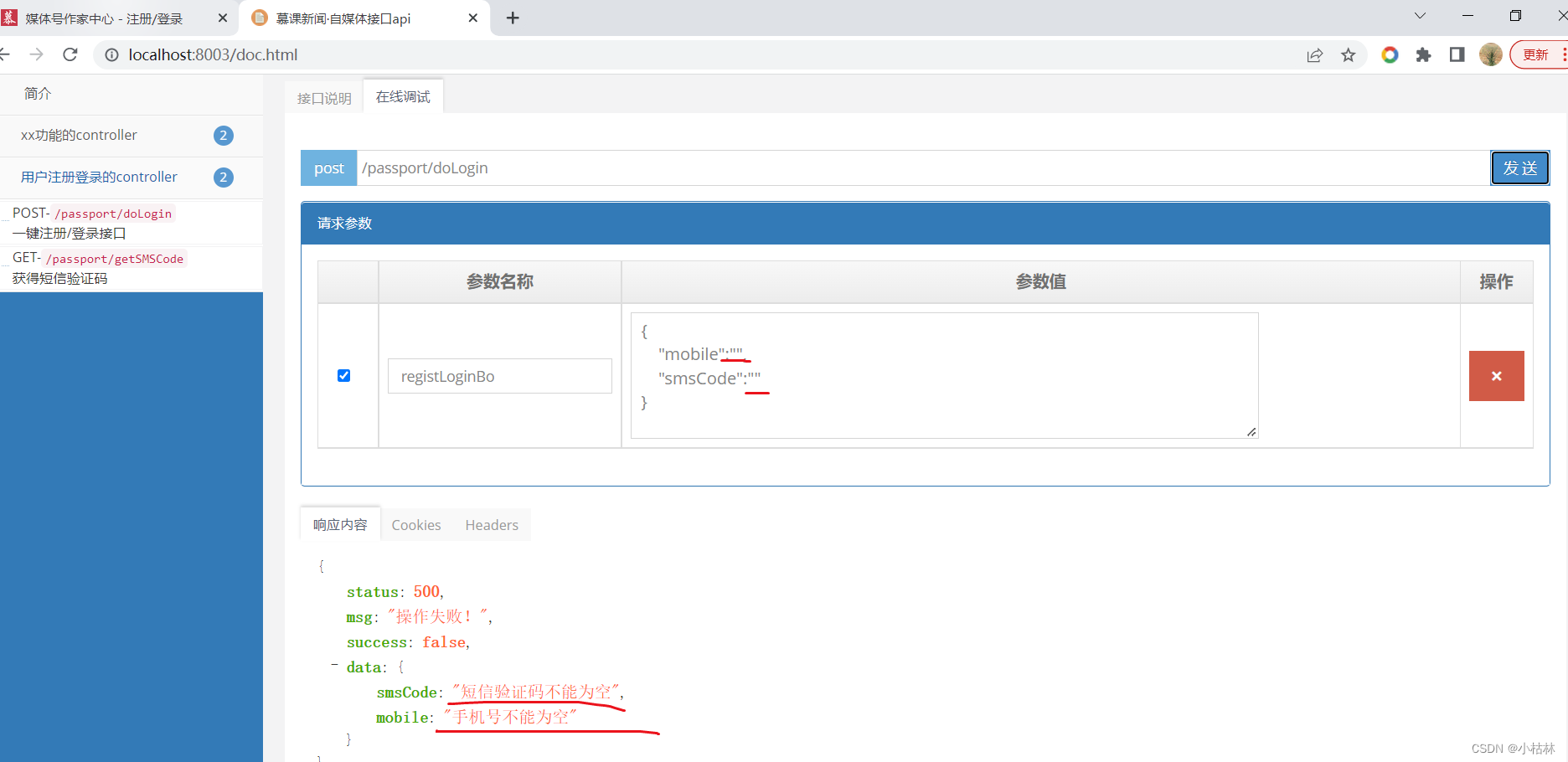
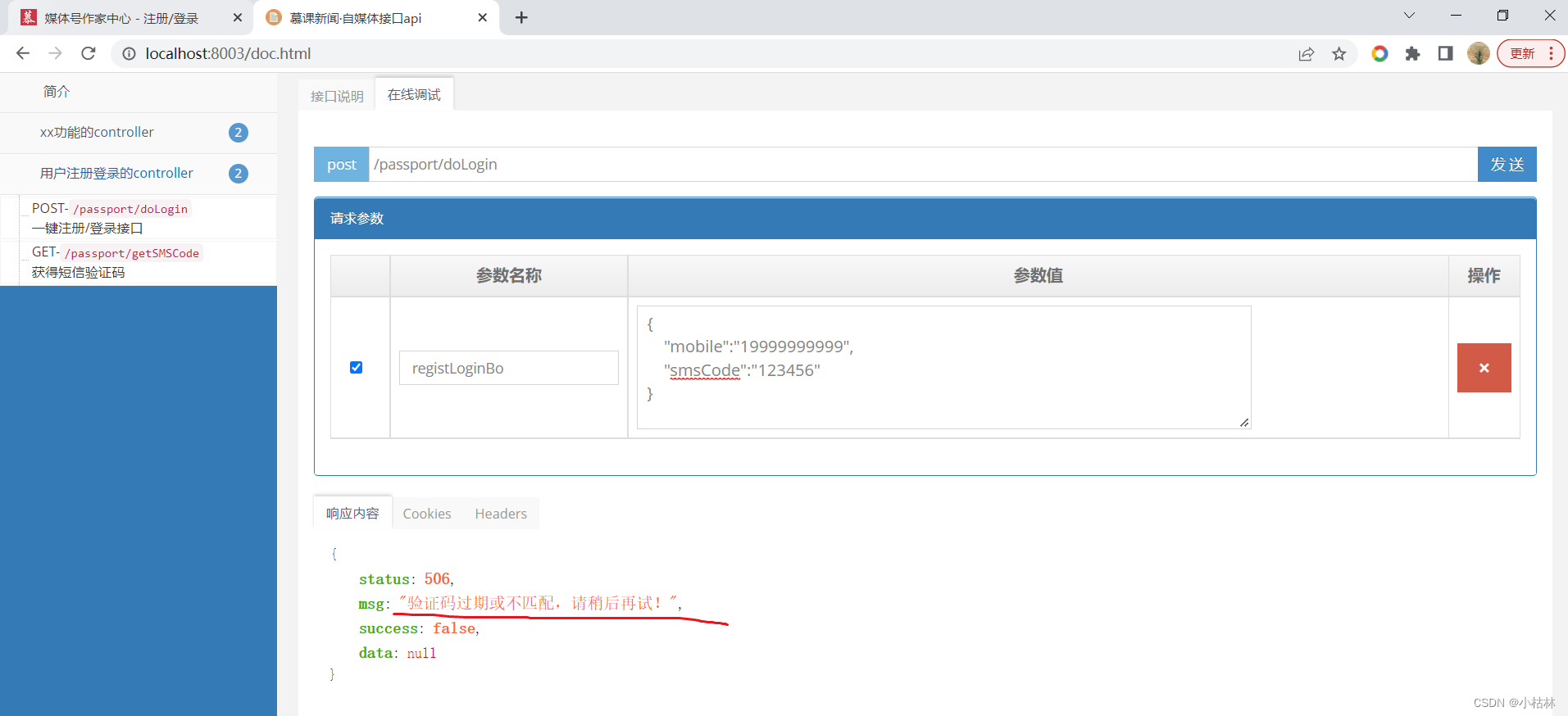
(3) We are 【http://localhost:8003/doc.html】Swagger2 On the page , To test the interface ;
● Failure situation ;
● OK The situation of ;


边栏推荐
- 为什么数字化转型战略必须包括持续测试?
- 太湖 “中国健康农产品·手机直播万里行”走进太湖
- Tensorflow2.4实现RepVGG
- 派尔特医疗在港交所招股书二次“失效”,上市计划实质性延迟
- Smarter! Airiot accelerates the upgrading of energy conservation and emission reduction in the coal industry
- 基于slate构建文档编辑器
- Source code analysis of redis ziplist compressed list
- 如何使用robots.txt及其详解
- Basic syntax of VB
- Ten percent of the time, the tar command can't parse the English bracket "()" when decompressing the file
猜你喜欢

MySQL billing Statistics (Part 1): MySQL installation and client dbeaver connection

exness:流动性系列-流动性清洗和反转、决策区间

今早,投资人开始集体出差

What is the difference between tolocal8bit and toutf8() in QT

Tencent conference application market was officially launched, with more than 20 applications in the first batch

【450. 删除二叉搜索树中的节点】

CADD course learning (2) -- target crystal structure information

The former king of fruit juice sold for 1.6 billion yuan

神经网络入门(上)

25:第三章:开发通行证服务:8:【注册/登录】接口:接收并校验“手机号和验证码”参数;(重点需要知道【利用redis来暂存数据,获取数据的】的应用场景)(使用到了【@Valid注解】参数校验)
随机推荐
传输层 使用滑动窗口实现流量控制
2022 最新 JCR正式发布全球最新影响因子名单(前600名)
arthas调试 确定问题工具包
mysql主从同步
建立自己的网站(20)
Tensorflow2.4实现RepVGG
将秒数转换为**小时**分钟
Torchdrug -- drug attribute prediction
Go language learning tutorial (13)
TorchDrug--药物属性预测
VB的基本语法
凌云出海记 | 一零跃动&华为云:共助非洲普惠金融服务
无线充U型超声波电动牙刷方案开发
开会,OneMeeting,OK!
Go语言学习教程(十三)
操作系统面试题汇总(不定期更新)
《微信小程序-基础篇》带你了解小程序中的生命周期(二)
Solution to rollback of MySQL database by mistake deletion
4.3寸触控屏12路控制端口可编程网络中控支持5台中控主机相互备份
网易云签到可抽奖?那一年我能签到365天。不信?你看。