当前位置:网站首页>On the routing tree of gin
On the routing tree of gin
2022-06-22 15:35:00 【Another cloud shot】
GIN It's a golang frequently-used Web frame , It's right API friendly , The source code comments are also very clear , It is fast and flexible to use , And high fault tolerance . The route in the title can be simply understood as the page address entered in the browser , and “ Trees ” It is An optimized data structure . Because in GIN This Web The routing tree in the framework is a prefix tree , So today we will focus on prefix tree .
What is a prefix tree
The prefix tree is actually Tire Trees , It's a variant of hash tree , Usually people call it word search tree . Prefix trees are often used for statistics , Sort and save a large number of strings . Because the prefix tree can reduce the query time by using the common prefix of the string , Minimize unnecessary string comparisons . Therefore, prefix tree is often used by search engine system for text word frequency statistics . Prefix trees have the following characteristics :
The root node contains no characters , Other nodes contain characters
The node contents of each layer are different
From the root node to a node , The characters passing through the path are concatenated , Is the string corresponding to the node
The child nodes of each node usually have a flag bit , Used to mark the end of a word
Take looking up Xinhua Dictionary as an example , Let's have a visual look at the prefix tree . I believe everyone has used the word search method of phonetic order , The operation contents are as follows :
Accurate pronunciation , Determine what letter to look up according to the syllable of the word .
stay “ Chinese phonetic syllable index ” Find this letter in , Find the syllable of the word in the corresponding part of the letter , Read the page number next to the syllable .
Open the body of the dictionary according to this page number , Find the word you want to look up in four tone order .
The whole process can be seen as a rough prefix tree lookup process , For example, to find idioms “ May all your wishes come true ” Medium “ assume ” Two words , In the dictionary, there is the following structure :
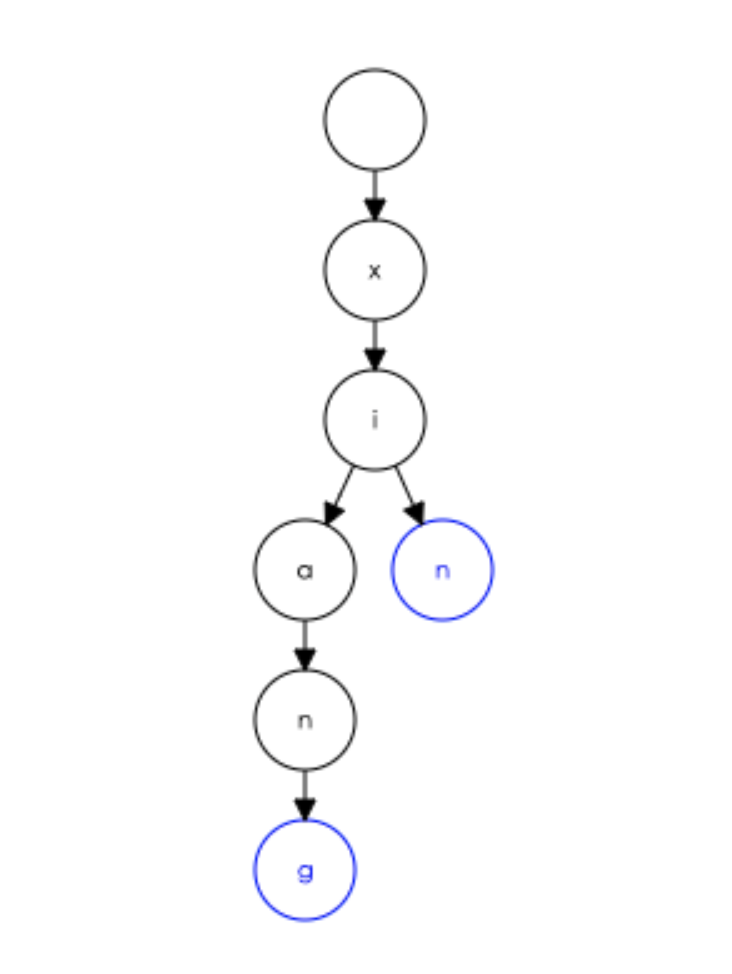
In the process of searching , We use the initials x, find x In the middle of xi This common part , Then find the corresponding rest according to different letters . Put it on the prefix tree , In the case of “ heart ” Corresponding xi -> n, and “ Want to ” It corresponds to xi -> ang
GIN Prefix tree in - Compact prefix tree
GIN Compared with the common prefix tree, the prefix tree in reduces the query level , For example, what we want to find above “ assume ” among xi As a common part , In fact, it can be allocated to the same node on the same layer instead of being divided into two parts :

This is the compact prefix tree , Similarly, if we have the following four routes , The compact prefix tree they form will look like this :
r.GET("/", handle1)r.GET("/product", handle2)r.GET("/product/:id", handle3)r.GET("/product/:name", handle4)
Store information in nodes
You can see from the above ,GIN The address of the entire query in the prefix tree can be obtained by splicing each node in the routing tree . that GIN How to complete the addition of these nodes , What is stored in each node ? We can solve this problem through GIN Source code to get the answer .
First GIN The common way to declare a route in is as follows :
func main(){ r := gin.Default() r.GET("/", func(context *gin.Context) { context.JSON(200, gin.H{ "status":"ok", }) }) r.Run()}// default Will initialize a engin example func Default() *Engine { debugPrintWARNINGDefault() engine := New() engine.Use(Logger(), Recovery()) return engine}type Engine struct { RouterGroup // type RouterGroup struct { // Handlers HandlersChain // basePath string // engine *Engine // root bool // } // Lowercase private , Not open trees methodTrees // ...}type methodTrees []methodTreetype methodTree struct { method string root *node}// trees This part of the routing tree consists of a method and root Field node List maintenance // Every node Represents each node in the routing tree // node The fields are as follows type node struct { path string // The absolute path of the current node indices string // Cache the first character of the next node When the child node is of wildcard type ,indices='' // The default is false, When children yes Wildcard type ,wildChild by true namely indices='' wildChild bool // The default is false, When children yes Wildcard type ,wildChild by true // The type of node , Because in the case of wildcards, special processing is required when querying , // The default is static type // The root node is root type // about path Cases that contain colon wildcards ,nType yes param type // To contain * Wildcards ,nType The type is catchAll type nType nodeType // It means that there are several routes passing through this node , Used on nodes priority uint32 // List of child nodes children []*node // child nodes, at most 1 :param style node at the end of the array handlers HandlersChain // It's from root All from node to current node path part ; If this node is the end node handlers For the corresponding processing chain , Otherwise nil; // maxParams Is the maximum number of wildcards from the current node to each leaf node fullPath string}// The specific node types are as follows const ( static nodeType = iota // default, Static nodes , Normal match (/user) root // The root node (/) param // Parameter node (/user/:id) catchAll // Universal matching , Match any parameter (*user))To add a route, you can do the following :
// In the process of creating a route , Each method will eventually be parsed and thrown to handle Function to handle func main(){ r := gin.Default() r.GET("/", func(context *gin.Context) { context.JSON(200, gin.H{ "status":"ok", }) }) r.Run()}func (group *RouterGroup) GET(relativePath string, handlers ...HandlerFunc) IRoutes { return group.handle(http.MethodGet, relativePath, handlers)}func (group *RouterGroup) POST(relativePath string, handlers ...HandlerFunc) IRoutes { return group.handle(http.MethodPost, relativePath, handlers)}// handle The function converts an absolute path to a relative path // And will Request method 、 Relative paths 、 processing method Pass to addRoutefunc (group *RouterGroup) handle(httpMethod, relativePath string, handlers HandlersChain) IRoutes { absolutePath := group.calculateAbsolutePath(relativePath) handlers = group.combineHandlers(handlers) group.engine.addRoute(httpMethod, absolutePath, handlers) return group.returnObj()}// Routing is mainly added in addRoute This function completes func (engine *Engine) addRoute(method, path string, handlers HandlersChain) { // check // The path must be in / start // The request method cannot be empty // Processing method cannot be empty assert1(path[0] == '/', "path must begin with '/'") assert1(method != "", "HTTP method can not be empty") assert1(len(handlers) > 0, "there must be at least one handler") // If it's on gin Of debug Pattern , Then the corresponding processing debugPrintRoute(method, path, handlers) // Get the root of the corresponding tree according to the request method // Each request method has its own corresponding compact prefix tree , Here we get the top root through the request method root := engine.trees.get(method) // If the root is empty , This means that this is the first route , Create one by yourself / by path The root node if root == nil { // If not, create root = new(node) root.fullPath = "/" engine.trees = append(engine.trees, methodTree{method: method, root: root}) } // Here path It's a sub route // The above content is a layer of pre verification , Avoid non-standard writing, which will cause the request query to fail // The next step is to add the body of the route root.addRoute(path, handlers)}// addRoute adds a node with the given handle to the path.// Not concurrency-safe! Concurrency is not secure func (n *node) addRoute(path string, handlers HandlersChain) { fullPath := path // When I'm done , The number of routes passing through this node will be +1 n.priority++ // Empty tree // If the tree is empty , That is, there is only one root node "/" Insert a child node , And set the current node to root Node of type if len(n.path) == 0 && len(n.children) == 0 { n.insertChild(path, fullPath, handlers) n.nType = root return } parentFullPathIndex := 0walk: for { // Find the longest common prefix. // This also implies that the common prefix contains no ':' or '*' // since the existing key can't contain those chars. // Find the length of the longest common prefix That is to i Location path[i] == n.path[i] i := longestCommonPrefix(path, n.path) // Split edge // Assume that the prefix information of the current node is hello // The existing prefix information is heo The node of , The current node needs to be split // Split into he node as well as (llo and o Two child nodes ) if i < len(n.path) { child := node{ // Remove the common prefix section , The rest of the content acts as child nodes path: n.path[i:], wildChild: n.wildChild, indices: n.indices, children: n.children, handlers: n.handlers, priority: n.priority - 1, fullPath: n.fullPath, } n.children = []*node{&child} // []byte for proper unicode char conversion, see #65 n.indices = bytesconv.BytesToString([]byte{n.path[i]}) n.path = path[:i] n.handlers = nil n.wildChild = false n.fullPath = fullPath[:parentFullPathIndex+i] } // Make new node a child of this node // Insert the new node into the new node parent Node as a child node if i < len(path) { path = path[i:] c := path[0] // '/' after param // If it is a parameter node Form like /:i if n.nType == param && c == '/' && len(n.children) == 1 { parentFullPathIndex += len(n.path) n = n.children[0] n.priority++ continue walk } // Check if a child with the next path byte exists for i, max := 0, len(n.indices); i < max; i++ { if c == n.indices[i] { parentFullPathIndex += len(n.path) i = n.incrementChildPrio(i) n = n.children[i] continue walk } } // Otherwise insert it if c != ':' && c != '*' && n.nType != catchAll { // []byte for proper unicode char conversion, see #65 n.indices += bytesconv.BytesToString([]byte{c}) child := &node{ fullPath: fullPath, } n.addChild(child) n.incrementChildPrio(len(n.indices) - 1) n = child } else if n.wildChild { // inserting a wildcard node, need to check if it conflicts with the existing wildcard n = n.children[len(n.children)-1] n.priority++ // Check if the wildcard matches if len(path) >= len(n.path) && n.path == path[:len(n.path)] && // Adding a child to a catchAll is not possible n.nType != catchAll && // Check for longer wildcard, e.g. :name and :names (len(n.path) >= len(path) || path[len(n.path)] == '/') { continue walk } // Wildcard conflict pathSeg := path if n.nType != catchAll { pathSeg = strings.SplitN(pathSeg, "/", 2)[0] } prefix := fullPath[:strings.Index(fullPath, pathSeg)] + n.path panic("'" + pathSeg + "' in new path '" + fullPath + "' conflicts with existing wildcard '" + n.path + "' in existing prefix '" + prefix + "'") } n.insertChild(path, fullPath, handlers) return } // Otherwise add handle to current node // Set processing function , If it already exists , False report if n.handlers != nil { panic("handlers are already registered for path '" + fullPath + "'") } n.handlers = handlers n.fullPath = fullPath return }}Priority priority
In order to quickly find and combine complete routes ,GIN While adding routes , Will be added to each node Priority This attribute . When searching, it is based on Priority Sort , Common node ( The node with the largest number of times ) At the front , And at the same level Priority The bigger the value is. , The more priority is given to matching .
Why should we 9 Two request methods are placed in slice instead of map in
This is because 9 Request methods correspond to 9 Routing tree , and GIN All corresponding request methods maintain a routing tree , At the same time, these key information are wrapped in Node In vivo structure , And placed in an array instead of map in . This is to fix the number of requests , At the same time, the request method will be maintained in memory after the project is started , Use fixed length slice So as to ensure a certain query efficiency and reduce memory consumption .
type methodTrees []methodTreefunc (trees methodTrees) get(method string) *node { for _, tree := range trees { if tree.method == method { return tree.root } } return nil}Find the route
After the routing tree is built ,GIN You can start to receive requests normally . The first step is from ServeHTTP Start to resolve the routing address , The processing logic of the search process is as follows :
Request a piece of memory to fill the response body
Processing request information
from trees Traverse the comparison request method in , Get the routing tree of the most corresponding request method
Get root node
func (engine *Engine) ServeHTTP(w http.ResponseWriter, req *http.Request) { c := engine.pool.Get().(*Context) c.writermem.reset(w) c.Request = req c.reset() // Really start processing requests engine.handleHTTPRequest(c) engine.pool.Put(c)}func (engine *Engine) handleHTTPRequest(c *Context) { // ... t := engine.trees for i, tl := 0, len(t); i < tl; i++ { // Judge according to the request method if t[i].method != httpMethod { continue } root := t[i].root // Find the route on the method tree value := root.getValue(rPath, c.params, unescape) if value.params != nil { c.Params = *value.params } // Execute processing functions if value.handlers != nil { c.handlers = value.handlers c.fullPath = value.fullPath c.Next() // involves gin Middleware mechanism // When you get here , The request has been processed , The returned results are also stored in the corresponding structure c.writermem.WriteHeaderNow() return } // ... break } if engine.HandleMethodNotAllowed { for _, tree := range engine.trees { if tree.method == httpMethod { continue } if value := tree.root.getValue(rPath, nil, c.skippedNodes, unescape); value.handlers != nil { c.handlers = engine.allNoMethod serveError(c, http.StatusMethodNotAllowed, default405Body) return } } }}It's about GIN Some experience sharing of routing tree , I hope I can help you .
Recommended reading
Interviewer asked :Go Whether the parameters in are passed by value or by reference ?
边栏推荐
- 社区文章|MOSN 构建 Subset 优化思路分享
- 阿里云发布CIPU,对于企业客户意味着什么?
- 还可以这样搞nlp(分类)
- 推荐几个AI智能平台
- The 12 SQL optimization schemes summarized by professional "brick moving" old drivers are very practical!
- Show me my personal work list for the past two years. I earn 6K a month in my spare time. It's so delicious to have a sideline
- 极致效率,云原生数据库TDSQL-C安身立命的根本
- Ask if you want to get the start of sqlserver_ Is there a good way for LSN?
- Phpstudy 2016 build Pikachu range
- How to use the concat() function of MySQL
猜你喜欢

【题目精刷】2023禾赛-FPGA

I took a private job and earned 15250. Is it still necessary to do my main business?

壹连科技冲刺深交所:年营收14亿 65%收入来自宁德时代

ML笔记-matrix fundamental, Gradient Descent
接了个私活项目,一下赚了15250,还有必要做主业吗?

Token processing during API encapsulation

Charles 乱码问题解决

曾经,我同时兼职5份工作,只为给女友买个新款耳环......

极致效率,云原生数据库TDSQL-C安身立命的根本
关于 GIN 的路由树
随机推荐
DevSecOps: CI/CD 流水线安全的最佳实践
米哈游六月社招火热开启!500+岗位,超多HC,就在这个夏天(附内推方式)
Is the encryption market a "natural disaster" or a "man-made disaster" in the cold winter?
又可以这样搞nlp(分类)
Fast and accurate point cloud registration based on minimizing 3D NDT distance
鸿世电器冲刺创业板:年营收6亿 刘金贤股权曾被广德小贷冻结
类似attention nlp
U++ programming array learning notes
flutter video_player實現監聽和自動播放下一首歌曲
大佬们 2.2.1cdc 监控sqlsever 只能拿到全量的数据 后期增量的数据拿不到 咋回事啊
天安科技IPO被终止:曾拟募资3.5亿 复星与九鼎是股东
再次认识 WebAssembly
flutter video_player实现监听和自动播放下一首歌曲
Is pioneer futures reliable? How to open a futures account safely?
Once, I had 5 part-time jobs just to buy a new earring for my girlfriend
剑指Offer46——把数字翻译成字符串
At 19:00 this Thursday evening, the 7th live broadcast of battle code Pioneer - how third-party application developers contribute to open source
数据库连接池:连接池功能点的实现
New hybrid architecture iformer! Flexible migration of convolution and maximum pooling to transformer
多年亿级流量下的高并发经验总结,都毫无保留地写在了这本书中