当前位置:网站首页>Self-augmented Unpaired Image Dehazing via Density and Depth Decomposition program running record
Self-augmented Unpaired Image Dehazing via Density and Depth Decomposition program running record
2022-07-30 07:08:00 【enen mad】
Thesis title:
"Self-augmented Unpaired Image Dehazing via Density and Depth Decomposition"
Author List:
Yang Yang (Tianjin University), Wang Chaoyue (Sydney University), Liu Risheng (Dalian University of Technology), Zhang Lin (Tongji University), Guo Xiaojie (Tianjin University), Tao Dacheng (Sydney University, JD Discovery Research Institute)
Paper abstract:
To overcome the overfitting problem of dehazing models trained on synthetic datasets, many recent approaches attempt to use unpaired data for training to improve the generalization ability of the models.However, most of these methods simply follow the idea of CycleGAN to construct the dehazing cycle and the fogging cycle, but ignore the physical characteristics of the haze environment in the real world, that is, the influence of haze on the visibility of objects varies with depth and fog density.In this paper, we propose a self-enhancing image dehazing framework, called D4 (Dehazing via Decomposing transmission map into Density and Depth), for image dehazing and fog generation.Rather than simply estimating transmission maps or clear images, our proposed framework focuses on exploring scattering coefficients and depth information in hazy and clear images.With the estimated scene depth, our method is able to re-render foggy images with different thicknesses of fog and improve the performance of the dehazing network as a self-data augmentation mechanism.Notably, the entire training process relies only on unpaired hazy and clear images, successfully recovering scattering coefficients, depth maps, and clear images from a single hazy image.Comprehensive experiments show that our method outperforms state-of-the-art non-pairwise dehazing methods with fewer parameters and FLOPs.
Paper Information:
[1] Yang Yang, Chaoyue Wang, Risheng Liu, Lin Zhang, Xiaojie Guo, Dacheng Tao. Self-augmented Unpaired Image Dehazing via Density and Depth Decomposition. CVPR 2022.
Paper link:
https://www.aliyundrive.com/s/WqWvoBkrzBi
Code link:
https://github.com/YaN9-Y/D4
Related instructional videos:
Code debugging:
1. Required packages
cv2
pip install opencv-pythonyaml
pip install pyyamlkornia
pip install korniamatplotlib
pip install matplotlib2. Some errors and their solutions
(1) The yaml.load function is missing the Loader parameter

Change the corresponding line in the corresponding config.py file to
self._dict = yaml.load(self._yaml, Loader=yaml.FullLoader)(2) No response to the Internet
 Load local model instead, src/blockLine 57 in .py
def _make_pretrained_efficientnet_lite3(use_pretrained, exportable=False):#efficientnet = torch.hub.load(# "rwightman/gen-efficientnet-pytorch",# "tf_efficientnet_lite3",# pretrained=use_pretrained,# exportable=exportable,# ) It needs to be connected to the Internet, so change it to the following writing and load the local fileefficientnet = torch.hub.load("/home/yanhaorui/.cache/torch/hub/rwightman_gen-efficientnet-pytorch_master","tf_efficientnet_lite3",pretrained=use_pretrained,exportable=exportable,source='local')return _make_efficientnet_backbone(efficientnet)3. The method in kornia is wrong
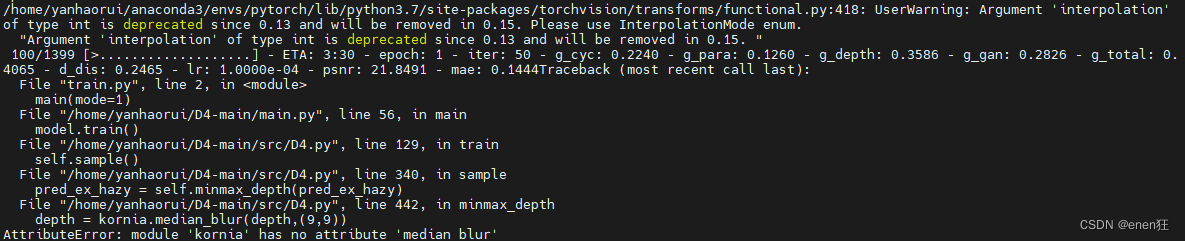
The corresponding line in D4.py is changed to
depth = kornia.filters.median_blur(depth,(9,9))4. save() parameter problem

The corresponding function of D4.py is changed to
def save(self, save_best=False, psnr=None, iteration=None):self.model.save()边栏推荐
- 边境的悍匪—机器学习实战:第十二章 使用TensorFlow自定义模型和训练
- 常用损失函数(二):Dice Loss
- 十一、Kotlin进阶学习:1、集合;2、List操作;3、可变集合——MutableList;4、Set;5、Map;6、MutableMap;
- 基于OpenCV的双目重建
- Based on R language geographic weighted regression, principal component analysis, discriminant analysis and other spatial heterogeneity data analysis
- The first WebAssembly program
- MySQL 5.7 安装教程(全步骤、保姆级教程)
- Flink CDC implements Postgres to MySQL streaming processing transmission case
- 边境的悍匪—机器学习实战:第十一章 训练深度神经网络
- Go简单实现协程池
猜你喜欢




随机推荐
TDengineGUI cannot connect to TDengine
Use kotlin to extend plugins/dependencies to simplify code (after the latest version 4.0, this plugin has been deprecated, so please choose to learn, mainly to understand.)
[Ten years of network security engineers finishing] - 100 penetration testing tools introduction
21. Kotlin Advanced Learning: Implementing Simple Network Access Encapsulation
Redis 发布/订阅
R语言 生态环境领域应用
Arthas 命令解析(jvm/thread/stack/heapdump)
CNN经典模型发展进程
Detailed explanation of ClickHouse query statement
Servlet basic principles and application of common API methods
Generalized Focal Loss 论文阅读笔记
原创 Acegi 1.03 安全机制
七、Kotlin基础学习:1、创建类;2、构造函数;3、继承;4、封装;5、抽象类;6、接口;7、嵌套类;8、内部类;9、枚举类
Jdbc & Mysql timeout分析
Detailed introduction to the usage of Nacos configuration center
Mysql client common exception analysis
基于全球模式比较计划CMIP6与区域气候-化学耦合模式 WRF-Chem 的未来大气污染变化模拟
基于PyTorch深度学习无人机遥感影像目标检测、地物分类及语义分割
二叉树(一):深度优先遍历与广度优先遍历
生产力工具分享——简洁而不简单