当前位置:网站首页>Go zero micro Service Practice Series (II. Service splitting)
Go zero micro Service Practice Series (II. Service splitting)
2022-06-10 00:22:00 【pythonxxoo】
High quality resource sharing
| Learning route guidance ( Click unlock ) | Knowledge orientation | Crowd positioning |
|---|---|---|
| 🧡 Python Actual wechat ordering applet 🧡 | Progressive class | This course is python flask+ Perfect combination of wechat applet , From the deployment of Tencent to the launch of the project , Create a full stack ordering system . |
| Python Quantitative trading practice | beginner | Take you hand in hand to create an easy to expand 、 More secure 、 More efficient quantitative trading system |
Overview of microservices
Microservice architecture is an architectural style , It builds a large system into a collection of multiple microservices , These microservices are built around business functions , Services focus on a single business function , These services have the following characteristics :
- Highly maintainable and testable
- Loose coupling
- Independently deployable
- Build around business functions
- Maintained by different small teams
The microservice architecture can 、 frequent 、 Reliable delivery of large 、 Complex applications , Realize service componentization through business splitting , Use components for composition to quickly develop systems .

Division of services
Let's first divide the microservices , In actual project development , We usually adopt two micro service partition strategies , The first method is to divide the boundaries of microservices through business functions , The second way is through DDD The boundary context is used to divide the microservice boundary , Here, we use the business functions that are easy to understand to divide microservices , Once again, post the mind map of our e-commerce project :

From the above mind map, we can see that the whole e-commerce system has many functions , We divide the following micro services according to business functions :
- Goods and services (product) - Addition of goods 、 Information Service 、 Inventory management and other functions
- Shopping cart service (cart) - Add, delete, modify and check the shopping cart
- Order service (order) - Generate order , Order management
- Payment services (pay) - The payment function is realized by calling the third-party payment
- Account Services (user) - User information 、 Grade 、 Prohibition 、 Address management
- Recommended services (recommend) - Home page product recommendation
- Comment service (reply) - The comment function of the product 、 Comment reply function
BFF layer
Generally, we will use... For the client HTTP Interface to provide services , Does it mean that these micro services need to be provided directly HTTP The interface provides external services ? Of course you can , The architecture as a whole looks simple .

But for a complex and highly concurrent system , We need to deal with various exception scenarios , For example, a page needs to rely on data provided by multiple microservices , In order to avoid the time-consuming caused by serial requests , We usually request multiple microservices in parallel , At this time, if a service request is abnormal, we may need to do some special processing , For example, provide some degraded data . In addition, the data displayed on our pages are often business function oriented , Not just the data of a microservice , At this time, we often need to assemble the data of multiple microservices to meet the requirements , If each of our microservices is directly provided externally HTTP Interface , Then these complex data assembly and exception handling can only be completed by the client . As we all know, the client is not suitable for complex business logic , The client should focus more on the optimization of interactive experience , Our overall architecture needs to be light in the front and heavy in the back , That is, the client logic should be as few as possible and the heavier business processing logic should be sunk to the server , The server is divided into different microservices according to business functions , These microservices focus on a single business , So where should these complex logic processing for business scenarios be put ? Our solution is to add a layer , namely BFF layer , adopt BFF External provision HTTP Interface , Client only with BFF Interact .

BFF The introduction of layer solves the problems we encountered above , But adding one layer will increase the complexity of the architecture , So if your service is a single application , that BFF It's not necessary , Introducing it doesn't add any value . For our project , Our applications depend on microservices , At the same time, we need to provide business oriented functions HTTP Interface and ensure high availability of the interface , therefore BFF It is a suitable choice for our project .
We can provide multiple BFF Do you ? The answer is, of course .BFF The purpose of is to provide a centralized interface for the client , For example, the data protocols of mobile terminal pages and browser pages are different , In this case, in order to better represent the data , Two can be used BFF, Only one at the same time BFF If it's time to BFF Exceptions will affect all businesses , Provide multiple BFF It can also improve the availability of services , Reduce the impact of business exceptions . Multiple BFF The architecture is as follows :
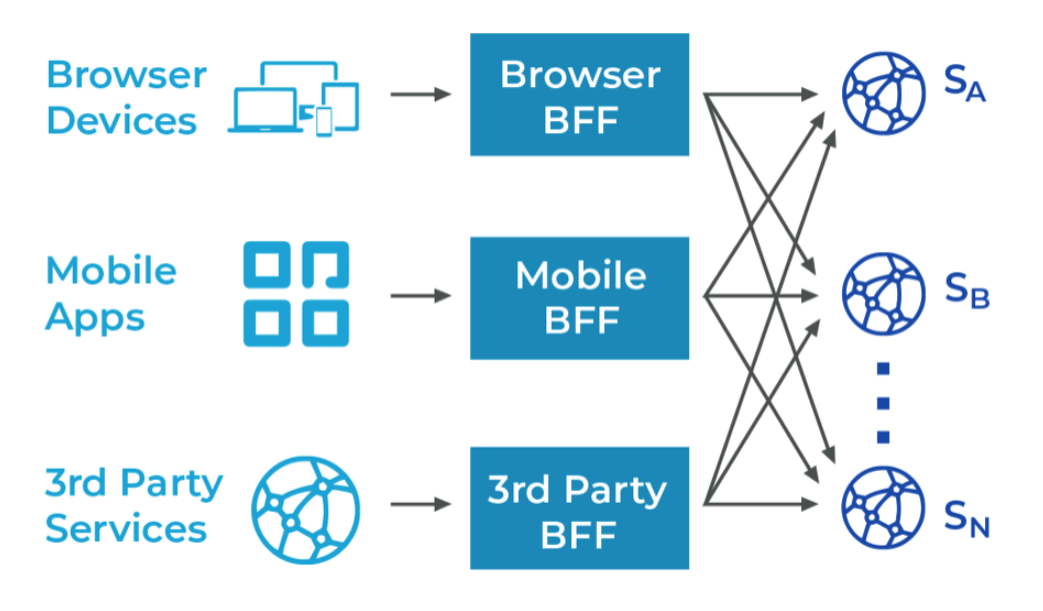
In order to simplify our project, only one BFF service .
Engineering structure
We use centralized management , Put all the services in one big warehouse , The directory structure of the warehouse is as follows :

lebron For the name of the project ,lebron There is apps and pkg Two directories , among apps All our micro services are stored , such as order For order related microservices ,pkg The directory is the storage path of packages that all services depend on , For example, if all services need to rely on authentication, they can be put into pkg Under the table of contents .
- app - BFF service
- cart - Shopping cart service
- order - Order service
- pay - Payment services
- product - Goods and services
- recommend - Recommended services
- reply - Comment service
- user - Account Services
Under each service directory, we will divide it into multiple services , There are mainly the following types of services :
- api - External BFF service , Accept requests from clients , expose HTTP Interface
- rpc - Internal micro Services , Only accept other internal micro services or BFF Request , expose gRPC Interface
- rmq - Responsible for flow task processing , Upstream typically relies on message queues , such as kafka etc.
- admin - It is also an internal service , The difference in rpc, Most of them are oriented to the operation side and have high data authority , Isolation can lead to better code level security , Provide directly HTTP Interface
apps The structure of each service under the directory is as follows :

Most services are split into rpc、rmq and admin To meet the demand of providing rpc Interface and operational data requirements , At the same time through rmq To handle streaming tasks . What's more special is app There is only api service , because app yes BFF All but api service , It may be added later rmq service , For example, stream processing users' first login and experience every day , We can expand at any time later , For the time being, only api service .recommend Only rpc service , Because the recommendation service needs to rely on AI Data provided by the team or big data team , We only need to request the corresponding data interface and do some business processing , So here recommend Only rpc service .
Code initialization
The structure of the whole project has been clearly defined , Let's initialize the service code
We use goctl To initialize the project , For example, let's initialize order, Enter the first order Under the table of contents :
$ cd lebron/apps/order
Execute the following command to initialize order rpc Code
$ goctl rpc new rpc
The generated code structure is as follows :

Execute the following command to initialize order admin Code , Be careful order admin by api service , Directly to the front end HTTP Interface
$ goctl api new admin
The generated code structure is as follows :

The generated service code can be run directly , Default listening is on 8888 port
$ go run admin.go

Starting server at 0.0.0.0:8888...
about rmq Service we will use go-zero Provided kq function , Here, first initialize main.go

Come here order The code initialization of the service has been completed , Other services and order The service is similar to , I won't go into that here .
pkg There is no need to initialize , When we need to provide general business functions, we add them .
Conclusion
In this article, we explained the definition of microservices , Microservices are built around business functions , Services focus on a single business , Lightweight communication mechanism is adopted between services , Each microservice can be deployed and tested independently .
We split the microservices according to the functions of the mall , Mainly split the shopping cart 、 Order 、 payment 、 goods 、 Comment on 、 recommend 、 Account number and other services , Then we explain why we need to introduce BFF service ,BFF It is essentially a service for data assembly , Provide business oriented or client oriented services externally UI Of HTTP Interface .
Then we define the directory structure of our project , It is mainly divided into api、rpc、rmq and admin Etc , Different services have different responsibilities ,api External provision HTTP Interface ,rpc Provide internally RPC Interface ,rmq Do streaming data processing ,admin Provide for the operation background HTTP Interface .
Finally, we passed goctl Initialize the project , Use goctl Project framework code can be generated with one click , Great productivity .
I hope this article can help you , thank you .
Every Monday 、 Thursday update
Code warehouse :https://github.com/zhoushuguang/lebron
Reference resources
https://microservices.io/index.html
https://blog.bitsrc.io/bff-pattern-backend-for-frontend-an-introduction-e4fa965128bf
Project address
https://github.com/zeromicro/go-zero
Welcome to use go-zero and star Support us !
WeChat ac group
Focus on 『 Microservice practice 』 Official account and click Communication group Get community group QR code .
边栏推荐
- PTP授时服务器(NTP网络时间服务器)技术方案应用
- 谁说Redis不能存大key
- Conversion between radiance and apparent reflectance
- Sparksql source code series | to understand the distribution source code system (spark3.2)
- 片上变化(on chip variation,OCV)概念学习
- SPSS主成分分析
- Mind map - 3. SQL injection vulnerability
- The essence and soul of message queue
- Blue Bridge Cup_ Split cube_ Combinatorial mathematics_ Addition principle
- RSA encryption and decryption tools
猜你喜欢

Do your filial duty to make an old people's fall prevention alarm system for your family

Py6S配置教程(win10 ×64)

Recommendation letter | look at the sky step by step, hand in hand, and see the stars one by two

Where is the bookmark saved in Google browser and how to import and export bookmarks

低边驱动和高边驱动

哨兵3(Sentinel-3)数据简介

工藤正男:如何一年发表5篇SCI

DDD driven domain design learning notes

It only takes eight steps to package the applet to generate an app

银行有没有必要建立数据中台?看完你就明白了
随机推荐
百度 95 后程序员删库跑路被判刑,动机为工作内容变动及对领导不满,删库会给互联网公司带来哪些影响?
打开xlsx文件时自动打开personal.xlsb表格文件
C# WPF后台动态添加控件(经典)
Process test supports batch parameter import, and the test efficiency is directly full!
尽一份孝心,为家人做一个老人防摔报警系统
Introduction to C # WPF layout control layoutcontrol
Dynamic reading of protobuf data
Blue Bridge Cup_ Split cube_ Combinatorial mathematics_ Addition principle
[typecho] find articles written in non markdown scripting languages
RSA encryption and decryption tools
pycharm 2022永久激活版下载,亲测有效
Idea uninstall tutorial
你了解单例模式吗?反正我不了解。
Leetcode296 weekly games
leetcode296场周赛
Where is the bookmark saved in Google browser and how to import and export bookmarks
Conversion between radiance and apparent reflectance
Mind map - 3. SQL injection vulnerability
MySQL scheduled task (event scheduler)
On chip variation (OCV) concept learning