当前位置:网站首页>Template school jumpserver security operation and maintenance audit screen
Template school jumpserver security operation and maintenance audit screen
2022-07-23 09:07:00 【Fit2cloud flying cloud】
2022 year 6 month 21 Japan ,DataEase Open source data visual analysis platform release Template Market (https://dataease.io/templates/). The template market is designed to DataEase Users provide professional services 、 beautiful 、 Dashboard template ready to use , It is convenient for users to select the corresponding dashboard template according to their own business needs and usage scenarios , And easily make your own dashboard on the basis of high-quality templates .
from 2022 year 7 Month begins , We will share with you the selected templates of the month , And the Application Tutorial of selected templates , At the same time, it is synchronized for the majority of users DataEase New situation in the template Market .
7 Monthly selected templates
The selected template recommended for you this month is JumpServer Security operation and maintenance audit screen .
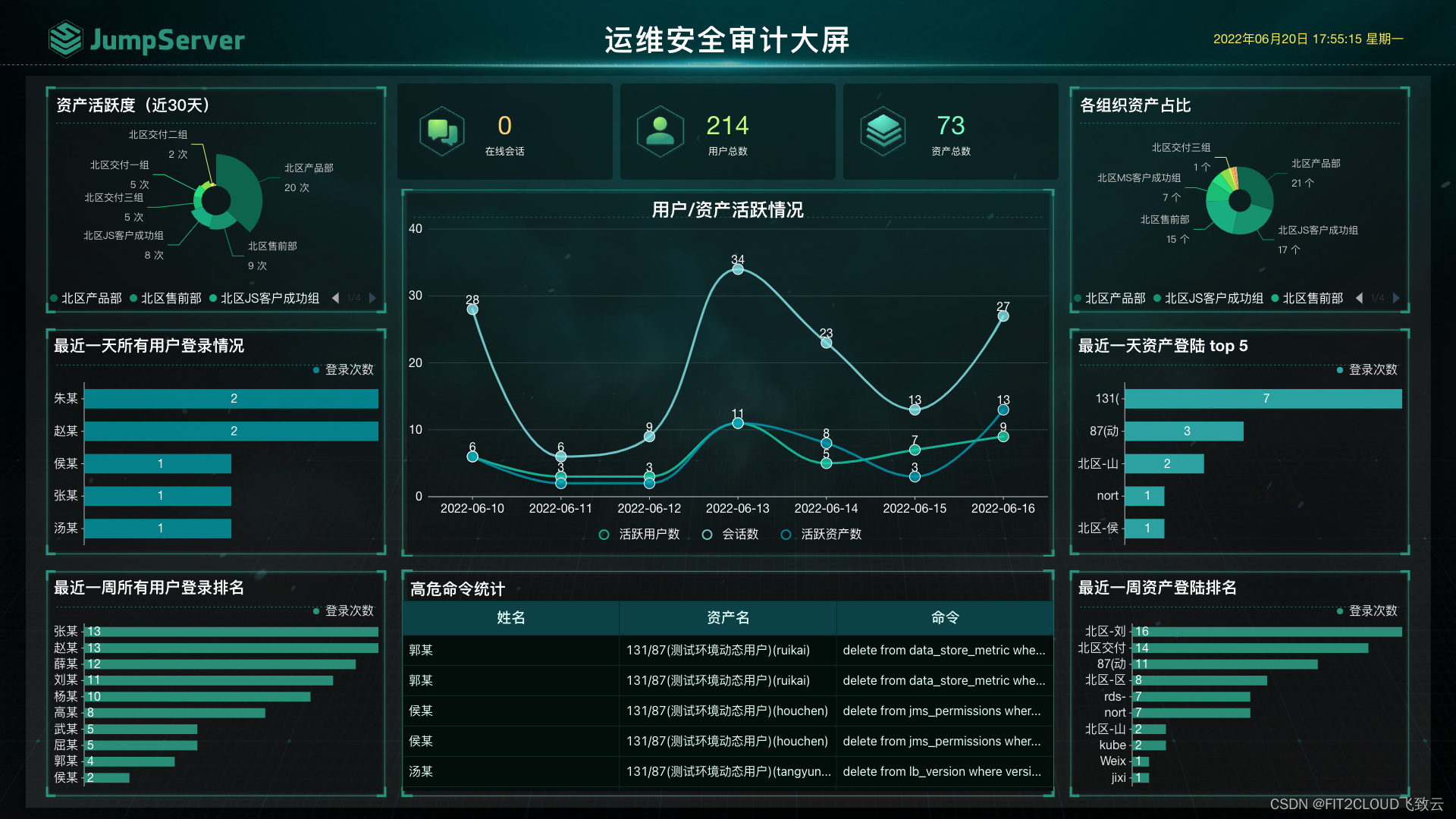
JumpServer yes FIT2CLOUD Feizhiyun's open source fortress machine , It is the world's first fully open source 、 accord with 4A Standardized operation and maintenance safety audit system .JumpServer The security operation and maintenance audit screen is mainly through IT Visual display of operation and maintenance data indicators , So that business personnel can quickly receive operation and maintenance statistics , So as to strengthen the operation and maintenance security control and regular operation and maintenance audit , Better operation and maintenance , Increase energy and efficiency for work .
- Large screen information
■ Product version number :JumpServer Open source fortress machine is based on v2.20.2 edition ,DataEase The open source data visualization analysis platform is based on v1.11.1 edition .
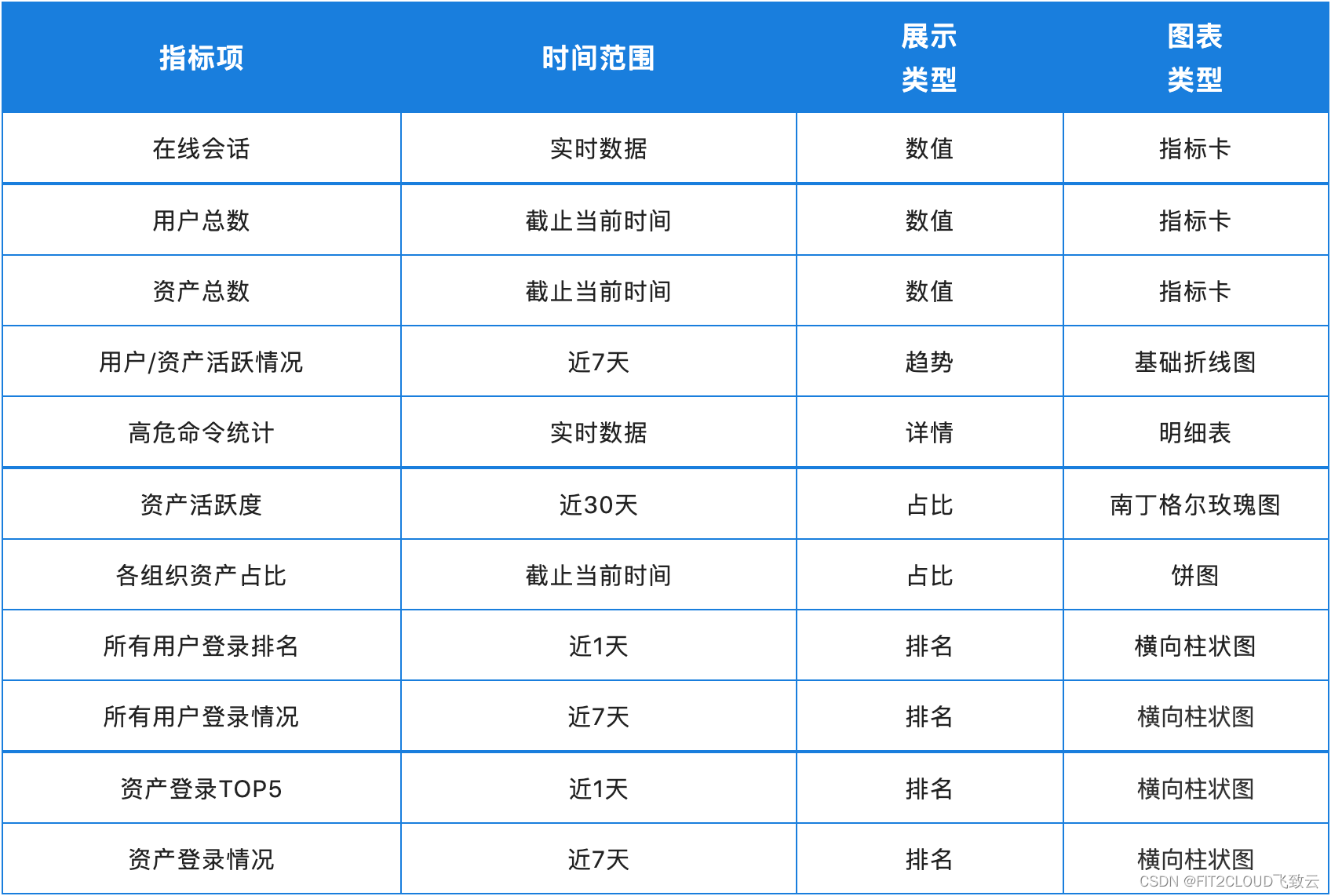
■ According to the use scenarios and personnel oriented of the security operation and maintenance audit screen , A total of 11 Indicators , The specific indicators are as follows :
- Large screen display
Template application
Next , We will explain in detail how to apply the security operation and maintenance audit large screen template .
- Template download
First , Get into DataEase Template Market homepage , Find the operation and maintenance security audit screen . The address of the template market is :
https://dataease.io/templates/. For quick retrieval , Keyword search or classification switching can be performed , You can quickly find the large screen template you want .

Click on “ Operation and maintenance security audit screen ” The dashboard template enters the details interface . Click on “ download ” Button to download the template to the local .

- Template import
Enter your own DataEase Systematic “ instrument panel ” Module , As shown in the following figure “ Import template ” To create a new dashboard , Click on “ Upload template ” Button , Choose to use “ Template Market ” Download the template file of the operation and maintenance security audit screen .

After the import is successful, as shown in the figure below , Components of the template 、 style 、 Background and dashboard data are brought into the new dashboard .

In addition to the above , You can also upload the template to DataEase Of “ Template Management ” In the function module , Select... When creating a new dashboard “ Reuse templates ” Options can be .

- Access data sources
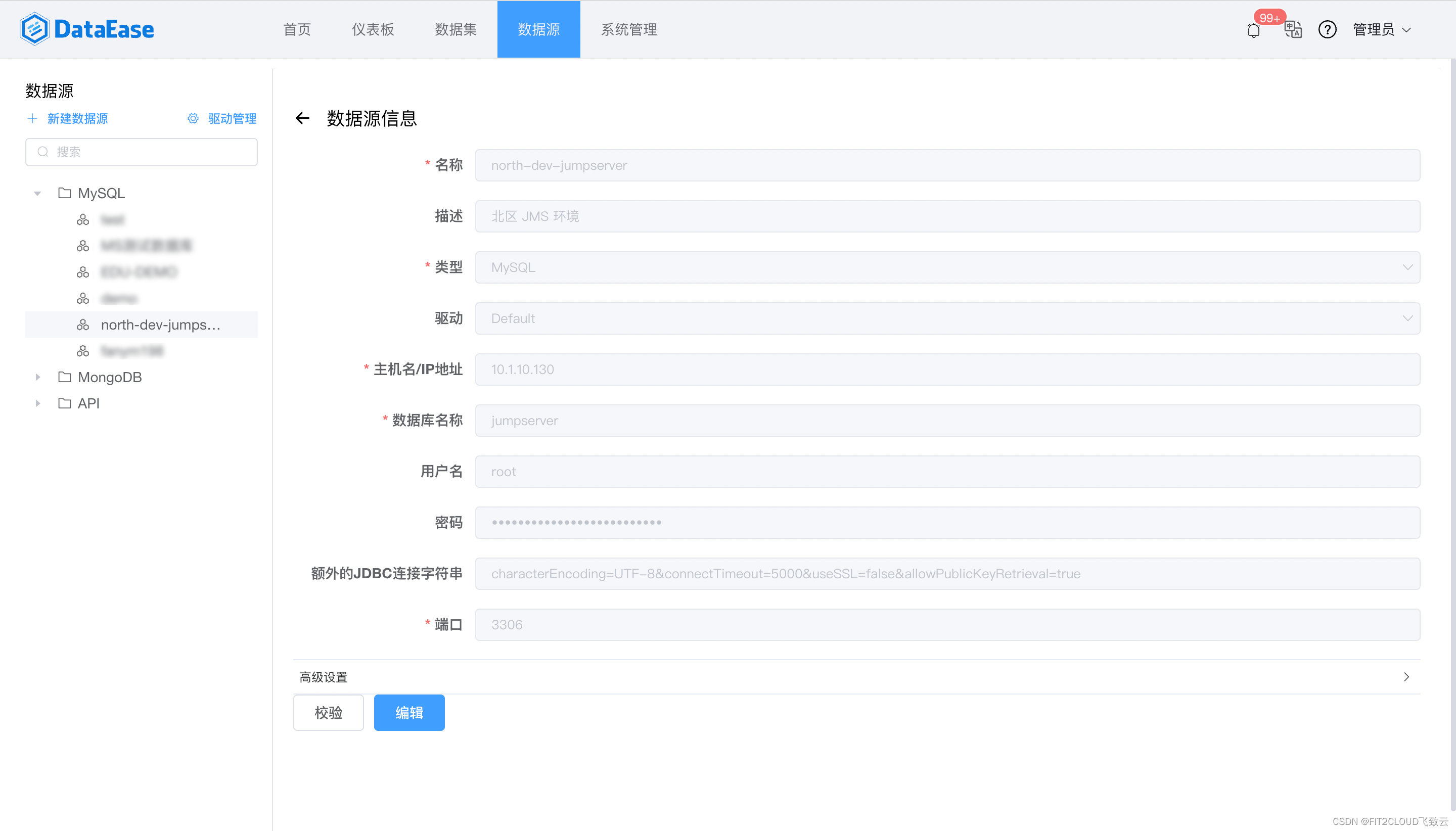
DataEase Support multiple databases as data sources ,JumpServer It uses MySQL database , Enter the corresponding information here , create data source .
- Add dataset
stay “ Data sets ” Design module , You can select the database added in the previous step from the data source , Select the corresponding table in the database as a dataset , Set the synchronization mode . Here you need to know the data type saved in each table , Easy to add corresponding data .
The datasets added here are SQL Data sets , For specific adding methods, please refer to DataEase Official documents :
https://dataease.io/docs/user_manual/dataset_configuration/dataset_SQL/.
The following figure is a screenshot of all data sets involved .

Specific data sets used SQL The statement is as follows :
① Online conversation
■ Indicator description : Query the number of sessions currently in progress .
■ Index caliber : Take the total number of current sessions that have not ended .
■ SQL sentence :
select count(1) ' Number of online sessions ' from terminal_session
where is_finished = false
② Total users
■ Indicator description : Total number of query users .
■ Index caliber : Take the total number of users whose roles are not used internally in the system .
■ SQL sentence :
select count(*) ' Total users ' from users_user where role <> 'App'
③ Total assets
■ Indicator description : Query the resource quantity of all organizations .
■ Index caliber : Take the current total assets .
■ SQL sentence :
select count(1) ' Total assets ' from assets_asset
④ user / Asset activity
■ Indicator description : Query recent user activity 、 Asset activity 、 History of online conversations .
■ Index caliber : Recent user activity is close 7 Total number of users logged in in days ; Asset activity is close 7 The total number of assets that have generated sessions in days ; The history of online conversation is close 7 Total number of sessions generated in days .
■ SQL sentence :
select u.` date `,u.` Number of active users `,a.` Number of active assets `,s.` Number of sessions ` from
(select count(distinct user_id) ' Number of active users ', d ' date '
    from (select DATE_FORMAT(date_start, '%Y-%m-%d') d, user_id from terminal_session where date_start > DATE_SUB(CURDATE(), INTERVAL 7 DAY))t group by d ORDER BY d DESC LIMIT 7) u
    left join (select count(distinct asset_id) ' Number of active assets ', d ' date ' from (select DATE_FORMAT(date_start, '%Y-%m-%d') d, asset_id from terminal_session where date_start > DATE_SUB(CURDATE(), INTERVAL 7 DAY))t group by d ORDER BY d DESC LIMIT 7) a
on u.` date ` = a.` date `
    left join (select d ' date ', count(1) ' Number of sessions ' from ( select DATE_FORMAT(date_start, '%Y-%m-%d') d from terminal_session where date_start > DATE_SUB(CURDATE(), INTERVAL 7 DAY)) t group by d ORDER BY d DESC LIMIT 7) s
on u.` date ` = s.` date `
⑤ High risk command statistics
■ Indicator description : Inquire about high-risk orders .
■ Index caliber : The risk level of high-risk orders is not equal to 0 The data of , That is, the number of regular expression hits filtered by the command .
■ SQL sentence :
SELECT * FROM terminal_command WHERE risk_level != 0;
⑥ Asset activity ( near 30 God )
■ Indicator description : Query near 30 Days of asset activity .
■ Index caliber : Get close to 30 The birth of heaven has ended SSH Total assets of the session , And display in groups according to the organization name .
■ SQL sentence :
select o.name ' organization ' , count(count_num ) ' Activity level '
from orgs_organization o
join
(SELECT
asset, count(*) count_num,
REPLACE(org_id,'-','') org_id
FROM
terminal_session t
WHERE
t.is_finished = 1
and t.protocol='ssh'
AND datediff( NOW(), t.date_end ) <= 30
GROUP BY
org_id, asset) terminal on o.id=terminal.org_id
group by o.name
⑦ Proportion of assets of each organization
■ Indicator description : Query the number of servers in all organizations .
■ Index caliber : Take the assets of each organization , Group by organization .
■ SQL sentence :
SELECT t.NAME, COUNT( * ) AS  Number of servers
FROM assets_asset a, orgs_organization t
WHERE LEFT ( a.org_id, 8 ) = LEFT ( t.id, 8 )
GROUP BY t.NAME ORDER BY  Number of servers  DESC
⑧ Login status of all users in the last day
■ Indicator description : Number of user logins in recent day .
■ Index caliber : Take the login times of all users in the recent day , Grouped by user name and sorted in descending order by login times .
■ SQL sentence :
select name  user name ,login_time  Login times  from (
SELECT
uu.name name,
count( * ) AS login_time
FROM
audits_userloginlog aul
left join users_user uu
on aul.username = uu.username
WHERE
TO_DAYS( now( ) ) - TO_DAYS( datetime ) <= 1
GROUP BY
aul.username
)t
where name is not null
ORDER BY
login_time DESC
⑨ The ranking of all users' login in the recent week
■ Indicator description : Query the login times of all users in the recent week .
■ Index caliber : Take the login times of all users in the past seven days , Grouped by user name and sorted in descending order by login times .
■ SQL sentence :
SELECT
(select name from users_user uu where uu.username = au.username) as name,
count( * ) AS  Login times
FROM
audits_userloginlog au
WHERE
TO_DAYS( now( ) ) - TO_DAYS( datetime ) <= 7
GROUP BY
username
ORDER BY
 Login times  DESC
⑩ Asset login last day TOP 5
■ Indicator description : Query the number of times the asset has been accessed in the last day .
■ Index caliber : Get the number of logins of assets in one day , In descending order of login times .
■ SQL sentence :
SELECT
asset,
assets_asset.ip,
COUNT( * ) AS  Login times
FROM
terminal_session
left join assets_asset
on replace(terminal_session.asset_id, '-', '') = assets_asset.id
WHERE
TO_DAYS( now( ) ) - TO_DAYS( date_end ) <= 1
GROUP BY
asset
ORDER BY
 Login times  DESC
⑪ Asset login ranking in the recent week
■ Indicator description : Query the login times of all assets in the recent week .
■ Index caliber : Get the login times of all assets in the past seven days , And in descending order of login times .
■ SQL sentence :
SELECT
asset,
assets_asset.ip as ip,
COUNT( * ) AS  Login times
FROM
terminal_session
left join assets_asset
on replace(terminal_session.asset_id, '-', '') = assets_asset.id
WHERE
TO_DAYS( now( ) ) - TO_DAYS( date_end ) <= 7
GROUP BY
asset
ORDER BY
 Login times  DESC
- Data substitution
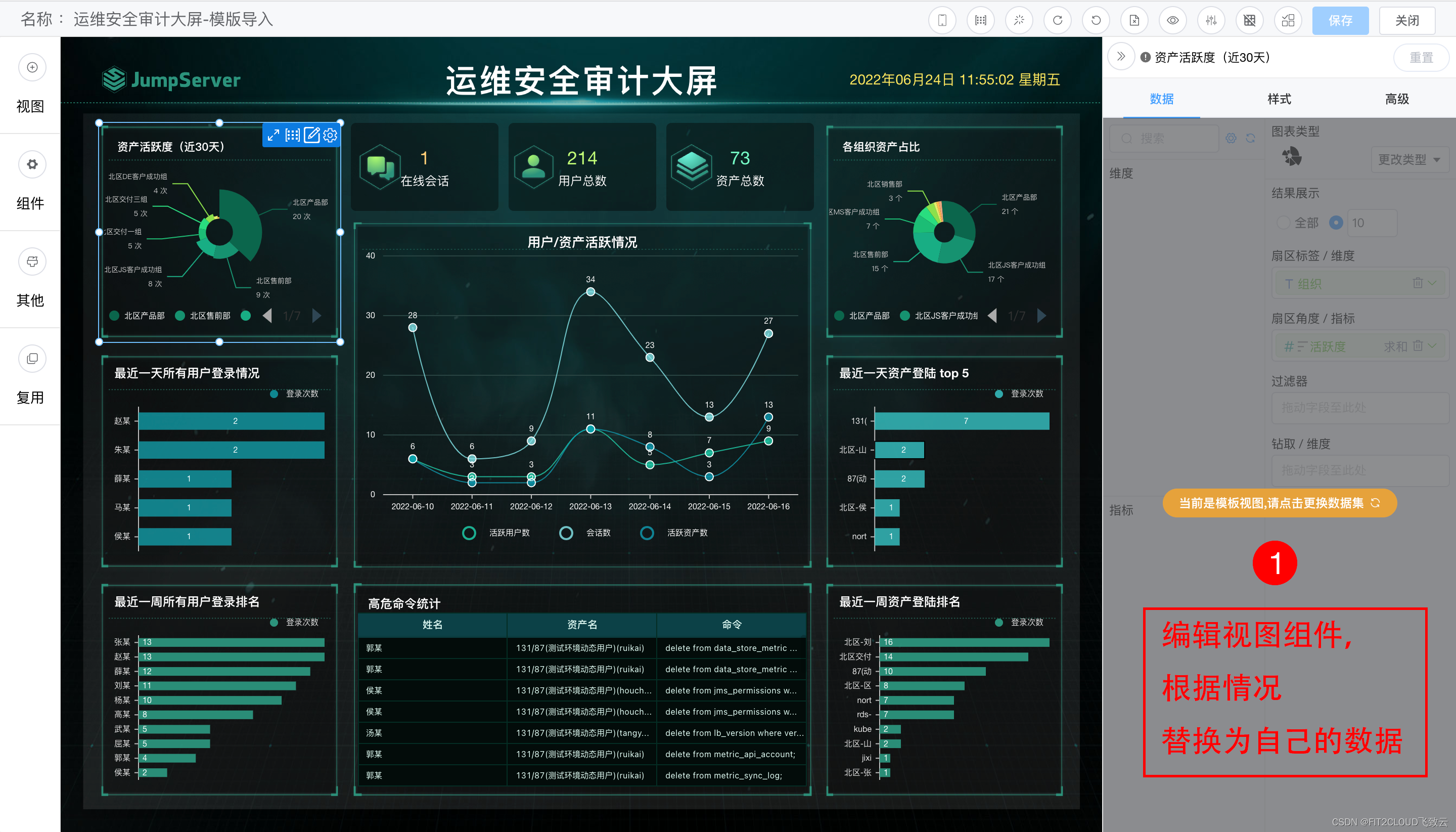
Next , Replace the data set associated with the view with its own actual data .
- matters needing attention
① Category axis / Dimension field is missing
Because sensitive information such as personnel name is involved in the template design stage , Therefore, a new desensitization field is created in the dataset . In this way, when users replace datasets, the situation shown in the red box in the following figure will appear in the data dimension area . Here it is , You can delete the red box indicator , hold “ user name ” The field can be directly dragged into the position shown .

② After replacing the fields , The dimension field is too long, resulting in incomplete chart display

When the situation shown in the above figure occurs , There are two solutions , As follows :
Scheme 1 : Do data interception for existing fields . Refer to for specific operation steps DataEase Official documents “ New calculated field ” part :
https://dataease.io/docs/user_manual/dataset_design/#24;
Option two : Replace the display field with IP Field .

- Final effect
Go through the above steps , You can get your own operation and maintenance security audit screen .
边栏推荐
- [zero based BLDC series] brushless DC motor control principle based on Hall sensor
- 解析创客教育活动所需的空间实践场
- Arduino框架下合宙ESP32C3 +1.8“TFT液晶屏通过TFT_eSPI库驱动显示
- No requirement document, reject development?
- UGUI源码解析——Mask
- College students downloaded 2578 documents abnormally, and the IP of the University of Social Sciences of China was banned by a database
- Flutter linear layout, filling
- IDM下载器免费高质量的Win下载工具无使用限制
- PMP备考心得 | 好的习惯、好的过程、好的结果
- How many of the 50 classic computer network interview questions can you answer? (III)
猜你喜欢

How many of the 50 classic computer network interview questions can you answer? (II)

go语言中的结构体和组合思想入门示例

Print prime numbers between 100 and 200

Ali II: why do MySQL indexes use b+ trees instead of jump tables?

DALSA smart camera boa spot communicates with Siemens s7-1200 PROFINET

SIP账号的作用-告诉你什么是SIP线路

【微信小程序】开发入门篇(二)

Implementation of OA office system based on JSP

Internet download manager is simply a killer of downloaders

【云原生】风云暗涌的时代,DBA们的利刃出鞘了
随机推荐
BGP experiment
超全PMP备考文档汇总
Swin transformer object detection project installation tutorial
IDM downloader free high-quality win download tool without restrictions
驱动单片机硬件调试器的一些开源库总结(包含stlink调试器)
【零基础玩转BLDC系列】基于霍尔传感器的无刷直流电机控制原理
openresty lua-resty-balancer动态负载均衡
UGUI源码解析——Mask
疫情隔离区订餐系统的开发
Flutter linear layout, filling
Internet Download Manager简直就是下载器中的大杀器
数学建模——插值拟合
7. Image data processing of paddlepaddle
数据可视化平台的下一站 | 来自国产开源数据可视化 datart「超级铁粉」的馈赠
What is the experience of writing concurrent tool classes (semaphore, cyclicbarrier, countdownlatch) by yourself in line 30?
Day05 MySql的基础使用
华为应用已经调用了checkAppUpdate接口,为什么应用内不提示版本更新
带你走进MySQL MVCC的世界
The concept and method of white box test
Is it safe for CICC fortune to open an account? How to buy stocks