当前位置:网站首页>Detailed explanation of MQ message oriented middleware theory
Detailed explanation of MQ message oriented middleware theory
2022-06-23 15:51:00 【Macaque】
One . Basic theory of message oriented middleware
1. summary
Message queuing has gradually become an enterprise IT The core means of system internal communication . It has low coupling 、 Reliable delivery 、 radio broadcast 、 flow control 、 Finally, a series of functions such as consistency , Become asynchronous RPC One of the main means of . common mq Yes :RocketMQ、RabbitMQ、ActiveMQ、Redis、Kafka、ZeroMQ etc. .
2. Message middleware consists of
- Broker: Message server , As server Provide message core services
- Producer: Message producer , The sponsor of the business , Responsible for the transmission of production messages to broker
- Consumer: Message consumer , The processor of the business , In charge of from broker Get the message and do business logic processing
- Topic: The theme , Unified message gathering place under publish and subscribe mode , Different producers turn to topic Send a message , from MQ The server distributes to different subscribers , Broadcast messages
- Queue: queue ,PTP In mode , Specific producers to specific queue Send a message , Consumers subscribe to specific queue Finish receiving the specified message
- Message: Message body , A packet encoded in a fixed format defined by different communication protocols , To encapsulate business data , Realize the transmission of messages
3. Message distribution strategy
1) Publish subscribe
Producers release information , All consumers who have subscribed to me can receive . Similar to live , As long as you subscribe to the live broadcast , You can watch the live broadcast when it's time .
Pub/Sub Publish subscribe ( radio broadcast ): Use topic As a communication carrier 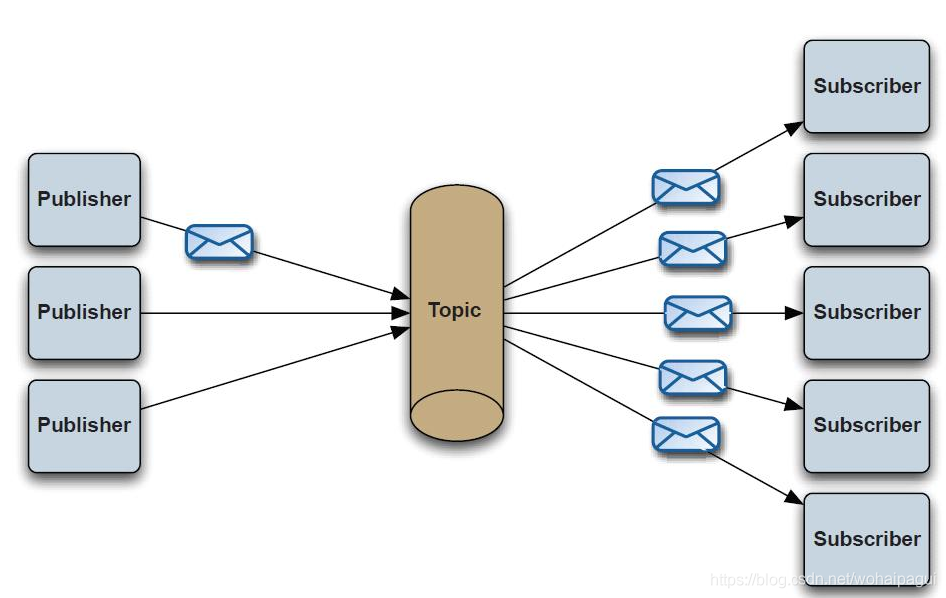
explain :
Message producer ( Release ) Publish a message to topic in , There are multiple message consumers at the same time ( subscribe ) Consume the news . It's different from point-to-point , Publish to topic Will be consumed by all subscribers .
queue Load balancing is realized , take producer The production message is sent to the message queue , Consumption by multiple consumers . But a message can only be accepted by one consumer , When no consumers are available , This message will be saved until a consumer is available .
topic Implemented publishing and subscription , When you post a message , All subscriptions to this topic All of our services can get the news , So from 1 To N Every subscriber can get a copy of a message .
2) Poll distribution
The producer sends multiple messages , Consumer servers will each consume the same number , There will be no deviation due to the advantages and disadvantages of consumer servers .

3) Fair distribution
The producer sends multiple messages , Consumers will consume different numbers of messages because of the advantages and disadvantages of the server , The better the server , The more you spend .
Compare polling distributions , There will be consumers 2 High server performance , Will consume more news , That is, the principle that those who can do more work .
4) retransmission
Producer sends message , The message distribution mechanism sends messages to the consumer server 1, If the consumer server 1 Hang up , It will be sent to the consumer server 2, And so on .
5) Message pull
After the producer message is sent , Consumers pull passively .
4. Advantages of message middleware
1) system decoupling
There is no direct call relationship between interactive systems , Just by message transmission , So the system is not very invasive , Low coupling .
2) Improve system response time
For example, the original set of logic , Completing the payment may involve modifying the order status first 、 Calculate member points 、 Only by notifying the logistics and distribution can the logic be completed ; adopt MQ Architecture design , It will make the emergency important ( Need immediate response ) The business is put into the calling method , Use message queuing with low response requirements , Put it in MQ In line , For consumers to deal with .
3) Provide services for big data processing architecture
Through message as integration , In the context of big data , Message queuing is also integrated with the real-time processing architecture , Provide performance support for data processing .
4)Java Message service ——JMS
Java Message service (Java Message Service,JMS) The API is a Java About message-oriented middleware in the platform (MOM) Of API, Used between two applications , Or send a message in a distributed system , Asynchronous communication .
JMS Medium P2P and Pub/Sub Message schema : Point to point (point to point, queue) And publish subscriptions (publish/subscribe,topic) It was originally made by JMS Defined . The main difference between the two modes or the problem to be solved is whether the messages sent to the queue can be consumed repeatedly ( Subscribe more ).
5. Message middleware application scenario
1) asynchronous communication
Some businesses don't want or need to process messages immediately . Message queues provide an asynchronous processing mechanism , Allows the user to queue a message , But not immediately . Put as many messages as you want into the queue , Then deal with them as needed .
2) decoupling
Reduce the strong dependence between projects , Adapt to heterogeneous systems . Predict what needs the project will encounter in the future at the beginning of the project , It's extremely difficult . The message system inserts an implicit 、 Data based interface layer , Both processes need to implement this interface , When the application changes , You can expand or modify the processing on both sides independently , Just make sure they adhere to the same interface constraints .
3) redundancy
In some cases , The process of processing data can fail . Unless the data is persisted , Otherwise, it will cause loss . Message queues persist data until they are fully processed , In this way, the risk of data loss is avoided . Used by many message queues ” Insert - obtain - Delete ” In the paradigm , Before deleting a message from the queue , Requires that your processing system explicitly indicate that the message has been processed , This ensures that your data is stored safely until you have finished using it .
4) Extensibility
Because message queues decouple your processing , So it is easy to increase the frequency of message enqueue and processing , Just add another process . No need to change code 、 There is no need to adjust the parameters . It is convenient for distributed expansion .
5) Overload protection
In the case of a dramatic increase in traffic , Applications still need to work , But such burst traffic can't be extracted and predicted ; If we think that we can deal with this kind of instantaneous peak visit as the standard to put resources on standby at any time is undoubtedly a huge waste . Using message queues enables critical components to withstand sudden access pressures , It won't crash completely because of a sudden overload of requests .
6) Recoverability
When a part of the system fails , It doesn't affect the whole system . Message queues reduce the degree of coupling between processes , So even if a process that processes the message fails , Messages enqueued can still be processed after the system recovers .
7) Sequence assurance
In most usage scenarios , The order in which the data is processed is important . Most message queues are sorted anyway , And it guarantees that the data will be processed in a particular order .
8) buffer
In any important system , There will be elements that require different processing times . Message queuing helps the most efficient execution of tasks through a buffer layer , This buffer helps to control and optimize the speed of data flow through the system . To adjust the system response time .
9) Data flow processing
Massive data streams generated by distributed systems , Such as : Business log 、 Monitoring data 、 User behavior, etc , Collect and summarize these data streams in real time or in batches , Then big data analysis is the necessary technology of the Internet , It is the best choice to complete this kind of data collection through message queuing .
6. Common protocols for message middleware
1)AMQP agreement
AMQP namely Advanced Message Queuing Protocol, An application-level standard advanced message queue protocol that provides a unified message service , Is an open standard for application layer protocols , Designed for message-oriented middleware . The client and message middleware based on this protocol can deliver messages , Not by the client / Different middleware products , Restrictions on different development languages and other conditions .
advantage : reliable 、 Universal
Personal understanding : In fact, it is based on tcp/ip Protocol extension , Added some security 、 Some operations of stability , Than http/https A simpler and more efficient protocol , And it is a long connection protocol .
2)MQTT agreement
MQTT(Message Queuing Telemetry Transport, Message queuing telemetry transmission ) yes IBM Developed an instant messaging protocol , It may become an important part of the Internet of things . The protocol supports all platforms , It can connect almost all online items with the outside world , Used as sensors and actuators ( Such as through Twitter Let the house network ) Communication protocol of .
advantage : Simple format 、 Small bandwidth 、 Mobile communication 、PUSH、 Embedded system
3)STOMP agreement
STOMP(Streaming Text Orientated Message Protocol) Is the streaming text oriented message protocol , It's for MOM(Message Oriented Middleware, Message Oriented Middleware ) Designed simple text protocol .STOMP Provide an interoperable connection format , Allow clients with any STOMP The message broker (Broker) Interact .
advantage : Command mode ( Not topic\queue Pattern )
4)XMPP agreement
XMPP( Extensible message processing field protocol ,Extensible Messaging and Presence Protocol) It's based on extensible markup language (XML) The agreement , More for instant messaging (IM) And online live detection . For quasi instant operation between servers . The core is based on XML streaming , This protocol may eventually allow Internet users to send instant messages to anyone else on the Internet , Even if its operating system and browser are different .
advantage : General public 、 Strong compatibility 、 Scalable 、 High safety , but XML The coding format takes up a large amount of bandwidth
4) The other is based on TCP/IP Custom protocol
Some special frames ( Such as :redis、kafka、zeroMq etc. ) Not strictly following according to one's own needs MQ standard , It's based on TCP\IP Self encapsulating a set of agreements , Through the network socket Interface for transmission , Realized MQ The function of .
Two . Common message middleware MQ Introduce
1.RocketMQ
Alibaba is an open source distributed 、 Message middleware of queue model , Original name Metaq,3.0 The version name is changed to RocketMQ, It's Ali's reference kafka Use of design ideas java A set of implementations mq. At the same time, the Department of Ali will have a number of internal mq product (Notify、metaq) Integration , Maintain only core functions , Remove all other runtime dependencies , Make sure the core functions are the simplest , On this basis, we will cooperate with other open-source products mentioned above to realize different scenarios mq The architecture of , At present, it is mainly used in order trading system .
It has the following characteristics :
- Can guarantee strict message order
- Provides filtering for messages
- Provides rich message pull patterns
- Efficient subscriber level scalability
- Real time message subscription mechanism
- 100 million message stacking capacity
2.RabbitMQ
Use Erlang Write an open source message queue , It supports a lot of agreements :AMQP,XMPP, SMTP,STOMP, Exactly so , It's very heavyweight , More suitable for enterprise level development . At the same time Broker framework , The core idea is that producers don't send messages directly to queues , Messages are queued in the central queue when they are sent to the client . Routing (Routing), Load balancing (Load balance)、 Data persistence is well supported . More for enterprise level ESB Integrate .
3. ActiveMQ
Apache Next sub project . Use Java Fully support JMS1.1 and J2EE 1.4 canonical JMS Provider Realization , A small amount of code can efficiently implement advanced application scenarios . Pluggable transport protocol support , such as :in-VM, TCP, SSL, NIO, UDP, multicast, JGroups and JXTA transports.RabbitMQ、ZeroMQ、ActiveMQ All support common multi language clients C++、Java、.Net,、Python、 Php、 Ruby etc. .
4. Redis
Use C Language development Key-Value Of NoSQL database , Development and maintenance are very active , Although it is a Key-Value Database storage system , But it supports MQ function , So it can be used as a lightweight queue service . about RabbitMQ and Redis The entry and exit operations of , Each executive 100 Ten thousand times , Every time 10 Ten thousand times record the execution time . The test data is divided into 128Bytes、512Bytes、1K and 10K Four different sizes of data . Experiments show that : When you join the team , When the data is small Redis The performance is higher than RabbitMQ, And if the data size exceeds 10K,Redis It's too slow to bear ; When the team , No matter the size of the data ,Redis All showed very good performance , and RabbitMQ The out of team performance is much lower than Redis.
5. Kafka
Apache Next sub project , Use scala Implementation of a high-performance distributed Publish/Subscribe Message queuing system , It has the following characteristics :
- Fast persistence : Through the disk sequential read-write and zero copy mechanism , Can be in O(1) Message persistence under the system overhead of ;
- High throughput : It can be achieved on a common server 10W/s The throughput rate of ;
- High accumulation : Support topic The next consumer is offline for a long time , There's a lot of news piling up ;
- A completely distributed system :Broker、Producer、Consumer All native automatic support distributed , rely on zookeeper Automatic load balancing ;
- Support Hadoop Data is loaded in parallel : For things like Hadoop The same log data and offline analysis system , But it also requires the limitation of real-time processing , This is a viable solution .
6. ZeroMQ
The fastest message queuing system , Dedicated to high throughput / Low latency scenario development , It is often used in financial applications , Focus on real-time data communication scenarios .ZMQ Can achieve RabbitMQ Not good at advanced / Complex queues , But developers need to assemble multiple technical frameworks themselves , High development cost . therefore ZeroMQ With a unique non middleware pattern , More like a socket library, You don't need to install and run a message server or middleware , Because your app itself uses ZeroMQ API Complete the role of logical Services . however ZeroMQ Only non persistent queues , If down machine , Data will be lost . Such as :Twitter Of Storm Use in ZeroMQ As the transmission of data stream .
ZeroMQ Sockets are not related to the transport layer :ZeroMQ Socket defines a unified... For all transport layer protocols API Interface . The default support In process (inproc) , Interprocess (IPC) , multicast ,TCP agreement , Switching between different protocols simply changes the prefix of the connection string . You can switch from local communication between processes to distributed communication at least at any time TCP signal communication .ZeroMQ In the back processing connection establishment , Disconnect and reconnect logic .
characteristic :
- Lockless queue model : For cross thread interactions ( The client and session) Data exchange channel between pipe, The queue algorithm without lock is adopted CAS; stay pipe There are asynchronous events registered at both ends of , Reading or writing messages to pipe When the , Will automatically trigger read and write events .
- Algorithms for batch processing : For bulk messages , We optimized the adaptability , Can receive and send messages in batches .
- Thread binding under multi-core , need not CPU Switch : Different from the traditional multithreading mode , Semaphore or critical area ,zeroMQ Make full use of the advantages of multi-core , Each core binding runs a worker thread , Avoid multithreading between CPU Switching overhead .
Figure comparison :
Later, specific project applications will be provided ,...........

It's not easy to create , It's time for dinner , Scan all the codes , Blogger real name authentication , Absolute truth .
边栏推荐
- VGG下载(.net文件和imagenet-vgg-verydeep-19)
- Big factory Architect: how to draw a grand business map?
- 32. Compose 优美的触摸动画
- 2022年个人理财利率是多少?个人如何选择理财产品?
- F5 application strategy status report in 2022: edge deployment and load security become the focus of attention in the Asia Pacific Region
- OpenResty 基础
- Important knowledge of golang: timer timer
- 服务器的部署及使用说明
- mysql 系列:存储引擎
- 重卡界销售和服务的“扛把子”,临沂广顺深耕产品全生命周期服务
猜你喜欢

The "shoulder" of sales and service in the heavy truck industry, Linyi Guangshun deep ploughing product life cycle service

Three simple tips for accelerating yarn install

The work and development steps that must be done in the early stage of the development of the source code of the live broadcasting room

golang 重要知识:sync.Cond 机制

js的slice()和splice()
Important knowledge of golang: rwmutex read / write lock analysis

Leetcode 450.删除二叉搜索树中的结点

JS创建一个数组(字面量)
golang 重要知识:atomic 原子操作

A transformer can only convert alternating current. How can I convert direct current?
随机推荐
stylegan1: a style-based henerator architecture for gemerative adversarial networks
Unshift() and shift() of JS
Big factory Architect: how to draw a grand business map?
mysql事务与锁
为什么高通滤波器也能变成微分器?
Shandong: food "hidden money", consumption "sweeping monk"
现在我要买股票,怎么开户?手机开户安全么?
get_edges
freemark 使用ftl文件 生成word
列表查询排序参数处理
[普通物理] 光的衍射
Gartner's latest report: development of low code application development platform in China
TCP协议三次握手和四次挥手抓包分析
List query sorting parameter processing
golang 重要知识:context 详解
[普通物理] 半波损失 等厚与等倾干涉
B. AND 0, Sum Big-Codeforces Round #716 (Div. 2)
golang 重要知识:sync.Once 讲解
Important knowledge of golang: mutex
stylegan3:alias-free generative adversarial networks