当前位置:网站首页>Study diary: February 15, 2022
Study diary: February 15, 2022
2022-06-30 02:44:00 【Chen Jia at the weekend】

This is simply the minimum spanning tree
There are two algorithms for calculating the minimum spanning tree
kruska Algorithm
and prim Algorithm
I use this topic prim Algorithm
Because this algorithm is similar to that of the shortest path dijkstra The algorithm is very similar to
dijkstra The algorithm calculates all the distances from one point to other points
The minimum spanning tree is the shortest path that can connect all nodes
dijkstra and prim The difference is that
dijkstra Will accumulate the original path to calculate
and prim There is no need to consider starting from the starting point , Every step he took was the shortest way
Finally, I walked through all the nodes . And each node only goes once
The code is as follows
#include<bits/stdc++.h>
using namespace std;
#define N 5003
#define M 200005
#define inf 123456789
struct Node
{
    int v,w,next;
}e[M*2];
int head[N]={0};
int dis[N];// Store final results
int vis[N];
int top=0;
int n,m;
int add(int a,int b,int c)
{
    top++;
    e[top].v=b;
    e[top].w=c;
    e[top].next=head[a];
    head[a]=top;
}
int finding()
{
    int result=0;
    for(int i=1;i<=n;i++)
    {
        dis[i]=inf;
    }
    dis[1]=0;
    int count=0;
    int present=1;
    while(count++<n)
    {
        int ming=inf;
        for(int i=1;i<=n;i++)
        {
            if(vis[i]==0&&ming>dis[i])
            {
                ming=dis[i];
                present=i;
            }
        }
        if(ming==inf)
        return 0;
        result+=ming;
        for(int i=head[present];i;i=e[i].next)
        {
            int v=e[i].v;
            if(dis[v]>e[i].w&&vis[v]==0)
            dis[v]=e[i].w;
        }
        vis[present]=1;
    }
    return result;
}
int main()
{
    cin>>n>>m;
    int a,b,c;
    for(int i=1;i<=m;i++)
    {
        cin>>a>>b>>c;
        add(a,b,c);
        add(b,a,c);
    }
    int result=finding();
    if(result)
    cout<<result;
    else
    cout<<"orz";
}
Compare what you wrote yesterday dijkstra
#include<iostream>
using namespace std;
long long Max=2147483647;
int point,side,start;
long long result[1000000];
long long book[1000000];
struct Data
{
    int to;
    int length;
    int next;
}data[1000000];
int head[1000000];
int top=0;
int add(int a,int b,int c)
{
    top++;
    data[top].to=b;
    data[top].length=c;
    data[top].next=head[a];
    head[a]=top;
    return 0;
}
int finding(int start)
{
    for(int i=1;i<=point ;i++)
    {
        result[i]=Max;
        book[i]=0;
    }
    result[start]=0;
    int present=start;
    while(book[present]==0)
    {
        book[present]=1;
        long long mining=Max;
        for(int i=head[present];i;i=data[i].next)
        {
            if(book[data[i].to]==0)
            if(result[data[i].to]>result[present]+data[i].length)
            result[data[i].to]=result[present]+data[i].length;
        }
        for(int i=1;i<=point;i++)
        {
            if(book[i]==0)
            if(result[i]<mining)
            {
                mining=result[i];
                present=i;
            }
        }
    }
            return 0;
}

int main()
{
    cin>>point>>side>>start;
    for(int i=1;i<=side;i++)
    {
        int a,b,c;
        cin>>a>>b>>c;
        add(a,b,c);
    }
    finding(start);
    for(int i=1;i<=point ;i++)
    cout<<result[i]<<' ';
}
You will find that the basic architectures are similar

This topic is also the direct establishment of the minimum spanning tree , Output No s+1 The big data can
Any two points in the title can be directly connected , Use prim The algorithm takes the shortest path every time
The code is as follows
#include<iostream>
#include<math.h>
using namespace std;
#define Max 502
#define inf 123456789
int n,m;
struct Data
{
    int x;
    int y;
    double range;
    bool select;
}data[Max];

double length(int a,int b)
{
    double result;
    int x=data[a].x-data[b].x;
    int y=data[a].y-data[b].y;
    result=sqrt(x*x+y*y);
    return result;
}

// Find the shortest distance corresponding to each point
int finding()
{
    int count=0;
    int present=1;
    while(count++<m)
    {
        int ming=inf;
        data[present].select=1;
        for(int i=1;i<=m;i++)
        {
            if(data[i].select)
            continue;
            double len=length(present,i);
            if(data[i].range>len)
            {
                data[i].range=len;
            }
        }
        for(int i=1;i<=m;i++)
        {
            if(data[i].select)
            continue;
            if(data[i].range<ming)
            {
                ming=data[i].range;
                present=i;
            }
        }
    }
    // for(int i=1;i<=m;i++)
    // {
    //     for(int j=i+1;j<=m;j++)
    //     {
    //         int len=length(i,j);
    //         if(data[j].range>len)
    //         data[j].range=len;
    //     }
    // }
}

// Sort by distance
int ranked()
{
    for(int i=1;i<=m;i++)
    {
        int ming=i;
        for(int j=i+1;j<=m;j++)
        if(data[ming].range<data[j].range)
        ming=j;
        Data change;
        {
            change=data[i];
            data[i]=data[ming];
            data[ming]=change;
        }
    }
}

int main()
{
    cin>>n>>m;
    for(int i=1;i<=m;i++)
    {
        data[i].range=inf;// The initial value of the distance is infinite
        data[i].select=0;
        cin>>data[i].x>>data[i].y;
    }

    finding();
    ranked();
    // for(int i=1;i<=m;i++)
    // cout<<data[i].range<<endl;

    printf("%.2lf",data[n+1].range);
}
This topic uses prim It's hard to calculate , So we can only use another algorithm
cruska Algorithm
First, we sort the data given by the title according to the beauty degree from big to small
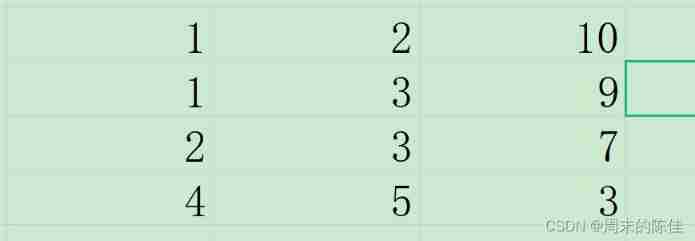
We choose from the biggest
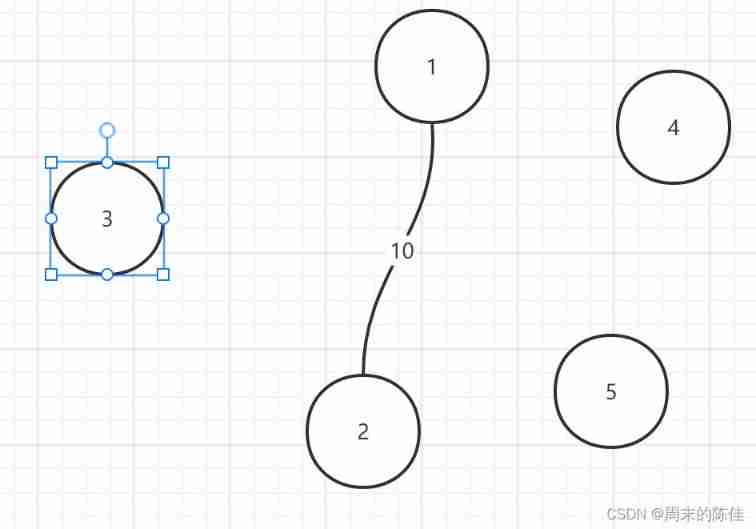
Then choose the second

Then choose the third one

At this time, we found that a ring was formed
First of all, no ring is allowed in the title , Secondly, the minimum spanning tree is not allowed to have rings , If there is a ring , It shows that there is more than one way to go from one point to another , The minimum spanning tree is a path through to the end
So in order to avoid the ring . We use and look up sets
Determine whether the two nodes to be connected are of the same class , If they are of the same kind , It means that the connection will form a ring
You won't , And put them in one category
This is cruska What the algorithm needs to pay attention to
Understand the principle , The implementation code is also relatively simple
#include<iostream>
using namespace std;
#define N 100005

int point ,rug ,needs;// Number of areas , Number of carpets , Reserved number
int result=0;// Store final results
int parent[N];// And look up the table
//  Union checking set
int check(int start)
{
    if(parent[start]==start)
    return start;
    parent[start]=check(parent[start]);
    return parent[start];
}

struct Data
{
    int a;
    int b;
    int beaut;
}data[N];


int comp(int start ,int end)
{
    int mid=(start+end)/2;
    int a=start;
    int b=mid+1;
    Data shadow[N];
    int len=0;
    while(a<=mid&&b<=end)
    {
        if(data[a].beaut>data[b].beaut)
        shadow[len++]=data[a++];
        else
        shadow[len++]=data[b++];
    }
    while(a<=mid)
    shadow[len++]=data[a++];
    while(b<=end)
    shadow[len++]=data[b++];
    for(int i=0;i<len;i++)
    data[start+i]=shadow[i];
    return 0;
}
int ranked(int start,int end)
{
    if(start>=end)
    return 0;
    int mid=(start+end)/2;
    ranked(start,mid);
    ranked(mid+1,end);
    comp(start,end);
    return 0;
}

int finding()
{
    // Initialize and look up the table
    for(int i=0;i<=point ;i++)
    parent[i]=i;

    int present=1;
    for(int i=1;i<=needs;i++)
    {
        // Locate blankets that do not form loops
        while(check(data[present].a)==check(data[present].b))
        present++;
        result+=data[present].beaut;
        parent[check(data[present].a)]=check(data[present].b);
        present++;
    }
    return 0;
}

int main()
{
    cin >>point>>rug>>needs;

    for(int i=1;i<=rug;i++)
    cin >>data[i].a>>data[i].b>>data[i].beaut;

    ranked(1,rug);
    finding();
    cout<<result;
}
Because to sort , And the amount of data is quite large , So we need to write a faster sorting method to sort
边栏推荐
- Global and Chinese markets of liquid optical waveguides 2022-2028: Research Report on technology, participants, trends, market size and share
- Some configuration details about servlet initial development
- Network neuroscience -- a review of network Neuroscience
- Enlightenment from the revocation of Russian digital certificate by mainstream CA: upgrade the SSL certificate of state secret algorithm to help China's network security to be autonomous and controlla
- CA数字证书包含哪些文件?如何查看SSL证书信息?
- Entering Jiangsu writers and poets carmine Jasmine World Book Day
- Shell Sort
- Recursion frog jumping steps problem
- Raki's notes on reading paper: discontinuous named entity recognition as maximum clique discovery
- Merge sort
猜你喜欢

论文回顾:Playful Palette: An Interactive Parametric Color Mixer for Artists
![[dry goods sharing] the latest WHQL logo certification application process](/img/c3/37277572c70b0af944e594f0965a6c.png)
[dry goods sharing] the latest WHQL logo certification application process

DigiCert Smart Seal是什么?

打造創客教育中精湛技藝

Detailed explanation of minimum stack

AutoJS代碼能加密嗎?YES,AutoJS加密技巧展示

Some configuration details about servlet initial development

重磅来袭--UE5的开源数字孪生解决方案

可视化HTA窗体设计器-HtaMaker 界面介绍及使用方法,下载 | HTA VBS可视化脚本编写

Cmake tutorial series -02- generating binaries using cmake code
随机推荐
Matlab code running tutorial (how to run the downloaded code)
代码签名、驱动签名的常见问题解答
What is a self signed certificate? Advantages and disadvantages of self signed SSL certificates?
Precautions for purchasing wildcard SSL certificate
如何预防钓鱼邮件?S/MIME邮件证书来支招
What files does a CA digital certificate contain? How to view SSL certificate information?
Recursion frog jumping steps problem
学术汇报(academic presentation)/PPT应该怎么做?
matlab代码运行教程(如何运行下载的代码)
IBM websphere通道联通搭建和测试
最小栈详解
SSL证书格式转化的两种方法
DigiCert Smart Seal是什么?
CMake教程系列-05-选项及变量
NPDP产品经理国际认证考试报名有什么要求?
Linear algebra Chapter 3 summary of vector and vector space knowledge points (Jeff's self perception)
Two methods of SSL certificate format conversion
Shell Sort
Lua 基础知识
福利抽奖 | 开源企业级监控Zabbix6.0都有哪些亮点