当前位置:网站首页>[C language] comprehensively analyze the pointer and sort out the pointer knowledge points
[C language] comprehensively analyze the pointer and sort out the pointer knowledge points
2022-07-28 20:15:00 【White Hibiscus KK】
Catalog
3.1 The origin of wild pointer :
3.2 How to avoid wild pointer ?
4. The operation of the pointer
Preface :
Yes C language , Pointer is a difficult point , If you use C Language to write data structures , It is necessary to master the usage of pointers , If the pointer doesn't learn well , It's hard to learn data structure . So I hope you must master the pointer !!!
1. The concept of pointer
1. The pointer is a Variable , be used for Storage address , The address uniquely represents a piece of memory space .
ps:( Memory number = Address = The pointer )
2. What is the size of the pointer fixed 4/8 Bytes (32 Bit platform /64 Bit platform )
2. The type of pointer
Pointers are typed , The type of pointer determines the pointer +- Integer step size , Pointer dereference permission .
Now let me explain the meaning of the red part above , for instance , Take a look at the following code and running results :
#include<stdio.h>
int main()
{
	int a = 4;
	int* p1 = &a;
	char* p2 = &a;
	printf("%p\n", p1);
	printf("%p\n", p2);
	printf("%p\n", p1+1);
	printf("%p\n", p2+1);
	return 0;
}
At first p1 and p2 The address is the same , But back let p1 and p2 separately +1, The later result is different ,p1 Plus 1 yes int Type of 1, and p2+1 Plus char Type of 1.
As we mentioned above, the size of the pointer is fixed 4/8 Bytes , The assumption is 32 Bit platform , Then a pointer will occupy 4 Bytes . If I define an integer pointer and a character pointer , So this Integer pointer When dereferencing, you can access 4 Bytes , and Character pointer You can only visit 1 Bytes .
3. Wild pointer
The concept of wild pointer is : The position of the pointer is unknown
3.1 The origin of wild pointer :
It's a wild pointer origin There are two :1. Pointer not initialized 2. Pointer out of bounds access
Explain to you :
Pointer not initialized
This should be well understood , That is, when we create a pointer variable, we don't let it point to any object
for example : int* p; such p It's a local variable ,p It's just one. Random value
Pointer out of bounds access
Take a look at the following code :
#include<stdio.h>
int main()
{
	int arr[5] = { 1,2,3,4,5 };
	int* p = arr;
	int i = 0;
	for (i = 0; i < 6; i++)
	{
		printf("%d ", *p);
		p++;
	}
	return 0;
}
First, explain the principle of this code ,int* p = arr; here arr It's an array name , The array name is the address of the first element
So now p Is the address of the first element Yes p Dereference is *p ,*p The value is 1
p++; This line of code is to make p The address of ++; What is the size of the pointer fixed 4/8 Bytes , int Type data in C Language is also 4/8 Bytes , All the pointers we get are data The address of the first byte , And the array in memory is continuity Of ,p++ Just move one data back .
But now arr The array has only 5 Elements , But the cycle 6 This will inevitably lead to the out of bounds of the array , Let's take a look at the running results

front 5 The number is arr The number in the array , The first 6 A value is a random value . Because when you cycle to the 6 When the time ,p There is no object to point to , here p It's a wild pointer .
3.2 How to avoid wild pointer ?
1. Good at using NULL, Initialize the pointer in time
If you are defining pointer variables , I have thought of the object pointed to by the pointer variable , Then initialize directly .
If you are defining , It's not clear what the pointer points to , It's not clear whether to use a pointer later , Then assign the pointer variable NULL
NULL It means empty , If int *p=NULL; So at this time p Is a null pointer , You can re assign values later , It does not affect the later use . If a pointer is a null pointer , Don't use it before you initialize it .
2. Avoid pointer out of bounds
3. Avoid returning the address of a local variable
4. The operation of the pointer
Look at the following code :
#include<stdio.h>
int main()
{
	// Pointer address plus or minus integer
	int arr[5] = { 1,2,3,4,5 };
	int* p1 = arr;
	int i = 0;
	for (i = 0; i < 5; i++)
	{
		printf("%d ", *p1);
		p1++;
	}
	printf("\n");
	// Dereferenced pointer plus or minus integers
	int b = 10;
	int* p2 = &b;
	(*p2)++;
	printf("%d", *p2);
	return 0;
}
p1++ Is an integer that adds or subtracts an address , We've already talked about that , Now I won't introduce more
and (*p2)++, I defined a b Variable , And then assigned to 10, And then put b The address of p2,*p2 By dereferencing, we get 10,(*p)++ amount to 10++ , What you get is 11.
So let's see what happens :

ps: Pointers can compare sizes
The pointer can also be subtracted
for instance :
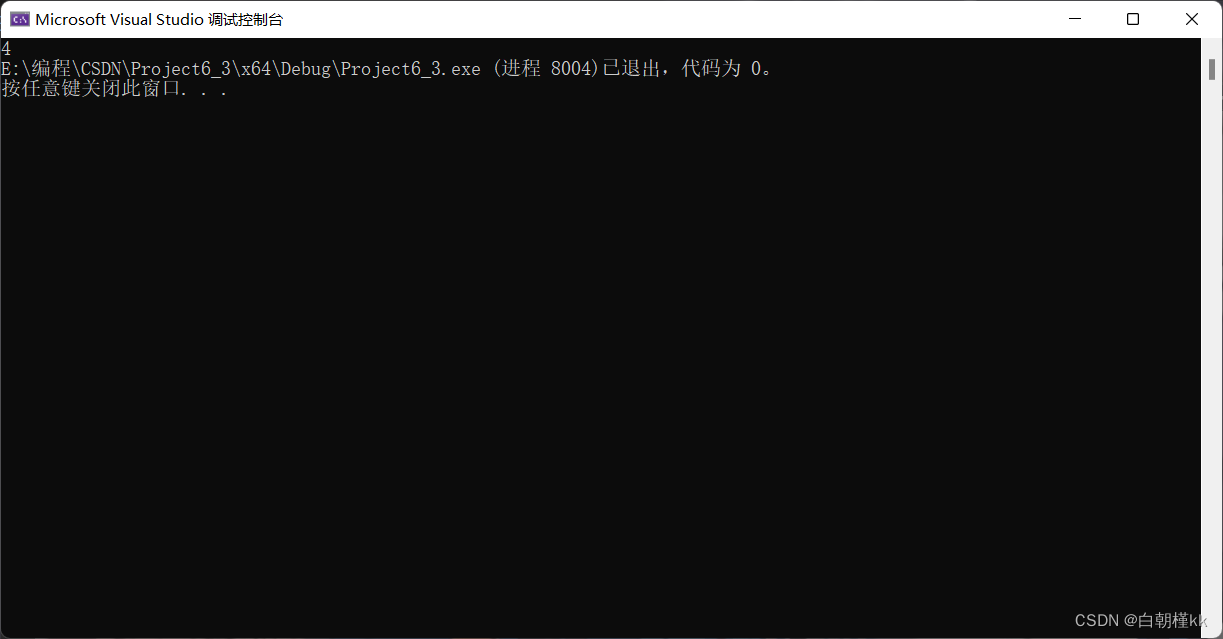
#include<stdio.h>
int main()
{
	int arr[5] = { 1,2,3,4,5 };
	printf("%d", &arr[4] - &arr[0]);
	return 0;
}
There is no pointer variable subtraction , It's the same thing . After all, the pointer is the address .
When two pointers point to the same space , The absolute value of pointer minus pointer is the number of data between these two pointers .
Note that this is not Number * The size of the data type C According to the language
5. Pointers and arrays
1. Arrays can be accessed through pointers , You can refer to the code I wrote above .
2. Usually The array name is the address of the first element
But there are exceptions to everything :
1.sizeof( Array name ) What you get is the size of the entire array
2.&+ Array name Here is the address of the entire array .
3. When transferring function parameters , If the parameter is an array , Formal parameters can be designed as pointers , Of course, if the formal parameter is an array , You can also pass a pointer as an argument .
6. The secondary pointer
The secondary pointer is used to store the primary pointer ( Pointer to the variable ) The address of .
#include<stdio.h>
int main()
{
	int a = 5;
	int* pa = &a;
	int** ppa = &pa;
	return 0;
}
here pa Is the first level pointer ,ppa It's a secondary pointer ,ppa It's a pa Take out the address of and put it in ppa Inside
**ppa Namely *pa find pa, In the face of pa Dereference to find a
7. Pointer array
The definition of pointer array :int* Array name [ size ]
Pointer array usage :
#include<stdio.h>
int main()
{
	int arr1[3] = { 1,2,3 };
	int arr2[3] = { 4,5,6, };
	int* arr3[2] = {arr1,arr2};
	int i = 0;
	int j = 0;
	for (i = 0; i < 2; i++)
	{
		for (j = 0; j < 3; j++)
		{
			printf("%d ", *(arr3[i] + j));
		}
		printf("\n");
	}
}
The pointer array can be simulated as a two-dimensional array ,arr[i] What's in it is arr1 and arr2 The address of .+j Is to get the address of each array element , Coming * Dereference to get the value inside . Export that place also Can be replaced by printf("%d ", arr3[i][j]); The effect is the same .

summary :
Pointers are really important ! Pointers are really important ! Pointers are really important !( Important things are to be repeated for 3 times ) Be sure to master
I hope this article can help you ( Level co., LTD. , If there are questions , Welcome the boss to correct ! thank !)
边栏推荐
- C language - question brushing column
- [C language] guessing numbers game [function]
- 一文读懂如何部署具有外部数据库的高可用 K3s
- 软考中级(系统集成项目管理工程师)高频考点
- Merge sort template
- 河北:稳粮扩豆助力粮油生产提质增效
- 2、 Relationship between software operation and memory
- plt. What does it mean when linestyle, marker, color equals none in plot()
- ssm中项目异常处理
- C language - pointer
猜你喜欢

Function fitting based on MATLAB

83. (cesium home) how the cesium example works

数字滤波器设计——Matlab

3、 Are formal and actual parameters in a programming language variables?

9. Pointer of C language (1) what is pointer and how to define pointer variables

Store and guarantee rancher data based on Minio objects

Deploy ZABBIX automatically with saltstack

What is the process of swing event processing?

What is the variance?

“中国网事·感动2022”二季度网络感动人物评选结果揭晓
随机推荐
9. Pointer of C language (4) pointer and one-dimensional array, pointer operation
软考中级(系统集成项目管理工程师)高频考点
C language - question brushing column
3、 Are formal and actual parameters in a programming language variables?
一文读懂如何部署具有外部数据库的高可用 K3s
【实验分享】CCIE—BGP反射器实验
党员故事|李青艾用漫画带动农民增收致富
JS preventdefault() keyboard input limit onmousewheel stoppropagation stop event propagation
[C language] Fibonacci sequence [recursion and iteration]
[C language] string reverse order implementation (recursion and iteration)
长轮询,iframe和sse三种web消息实时推送demo实践
[C language] Hanoi Tower problem [recursion]
How to automatically store email attachments in SharePoint
[C language] Pointer elementary knowledge points
Getting started with enterprise distributed crawler framework
English translation Arabic - batch English translation Arabic tools free of charge
9. Pointer of C language (3) classic program, exchange the value of two numbers for deep analysis, (easy to understand), are formal parameters and arguments a variable?
How can Plato obtain premium income through elephant swap in a bear market?
Simple use of robobrowser
Labelme(一)