当前位置:网站首页>13. User web layer services (I)
13. User web layer services (I)
2022-07-27 13:51:00 【Endless character】
Catalog
Preface
- Prior to 6、 Microservice architecture analysis in , We will split srv Layer services and web Layer services
- srv We are already in 12、 User microservices Realized
- Next we need to achieve web User service of layer
One 、 High performance log Library zap
1 - zap Quick Start
zap The official website address of the logstore :https://github.com/uber-go/zap
zap The advantages of : High performance
Zap There are two types of loggers available —Sugared Logger and Logger
- In a context where performance is good but not critical , Use SugaredLogger. It's faster than other structured logging packages 4-10 times , And support structured and printf Style logging
- In the context where every microsecond and every memory allocation is important , Use Logger. It's even better than SugaredLogger faster , Less memory allocation , But it only supports strongly typed structured logging
Why? logger More efficient : because logger Indicates the type ,zap Will not enable go Reflection of , So the efficiency is better than Sugared Logger Higher ; But even if it's Sugared Logger It is also much higher than the general log Library
SugaredLogger Use
package main

import (
	"time"

	"go.uber.org/zap"
)

func main() {

	url := "https//www.baidu.com"
	logger, _ := zap.NewProduction() //  Use in production environment
	// logger, _ := zap.NewDevelopment() //  Use... In a development environment

	defer logger.Sync()     // flushes buffer, if any
	sugar := logger.Sugar() //  Use sugar Example , It is more convenient to record logs
	sugar.Infow("failed to fetch URL",
		// Structured context as loosely typed key-value pairs.
		"url", url,
		"attempt", 3,
		"backoff", time.Second,
	)
	sugar.Infof("Failed to fetch URL: %s", url)
}
- logger Use
package main

import (
	"go.uber.org/zap"
)

func main() {

	url := "https//www.baidu.com"
	logger, _ := zap.NewProduction() //  Use in production environment
	// logger, _ := zap.NewDevelopment() //  Use... In a development environment
	defer logger.Sync() // flushes buffer, if any

	//  This is more efficient , Because it indicates the type ,zap Will not enable go Reflection of , In this way, the efficiency is relatively high
	logger.Info("failed to fetch URL",
		zap.String("url", url),
		zap.Int("nums", 3),
	)
}
2 - zap File output
package main

import (
	"time"

	"go.uber.org/zap"
)

func NewLogger() (*zap.Logger, error) {

	cfg := zap.NewProductionConfig()
	cfg.OutputPaths = []string{
     // You can navigate to multiple files
		"./myproject.log",
		"stderr",
		"stdout",
	}
	return cfg.Build()
}

func main() {

	logger, err := NewLogger()
	if err != nil {

		panic(err)
		//panic(" initialization logger Failure ")
	}
	su := logger.Sugar()
	defer su.Sync()
	url := "https://www.baidu.com"
	su.Info("failed to fetch URL",
		// Structured context as strongly typed Field values.
		zap.String("url", url),
		zap.Int("attempt", 3),
		zap.Duration("backoff", time.Second),
	)
}

Two 、 Project integration zap and router
Here are two main things to do :
1、 initialization zap And initialize router Separate independent modules
2、 In the module router To achieve and api The binding of
- user_web\initialize\init_logger.go: Initialize log
package initialize

import "go.uber.org/zap"

func InitLogger() {

	logger, _ := zap.NewDevelopment()
	zap.ReplaceGlobals(logger)
}
- user_web\initialize\init_router.go: initialization router
package initialize

import (
	"web_api/user_web/router"

	"github.com/gin-gonic/gin"
)

func Routers() *gin.Engine {

	Router := gin.Default()
	ApiGroup := Router.Group("v1")

	router.InitUserRouter(ApiGroup)
	return Router
}
- user_web\router\router_user.go:user Of RouterGroup
package router

import (
	"web_api/user_web/api"

	"github.com/gin-gonic/gin"
	"go.uber.org/zap"
)

func InitUserRouter(Router *gin.RouterGroup) {

	UserRouter := Router.Group("user")
	zap.S().Info(" Configure user related url")
	{

		UserRouter.GET("list", api.GetUserList)
	}
}
- user_web\api\api_user.go:api External interface
package api

import (
	"github.com/gin-gonic/gin"
	"go.uber.org/zap"
)

func GetUserList(ctx *gin.Context) {

	zap.S().Debug(" Get the list of users ")
}
- user_web\main.go:main
package main

import (
	"fmt"
	"web_api/user_web/initialize"

	"go.uber.org/zap"
)

func main() {


	port := 8081
	//2.  initialization logger
	initialize.InitLogger()
	//3.  initialization routers
	Router := initialize.Routers()

	/* 1. S() You can get a global sugar, We can set a global logger 2.  Logs are graded ,debug, info , warn, error, fetal debug The minimum ,fetal The highest , If configured to info, All than info Low ones will not output  NewProduction The default log level is info NewDevelopment The default log level is debug 3. S Functions and L Functions are useful ,  Provides a global security access logger Way  */
	zap.S().Debugf(" Start the server ,  port : %d", port)

	if err := Router.Run(fmt.Sprintf(":%d", port)); err != nil {

		zap.S().Panic(" Boot failure :", err.Error())
	}
}
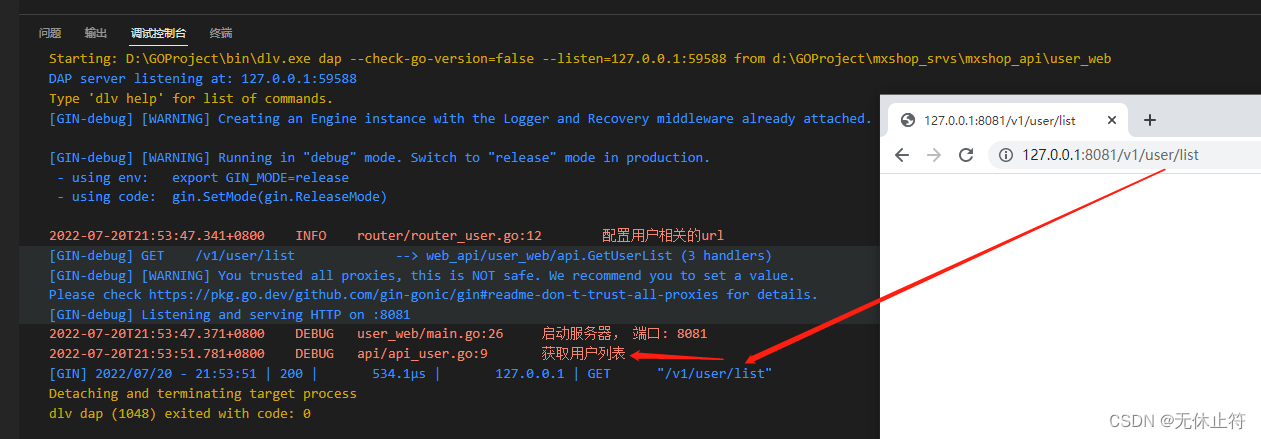
3、 ... and 、gin call grpc service
1 - YApi test
- start-up YApi test : Reference address
- user_web\initialize\init_router.go Change the path to
ApiGroup := Router.Group("/u/v1") - YApi Note that the port number is modified to 8081
- user_web\initialize\init_router.go Change the path to

2 - proto Generate
- Copy user_srv Under the project of user.proto, And regenerate :
protoc --go_out=. --go_opt=paths=source_relative --go-grpc_out=. --go-grpc_opt=paths=source_relative *.proto
syntax = "proto3";
import "google/protobuf/empty.proto";
option go_package = ".;proto";

service User{

    rpc GetUserList(PageInfo) returns (UserListResponse); //  User list
    rpc GetUserByMobile(MobileRequest) returns (UserInfoResponse); // adopt mobile Query the user
    rpc GetUserById(IdRequest) returns (UserInfoResponse); // adopt id Query the user
    rpc CreateUser(CreateUserInfo) returns (UserInfoResponse); //  Add users
    rpc UpdateUser(UpdateUserInfo) returns (google.protobuf.Empty); //  Update user
    rpc CheckPassWord(PasswordCheckInfo) returns (CheckResponse); // Check the password
}

message PageInfo {

    uint32 pn = 1;
    uint32 pSize = 2;
}

message UserInfoResponse {

    int32 id = 1;
    string passWord = 2;
    string mobile = 3;
    string nickName = 4;
    uint64 birthDay = 5;
    string gender = 6;
    int32 role = 7;
}

message UserListResponse {

    int32 total = 1;
    repeated UserInfoResponse data = 2;
}

message CreateUserInfo {

    string nickName = 1;
    string passWord = 2;
    string mobile = 3;
}

message MobileRequest{

    string mobile = 1;
}

message IdRequest {

    int32 id = 1;
}

message UpdateUserInfo {

    int32 id = 1;
    string nickName = 2;
    string gender = 3;
    uint64 birthDay = 4;
}

message PasswordCheckInfo {

    string password = 1;
    string encryptedPassword = 2;
}

message CheckResponse{

    bool success = 1;
}
3 - gin call grpc service
- user_web\global\response\rsp_user.go: Add return message , Encapsulation of user objects
package response

import (
	"fmt"
	"time"
)

type JsonTime time.Time

//  Internal automatic call MarshalJSON Method
func (j JsonTime) MarshalJSON() ([]byte, error) {

	var stmp = fmt.Sprintf("\"%s\"", time.Time(j).Format("2006-01-02"))
	return []byte(stmp), nil
}

type UserResponse struct {

	Id       int32    `json:"id"`
	NickName string   `json:"name"`
	Birthday JsonTime `json:"birthday"`
	Gender   string   `json:"gender"`
	Mobile   string   `json:"mobile"`
}
- user_web\api\api_user.go:
- Unified specification error type prompt
- Implement user list interface query
package api

import (
	"context"
	"fmt"
	"net/http"
	"time"

	"github.com/gin-gonic/gin"
	"go.uber.org/zap"
	"google.golang.org/grpc"
	"google.golang.org/grpc/codes"
	"google.golang.org/grpc/credentials/insecure"
	"google.golang.org/grpc/status"

	"web_api/user_web/global/response"
	"web_api/user_web/proto"
)

func HandleGrpcErrorToHttp(err error, c *gin.Context) {

	// take grpc Of code convert to http The status code
	if err != nil {

		if e, ok := status.FromError(err); ok {

			switch e.Code() {

			case codes.NotFound:
				c.JSON(http.StatusNotFound, gin.H{

					"msg": e.Message(),
				})
			case codes.Internal:
				c.JSON(http.StatusInternalServerError, gin.H{

					"msg:": " internal error ",
				})
			case codes.InvalidArgument:
				c.JSON(http.StatusBadRequest, gin.H{

					"msg": " Parameter error ",
				})
			case codes.Unavailable:
				c.JSON(http.StatusInternalServerError, gin.H{

					"msg": " User services are not available ",
				})
			default:
				c.JSON(http.StatusInternalServerError, gin.H{

					"msg": e.Code(),
				})
			}
			return
		}
	}
}

func GetUserList(ctx *gin.Context) {

	ip := "127.0.0.1"
	port := 50051

	// Dial up connection users grpc The server
	userConn, err := grpc.Dial(fmt.Sprintf("%s:%d", ip, port), grpc.WithTransportCredentials(insecure.NewCredentials()))
	if err != nil {

		zap.S().Errorw("[GetUserList]  Connect  【 User service failed 】", "msg", err.Error())
	}
	// Generate grpc Of client And call the interface
	userSrvClient := proto.NewUserClient(userConn)
	rsp, err := userSrvClient.GetUserList(context.Background(), &proto.PageInfo{

		Pn:    0,
		PSize: 0,
	})
	if err != nil {

		zap.S().Errorw("[GetUserList]  Inquire about  【 User list 】  Failure ")
		HandleGrpcErrorToHttp(err, ctx)
		return
	}

	result := make([]interface{
    }, 0)
	for _, value := range rsp.Data {

		user := response.UserResponse{

			Id:       value.Id,
			NickName: value.NickName,
			//Birthday: time.Time(time.Unix(int64(value.BirthDay), 0)).Format("2006-01-02"),
			Birthday: response.JsonTime(time.Unix(int64(value.BirthDay), 0)),
			Gender:   value.Gender,
			Mobile:   value.Mobile,
		}
		result = append(result, user)
	}

	ctx.JSON(http.StatusOK, result)
}
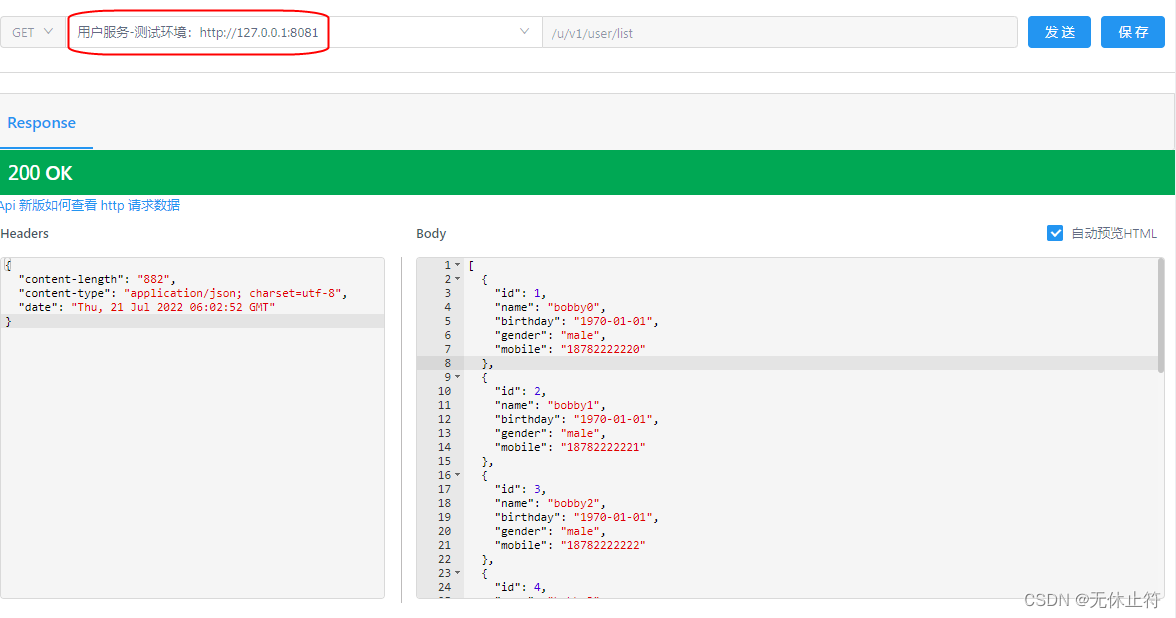
- Test conclusion
- YApi Of docker Need to open
- user_srv Need to open , port 50051
- user_web Of http port ,8081


Four 、viper Configuration Management
1 - viper brief introduction
- Viper brief introduction :Viper Apply to Go Complete configuration solution for applications ; It's designed to work in applications , And can handle all types of configuration requirements and formats
- Viper Characteristics of
- Set the default value
- from JSON、TOML、YAML、HCL、envfile and Java properties Read the configuration information from the configuration file
- Real time monitoring and rereading configuration files ( Optional )
- Read from environment variable
- Configure the system remotely (etcd or Consul) Read and monitor configuration changes
- Read configuration from command line parameters
- from buffer Reading configuration
- Explicit configuration value
- Viper Address :https://github.com/spf13/viper
- config.yaml:
name: 'user-web'
mysql:
  host: '127.0.0.1'
  port: 3306
package main

import (
	"fmt"
	"github.com/spf13/viper"
)

type ServerConfig struct {

	ServiceName string `mapstructure:"name"`
	Port        int    `mapstructure:"port"`
}

func main() {

	v := viper.New()
	// How to set the path of the file
	v.SetConfigFile("viper_test/config.yaml")
	if err := v.ReadInConfig(); err != nil {

		panic(err)
	}
	serverConfig := ServerConfig{
    }
	if err := v.Unmarshal(&serverConfig); err != nil {

		panic(err)
	}
	fmt.Println(serverConfig)
	fmt.Printf("%v", v.Get("name"))
}
2 - viper Environmental isolation and dynamic monitoring
- Demand thinking : How to achieve , There is no need to change any code, and online and online configuration files can be separated
- Solution :
- Use environment variables to determine whether it is a production environment or a development environment
- Use
fsnotifyFile change notification library to achieve dynamic monitoring
- main.go
package main

import (
	"fmt"
	"github.com/fsnotify/fsnotify"
	"github.com/spf13/viper"
	"time"
)

// How to isolate online and offline configuration files
// There is no need to change any code, and online and online configuration files can be separated

type MysqlConfig struct {

	Host string `mapstructure:"host"`
	Port int    `mapstructure:"port"`
}

type ServerConfig struct {

	ServiceName string      `mapstructure:"name"`
	MysqlInfo   MysqlConfig `mapstructure:"mysql"`
}

func GetEnvInfo(env string) bool {

	viper.AutomaticEnv()
	return viper.GetBool(env)
	// The environment variable just set   Want to take effect   We have to restart goland
}

func main() {

	debug := GetEnvInfo("DEV_CONFIG")
	configFilePrefix := "config"
	configFileName := fmt.Sprintf("viper_test/%s_pro.yaml", configFilePrefix)
	if debug {

		configFileName = fmt.Sprintf("viper_test/%s_debug.yaml", configFilePrefix)
	}

	v := viper.New()
	// How to set the path of the file
	v.SetConfigFile(configFileName)
	if err := v.ReadInConfig(); err != nil {

		panic(err)
	}
	serverConfig := ServerConfig{
    }
	if err := v.Unmarshal(&serverConfig); err != nil {

		panic(err)
	}
	fmt.Println(serverConfig)
	fmt.Printf("%v", v.Get("name"))

	//viper The function of  -  Dynamically monitor changes
	v.WatchConfig()
	v.OnConfigChange(func(e fsnotify.Event) {

		fmt.Println("config file channed: ", e.Name)
		_ = v.ReadInConfig()
		_ = v.Unmarshal(&serverConfig)
		fmt.Println(serverConfig)
	})

	time.Sleep(time.Second * 300)
}
- yaml
//config_pro.yaml
name: 'user-web'
mysql:
  host: '127.0.0.2'
  port: 3309

//config_debug.yaml
name: 'user-web2'
mysql:
  host: '127.0.0.1'
  port: 3306

3 - gin Integrate viper
- Configurations that need to be integrated include
- user_srv Service configuration information
- user_web Service configuration information
- yaml
//config_debug.yaml
name: 'user-web'
port: '8081'
user_srv:
  host: '127.0.0.1'
  port: '50051'
//config_pro.yaml
name: 'user-web'
port: '8031'
user_srv:
  host: '127.0.0.1'
  port: '50052'
- user_web\config\config.go: add to user_srv and user_web Configuration of struct
package config

type UserSrvConfig struct {

	Host string `mapstructure:"host" json:"host"`
	Port int    `mapstructure:"port" json:"port"`
}

type ServerConfig struct {

	Name        string        `mapstructure:"name" json:"name"`
	Port        int           `mapstructure:"port" json:"port"`
	UserSrvInfo UserSrvConfig `mapstructure:"user_srv" json:"user_srv"`
}
- user_web\global\global.go: In order to make ServerConfig It can be read in other files , stay global.go Add global variables to
package global

import "web_api/user_web/config"

var (
	ServerConfig *config.ServerConfig = &config.ServerConfig{
    }
)
- user_web\initialize\init_config.go: Initialize read configuration information
package initialize

import (
	"fmt"

	"github.com/fsnotify/fsnotify"
	"github.com/spf13/viper"
	"go.uber.org/zap"

	"web_api/user_web/global"
)

func GetEnvInfo(env string) bool {

	viper.AutomaticEnv()
	return viper.GetBool(env)
	// The environment variable just set   Want to take effect   We have to restart goland
}

func InitConfig() {

	debug := GetEnvInfo("DEV_CONFIG")
	configFilePrefix := "config"
	configFileName := fmt.Sprintf("%s_pro.yaml", configFilePrefix)
	if debug {

		configFileName = fmt.Sprintf("%s_debug.yaml", configFilePrefix)
	}

	v := viper.New()
	// How to set the path of the file
	v.SetConfigFile(configFileName)
	if err := v.ReadInConfig(); err != nil {

		panic(err)
	}
	// How this object is used in other files  -  Global variables
	if err := v.Unmarshal(&global.ServerConfig); err != nil {

		panic(err)
	}
	zap.S().Infof(" Configuration information : &v", global.ServerConfig)

	//viper The function of  -  Dynamically monitor changes
	v.WatchConfig()
	v.OnConfigChange(func(e fsnotify.Event) {

		zap.S().Infof(" Configuration file changes : &s", e.Name)
		_ = v.ReadInConfig()
		_ = v.Unmarshal(&global.ServerConfig)
		zap.S().Infof(" Configuration information : &v", global.ServerConfig)
	})
}
- main.go
- add to viper The initialization :
initialize.InitConfig() - The service startup port is modified to a global object :
global.ServerConfig.Port
- add to viper The initialization :
package main

import (
	"fmt"
	"web_api/user_web/global"
	"web_api/user_web/initialize"

	"go.uber.org/zap"
)

func main() {

	//1.  initialization logger
	initialize.InitLogger()
	//2.  Initialize configuration file
	initialize.InitConfig()
	//3.  initialization routers
	Router := initialize.Routers()

	/* 1. S() You can get a global sugar, We can set a global logger 2.  Logs are graded ,debug, info , warn, error, fetal debug The minimum ,fetal The highest , If configured to info, All than info Low ones will not output  NewProduction The default log level is info NewDevelopment The default log level is debug 3. S Functions and L Functions are useful ,  Provides a global security access logger Way  */
	zap.S().Debugf(" Start the server ,  port : %d", global.ServerConfig.Port)

	if err := Router.Run(fmt.Sprintf(":%d", global.ServerConfig.Port)); err != nil {

		zap.S().Panic(" Boot failure :", err.Error())
	}
}

5、 ... and 、 Complete source code
Source code address :https://download.csdn.net/download/qq23001186/86261620
边栏推荐
- Cesium region clipping, local rendering
- 软考 系统架构设计师 简明教程 | 系统设计
- 字节跳动 AI Lab 总监李航:语言模型的过去、现在和未来
- Jianzhi offer 07 rebuild binary tree -- construct binary tree from middle order and post order traversal sequence
- 小程序毕设作品之微信校园洗衣小程序毕业设计成品(1)开发概要
- [leetcode] 592. Fraction addition and subtraction
- Egg swagger doc graphic verification code solution
- 软考 系统架构设计师 简明教程 | 软件测试
- Leetcode error reporting and its solution
- Keras deep learning practice - recommend system data coding
猜你喜欢

Summary of scaling and coding methods in Feature Engineering

js将数组根据指定属性值分组成二维数组

Oppo self-developed large-scale knowledge map and its application in digital intelligence engineering
Go language series: how to build a go language development environment?

建议收藏,PMP应战篇(2)之易混淆知识点
![[300 + selected interview questions from big companies continued to share] big data operation and maintenance sharp knife interview question column (IX)](/img/cf/44b3983dd5d5f7b92d90d918215908.png)
[300 + selected interview questions from big companies continued to share] big data operation and maintenance sharp knife interview question column (IX)

Keras深度学习实战——推荐系统数据编码

Fiddler bag capturing Tool + night God simulator

SCI thesis writing

在“元宇宙空间”UTONMOS将打开虚实结合的数字世界
随机推荐
A brief analysis of the four process pools
Fiddler抓包工具+夜神模拟器
Image features and extraction
建议收藏,PMP应战篇(2)之易混淆知识点
字节跳动 AI Lab 总监李航:语言模型的过去、现在和未来
libevent 之 evconnlistener_new_bind
What are the precautions for using carbon brushes
剑指Offer 07 重建二叉树 -- 从中序与后序遍历序列构造二叉树
MFC FTP creates multi-level folders and uploads files to the specified directory of FTP
evutil_make_internal_pipe_: pipe: Too many open files
opencv图像的缩放平移及旋转
[introduction to C language] zzulioj 1021-1025
双料第一!
将目标检测大尺寸图片裁剪成固定尺寸图片
Add index to the field of existing data (Damon database version)
Unapp prevents continuous click errors
小程序毕设作品之微信校园洗衣小程序毕业设计成品(8)毕业设计论文模板
软考 系统架构设计师 简明教程 | 软件系统建模
[C Advanced] pointer array vs array pointer
小程序毕设作品之微信校园洗衣小程序毕业设计成品(3)后台功能