当前位置:网站首页>Li Hongyi machine learning team learning punch in activity day04 - Introduction to deep learning and back propagation mechanism
Li Hongyi machine learning team learning punch in activity day04 - Introduction to deep learning and back propagation mechanism
2022-07-27 05:27:00 【Charleslc's blog】
List of articles
Write it at the front
I signed up for a team learning activity , Today's task is deep learning , There is little contact before deep learning , You can study hard this time .
Reference video :https://www.bilibili.com/video/av59538266
Reference notes :https://github.com/datawhalechina/leeml-notes
Deep learning Introduction
The three steps of deep learning
deep learning There are generally three parts :
- step1: neural network (Neural network)
- step2: Model to evaluate (Goodness of function)
- step3: Choose the best function (Pick best function)

step1: neural network

Neuron : Nodes in Neural Networks 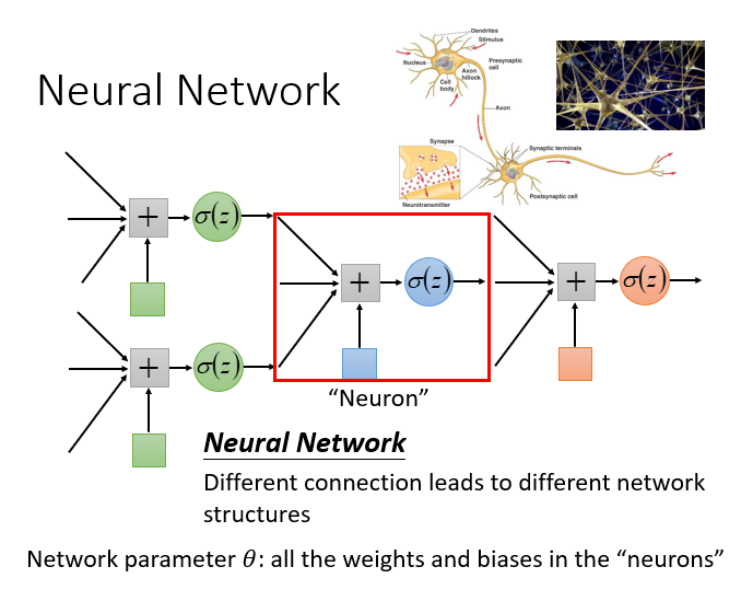
Neural networks have many different connections , This will produce different structures .
Complete feedforward neural network
Concept : feedforward (feedforward) It can also be called forward , From the signal flow direction to understand is the input signal into the network , Signal flow is Individual Of , That is, the signal flows from the previous layer to the next layer , All the way to the output layer , There is no connection between any two layers feedback (feedback), That is, the signal does not return from the next layer to the previous layer .
For example, the input (1,-1) and (-1,0) Result :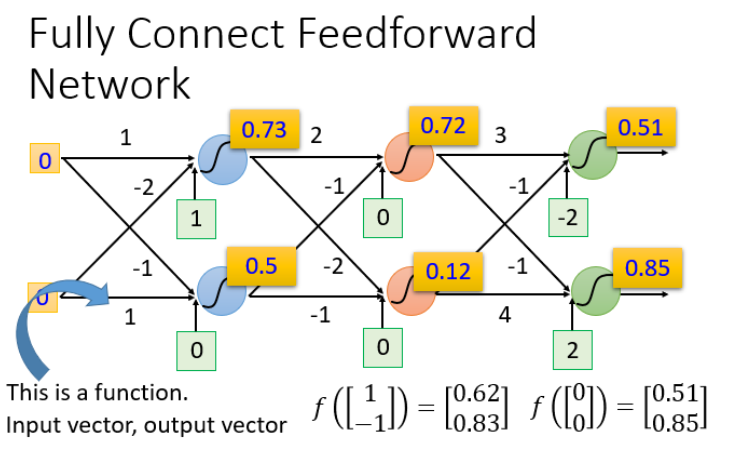
We can set the parameters of the above structure to different numbers , Just different functions (function). These possible functions (function) Together, it is a set of functions (function set).
Full link and feedforward understanding
- Input layer (Input Layer):1 layer
- Hidden layer (Hidden Layer):N layer
- Output layer (Output Layer):1 layer

Fully connected understanding : because layer And layer2 There are connections between Liangliang , So it's called full link (Fully Connect)
Feedforward understanding : Because the direction of transmission is from back to front , So it's called Feedforward.
Deep understanding
What does that mean Deep Well ?Deep = Many hidden layer. How many floors can there be ?
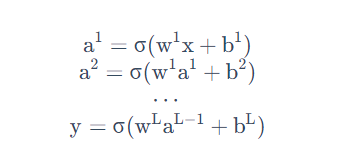
As the number of layers increases , Lower error rate , And then the amount of computation increases , It's usually more than a billion calculations . use Matrix operations It can speed up the calculation .

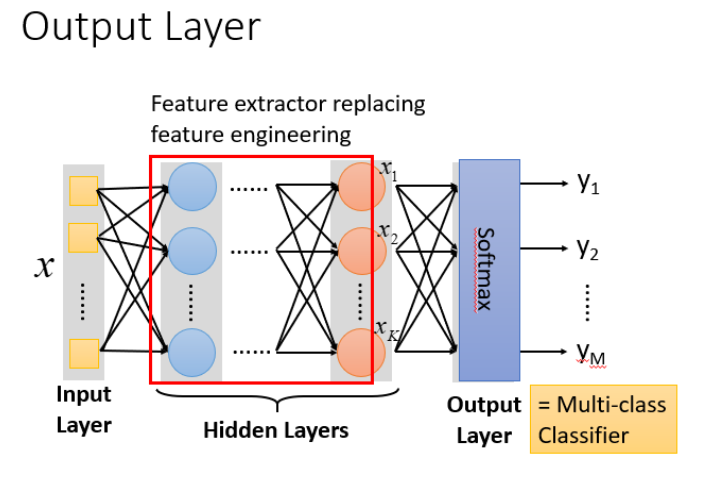
The essence : Feature transformation through hidden layer
The hidden layer is replaced by the original feature engineering by feature extraction , So in the last hidden layer, the output is a new set of features ( Equivalent to black box operation ) And for the output layer , In fact, the output of the previous hidden layer is regarded as the input ( The best set of features obtained by feature extraction ) And then through a multi classifier ( It can be softmax function ) Get the final output y.
step2: Model to evaluate
Examples of losses :
For losses , We don't just need to calculate the amount of data , It's about calculating the loss of all the training data as a whole , And then add up the loss of all the training data , Get an overall loss L.
Evaluation of the model . We usually use the loss function to reflect the quality of the model , For neural networks , It is generally used ** Cross entropy (cross entropy)** Function to calculate .
step3: Choose the best function
gradient descent 

Specific process : θ \theta θ It's a set of parameters with weights and deviations , Find an initial value at random , Next, calculate the partial differential corresponding to each parameter , Get a set of partial differential ∇ L \nabla L ∇L It's gradient , With these partial differentials , You can update the gradient constantly to get new parameters , It's going on over and over again , You can get the best parameters to minimize the loss function .
Back propagation

The best way to calculate the loss in neural network clock is back propagation , You can use TensorFlow, theano, Pytorch Etc. frame calculation .
- Loss function (Loss function) It's defined on a single training sample , That is to calculate the error of a sample ,
- Cost function (Cost function) It's defined throughout the training set , That is, the average of the sum of the errors of all samples .
- The total loss function (Total loss function) It's defined on the whole training set , That is, the total error of all samples , That is to evaluate the value that we need to minimize back propagation .

For a neuron (Neuron) Analyze

Forward part
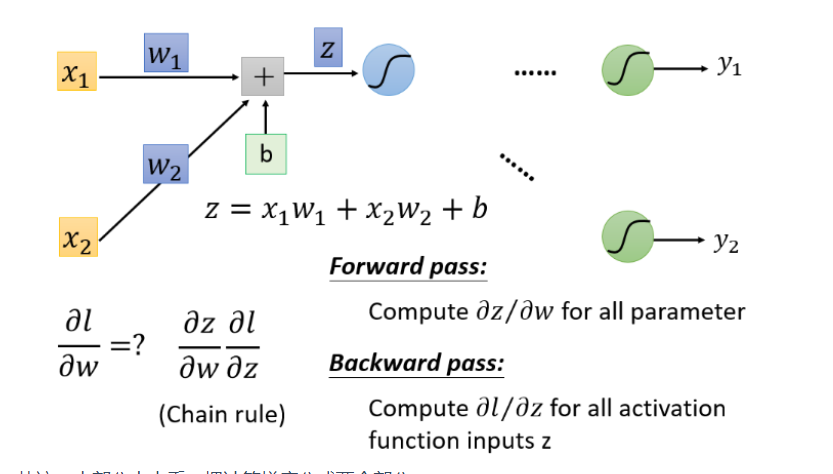
According to the differential principle , ∂ z ∂ w 1 = x 1 \frac{\partial z}{\partial w_1} = x_1 ∂w1∂z=x1, ∂ z ∂ w 2 = x 2 \frac{\partial z}{\partial w_2}=x_2 ∂w2∂z=x2

Reverse part


final result :
understand : But you can imagine looking at this thing from another angle , Now there's another neuron , hold forward The process is reversed ,
among σ ′ ( z ) \sigma'(z) σ′(z) Is constant , Because it has been determined when it propagates forward .
if ∂ l ∂ z ′ \frac{\partial l}{\partial z'} ∂z′∂l and ∂ l ∂ z ′ ′ \frac{\partial l}{\partial z''} ∂z′′∂l It's the last hidden layer , Then direct calculation can get the result 
if ∂ l ∂ z ′ \frac{\partial l}{\partial z'} ∂z′∂l and ∂ l ∂ z ′ ′ \frac{\partial l}{\partial z''} ∂z′′∂l The last hidden layer , You need to calculate it all the way back through the chain rule 
summary
Our goal is to calculate ∂ z ∂ w \frac{\partial z}{\partial w} ∂w∂z(Forward pass part ) And calculation KaTeX parse error: Undefined control sequence: \patial at position 19: …ac{\partial l}{\̲p̲a̲t̲i̲a̲l̲ ̲z}(Backward pass Part of ), And then ∂ z ∂ w \frac{\partial z}{\partial w} ∂w∂z and KaTeX parse error: Undefined control sequence: \patial at position 19: …ac{\partial l}{\̲p̲a̲t̲i̲a̲l̲ ̲z} Multiply and you get
∂ l ∂ w \frac{\partial l}{\partial w} ∂w∂l, You can get all the parameters in the neural network , Then use gradient descent to continuously update , Get the loss minimum function .
边栏推荐
猜你喜欢

JVM Part 1: memory and garbage collection part 6 -- runtime data area local method & local method stack

JVM Part 1: memory and garbage collection part 8 - runtime data area - Method area

Li Kou achieved the second largest result
![[CSAPP] Application of bit vectors | encoding and byte ordering](/img/96/344936abad90ea156533ff49e74f59.gif)
[CSAPP] Application of bit vectors | encoding and byte ordering

Message reliability processing

ERP system brand

Graph cuts learning

The receiver sets the concurrency and current limit
李宏毅机器学习组队学习打卡活动day05---网络设计的技巧

Mysql速成
随机推荐
34. Analyze flexible.js
SQL database → constraint → design → multi table query → transaction
JVM上篇:内存与垃圾回收篇八--运行时数据区-方法区
[optical flow] - data format analysis, flowwarp visualization
Graph cuts learning
SSM framework integration
Student management system
B1024 scientific counting method
数据库设计——关系数据理论(超详细)
JVM Part 1: memory and garbage collection part 11 -- execution engine
MQ set expiration time, priority, dead letter queue, delay queue
B1022 D进制的A+B
Li Hongyi machine learning team learning punch in activity day01 --- introduction to machine learning
conda和pip环境常用命令
I've heard the most self disciplined sentence: those I can't say are silent
JVM Part 1: memory and garbage collection part 14 -- garbage collector
如何快速上手强化学习?
idea远程调试debug
Could not autowire. No beans of ‘userMapper‘ type found.
B1022 a+b in d-ary