当前位置:网站首页>Creation and traversal of binary tree
Creation and traversal of binary tree
2022-07-26 15:22:00 【Le nineteen】
The definition of a tree
: What is a tree ?
Suppose we give the results of preorder traversal and inorder traversal of a binary tree , How can we create a tree from these two traversal results ?
Through the result of preorder traversal, we can find the root node of the binary tree , Now that you have the root node of the binary tree , We are looking at sequence traversal , Find the root node of the binary tree in the middle order traversal , All nodes before the root node are the left subtree of the binary tree , All nodes after the root node are the right subtree of the binary tree . Thus, the traversal results can be segmented .
![[ Failed to transfer the external chain picture , The origin station may have anti-theft chain mechanism , It is suggested to save the pictures and upload them directly (img-bxIzd7is-1658396240736)(C:\Users\lenovo\AppData\Roaming\Typora\typora-user-images\image-20220721095910621.png)]](/img/49/ad20d06460743e62af3f31fb1b11df.png)
Now that you have got the left subtree and the right subtree, it's easy to do , We know that the left and right subtrees of a binary tree can also be regarded as a binary tree , At this time, the scale of binary tree becomes smaller , But it still conforms to the results of preorder traversal and inorder traversal , Therefore, the left and right subtrees can be created separately .
Pseudo code means :
BtNode* BuyNode()
{

    BtNode* s = (BtNode*)malloc(sizeof(BtNode));
    if(s == nullptr) return nullptr;
    memset(s,0,sizeof(BtNode));
    return s;
}

int FindPos(char* in,int n,char a)
{

    int pos  = -1;
    for(int i =0;i<n;++i)
    {

        if(in[i] == a)
        {

            pos = i;
            break;
        }
    }
    return pos;
}

BinaryTree CreateBinaryTree(char* Pre,char* in,int n)
{

    // First, we need to buy a node , Let it be the root node , So you need a purchase node function
    BtNode* root = BuyNode();// Buy nodes
    root->value = pre[0];
    // To build a binary tree , We also need to find the location of the root node in the middle order traversal , So as to determine the left and right subtrees , So you also need a lookup function , The return value is the location of the root node pos
    int pos = FindPos(in,n,pre[0]);// Find... In the middle order traversal pre[0] The location of , If not found , It shows that the two traversal results are not a binary tree , immediate withdrawal
    if(pos == -1) exit(0);
    // At this time, we have new left subtree and right subtree , Create... Separately
    CreateBinaryTree( The result of preorder traversal of left subtree , Middle order traversal results of left subtree , The size of the left subtree );// Create the left subtree
    CreateBinaryTree( The result of preorder traversal of the right subtree , The middle order traversal result of the right subtree , The size of the right subtree );// Create the right subtree
}


//pre  Indicates that the pre order traversal array ,in Indicates that the array is traversed in middle order ,n Represents the number of nodes
BinaryTree CreateBtree(char* Pre,char* in)
{

    int n = sizeof(pre)/sizeof(pre[0]);
    if(pre==nullptr||in==nullptr||n<=0)
    {

        return nullptr;// If the above conditions are not met, the binary tree does not exist , Returns a null pointer directly
    }
    CreateBinaryTree(pre,in,n);// Start to create
}
The complete code for building a binary tree and traversing before, during and after recursion is as follows :
#include<iostream>
#include<stack>
#include<queue>
#include<memory>

/* * There are two ways to store binary trees , One is to store in a linked list , One is to store in an array  *  When storing in an array , Pay attention to the relationship between nodes , Suppose the location of the root node is POS Then the position of the left subtree is  * 2*POS+1, The position of the right subtree is 2*POS+2. Because of this relationship , When the binary tree is not full , Use arrays for storage  *  It's a waste of space , Low utilization of space . *  When storing a binary tree in a linked list , Each binary tree node contains a left child pointer and a right child pointer , Two pointers, respectively  *  Point to the corresponding node , Save a space , And it's easier to use . */
using namespace std;
typedef char ElemType;
typedef struct BtNode
{

	ElemType value;
	BtNode* leftchild;
	BtNode* rightchild;
}BtNode,*BinaryTree;


BtNode* BuyNode()
{

	BtNode* s = (BtNode*)malloc(sizeof(BtNode));
	if (s == NULL)return nullptr;
	memset(s, 0, sizeof(BtNode));
	return s;
}

int FindPos(ElemType* In, int n, ElemType val)
{

	int pos = -1;
	for (int i = 0; i < n ; ++i)
	{

		if (In[i] == val)
		{

			pos = i;
			break;
		}
	}
	return pos;
}

BinaryTree CreateBinTree(ElemType* Pr, ElemType* In, int n)
{

	BtNode* s = nullptr;
	if (n >= 1)
	{

		s = BuyNode();
		s->value = Pr[0];
		int pos = FindPos(In, n, Pr[0]);
		if (pos == -1) exit(0);

		s->leftchild = CreateBinTree(Pr + 1, In, pos);
		s->rightchild = CreateBinTree(Pr + pos + 1, In + pos + 1, n - pos - 1);
	}
	return s;
}


// Create a binary tree through the first and middle order array
BinaryTree CreateBinaryTree(ElemType* Pr, ElemType* In)
{

	int n = strlen(Pr);
	if (Pr == nullptr || In == nullptr)
	{

		return nullptr;
	}
	else
		return CreateBinTree(Pr, In, n);
}

BinaryTree CreateLI(ElemType* Li, ElemType* In, int n)
{

	BtNode* s = nullptr;
	if (n >= 1)
	{

		s = BuyNode();
		s->value = Li[n - 1];// The last data of post order traversal is the root node
		int pos = FindPos(In, n, Li[n - 1]);
		if (pos == -1)exit(0);
		s->leftchild = CreateLI(Li, In, pos);
		s->rightchild = CreateLI(Li + pos, In + pos + 1, n - pos - 1);
	}

	return s;
}

// Establish a binary tree through the post ordered array
BinaryTree CreateLITree(ElemType* Li, ElemType* In)
{

	int n = strlen(Li);
	if (Li == nullptr || In == nullptr)
	{

		return nullptr;
	}
	else
		return CreateLI(Li, In, n);
}

// Preorder traversal of two tree ( recursively ) The root node - The left subtree - Right subtree
void PreOrder(BtNode* root)
{

	if (root != nullptr)
	{

		cout << root->value << " ";
		PreOrder(root->leftchild);
		PreOrder(root->rightchild);
	}
}

// Middle order traversal of binary trees ( recursively ) The left subtree - The root node - Right subtree
void InOrder(BtNode* root)
{

	if (root != nullptr)
	{

		InOrder(root->leftchild);
		cout << root->value << " ";
		InOrder(root->rightchild);
	}
}

// Postorder traversal of binary trees ( recursively ) The left subtree - Right subtree - The root node
void PastOrder(BtNode* root)
{

	if (root != nullptr)
	{

		InOrder(root->leftchild);
		InOrder(root->rightchild);
		cout << root->value << " ";
	}
}

int main()
{

	char ar[] = {
     "ABCDEFGH" };
	char br[] = {
     "CBEDFAGH" };
	char cr[] = {
     "CBEDFGHA" };
	//BinaryTree root = CreateBinaryTree(ar, br);
	BinaryTree root = CreateLITree(cr, br);
	PreOrder(root);
	cout << endl;
	InOrder(root);
	cout << endl;
	PastOrder(root);
	cout << endl;
}
Implementation of non recursive middle order traversal :
Here we need a stack to realize , Take advantage of stack features , Last in, first out , When we reach the end node , Print end node . In the order of the middle , Both left, middle and right print binary tree . How do you do that ?
Apply for a station to store nodes , When the root node is not empty , Or when the stack is not empty, judge whether the left child of the node in the stack is empty , If the left child is not empty, continue to put the left child in the stack , If the left child is empty , Just print this node , Then visit the right child , Continue the previous judgment .
The point is that when we visit each node , It should be judged as the root node , Think of it as a small binary tree , Complete the middle order traversal , Then the overall implementation is the middle order traversal of the whole binary tree .
Code implementation :
void NiceInOrder(BtNode* root)
{

	// If the root node is empty , Return directly without sorting
	if(root == nullptr) return;
    std::stack<BtNode*> st;
    while(root!=nullptr || !st.empty())
    {

        // Keep putting the left subtree on the stack , When the left subtree is empty , It indicates that the end node is reached
        while(root!=nullptr)
        {

            st.push(root);
            root = root->leftchild;
        }
        root = st.top(); st.pop();
        cout<< root->value;
        root = root->rightchild;
        }
    }
}
Non recursive postorder traversal of binary trees :
The order of post order traversal is left, right, middle , Access the left subtree first when the left subtree is accessed , When accessing the right subtree , Finally, the root node is accessed . Then the difficulty of non recursive post order traversal is , After accessing the end node, how can we determine whether to print the node , Whether there is any right subtree of this node that has not been accessed .
Suppose the binary tree has only three nodes , As shown in the figure :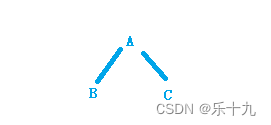
If the root node is not empty, put the root node on the stack , Because it is post order traversal , So you need to visit the left subtree of the root node , You can see that the left subtree is not empty , Continue to visit the left subtree , When the left subtree is empty, return to the root node and continue to judge whether the right subtree is empty , When the left and right subtrees are empty , To print the root node .
Code implementation :
void NicePastOrder(BtrNode* root)
{

    if(root == nullptr) return;
    std::stack<BtNode*> st;
    BtNode* tag = nullptr;// Sign a , Always point to the most recently printed node
    while(root != nullptr || !st.empty())
    {

        while(root!=nullptr)
        {

            st.push(root);
            root = root->left;
        }
        // When the above loop is completed , State the current *root It has pointed to nullptr, Then his parent node has no left subtree , Then you can go to war
        // After performing the stack out operation , We already know root The left child of the node is empty , Or the left child has already printed it .
        root= st.top(); st.pop();
        // Because it performs post order traversal 、 After coming out of the stack, we still need to judge , Whether the node has a right subtree , If there is and has not been traversed , Then the root node can be printed after traversing the right subtree
        if(root->rightchild == nullptr || root->rightchild == tag)
        {

            cout << root->value;
            tag = ptr;
            ptr =nullptr;
        }
        else
        {

            // If the right subtree is not empty , You need to put the right subtree on the stack again , Continue to judge
            st.push(root);
            root = root->rightchild;
        }
    }
}
Implementation of non recursive preorder traversal of binary tree :
To implement the preorder traversal, you need to print the root node first , Then print the left subtree and then the right subtree , Still use the divide and conquer strategy . Using a stack , First put the root node on the stack , as long as root If it is not empty or the stack is not empty, it will always loop , Every cycle produces the top element , And judge and put the left and right children of the elements on the top of the stack .
Code implementation :
void NicePreOrder(BtNode* root)
{

	if (root == nullptr) return;
	stack<BtNode*> s;
	s.push(root);// First put the root node
	while (root != nullptr || !s.empty())
	{

		root = s.top(); s.pop();
		cout << root->value;
		if (root->rightchild != nullptr)
		{

			s.push(root->rightchild);
			root = root->rightchild;
		}
		if (root->leftchild != nullptr)
		{

			s.push(root->leftchild);
			root = root->leftchild;
		}
	}
}
The creation of binary tree and the code summary of traversal before, during and after :
#include<iostream>
#include<stack>
#include<queue>
#include<memory>

/*
* There are two ways to store binary trees , One is to store in a linked list , One is to store in an array
*  When storing in an array , Pay attention to the relationship between nodes , Suppose the location of the root node is POS Then the position of the left subtree is
* 2*POS+1, The position of the right subtree is 2*POS+2. Because of this relationship , When the binary tree is not full , Use arrays for storage
*  It's a waste of space , Low utilization of space .
*  When storing a binary tree in a linked list , Each binary tree node contains a left child pointer and a right child pointer , Two pointers, respectively
*  Point to the corresponding node , Save a space , And it's easier to use .
*/
using namespace std;
typedef char ElemType;
typedef struct BtNode
{
	ElemType value;
	BtNode* leftchild;
	BtNode* rightchild;
}BtNode,*BinaryTree;


BtNode* BuyNode()
{
	BtNode* s = (BtNode*)malloc(sizeof(BtNode));
	if (s == NULL)return nullptr;
	memset(s, 0, sizeof(BtNode));
	return s;
}

int FindPos(ElemType* In, int n, ElemType val)
{
	int pos = -1;
	for (int i = 0; i < n ; ++i)
	{
		if (In[i] == val)
		{
			pos = i;
			break;
		}
	}
	return pos;
}

BinaryTree CreateBinTree(ElemType* Pr, ElemType* In, int n)
{
	BtNode* s = nullptr;
	if (n >= 1)
	{
		s = BuyNode();
		s->value = Pr[0];
		int pos = FindPos(In, n, Pr[0]);
		if (pos == -1) exit(0);

		s->leftchild = CreateBinTree(Pr + 1, In, pos);
		s->rightchild = CreateBinTree(Pr + pos + 1, In + pos + 1, n - pos - 1);
	}
	return s;
}


// Create a binary tree through the first and middle order array
BinaryTree CreateBinaryTree(ElemType* Pr, ElemType* In)
{
	int n = strlen(Pr);
	if (Pr == nullptr || In == nullptr)
	{
		return nullptr;
	}
	else
		return CreateBinTree(Pr, In, n);
}

BinaryTree CreateLI(ElemType* In, ElemType* Li, int n)
{
	BtNode* s = nullptr;
	if (n >= 1)
	{
		s = BuyNode();
		s->value = Li[n - 1];// The last data of post order traversal is the root node
		int pos = FindPos(In, n, Li[n - 1]);
		if (pos == -1)exit(0);
		s->leftchild = CreateLI( In,Li, pos);
		s->rightchild = CreateLI( In + pos + 1,Li + pos, n - pos - 1);
	}

	return s;
}

// Establish a binary tree through the post ordered array
BinaryTree CreateLITree(ElemType* In , ElemType* Li)
{
	int n = strlen(In );
	if (Li == nullptr || In == nullptr)
	{
		return nullptr;
	}
	else
		return CreateLI(In,Li , n);
}

// Preorder traversal of two tree ( recursively ) The root node - The left subtree - Right subtree
void PreOrder(BtNode* root)
{
	if (root != nullptr)
	{
		cout << root->value << " ";
		PreOrder(root->leftchild);
		PreOrder(root->rightchild);
	}
}

// Middle order traversal of binary trees ( recursively ) The left subtree - The root node - Right subtree
void InOrder(BtNode* root)
{
	if (root != nullptr)
	{
		InOrder(root->leftchild);
		cout << root->value << " ";
		InOrder(root->rightchild);
	}
}

// Postorder traversal of binary trees ( recursively ) The left subtree - Right subtree - The root node
void PastOrder(BtNode* root)
{
	if (root != nullptr)
	{
		InOrder(root->leftchild);
		InOrder(root->rightchild);
		cout << root->value << " ";
	}
}
 Middle order traversal of binary trees ( Non recursive )
// The use of circulation is generally the focus of the interview , The principle is to use the stack to store the corresponding subtree , When reaching the terminal node , Then take the nodes in the stack out of the stack one by one
void NiceInOrder(BtNode* root)
{
	if (root == nullptr) return;
	stack<BtNode*> s;
	while (root !=nullptr || !s.empty())
	{
		// Stack the entire left subtree
		while (root != nullptr)
		{
			s.push(root);
			root = root->leftchild;
		}
		// Start to stack when reaching the end node
		root = s.top();
		s.pop();
		cout << root->value;
		root = root->rightchild;
	}
	cout << endl;
}


// Preorder traversal of two tree ( Non recursive )
void NicePreOrder(BtNode* root)
{
	if (root == nullptr) return;
	stack<BtNode*> s;
	BtNode* node = nullptr;
	s.push(root);
	while (!s.empty())
	{
		node = s.top();
		s.pop();
		cout << node->value;
		if (node->rightchild)
			s.push(node->rightchild);
		if (node->leftchild)
			s.push(node->leftchild);
	}
	cout << endl;
}

// Postorder traversal of binary trees ( Non recursive )
void NicePastOrder(BtNode* root)
{
	if (root == nullptr)return;
	stack<BtNode*> st;
	BtNode* tag = nullptr;
	while (root != nullptr || !st.empty())
	{
		while (root != nullptr)
		{
			st.push(root);
			root = root->leftchild;
		}
		root = st.top();
		st.pop();
		if (root->rightchild == nullptr || root->rightchild == tag)
		{
			cout << root->value;
			tag = root;
			root = nullptr;
		}
		else
		{
			st.push(root);
			root = root->rightchild;
		}
	}
	cout << endl;
}


int main()
{
	char ar[] = { "ABCDEFGH" };
	char br[] = { "CBEDFAGH" };
	char cr[] = { "CEFDBHGA" };
	//BinaryTree root = CreateBinaryTree(ar, br);
	BinaryTree root = CreateLITree(br,cr );
	NiceInOrder(root);
	NicePreOrder(root);
	PreOrder(root);
	/*PreOrder(root);
	cout << endl;
	InOrder(root);
	cout << endl;
	PastOrder(root);
	cout << endl;*/
}
ightchild == tag)
{
cout << root->value;
tag = root;
root = nullptr;
}
else
{
st.push(root);
root = root->rightchild;
}
}
cout << endl;
}
int main()
{
char ar[] = { “ABCDEFGH” };
char br[] = { “CBEDFAGH” };
char cr[] = { “CEFDBHGA” };
//BinaryTree root = CreateBinaryTree(ar, br);
BinaryTree root = CreateLITree(br,cr );
NiceInOrder(root);
NicePreOrder(root);
PreOrder(root);
/PreOrder(root);
cout << endl;
InOrder(root);
cout << endl;
PastOrder(root);
cout << endl;/
}
边栏推荐
- Deep Packet Inspection Using Quotient Filter论文总结
- Qt最基本的布局,创建window界面
- Is there any need for livedata to learn—— Jetpack series (2)
- Within a week, I developed my own knowledge sharing platform
- 最详细的专利申请教程,教你如何申请专利
- sqlDeveloper工具快速入门
- 大学论文格式怎么写?
- Abbkine EliKine人甲胎蛋白(AFP)ELISA定量试剂盒操作方法
- DICOM学习资料收集
- FOC motor control foundation
猜你喜欢

什么是传输层协议TCP/UDP???

大学论文格式怎么写?

Deep Packet Inspection Using Cuckoo Filter论文总结

What are the skills and methods of searching foreign literature

【LeetCode每日一题】——121.买卖股票的最佳时机

Chuhuan technology is listed on Shenzhen Stock Exchange: Minsheng securities, with a market value of 2.7 billion, is a shareholder
OpenGL学习日记2——着色器

Double the efficiency of dual screen collaboration lingyao x dual screen Pro leads the new trend of dual screen technology

生泰尔科技IPO被终止:曾拟募资5.6亿 启明与济峰资本是股东

桌面应用布局图
随机推荐
DICOM学习资料收集
OpenGL学习日记2——着色器
Cve-2022-33891 vulnerability recurrence
C # set different text watermarks for each page of word
R language ggplot2 visualization: use the ggballoonplot function of ggpubr package to visualize the balloon graph (visualize the contingency table composed of two classification variables), and config
Driver development environment
【基础】动态链接库/静态链接库的区别
81.(cesium之家)cesium修改灰色背景(默认蓝色)
Simulation of character function and string function
The leader took credit for it. I changed the variable name and laid him off
【静态代码质量分析工具】上海道宁为您带来SonarSource/SonarQube下载、试用、教程
本科毕业论文外文文献翻译怎么找?
如何查询外文文献?
楚环科技深交所上市:市值27亿 民生证券是股东
Sqldeveloper tools quick start
Vs add settings for author information and time information
Deep packet inspection using cuckoo filter paper summary
Sword finger offer II 009. subarray with product less than k
R language uses LM function to build multiple linear regression model, writes regression equation according to model coefficient, and uses fitted function to calculate y value (response value) vector
Soft test (VII) performance test (1) brief introduction