当前位置:网站首页>Solution and analysis of Hanoi Tower problem
Solution and analysis of Hanoi Tower problem
2022-07-02 08:47:00 【Programmers on the road】
One 、 Introduction of recursive algorithm
This article is about an ancient and classic Hanoi Tower problem , It is a good application example of recursive algorithm . Introduction to recursive functions , stay Use recursive functions to solve the inverse problem of strings The article introduces . The idea of recursion is to solve computable problems , His fundamental feature is the gradual calculation and decomposition of this calculation , By decomposing a big problem into logically identical small problems , Then solve the small problem and get the final answer . Programs that use recursive algorithms are often concise in form , This is where his value lies .( Better reading experience , Please visit Programmers are on the road )
Computers use stack memory structures to physically implement recursive algorithms , Every recursive call , The system should return the return address of this call 、 local variable 、 Formal parameters are pressed into the stack equivalently , At the end of the call , Then take the saved information from the top of the stack and return it to the corresponding variable and exit the stack , Then continue to execute the recursive upper function . Because the stack space allocated by the computer system to each program is limited , therefore , When using recursion to solve problems , Be sure to pay attention to the depth of recursion , If the number of recursion is too many , Stack overflow is likely to occur , Cause problem solving failure .
Two 、 The hanotta problem
2.1 Origin of the problem
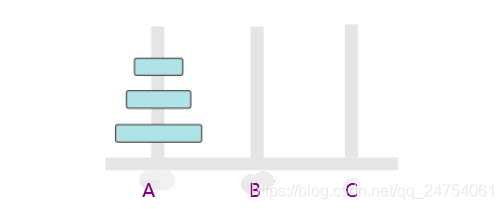
It's said that in the ancient temple of India , There is one called the Hanoi Tower (Hanoi) The game of . The game is on a copper device , There are three rods ( Number A、B、C), stay A From the bottom up 、 Place in order from large to small 64 A gold plate . The goal of the game : hold A All the gold plates on the pole are moved to C On the pole , And still keep the original order . Operating rules : Only one plate can be moved at a time , And keep the big plate down all the time during the moving process , Small in , The plate can be placed during the operation A、B、C On any pole .
2.2 Problem analysis
The tower of Hanoi problem is a multi branch recursive solution , Relative to the recursive solution of single branch ( Such as : Recursive solution of factorial ) Come on , It's not easy to understand , But as long as we grasp the core of recursion, we can understand the logic of this program . There are three steps in the solution of Hanoi Tower :
1) hold N-1 null Move to the transfer column
2) The first N The plates move to Target column
3) Put the above of the transfer column N-1 With the help of the currently free pillars Move to Target column .
Be careful , The upper transfer column , Starting column , It will change . The logic of recursion at every level is , With the help of " Target pillars ", take n-1 individual The plate moves to “ Transfer column ”, Then move the last plate to " Target pillars ", Then move the plates on the transfer column to " Target pillars ".
No matter how many plates there are , In the process of moving , Follow the above three steps . On mobile page N When it's a plate , We have to find a way to put the front N-1 Move the plates to the transfer column , Only then can the N Move a plate to the target column . On mobile page N-1 When it's a plate , It's also necessary to put the front N-2 Move the plates to the transfer column , Then we can put the N-1 Move a plate to the target column . therefore , You can see , Move N、N-1、N-2··· The idea from plate No. 1 to the target column is the same , therefore , We can solve this problem with recursion .
2.3 Program realization
#include<stdio.h>

void hnt(int n, char a,  char b, char c){


   if(n == 1){
       //  Recursive out of bounds condition

   	printf("%c -- > %c \n", a,c);
   }else{

   	/*  The logic of recursion at every level is , With the help of " Target pillars ", take n-1 individual   The plate moves to  " Transfer column ", Then move the last plate to " Target pillars ".  Be careful , The transfer column here will change . */
   	hnt(n-1,a,c,b); // ①  With the help of  c  Pillar will a On the pillar n-1 null   Move to  b  On the pillars

   	printf("%c -- > %c \n", a,c); // ②  take  a The first one on the post n null   Move to  c On the pillars

   	hnt(n-1, b,a,c);  // ③  Will be in b On the pillar n-1 null , With the help of  a  column ( here a Free )  Move to  c  On the pillars
   }
}

int main(){

   int n;
   scanf("%d", &n);
   hnt(n,'a','b','c');
   return 0;
}
2.4 Program analysis
Through the analysis of the tower of Hanoi , You may understand , The above program is the answer to the problem , But you may have some doubts , Why the above program , You can record the moving process of each step ? For this multi branch recursive algorithm , If you understand single branch recursion , List the moving process of each step in your mind as much as possible , Sometimes it's very difficult , This is also inconsistent with the principle of using recursion to solve problems . But if we really want to understand the specific process of each step , What shall I do? ? The following is a summary , To list N∈[1,4] The moving process of , Analyze his movement law .
When N =1 when :
When N =2 when :
When N =3 when :
adopt N=1,N=2 The solution of , We can infer that ,N =3 When , There will be 3 + 1 + 3 = 7 Secondary mobility .3 A plate , We have to move the first two plates to B, Then move the third plate to C, Finally, put B Two plates on top , With the help of A Move to C. Two plates on top , First move to B, Then move to C, These two processes , The number of moves required is the same , The same goes for mobile logic .
When N =4 when :
Or the previous logic ,N=4 When , There will be 7 + 1 + 7 = 15 Secondary mobility . The idea is the same as before , The former 3 null , With the help of C Move to B, Then move the fourth plate to C.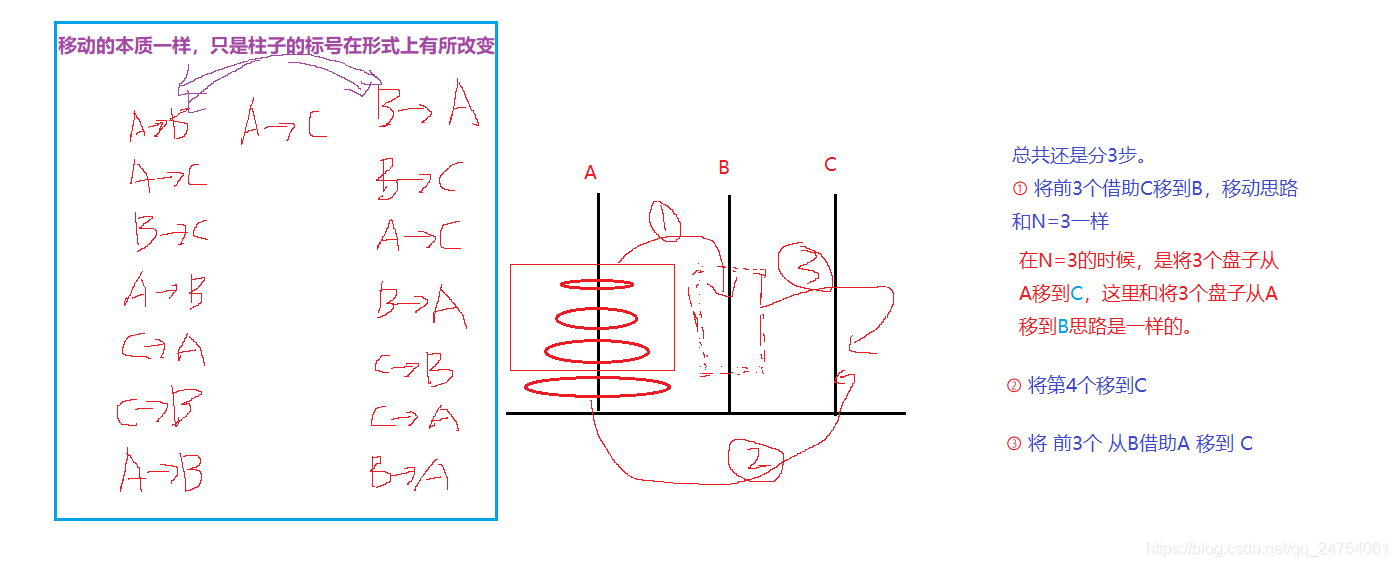
We can see from the previous demonstrations , solve N And solve N-1 Their ideas are exactly the same , This is the core to ensure that recursive algorithms can be used .
A、B、C Just a formal annotation , In essence, the above meaning is , start 、 transit 、 The goal is . In the process of moving , If you want to ensure that the small one is on , Big next , We have to rely on transit , To achieve , As for who is the transit , This sum (N-1) This pile of plates is related to the location .
When writing recursive programs , The points needing attention are shown in the following figure :
3、 ... and 、 summary
The core of recursive algorithm is recursive logic , therefore , Use recursive algorithm to solve the problem , We don't have to worry about the specific operation of each layer of function , And put the core on logic , If the solution of the problem is inductive , There is a recursive relationship in it , And it is computable , Then there is no logical problem , Generally, recursive algorithm can be used to solve .
Recursion includes single branch recursion and multi branch recursion , Single branch is relatively simple to understand , For example, the following recursive program
int f(int n) // seek n The factorial
{
int fac;
if (n == 0 || n == 1)
fac = 1;
else
fac = f(n - 1) * n;
return fac;
}
Multi branched, such as tower of Hanoi 、 Binary tree traversal, etc , It's more difficult to understand , But the mind is the same .
When a computer executes a recursive program , Calls to functions at each level , Stack data structure is used for on-site protection , So when writing recursive programs , Pay attention to the depth of recursion , Prevent emergence Stack Overflow abnormal .
边栏推荐
- 文件上传-upload-labs
- Data asset management function
- Linux安装Oracle Database 19c RAC
- Finishing the interview essentials of secsha system!!!
- OpenFeign 簡單使用
- Honeypot attack and defense drill landing application scheme
- Loadbalancer dynamically refreshes Nacos server
- OpenShift 容器平台社区版 OKD 4.10.0部署
- Minecraft插件服开服
- Shortcut key to comment code and cancel code in idea
猜你喜欢



![[blackmail virus data recovery] suffix Rook3 blackmail virus](/img/46/debc848d17767d021f3f41924cccfe.jpg)

随机推荐
Minecraft群組服開服
Benefits of ufcs of D
Qt——如何在QWidget中设置阴影效果
sqli-labs第8关(布尔盲注)
Npoi export word font size correspondence
C# 将网页保存为图片(利用WebBrowser)
Linux安装Oracle Database 19c RAC
Linked list classic interview questions (reverse the linked list, middle node, penultimate node, merge and split the linked list, and delete duplicate nodes)
汉诺塔问题的求解与分析
[blackmail virus data recovery] suffix Rook3 blackmail virus
Honeypot attack and defense drill landing application scheme
[flask] ORM one-to-one relationship
一个经典约瑟夫问题的分析与解答
idea中注释代码取消代码的快捷键
OpenFeign 簡單使用
Driving test Baodian and its spokesperson Huang Bo appeared together to call for safe and civilized travel
Oracle 相关统计
Minecraft plug-in service opening
Jumping | Blue Bridge Cup
Flex layout