当前位置:网站首页>Detailed explanation and code example of affinity propagation clustering calculation formula based on graph
Detailed explanation and code example of affinity propagation clustering calculation formula based on graph
2022-07-01 20:27:00 【deephub】
Spectral clustering and AP Clustering is two kinds of clustering based on graph , Here I introduce AP clustering .
Affinity Propagation Clustering( abbreviation AP Algorithm ) yes 2007 Proposed , It was published in Science On 《single-exemplar-based》. Especially suitable for high dimension 、 Fast clustering of multi class data , Compared with the traditional clustering algorithm , The algorithm is relatively new , Clustering performance and efficiency have been greatly improved .
Affinity Propagation It can be translated into relevance communication , It is based on data points “ The messaging ” Clustering technology of concepts , So we call it graph based clustering .
The algorithm creates clusters by sending messages between data points until convergence . It takes the similarity between data points as input , And determine examples according to certain standards . Exchange messages between data points , Until you get a set of high-quality examples . And k-means or k-medoids And other clustering algorithms are different , Propagation does not need to determine or estimate the number of clusters before running the algorithm .
Detailed explanation of the formula
We use the following data set , To introduce the working principle of the algorithm .

Similarity matrix
Each cell in the similarity matrix is calculated by negating the sum of squares of differences between participants .
such as Alice and Bob The similarity , The sum of the squares of the differences is (3–4)² + (4–3)² + (3–5)² + (2–1)² + (1– 1)² = 7. therefore ,Alice and Bob The similarity value of is -(7).
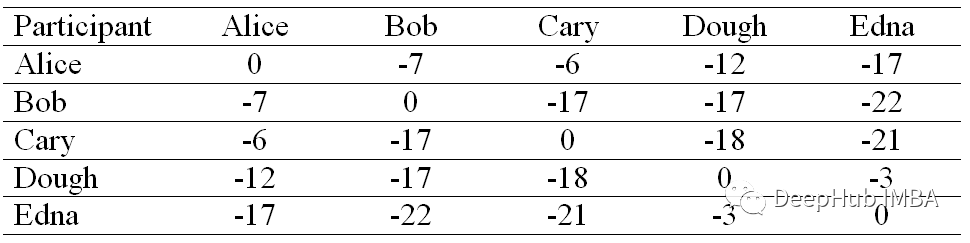
If you choose a smaller value for the diagonal , Then the algorithm will converge around a small number of clusters , vice versa . So we use -22 Fill the diagonal elements of similar matrices , This is the minimum value in our similarity matrix .

Attractiveness (Responsibility) matrix
We will first construct a structure where all elements are set to 0 Availability matrix . then , We will use the following formula to calculate each cell in the attractiveness matrix :

here i It means line ,k It refers to the column of the correlation matrix .
for example ,Bob( Column ) Yes Alice( That's ok ) The degree of attraction is -1, This is done through Bob and Alice The similarity (-7) Subtract from Alice The maximum similarity of the line (Bob and Alice The similarity (-6) With the exception of ) Calculated .
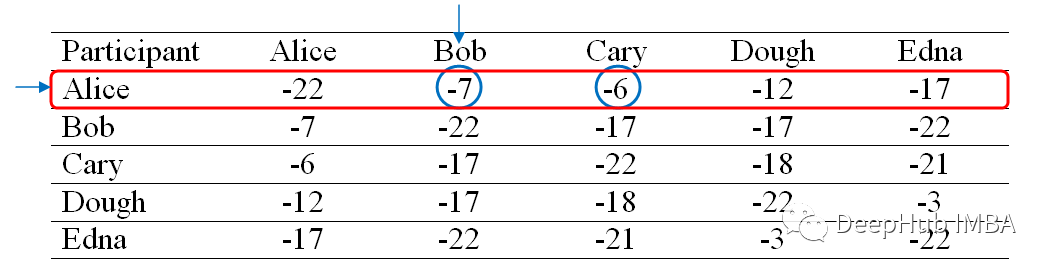
After calculating the attractiveness of other participants , We get the following matrix .

Attractiveness is used to describe points k Suitable for data points i The degree of clustering center .
Attribution degree (Availability) matrix
In order to construct a attribution matrix , Two separate equations of diagonal and off diagonal elements will be used for calculation , And apply them to our attractiveness matrix .
Diagonal elements will use the following formula .

here i It refers to the row sum of the incidence matrix k Column .
This equation tells us to calculate all values greater than... Along the column 0 The sum of the values of , Except for rows with values equal to the columns in question . for example ,Alice The element value on the diagonal of will be Alice The sum of the positive values of the columns , But does not include Alice The value of the column , be equal to 21(10 + 11 + 0 + 0).
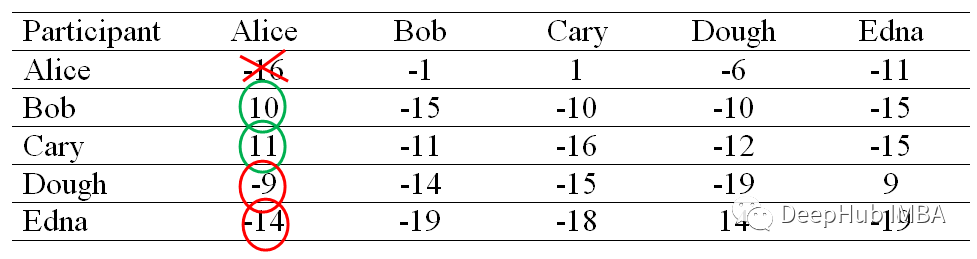
After modification , Our attribution matrix will be as follows :
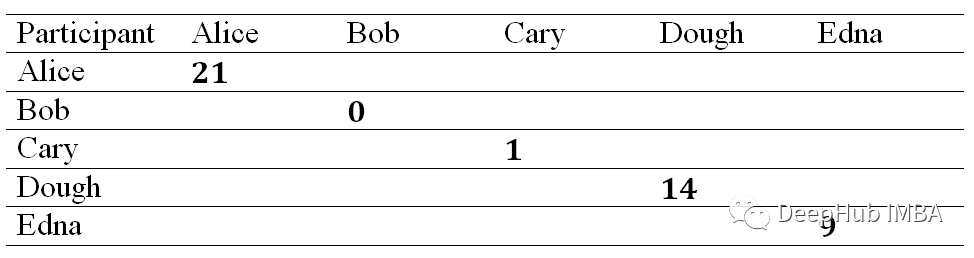
Now for off diagonal elements , Update their values using the following equation .

Understand the above equation through an example . Suppose we need to find Bob( Column ) Yes Alice( That's ok ) The degree of belonging , Then it will be Bob My self belonging ( On the diagonal ) and Bob The sum of the remaining positive attractiveness of the column , barring Bob Of Alice That's ok (-15 + 0 + 0 + 0 = -15).
After calculating the rest , Get the following attribution matrix .

Belonging degree can be understood as describing points i Select point k The suitability as its clustering center .
Applicable (Criterion) matrix
Each cell in the applicable matrix is only the sum of the attraction matrix and the attribution matrix of the position .

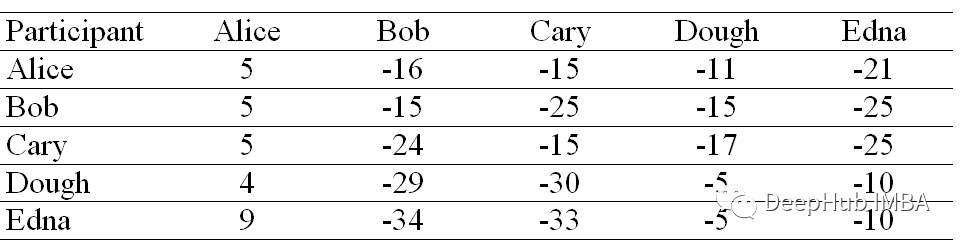
The column with the highest applicable value in each row is designated as the sample . Rows sharing the same instance are in the same cluster . In our example .Alice、Bob、Cary 、Doug and Edna All belong to the same cluster .
If this is the case :

that Alice、Bob and Cary Form a cluster , and Doug and Edna Form the second cluster .
Criterion Translated by me, it means that this matrix is the criterion and basis for our clustering algorithm .
Code example
stay sklearn The algorithm has been included in , So we can use it directly :
import numpy as np
from matplotlib import pyplot as plt
import seaborn as sns
sns.set()
from sklearn.datasets import make_blobs
from sklearn.cluster import AffinityPropagation
from Sklearn Generate clustering data
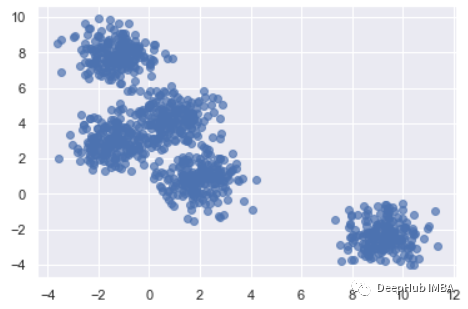
X, clusters = make_blobs(n_samples=1000, centers=5, cluster_std=0.8, random_state=0)
plt.scatter(X[:,0], X[:,1], alpha=0.7, edgecolors='b')
Initialize and fit the model .
af = AffinityPropagation(preference=-50)
clustering = af.fit(X)
AP In clustering applications, you need to manually specify Preference and Damping factor, Although there is no need to explicitly specify the number of clusters , But these two parameters are actually the original clustering “ Number ” Controlled variants :
Preference: The data points i The reference degree of is called p(i) or s(i,i), It's about pointing i As the reference of cluster center , The number of clusters is subject to reference p Influence , If you think that every data point can be used as a cluster center , that p You should take the same value . If the average of the input similarity is taken as p Value , The number of clusters is medium . If the minimum value is taken , Get clusters with fewer classes .
Damping factor( Damping coefficient ): Mainly for convergence .
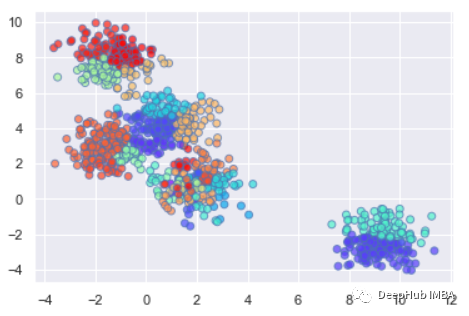
Draw data points of clustering results
plt.scatter(X[:,0], X[:,1], c=clustering.labels_, cmap=‘rainbow’, alpha=0.7, edgecolors=‘b’)
summary
Affinity Propagation It's an unsupervised machine learning technology , It is especially applicable when we do not know the optimal number of clusters . And the algorithm has high complexity , So the running time is compared K-Means A lot longer , This will make it a lot of time, especially when running under massive data .
https://avoid.overfit.cn/post/70c0efd697ef43a6a43fea8938afff60
author :Sarthak Kedia
边栏推荐
- 架构师毕业总结
- 运动捕捉系统原理
- 使用Zadig从0到1搭建持续交付平台
- 3D panoramic model display visualization technology demonstration
- What else do you not know about new set()
- List is divided into sets that meet and do not meet conditions (partitioningby)
- Hls4ml reports an error the board_ part definition was not found for tul. com. tw:pynq-z2:part0:1.0.
-
- Common components of flask
- DS transunet: Dual Swing transformer u-net for medical image segmentation
猜你喜欢






随机推荐
开发那些事儿:EasyCVR平台添加播放地址鉴权功能
Iframe 父子页面通信
ORA-01950
Sum the amount
写博客文档
RichView TRVDocParameters 页面参数设置
Entering Ruxin Town, digital intelligence transformation connects "future community"
Modsim basic use (Modbus simulator)
《软件工程导论(第六版)》 张海藩 复习笔记
【C语言】详解 memset() 函数用法
寫博客文檔
Hls4ml entry method
Realize pyramids through JS (asterisk pyramid, palindrome symmetric digital pyramid)
RichView 文档中的 ITEM
fastDFS入门
EURA eurui E1000 series inverter uses PID to realize the relevant parameter setting and wiring of constant pressure water supply function
Getting started with fastdfs
Problems encountered in installing MySQL in docker Ubuntu container
Anaconda installs the virtual environment to the specified path
Interesting! Database is also serverless!