当前位置:网站首页>Pytorch learning notes 5: model creation
Pytorch learning notes 5: model creation
2022-07-03 23:30:00 【Dear_ learner】
In the previous section, I sorted out the knowledge points of the data module , In this section, we mainly focus on how to use pytorch Build a model to expand , Last use pytorch Realization Alexnet The construction of network structure .
Next, we will explore the implementation details of each module based on the above framework .
One 、 Model creation

It's on it LetNet Network diagram of , It's made up of edges and nodes , The node represents the size of the input data , And edges are operations between data . From the above LetNet Can be seen in the network , The network accepts an input , Then an output is obtained through operation , Inside the network structure , It is also divided into several sub network layers for splicing , The splicing between these sub network layers coordination , Finally, we get the output we want .
So through the above analysis , You can get two elements of building the model :
● Building sub modules ( For example, the convolution layer in the network structure 、 Pooling layer 、 Activation layer 、 Fully connected layer );
● Splice submodules ( Splice the sub modules in a certain order , Finally get the network structure you want ).
Construct with the task of RMB classification LetNet Network structure :
class LeNet(nn.Module):
    def __init__(self, classes):
        super(LeNet, self).__init__()

        self.conv1 = nn.Conv2d(3, 6, 5)
        self.conv2 = nn.Conv2d(6, 16, 5)
        self.fc1 = nn.Linear(16*5*5, 120)
        self.fc2 = nn.Linear(120, 84)
        self.fc3 = nn.Linear(84, classes)

    def forward(self, x):
        # layer1: conv2d -> relu -> max_pool
        x = F.relu(self.conv1(x))
        x = F.max_pool2d(x, 2)

        # layer2: conv2d -> relu -> max_pool
        x = F.relu(self.conv2(x))
        x = F.max_pool2d(x, 2)

        # layer3: fc1 -> relu
        x = x.view(x.size(0), -1)
        x = F.relu(self.fc1(x))

        # layer4: fc2 -> relu
        x = F.relu(self.fc2(x))

        # layer5:fc3
        x = self.fc3(x)

        return x

    def initialize_weights(self):
        for m in self.modules():
            if isinstance(m, nn.Conv2d):
                nn.init.xavier_normal_(m.weight.data)
                if m.bias is not None:
                    m.bias.data.zero_()
            elif isinstance(m, nn.BatchNorm2d):
                m.weight.data.fill_(1)
                m.bias.data.zero_()
            elif isinstance(m, nn.Linear):
                nn.init.normal_(m.weight.data, 0, 0.1)
                m.bias.data.zero_()
From the code above, we can see ,LeNet Class inherited nn.Module, And in __init__ The method realizes the construction of each sub module , So the first element of building a model —— The construction sub module is embodied here .
How to realize the splicing of sub modules ?——LetNet The inside of the class forward Method , Let's debug the code , See how to call forward Method to realize the splicing operation of sub modules .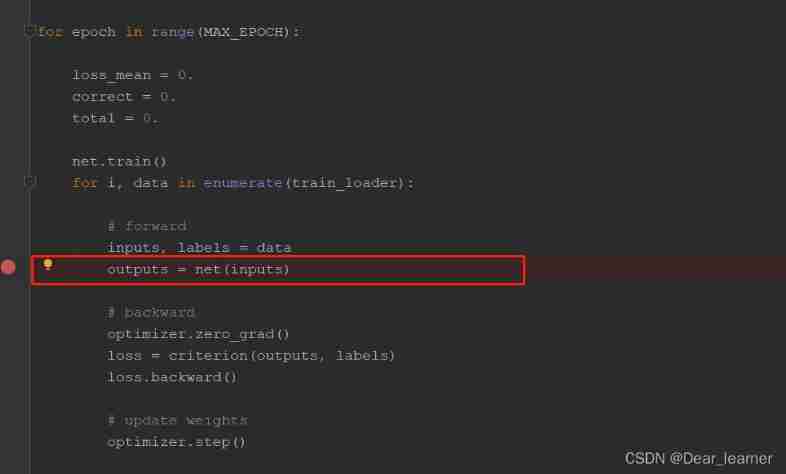
Main program model training part , stay outputs = net(inputs) Place a breakpoint , Because this is the part where the model starts training , Here is also the process of the model starting to propagate forward ,debug as follows :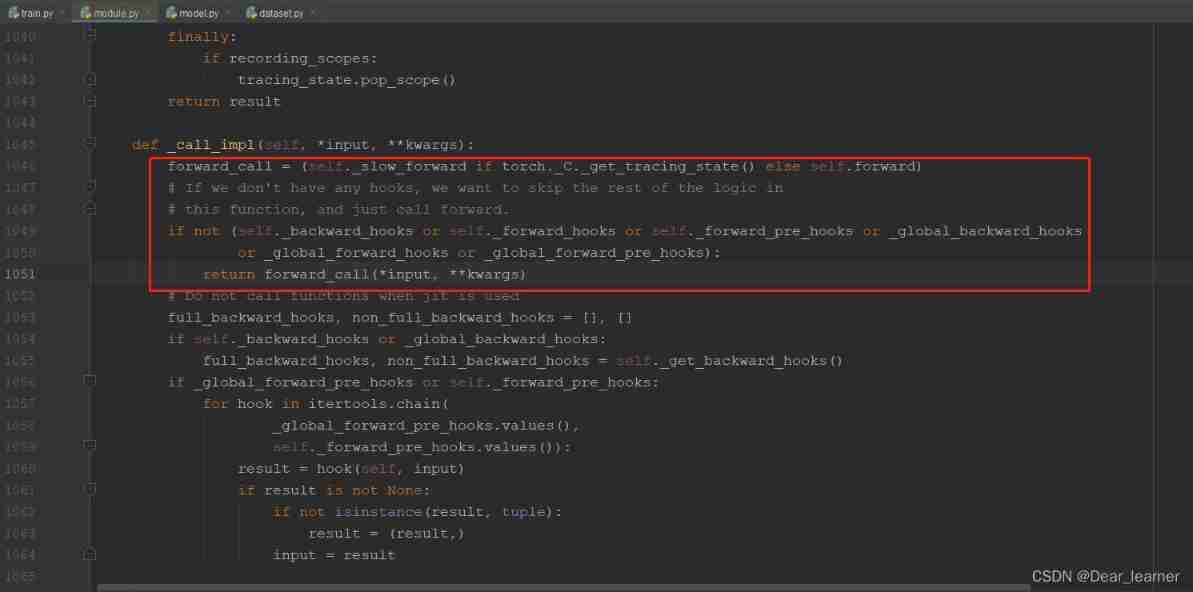
Program entry module.py In the document __call_impl function , This is because of the class LetNet Inherited nn.Module. Here we will call forward Method , Put the sub modules together .
Inherited in the construction model nn.Module class , All network layers are inherited from this class . So let's take a closer look nn.Module class .
Two 、nn.Module class
1、nn.Module An introduction to the
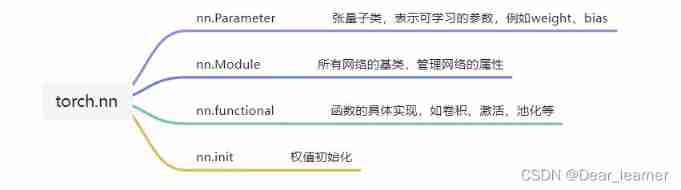
torch.nn: This is a Pytorch The neural network module of , there Module It's one of its submodules , There are also a few with Module Parallel submodules . among nn.Module The customization of is :
class Module(object):
    def __init__(self):
        torch._C._log_api_usage_once("python.nn_module")

        self.training = True
        self._parameters = OrderedDict()
        self._buffers = OrderedDict()
        self._non_persistent_buffers_set = set()
        self._backward_hooks = OrderedDict()
        self._forward_hooks = OrderedDict()
        self._forward_pre_hooks = OrderedDict()
        self._state_dict_hooks = OrderedDict()
        self._load_state_dict_pre_hooks = OrderedDict()
        self._modules = OrderedDict()

    def register_parameter(self, name: str, param: Optional[Parameter]) -> None:
    def add_module(self, name: str, module: Optional['Module']) -> None:
    def get_parameter(self, target: str) -> "Parameter":
    def apply(self: T, fn: Callable[['Module'], None]) -> T:
    def cuda(self: T, device: Optional[Union[int, device]] = None) -> T:
    def cpu(self: T) -> T:
    def state_dict(self, destination=None, prefix='', keep_vars=False):
    def load_state_dict(self, state_dict: 'OrderedDict[str, Tensor]',
                        strict: bool = True):
    def named_parameters(self, prefix: str = '',
                         recurse: bool = True) -> Iterator[Tuple[str, Parameter]]:
    def children(self) -> Iterator['Module']:
    def named_children(self) -> Iterator[Tuple[str, 'Module']]:
    def modules(self) -> Iterator['Module']:
    def named_modules(self, memo: Optional[Set['Module']] = None,
                      prefix: str = '', remove_duplicate: bool = True):
    def train(self: T, mode: bool = True) -> T:
    def eval(self: T) -> T:
    ...
"""  There are other functions  """
stay nn.Module Properties in customization :
● parameters: Storage management nn.Parameter class ;
● modules: Storage management nn.Modules class ;
● buffers: Storage management buffer properties , Such as BN Layer. running_mean;
● ***_hook: Storage management hook function 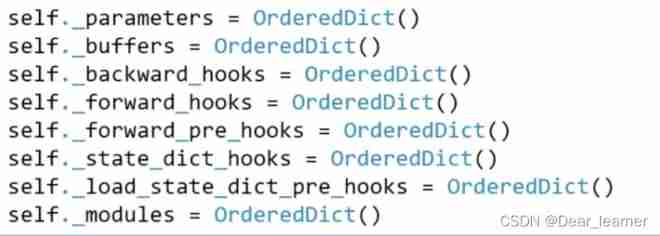
In the construction of network structure, we need to inherit nn.Module class , And reconstruct __init__ and forward Two methods , But there are some things that need to be noticed :
● Generally, the layer with learnable parameters in the network ( Such as convolution 、 Fully connected layer ) Put it in the constructor __init__ in , Of course, you can also put layers without parameters inside ;
● Generally, layers that do not have learnable parameters ( Such as ReLU、dropout、BatchNormanation layer ) Can be placed in the constructor , It can also be left out of the constructor , If you don't put it in the constructor __init__ Inside , It's in forward You can use nn.functional Instead of ;
● forward Methods must be rewritten , It is the function of implementing the model , The core of realizing the connection relationship between various layers .
for example :
1、 Put all the layers in the constructor __init__ in , And then in forward Connect these layers in order .
import torch.nn as nn

class MyNet(nn.Module):
    def __init__(self):
        super(MyNet, self).__init__()

        self.conv1 = nn.Conv2d(3, 32, 3, 1, 1)
        self.relu1 = nn.ReLU()
        self.max_pooling1 = nn.MaxPool2d(2, 1)

        self.conv2 = nn.Conv2d(32, 32, 3, 1, 1)
        self.relu2 = nn.ReLU()
        self.max_pooling2 = nn.MaxPool2d(2, 1)

        self.dense1 = nn.Linear(32*3*3, 128)
        self.dense2 = nn.Linear(128, 10)

    def forward(self, x):
        x = self.conv1(x)
        x = self.relu1(x)
        x = self.max_pooling1(x)
        x = self.conv2(x)
        x = self.relu2(x)
        x = self.max_pooling2(x)
        x = self.dense1(x)
        x = self.dense2(x)
        return x

model = MyNet()
print(model)
Output results :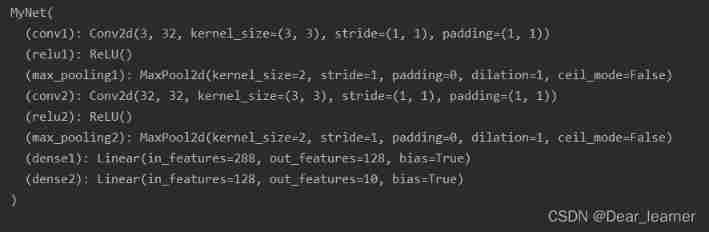
2、 Put the layer without training parameters into forward in , So these layers do not appear in model in , But the running relationship is forward Pass through torch.nn.function Realization , as follows :
import torch.nn.functional as F

class MyNet(nn.Module):
    def __init__(self):
        super(MyNet, self).__init__()

        self.conv1 = nn.Conv2d(3, 32, 3, 1, 1)
        self.conv2 = nn.Conv2d(3, 32, 3, 1, 1)

        self.dense1 = nn.Linear(32 * 3 * 3, 128)
        self.dense2 = nn.Linear(128, 10)

    def forward(self, x):
        x = self.conv1(x)
        x = F.relu(x)
        x = F.max_pool2d(x)
        x = self.conv2(x)
        x = F.relu(x)
        x = F.max_pool2d(x)
        x = self.dense1(x)
        x = self.dense2(x)
        return x

model = MyNet()
print(model)
Output results :
As can be seen from the above two examples , In the constructor __init__ The layer in this model “ Intrinsic properties ”.
2、nn.Module The implementation of the
2.1 adopt Sequential Packing layer
Pack several layers into one large layer ( block ), Then directly call the wrapped layer .Sequential Is defined as follows :
class Sequential(Module): #  Inherit Module
    def __init__(self, *args):  #  Overriding the constructor
    def _get_item_by_idx(self, iterator, idx):
    def __getitem__(self, idx):
    def __setitem__(self, idx, module):
    def __delitem__(self, idx):
    def __len__(self):
    def __dir__(self):
    def forward(self, input):  #  Rewrite key methods forward
Add :
Sequential Three ways of implementation are as follows :
1、 The simplest sequential model
import torch.nn as nn

model = nn.Sequential(
                      nn.Conv2d(3, 24, 3),
                      nn.ReLU(),
                      nn.Conv2d(24, 5, 3),
                      nn.ReLU())
print(model)
Output results :
Sequential(
  (0): Conv2d(3, 24, kernel_size=(3, 3), stride=(1, 1))
  (1): ReLU()
  (2): Conv2d(24, 5, kernel_size=(3, 3), stride=(1, 1))
  (3): ReLU()
)
As can be seen from the output above , Each layer of the model has no name , The default is 0,1,2,3 Named after .
2、 Add a name to each layer
import torch.nn as nn
from collections import OrderedDict
model = nn.Sequential(OrderedDict([
                  ('conv1', nn.Conv2d(1,20,5)),
                  ('relu1', nn.ReLU()),
                  ('conv2', nn.Conv2d(20,64,5)),
                  ('relu2', nn.ReLU())
                ]))

print(model)
print(model[2]) #  Get the layers through the index
"""  Output results : Sequential( (conv1): Conv2d(1, 20, kernel_size=(5, 5), stride=(1, 1)) (relu1): ReLU() (conv2): Conv2d(20, 64, kernel_size=(5, 5), stride=(1, 1)) (relu2): ReLU() ) Conv2d(20, 64, kernel_size=(5, 5), stride=(1, 1)) """
As can be seen from the output above , The output of each layer has a name , But you can't get the layer by name , Still get it by index , namely model[2] That's right. , and model[‘conv2’] It's wrong. . This can actually be seen from Sequential The definition of , Only support index visit .
3、Sequential The third implementation of
import torch.nn as nn
from collections import OrderedDict

model = nn.Sequential()
model.add_module("conv1",nn.Conv2d(1,20,5))
model.add_module('relu1', nn.ReLU())
model.add_module('conv2', nn.Conv2d(20,64,5))
model.add_module('relu2', nn.ReLU())

print(model)
print(model[2]) #  Get the layers through the index

”“”
 Output results :
Sequential(
  (conv1): Conv2d(1, 20, kernel_size=(5, 5), stride=(1, 1))
  (relu1): ReLU()
  (conv2): Conv2d(20, 64, kernel_size=(5, 5), stride=(1, 1))
  (relu2): ReLU()
)
Conv2d(20, 64, kernel_size=(5, 5), stride=(1, 1))
“”“
add_module The method is Sequential Inherited the parent class Module Methods .
because sequential Can be achieved in the above three ways , The packaging of layers can also be realized in three ways
Mode one :
import torch.nn as nn
from collections import OrderedDict
class MyNet(nn.Module):
    def __init__(self):
        super(MyNet, self).__init__()
        self.conv_block = nn.Sequential(
            nn.Conv2d(3, 32, 3, 1, 1),
            nn.ReLU(),
            nn.MaxPool2d(2))
        self.dense_block = nn.Sequential(
            nn.Linear(32 * 3 * 3, 128),
            nn.ReLU(),
            nn.Linear(128, 10)
        )
    #  The connection between layers is realized here , In fact, it is the so-called forward communication
    def forward(self, x):
        conv_out = self.conv_block(x)
        res = conv_out.view(conv_out.size(0), -1)
        out = self.dense_block(res)
        return out

model = MyNet()
print(model)

''' The running result is : MyNet( (conv_block): Sequential( (0): Conv2d(3, 32, kernel_size=(3, 3), stride=(1, 1), padding=(1, 1)) (1): ReLU() (2): MaxPool2d(kernel_size=2, stride=2, padding=0, dilation=1, ceil_mode=False) ) (dense_block): Sequential( (0): Linear(in_features=288, out_features=128, bias=True) (1): ReLU() (2): Linear(in_features=128, out_features=10, bias=True) ) ) '''
Mode two :
import torch.nn as nn
from collections import OrderedDict
class MyNet(nn.Module):
    def __init__(self):
        super(MyNet, self).__init__()
        self.conv_block = nn.Sequential(
            OrderedDict(
                [
                    ("conv1", nn.Conv2d(3, 32, 3, 1, 1)),
                    ("relu1", nn.ReLU()),
                    ("pool", nn.MaxPool2d(2))
                ]
            ))

        self.dense_block = nn.Sequential(
            OrderedDict([
                ("dense1", nn.Linear(32 * 3 * 3, 128)),
                ("relu2", nn.ReLU()),
                ("dense2", nn.Linear(128, 10))
            ])
        )

    def forward(self, x):
        conv_out = self.conv_block(x)
        res = conv_out.view(conv_out.size(0), -1)
        out = self.dense_block(res)
        return out

model = MyNet()
print(model)

''' The running result is : MyNet( (conv_block): Sequential( (conv1): Conv2d(3, 32, kernel_size=(3, 3), stride=(1, 1), padding=(1, 1)) (relu1): ReLU() (pool): MaxPool2d(kernel_size=2, stride=2, padding=0, dilation=1, ceil_mode=False) ) (dense_block): Sequential( (dense1): Linear(in_features=288, out_features=128, bias=True) (relu2): ReLU() (dense2): Linear(in_features=128, out_features=10, bias=True) ) ) '''
Mode three :
import torch.nn as nn
from collections import OrderedDict
class MyNet(nn.Module):
    def __init__(self):
        super(MyNet, self).__init__()
        self.conv_block=torch.nn.Sequential()
        self.conv_block.add_module("conv1",torch.nn.Conv2d(3, 32, 3, 1, 1))
        self.conv_block.add_module("relu1",torch.nn.ReLU())
        self.conv_block.add_module("pool1",torch.nn.MaxPool2d(2))

        self.dense_block = torch.nn.Sequential()
        self.dense_block.add_module("dense1",torch.nn.Linear(32 * 3 * 3, 128))
        self.dense_block.add_module("relu2",torch.nn.ReLU())
        self.dense_block.add_module("dense2",torch.nn.Linear(128, 10))

    def forward(self, x):
        conv_out = self.conv_block(x)
        res = conv_out.view(conv_out.size(0), -1)
        out = self.dense_block(res)
        return out

model = MyNet()
print(model)

''' The running result is : MyNet( (conv_block): Sequential( (conv1): Conv2d(3, 32, kernel_size=(3, 3), stride=(1, 1), padding=(1, 1)) (relu1): ReLU() (pool1): MaxPool2d(kernel_size=2, stride=2, padding=0, dilation=1, ceil_mode=False) ) (dense_block): Sequential( (dense1): Linear(in_features=288, out_features=128, bias=True) (relu2): ReLU() (dense2): Linear(in_features=128, out_features=10, bias=True) ) ) '''
3、nn.Module Use of several common methods in
Sequenrtial Class implements integer indexing , Therefore, it can be used model[index] Get a layer in this way , however Module Class does not implement integer indexing , It is not possible to obtain the layer by integer index , So what should we do ? It provides several main methods , as follows :
def children(self):

def named_children(self):

def modules(self):

def named_modules(self, memo=None, prefix=''):

'''  Be careful : These methods return a Iterator iterator , Therefore, it was passed for Loop access , Of course, it can also be next '''
Take the network constructed above as an example to illustrate as follows :
1、model.children() Method
import torch.nn as nn
from collections import OrderedDict
class MyNet(nn.Module):
    def __init__(self):
        super(MyNet, self).__init__()
        self.conv_block=torch.nn.Sequential()
        self.conv_block.add_module("conv1",torch.nn.Conv2d(3, 32, 3, 1, 1))
        self.conv_block.add_module("relu1",torch.nn.ReLU())
        self.conv_block.add_module("pool1",torch.nn.MaxPool2d(2))

        self.dense_block = torch.nn.Sequential()
        self.dense_block.add_module("dense1",torch.nn.Linear(32 * 3 * 3, 128))
        self.dense_block.add_module("relu2",torch.nn.ReLU())
        self.dense_block.add_module("dense2",torch.nn.Linear(128, 10))

    def forward(self, x):
        conv_out = self.conv_block(x)
        res = conv_out.view(conv_out.size(0), -1)
        out = self.dense_block(res)
        return out

model = MyNet()

for i in model.children():
    print(i)
    print(type(i)) #  See what type of elements are in each iteration , It's actually  Sequential  type , So you can use subscripts index Index to get each Sequenrial  The concrete layer inside

# The running result is :
Sequential(
  (conv1): Conv2d(3, 32, kernel_size=(3, 3), stride=(1, 1), padding=(1, 1))
  (relu1): ReLU()
  (pool1): MaxPool2d(kernel_size=2, stride=2, padding=0, dilation=1, ceil_mode=False)
)
<class 'torch.nn.modules.container.Sequential'>
Sequential(
  (dense1): Linear(in_features=288, out_features=128, bias=True)
  (relu2): ReLU()
  (dense2): Linear(in_features=128, out_features=10, bias=True)
)
<class 'torch.nn.modules.container.Sequential'>
2、model.named_children
for i in model.named_children():
    print(i)


 # Output results :
 ('conv_block', Sequential(
  (conv1): Conv2d(3, 32, kernel_size=(3, 3), stride=(1, 1), padding=(1, 1))
  (relu1): ReLU()
  (pool1): MaxPool2d(kernel_size=2, stride=2, padding=0, dilation=1, ceil_mode=False)
))
('dense_block', Sequential(
  (dense1): Linear(in_features=288, out_features=128, bias=True)
  (relu2): ReLU()
  (dense2): Linear(in_features=128, out_features=10, bias=True)
))
summary :
(1)model.children() and model.named_children() Method returns an iterator iterator;
(2)model.children(): Each element returned from each iteration is actually Sequential type , and Sequential Type can also use subscript index Index to get each Sequenrial The concrete layer inside , such as conv layer 、dense Layer, etc. ;
(3)model.named_children(): Each element returned from each iteration is actually A tuple type , The first element of a tuple is the name , The second element is the corresponding layer or Sequential.
3、model.modules() Method
for i in model.modules():
    print(i)
    print("==================================================")
#  Output results :
MyNet(
  (conv_block): Sequential(
    (conv1): Conv2d(3, 32, kernel_size=(3, 3), stride=(1, 1), padding=(1, 1))
    (relu1): ReLU()
    (pool1): MaxPool2d(kernel_size=2, stride=2, padding=0, dilation=1, ceil_mode=False)
  )
  (dense_block): Sequential(
    (dense1): Linear(in_features=288, out_features=128, bias=True)
    (relu2): ReLU()
    (dense2): Linear(in_features=128, out_features=10, bias=True)
  )
)
==================================================
Sequential(
  (conv1): Conv2d(3, 32, kernel_size=(3, 3), stride=(1, 1), padding=(1, 1))
  (relu1): ReLU()
  (pool1): MaxPool2d(kernel_size=2, stride=2, padding=0, dilation=1, ceil_mode=False)
)
==================================================
Conv2d(3, 32, kernel_size=(3, 3), stride=(1, 1), padding=(1, 1))
==================================================
ReLU()
==================================================
MaxPool2d(kernel_size=2, stride=2, padding=0, dilation=1, ceil_mode=False)
==================================================
Sequential(
  (dense1): Linear(in_features=288, out_features=128, bias=True)
  (relu2): ReLU()
  (dense2): Linear(in_features=128, out_features=10, bias=True)
)
==================================================
Linear(in_features=288, out_features=128, bias=True)
==================================================
ReLU()
==================================================
Linear(in_features=128, out_features=10, bias=True)
==================================================
4、model.named_modules() Method
for i in model.named_modules():
print(i)
print("==================================================")
# Output results :
('', MyNet(
(conv_block): Sequential(
(conv1): Conv2d(3, 32, kernel_size=(3, 3), stride=(1, 1), padding=(1, 1))
(relu1): ReLU()
(pool1): MaxPool2d(kernel_size=2, stride=2, padding=0, dilation=1, ceil_mode=False)
)
(dense_block): Sequential(
(dense1): Linear(in_features=288, out_features=128, bias=True)
(relu2): ReLU()
(dense2): Linear(in_features=128, out_features=10, bias=True)
)
))
==================================================
('conv_block', Sequential(
(conv1): Conv2d(3, 32, kernel_size=(3, 3), stride=(1, 1), padding=(1, 1))
(relu1): ReLU()
(pool1): MaxPool2d(kernel_size=2, stride=2, padding=0, dilation=1, ceil_mode=False)
))
==================================================
('conv_block.conv1', Conv2d(3, 32, kernel_size=(3, 3), stride=(1, 1), padding=(1, 1)))
==================================================
('conv_block.relu1', ReLU())
==================================================
('conv_block.pool1', MaxPool2d(kernel_size=2, stride=2, padding=0, dilation=1, ceil_mode=False))
==================================================
('dense_block', Sequential(
(dense1): Linear(in_features=288, out_features=128, bias=True)
(relu2): ReLU()
(dense2): Linear(in_features=128, out_features=10, bias=True)
))
==================================================
('dense_block.dense1', Linear(in_features=288, out_features=128, bias=True))
==================================================
('dense_block.relu2', ReLU())
==================================================
('dense_block.dense2', Linear(in_features=128, out_features=10, bias=True))
==================================================
summary :
(1)model.modules() and model.named_modules() Method returns an iterator iterator;
(2)model Of modules() Methods and named_modules() Methods will integrate all the components of the whole model ( Including the packaging layer 、 Separate layers 、 Custom layer, etc ) Traverse from shallow to deep , It's just modules() Each element returned is the directly returned layer object itself , and named_modules() Each element returned is a tuple , The first element is the name , The second element is the layer object itself .
(3) How to understand children and modules This difference between . Be careful pytorch Whether it's a model 、 layer 、 Activation function 、 The loss function can be regarded as Module Development of , therefore modules and named_modules Will iterate layer by layer , from the shallower to the deeper , Put each custom block block、 then block Every layer inside is regarded as module To iterate . and children It's more intuitive , It means the so-called “ children ”, So there is no layer by layer iteration .
3、 ... and 、 Model container Containers
In the process of building the model , Another very important concept is containers, Let's take a look first containers Overall framework :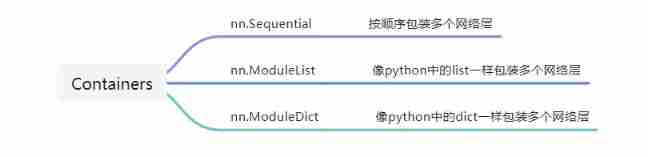
1、nn.Sequential
nn.Sequential yes nn.Module In the container , Used to wrap a set of network layers in order , It has been explained in detail in the above nn.Sequential Usage of , below debug Take a look at the specific implementation process
class LeNetSequential(nn.Module):
    def __init__(self, classes):
        super(LeNetSequential, self).__init__()
        self.features = nn.Sequential(
            nn.Conv2d(3, 6, 5),
            nn.ReLU(),
            nn.MaxPool2d(kernel_size=2, stride=2),
            nn.Conv2d(6, 16, 5),
            nn.ReLU(),
            nn.MaxPool2d(kernel_size=2, stride=2),)

        self.classifier = nn.Sequential(
            nn.Linear(16*5*5, 120),
            nn.ReLU(),
            nn.Linear(120, 84),
            nn.ReLU(),
            nn.Linear(84, classes),)

    def forward(self, x):
        x = self.features(x)
        x = x.view(x.size()[0], -1)
        x = self.classifier(x)
        return x
net = LeNetSequential(classes=2)
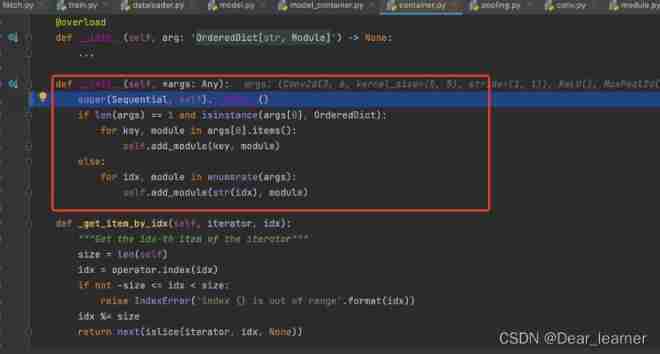
Program entry container.py Of documents Sequential Class , stay __init__ You can see in the first step is to determine whether the added layer is an ordered dictionary , And then nn.Sequential The ordered layers in are added to module in , The construction of the model is completed here , continue debug, It can be seen that the splicing of the model is in container.py Medium forward() To realize .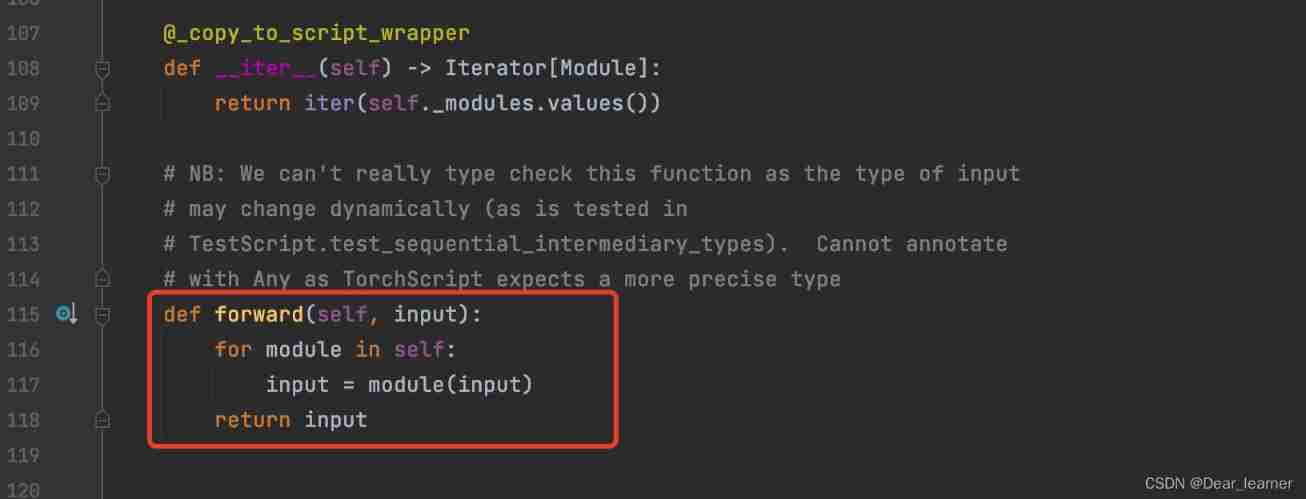
summary :
Use nn.Sequential When wrapping a set of network layers in order :
● Sequence : The networks at all levels are built in strict order ;
● Bring their own forward(): Bring their own forward in , adopt for The loop executes the forward propagation process in turn .
2、nn.ModuleList
nn.ModuleList yes nn.module The container of , Used to package a set of network layers , Call the network layer iteratively , The main method :
- append(): stay ModuleList Add the network layer after ;
- extend(): Splice two ModuleList;
- insert(): Specified in the ModuleList Insert network layer in middle position
Be similar to python Medium list operation , But the element is replaced by the network layer , Examples are as follows :
Use ModuleList To implement a loop iteration 20 The construction of a full connectivity layer network .
class ModuleList(nn.Module):
    def __init__(self):
        super(ModuleList, self).__init__()
        self.linears = nn.ModuleList([nn.Linear(10, 10) for i in range(20)])

    def forward(self, x):
        for i, linear in enumerate(self.linears):
            x = linear(x)
        return x
model = ModuleList()
print(model)
#  Output results
ModuleList(
  (linears): ModuleList(
    (0): Linear(in_features=10, out_features=10, bias=True)
    (1): Linear(in_features=10, out_features=10, bias=True)
    (2): Linear(in_features=10, out_features=10, bias=True)
    (3): Linear(in_features=10, out_features=10, bias=True)
    (4): Linear(in_features=10, out_features=10, bias=True)
    (5): Linear(in_features=10, out_features=10, bias=True)
    (6): Linear(in_features=10, out_features=10, bias=True)
    (7): Linear(in_features=10, out_features=10, bias=True)
    (8): Linear(in_features=10, out_features=10, bias=True)
    (9): Linear(in_features=10, out_features=10, bias=True)
    (10): Linear(in_features=10, out_features=10, bias=True)
    (11): Linear(in_features=10, out_features=10, bias=True)
    (12): Linear(in_features=10, out_features=10, bias=True)
    (13): Linear(in_features=10, out_features=10, bias=True)
    (14): Linear(in_features=10, out_features=10, bias=True)
    (15): Linear(in_features=10, out_features=10, bias=True)
    (16): Linear(in_features=10, out_features=10, bias=True)
    (17): Linear(in_features=10, out_features=10, bias=True)
    (18): Linear(in_features=10, out_features=10, bias=True)
    (19): Linear(in_features=10, out_features=10, bias=True)
  )
)
nn.ModuleList The specific implementation process of 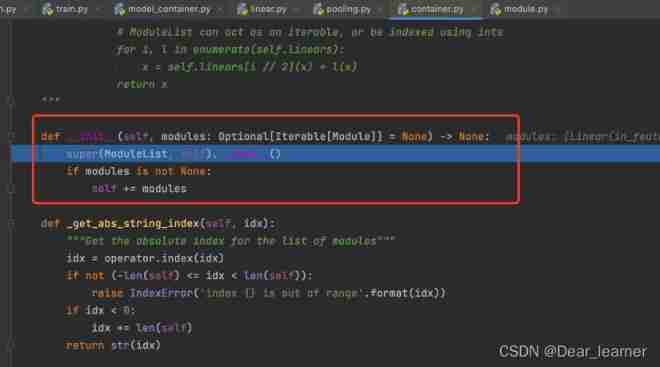
3、nn.ModuleDict
nn.ModuleDict yes nn.Module The container of , Used to package a set of network layers , Call the network layer by index , The main methods are :
- clear(): Empty ModuleDict;
- items(): Returns an iteratable key value pair ;
- keys(): Return to the dictionary key ;
- values(): Returns the dictionary value ;
- pop(): Returns a pair of key values , And delete it from the dictionary .
class ModuleDict(nn.Module):
    def __init__(self):
        super(ModuleDict, self).__init__()
        self.choices = nn.ModuleDict({

            'conv': nn.Conv2d(10, 10, 3),
            'pool': nn.MaxPool2d(3)
        })

        self.activations = nn.ModuleDict({

            'relu': nn.ReLU(),
            'prelu': nn.PReLU()
        })

    def forward(self, x, choice, act):
        x = self.choices[choice](x)
        x = self.activations[act](x)
        return x
Output results :
Four 、AlexNet The realization of network
AlexNet:2012 Second place higher than in 10 The accuracy rate of more than% is obtained ImageNet Classification task champion , A new era of convolutional neural networks has been created ,AlexNet The characteristics are as follows :
● use ReLU: Replace saturation activation function , The relief gradient disappears
● use LRN(Local Response Normalization): Normalize the data , The relief gradient disappears
● Dropout: Improve the robustness of the full connectivity layer , Increase the generalization ability of the network
● Data Augmentation:TenCrop, Color modification
The network structure diagram is as follows :
Implementation process :
# pytorch in AlexNet The implementation of the

alexnet = torchvision.models.AlexNet()

#  Implementation process
class AlexNet(nn.Module):

    def __init__(self, num_classes=1000):
        super(AlexNet, self).__init__()
        self.features = nn.Sequential(
            nn.Conv2d(3, 64, kernel_size=11, stride=4, padding=2),
            nn.ReLU(inplace=True),
            nn.MaxPool2d(kernel_size=3, stride=2),
            nn.Conv2d(64, 192, kernel_size=5, padding=2),
            nn.ReLU(inplace=True),
            nn.MaxPool2d(kernel_size=3, stride=2),
            nn.Conv2d(192, 384, kernel_size=3, padding=1),
            nn.ReLU(inplace=True),
            nn.Conv2d(384, 256, kernel_size=3, padding=1),
            nn.ReLU(inplace=True),
            nn.Conv2d(256, 256, kernel_size=3, padding=1),
            nn.ReLU(inplace=True),
            nn.MaxPool2d(kernel_size=3, stride=2),
        )
        self.avgpool = nn.AdaptiveAvgPool2d((6, 6))
        self.classifier = nn.Sequential(
            nn.Dropout(),
            nn.Linear(256 * 6 * 6, 4096),
            nn.ReLU(inplace=True),
            nn.Dropout(),
            nn.Linear(4096, 4096),
            nn.ReLU(inplace=True),
            nn.Linear(4096, num_classes),
        )

    def forward(self, x):
        x = self.features(x)
        x = self.avgpool(x)
        x = torch.flatten(x, 1)
        x = self.classifier(x)
        return x
边栏推荐
- "Learning notes" recursive & recursive
- Scratch uses runner Py run or debug crawler
- Ningde times and BYD have refuted rumors one after another. Why does someone always want to harm domestic brands?
- 股票开户最低佣金炒股开户免费,网上开户安全吗
- What are the securities companies with the lowest Commission for stock account opening? Would you recommend it? Is it safe to open an account on your mobile phone
- [15th issue] Tencent PCG background development internship I, II and III (OC)
- Gossip about redis source code 80
- Gossip about redis source code 76
- Yyds dry goods inventory [practical] simply encapsulate JS cycle with FP idea~
- D27:mode of sequence (maximum, translation)
猜你喜欢
Pyqt5 sensitive word detection tool production, operator's Gospel
Fluent learning (4) listview

Alibaba cloud container service differentiation SLO hybrid technology practice

Ningde times and BYD have refuted rumors one after another. Why does someone always want to harm domestic brands?

Qtoolbutton available signal
How to solve the "safe startup function prevents the operating system from starting" prompt when installing windows10 on parallel desktop?

Blue Bridge Cup -- guess age

2022 chemical automation control instrument examination content and chemical automation control instrument simulation examination
Recursive least square adjustment

IO flow review
随机推荐
Pyqt5 sensitive word detection tool production, operator's Gospel
Summary of fluent systemchrome
FPGA tutorial and Allegro tutorial - link
Ningde times and BYD have refuted rumors one after another. Why does someone always want to harm domestic brands?
EPF: a fuzzy testing framework for network protocols based on evolution, protocol awareness and coverage guidance
Alibaba cloud container service differentiation SLO hybrid technology practice
finalize finalization finally final
NPM script
Ningde times and BYD have refuted rumors one after another. Why does someone always want to harm domestic brands?
[15th issue] Tencent PCG background development internship I, II and III (OC)
Flutter internationalized Intl
QT creator source code learning note 05, how does the menu bar realize plug-in?
C deep anatomy - the concept of keywords and variables # dry inventory #
C # basic knowledge (3)
Gossip about redis source code 74
Subset enumeration method
Current detection circuit - including op amp current scheme
Gossip about redis source code 78
How can I get the Commission discount of stock trading account opening? Is it safe to open an account online
Actual combat | use composite material 3 in application