当前位置:网站首页>Why is the frame rate calculated by opencv wrong?
Why is the frame rate calculated by opencv wrong?
2022-06-28 04:31:00 【LiveVideoStack_】

▲ Scan the QR code in the picture to learn more about the audio and video technology conference ▲
author : Wang Wei
edit :Alex
lead said
We have a platform to periodically detect the live stream data on the Internet , For example, black / White screen detection 、 Static picture detection …… In the process of testing , We will estimate the number of frames to be calculated according to the frame rate of the extracted live stream , for example , If you want to test 5s Live streaming of , The frame rate of the live stream is 20fps, The number of frames to be calculated is 100. Then one day , We found that , The platform began to time out in a large area , Before that, we just needed 2s Can complete the calculation , Now we need to 30+ minute . After checking , We found that , The reason for calculating the timeout is because OpenCV The calculated frame rate is 2000, As a result, the number of frames to be calculated is reduced from 100 Change into 10000, This in turn causes a computation timeout .
1、OpenCV How to calculate the frame rate
For a detailed description of this problem, see OpenCV Issues 21006[1]. The simulated live stream segment of this problem test.ts You can click the link to download :
https://pan.baidu.com/share/init?surl=RY0Zk5C_DOEwTXYe2SLFEg, The download extraction code is x87m.
If you use the following code to get test.ts Of fps,
const double FPS = cap.get(cv::CAP_PROP_FPS);
std::cout << "fps: " << FPS << std::endl;
You can get :
$ fps: 2000
use ffprobe Analyze the video , You can get :
codec_name=h264
r_frame_rate=30/1
avg_frame_rate=0/0
……
from opencv/modules/videoio/src/cap_ffmpeg_impl.hpp[2] in , We found that fps from CvCapture_FFMPEG::get Come by calculation , The calculation logic is as follows :
double fps = r2d(ic->streams[video_stream]->avg_frame_rate);
if (fps < eps_zero) {
    fps = 1.0 / r2d(ic->streams[video_stream]->codec->time_base);
}
2、 Why? OpenCV The frame rate is wrong
utilize test_time_base.cpp[3], We can get :
time_base: 1/2000
framerate: 0/0
avg_framerate: 0/0
r2d(ic->streams[video_stream]->avg_frame_rate) = 0
therefore OpenCV Adopted :
1.0 / r2d(ic->streams[video_stream]->codec->time_base)
To calculate the fps. And here time_base = 1/2000, therefore , resulting fps yes 2000.
in other words ,AVStream->codec->time_base The value of results in OpenCV Get one that looks wrong fps. that ,AVStream->codec->time_base Why is this value ?FFmpeg How to calculate this field ?
3、FFmpeg How to calculate
AVCodecContext.time_base
AVStream->codec->time_base yes AVCodecContext As defined in time_base Field , according to libavcodec/avcodec.h[4] As defined in , For decoding ,time_base Has been abandoned , Need to use framerate To replace time_base. also , For a fixed frame rate ,time_base = 1/framerate, But not always .
utilize H264Naked[5] Yes test.ts Corresponding H.264 Code stream analysis , We get SPS.Vui Information :
timing_info_present_flag :1
num_units_in_tick :1
time_scale :2000
fixed_frame_rate_flag :0
You can see from it ,test.ts Is a non fixed frame rate video . from test_time_base.cpp[3] Look at the result ,test.ts In the video ,framerate = 0/0, and time_base = 1/2000.
Don't , For non fixed frame rate video ,time_base and framerate There's no connection ? If there is a connection , What kind of operation can produce such a result ? This time_base How exactly is it calculated ? What is the relationship between framerate It doesn't matter ? A series of problems followed ……
The source code in front , No secret . Next , With this question , Let's analyze FFmpeg How to deal with time_base Of .
3.1 avformat_find_stream_info
stay FFmpeg in ,avformat_find_stream_info() Yes ic->streams[video_stream]->codec To initialize , So we can go from avformat_find_stream_info() To analyze .
from libavformat/avformat.h[6] in , It can be learned that avformat_open_input() Will open the video stream , Read relevant information from , Then stored in AVFormatContext in , But sometimes , The information obtained here is not complete , So you need to call avformat_find_stream_info() To get more information .
It should be noted that :
avformat_find_stream_info() Will try to decode some video frames to obtain the required information .
/**
* Read packets of a media file to get stream information. This
* is useful for file formats with no headers such as MPEG. This
* function also computes the real framerate in case of MPEG-2 repeat
* frame mode.
* The logical file position is not changed by this function;
* examined packets may be buffered for later processing.
*
* @param ic media file handle
* @param options  If non-NULL, an ic.nb_streams long array of pointers to
*                 dictionaries, where i-th member contains options for
*                 codec corresponding to i-th stream.
*                 On return each dictionary will be filled with options that
*                 were not found.
* @return >=0 if OK, AVERROR_xxx on error
*
* @note this function isn't guaranteed to open all the codecs, so
*       options being non-empty at return is a perfectly normal behavior.
*
* @todo Let the user decide somehow what information is needed so that
*       we do not waste time getting stuff the user does not need.
*/
int avformat_find_stream_info(AVFormatContext*ic, AVDictionary **options);
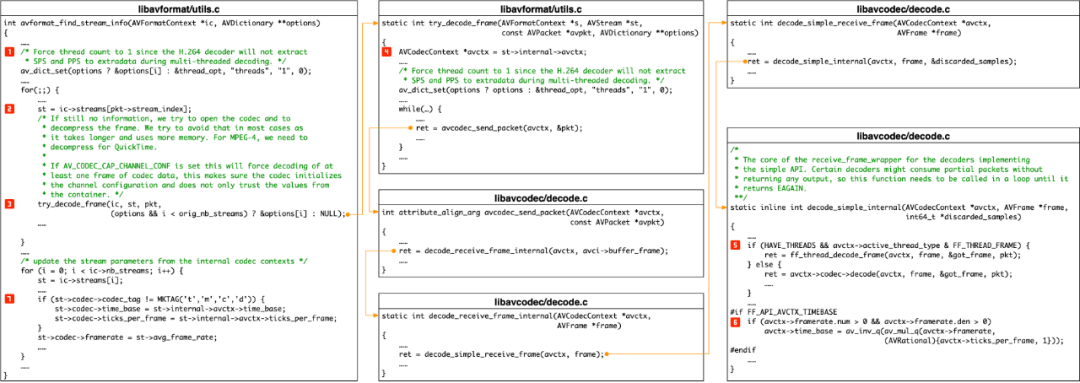
avformat_find_stream_info() The overall logic of is roughly as shown in the figure below , Special attention should be paid to the 7 A step :
3.2 avformat_find_stream_info() Description of the important steps of
STEP 1 Set the number of threads , avoid H.264 Multithreaded decoding does not put SPS/PPS Information is extracted to extradata.
STEP 2 Set up AVStream *st,st It will be transmitted to... In subsequent function calls try_decode_frame().
STEP 3 Relatively simple , No more details here .
STEP 4 Set up AVCodecContext *avctx Transparent st->internal->avctx, In subsequent decoding function calls , This is what has been transmitted all the time avctx, therefore , The execution process starts here ,FFmpeg All used are st->internal->avctx, instead of st->codec, Pay special attention here . The number of decoding threads will also be set here , Its purpose and STEP 1 It's consistent .
STEP 5 Because the number of decoding threads was set to 1, So here we call
ret = avctx->codec->decode(avctx, frame, &got_frame, pkt)
To decode and calculate avctx->framerate. Be careful , Here avctx In fact, it came from the outside st->internal->avctx. Calculation framerate The logic of how to calculate framerate Part introduction .
STEP 6 According to the decoder framerate Information to calculate avctx->time_base, Notice that this is actually st->internal->avctx->time_base. according to How to calculate framerate You know , here framerate = {1000, 1}. according to AVCodecContext.ticks_per_frame The introduction of ,ticks_per_frame = 2. therefore , here avctx->time_base = {1, 2000}:
avctx->time_base = av_inv_q(av_mul_q({1000, 1}, {2, 1})) = {1, 2000}
STEP 7 This step can be described as “ Practise deception , Build the plank road to hide the storehouse ”. This step is to solve API Forward compatibility of , Made a replacement , hold st->internal->avctx->time_base Assigned to st->codec->time_base, But the s****t->avg_frame_rate Assigned to st->codec->framerate. therefore :
st->codec->time_base = {1, 2000}
st->codec->framerate = {0, 0}
st->codec->time_base And st->codec->framerate There is no relationship between , But and st->internal->avctx->framerate of . Its essence , Is and sps.time_scale,sps.num_units_in_tick of .
st->internal->avctx->time_base.num =
sps->num_units_in_tick *
st->internal->avctx->ticks_per_frame

st->internal->avctx->time_base.den = sps->time_scale *
   st->internal->avctx->ticks_per_frame;

st->internal->avctx->time_base = {sps->num_units_in_tick,
sps->time_scale}
3.3 internal->avctx->time_base & internal->framerate
So actually ,internal->avctx->time_base by :
avctx->time_base = sps->num_units_in_tick /
sps->time_scale
and internal->avctx->framerate It is :
avctx->framerate = sps->time_scale /
(sps->num_units_in_tick * avctx->ticks_per_frame)
therefore , about H.264 In terms of code stream ,time_base = 1 / (2 * framerate), instead of 1 / framerate.
That's why
libavcodec/avcodec.h[4] In the said :
* This often, but not always is the inverse of the frame rate or field rate
* for video.
From the above analysis, we can know :
avctx->framerate = 1 / (avctx->time_base * avctx->ticks_per_frame)
therefore , When st->avg_frame_rate = 0 when ,OpenCV Calculation fps The logic of is wrong .
stay H.265 in ,ticks_per_frame = 1, So for H.265 The coding ,OpenCV There is no such problem . have access to Zond 265 [7] Tools to analyze a H.265 Video stream , Then compare it with OpenCV as well as FFmpeg The results are verified .
meanwhile , As shown above STEP 7 The grafting of trees in the results in test_time_base.cpp[3] Result :
st->codec->framerate: 0/0
st->codec->time_base: 1/2000
3.4 ff_h264_decoder
libavcodec/decode.c [8] Medium
decode_simple_internal() The corresponding decoder will be called to decode (STEP 5). And as shown before ,test.ts by H.264 Encoded video stream , So... Will be called here H.264 Decoder to decode . stay FFmpeg in ,H.264 The decoder is located at libavcodec/h264dec.c[9] As defined in
const AVCodec ff_h264_decoder.
const AVCodec ff_h264_decoder = {
    .name                  = "h264",
    .type                  = AVMEDIA_TYPE_VIDEO,
    .id                    = AV_CODEC_ID_H264,
    .priv_data_size        = sizeof(H264Context),
    .init                  = h264_decode_init,
    .close                 = h264_decode_end,
    .decode                = h264_decode_frame,
    ......
};
In the figure above STEP 5 in ,
ret = avctx->codec->decode(avctx, frame, &got_frame, pkt);
The actual call is :
ff_h264_decoder->h264_decode_frame(avctx, frame, &got_frame, pkt);
And here avctx That is to say
try_decode_frame() It's passed down from Zhongtou st->internal->avctx, That is... In the figure above STEP 4.
3.5 h264_decode_frame
h264_decode_frame() The overall logic of is shown in the figure below :

3.6 AVCodecContext.ticks_per_frame
We'll use that later ticks_per_frame To calculate framerate. stay STEP 6 Middle computation time_base This value is also used when . therefore , It is necessary to make a special explanation . stay H.264 In decoder ,ticks_per_frame=2, The specific value can be seen from the following :
- libavcodec/avcodec.h [4] Field description in :
/**
* For some codecs, the time base is closer to the field rate than the frame rate.
* Most notably, H.264 and MPEG-2 specify time_base as half of frame duration
* if no telecine is used ...
*
* Set to time_base ticks per frame. Default 1, e.g., H.264/MPEG-2 set it to 2.
 */
 int ticks_per_frame;
- libavcodec/h264dec.c [9] Medium
h264_decode_init():
avctx->ticks_per_frame = 2;
4、 How to calculate framerate
STEP 1 According to the overall calculation process , Here h It's actually
avformat_find_stream_info() Medium
st->internal->avctx->priv_data.h It will be transmitted to all subsequent processes , This must be noted .
STEP 2 Here you will first get sps Information about , For subsequent calculation , We can take another look at test.ts sps[10] Information about .
timing_info_present_flag :1
num_units_in_tick :1
time_scale :2000
fixed_frame_rate_flag :0
STEP 3 according to sps Calculation of relevant information framerate, Above STEP 6 Middle computation time_base Use of framerate It is calculated here . because timing_info_present_flag = 1, Therefore, the calculation will be performed framerate The logic of :
avctx->framerate.den = sps->num_units_in_tick * h->avctx->ticks_per_frame = 1 * 2 = 2
avctx->framerate.num = sps->time_scale = 2000
avctx->framerate = (AVRational){1000, 1}
therefore ,
st->internal->avctx->framerate = {1000, 1}
however , because avctx->time_base={1,2000}, therefore OpenCV The calculated frame rate is 2000. The reason for this inconsistency is ,OpenCV In the use of codec->time_base The frame rate is calculated without considering ticks_per_frame. therefore , about OpenCV for , The correct way to calculate the frame rate should be :
double fps = r2d(ic->streams[video_stream]->avg_frame_rate);
if (fps < eps_zero) {
fps = 1.0 / r2d(ic->streams[video_stream]->codec->time_base * ic->streams[video_stream]->codec->ticks_per_frame);
}
junction On
Through the above analysis, we can know :
FFmpeg In the calculation
AVCodecContexMedium framerate and time_base When , use :o sps.time_scale
o sps.num_units_in_tick
o AVCodecContex.ticks_per_frame
stay FFmpeg in ,framerate and time_base The relationship is :
o framerate = 1 / (time_base * ticks_per_frame)
o time_base = 1 / (framerate * ticks_per_frame)
For non H.264/MPEG-2,
ticks_per_frame=1, therefore framerate and time_base It is reciprocal relationship . And for H.264/MPEG-2 for ,ticks_per_frame=2, therefore , At this time, the two are not reciprocal relations . thus ,FFmpeg Just say ,framerate and time_base It is usually a reciprocal relationship , But not always .
stay OpenCV in , about H.264/MPEG-2 In terms of video , When
AVStream.avg_frame_rate=0 when , Its calculation fps The logic of existence BUG.
Because in decoding ,
AVCodecContex.time_base Has been abandoned , meanwhile AVStream.avctx It's abandoned , and
avformat_find_stream_info()In order to be compatible with the old API, So I will take advantage of AVStream.internal.avctx And other information AVStream.avctx. and AVStream.avctx.time_base Taken from the AVStream.internal.avctx,AVStream.avctx.framerate From AVStream.framerate.
notes :
[1] https://github.com/opencv/opencv/issues/21006
[2] https://github.com/opencv/opencv/blob/4.x/modules/videoio/src/cap_FFmpeg_impl.hpp
[3] https://github.com/wangwei1237/wangwei1237.github.io_src/blob/master/source/_posts/Why-OpenCV-Get-the-Wrong-FPS/test_time_base.cpp
[4]https://github.com/FFmpeg/FFmpeg/blob/master/libavcodec/avcodec.h
[5] https://github.com/shi-yan/H264Naked
[6] https://github.com/FFmpeg/FFmpeg/blob/master/libavformat/avformat.h
[7] https://www.dektec.com/products/applications/Zond/
[8]https://github.com/FFmpeg/FFmpeg/blob/master/libavcodec/decode.c
[9]https://github.com/FFmpeg/FFmpeg/blob/master/libavcodec/h264dec.c
[10] https://wangwei1237.github.io/2021/11/26/Why-OpenCV-Get-the-Wrong-FPS/#sps
Author's brief introduction :
Wang Wei ,17 Brother , Baidu Senior Test Engineer . Technical director of Baidu video quality evaluation , In solving the standardization of video quality evaluation 、 I have rich practical experience in confidence , Built Baidu's first systematic video quality evaluation service platform , And serve multiple video services .

边栏推荐
- GO语言-select语句
- 抖音实战~取关博主
- 27 years, Microsoft IE is over!
- @Several scenarios of transactional failure
- Multithreading and high concurrency II: detailed introduction to volatile and CAS
- From zero to one, I will teach you to build a "search by text and map" search service (I)
- PostgreSQL implements batch update, deletion and insertion
- RT thread bidirectional linked list (learning notes)
- TFTLCD display experiment of mini plate based on punctual atom stm32
- Matlab exercises -- routine operation of matrix
猜你喜欢

Tiktok actual battle ~ take off the blogger

阿里P8倾情推荐,Fiddler抓包工具实战篇(一)

Analyse complète annuelle du marché chinois de l'audio en 2022

Reading notes of top performance version 2 (II) -- Performance observation tool

In the era of video explosion, who is supporting the high-speed operation of video ecological network?

抖音實戰~關注博主

Iso8191 test is mentioned in as 3744.1. Are the two tests the same?

【Matlab红绿灯识别】红绿灯识别【含GUI源码 1908期】

Pinda general permission system (day 5~day 6)

Introduction notes to machine learning
随机推荐
Introduction notes to machine learning
【Linux】【Mysql】ERROR 1698 (28000): Access denied for user ‘root‘@‘localhost‘
Iso8191 test is mentioned in as 3744.1. Are the two tests the same?
mysql导入文本文件时的pager
Digital promising, easy to reach, Huawei accelerates the layout of the commercial market with "five pole" star products
A summary of my recent situation in June 2022
PostgreSQL implements batch update, deletion and insertion
After launching the MES system, these changes have taken place in the enterprise
易周金融 | Q1手机银行活跃用户规模6.5亿;理财子公司布局新兴领域
政策利好,20多省市开启元宇宙发展规划
从零到一,教你搭建「以文搜图」搜索服务(一)
Multithreading and high concurrency IV: varhandle, strong weak virtual reference and ThreadLocal
《性能之巅第2版》阅读笔记(二)--性能观察工具
Matlab exercises -- routine operation of matrix
The coming wave of Web3
leetcode:714. 买卖股票的最佳时机含手续费【dp双状态】
Single responsibility principle
Problems with cat and dog queues
Principle of event delegation
[small program practice series] e-commerce platform source code and function implementation