当前位置:网站首页>RT thread bidirectional linked list (learning notes)
RT thread bidirectional linked list (learning notes)
2022-06-28 04:12:00 【Xiaohui_ Super】
This article references from [ Wildfire EmbedFire]《RT-Thread Actual combat of Kernel Implementation and application development —— be based on STM32》, For personal study notes only . Please refer to the original text for more detailed contents and steps ( Download to the wildfire center )
List of articles
The basic concept of two-way linked list
Double linked list is also called double linked list , It's a kind of linked list , It has two pointers in each data node , Direct successor and direct precursor respectively . therefore , Starting from any node in the double linked list , Can easily access its predecessor and successor nodes . In general, we construct a bidirectional circular list .
—— Baidu Encyclopedia
This form of data structure makes it more convenient to find bidirectional linked list , Especially the traversal of a large amount of data , Because of the symmetry of the two-way linked list , It can easily complete all kinds of insertion 、 Delete and other operations , But you need to pay attention to the front and back direction of operation .
Function interface of bidirectional linked list
Linked list node structure
First introduced RT-Thread Linked list node structure in , This is no different from the two-way linked list we usually define ourselves .
/** * Double List structure */
struct rt_list_node
{

    struct rt_list_node *next;           /**<  Tail pointer , Point to next node . */
    struct rt_list_node *prev;           /**<  The head pointer , Point to the previous node . */
};
typedef struct rt_list_node rt_list_t;   /**< Type for lists. */
Initialization of linked list rt_list_init()
The linked list must be initialized before use , Point the head and tail pointers of the linked list to yourself .
/** * @brief initialize a list * * @param l list to be initialized */
rt_inline void rt_list_init(rt_list_t *l)
{

    l->next = l->prev = l;
}
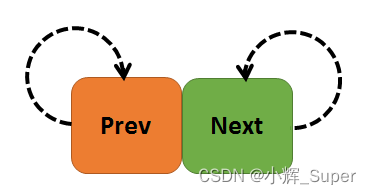
The initialization function does not apply for space for the chain header , This step requires manual use rt_malloc() To apply for , Refer to the following code for details ( Reference to the original ).
head = rt_malloc(sizeof(rt_list_t)); //  Apply dynamic memory
if(RT_NULL == head)
	rt_kprintf(" Dynamic memory request failed !\n");
else
	rt_kprintf(" Dynamic memory request succeeded ");

rt_kprintf(" Two way linked list initialization ......\n");
rt_list_init(head);
if(rt_list_isempty(head)
	rt_kprintf(" The two-way linked list was initialized successfully !\n");
Insert a node after the specified node in the linked list rt_list_insert_after()
Before inserting a node , You need to apply for node size memory first ( See below ), Then insert a new node after the specified node .
/** * @brief insert a node after a list * * @param l list to insert it * @param n new node to be inserted */
rt_inline void rt_list_insert_after(rt_list_t *l, rt_list_t *n)
{

    l->next->prev = n;
    n->next = l->next;

    l->next = n;
    n->prev = l;
}

Insert a node before the specified node in the linked list rt_list_insert_before()
Before inserting a node , You need to apply for node size memory first , Then insert the new node before the specified node .
/** * @brief insert a node before a list * * @param n new node to be inserted * @param l list to insert it */
rt_inline void rt_list_insert_before(rt_list_t *l, rt_list_t *n)
{

    l->prev->next = n;
    n->prev = l->prev;

    l->prev = n;
    n->next = l;
}

Here is the sample code for the node insertion operation ( Reference from the original text ):
//  Dynamically request the memory of the first node
node1 = rt_malloc(sizeof(rt_list_t));

//  Dynamically request the memory of the second node
node2 = rt_malloc(sizeof(rt_list_t));

//  take  node2  Insert into  head  Back
rt_list_insert_after(head, node2);

//  take  node1  Insert into  node2  front
rt_list_insert_before(node2, node1);

if((node1->prev == head) && (node2->prev == node1))
	rt_kprintf(" Node added successfully !\n");
else
	rt_kprintf(" Failed to add node !\n");
Delete a node from the linked list rt_list_remove()
Deleting a node is easier than adding a node , Just connect the two nodes before and after the node to be deleted , Release the memory of the node to be deleted .
/** * @brief remove node from list. * @param n the node to remove from the list. */
rt_inline void rt_list_remove(rt_list_t *n)
{

    n->next->prev = n->prev;
    n->prev->next = n->next;

    n->next = n->prev = n;
}

How to delete a node :
//  The original linked list structure :head ->> node1 ->> node2 ->> node3
rt_list_remove(node2);
rt_free(node2); //  Release  node2  Of memory
if(node3->prev == node1) //  Whether the following node is connected to the previous node
	rt_kprintf(" Node deleted successfully \n");
Bidirectional linked list experiment
#include "board.h"
#include "rtthread.h"


//  Define thread control block pointers
static rt_thread_t test_thread = RT_NULL;


/****************************************************************************** * @  Function name  : test_thread_entry * @  work   can  :  Thread entry function  * @  ginseng   Count  : parameter  Parameters passed in from outside  * @  Return value  :  nothing  ******************************************************************************/
static void test_thread_entry(void *parameter)
{

	rt_list_t *head;  //  Two way chain header
	rt_list_t *node1; //  Node of bidirectional linked list 1
	rt_list_t *node2; //  Node of bidirectional linked list 2

	head = rt_malloc(sizeof(rt_list_t)); //  Apply dynamic memory
	if(RT_NULL == head) //  Failed to apply
		rt_kprintf(" Dynamic memory request failed !\n");
	else
		rt_kprintf(" Dynamic memory request succeeded , The header node address is %d !\n", head);

	rt_kprintf("\n Two way linked list initialization ......\n");
	rt_list_init(head);

	if(rt_list_isempty(head))
		rt_kprintf(" The two-way linked list was initialized successfully !\n");

	// Dynamically request the memory of the first node
	node1 = rt_malloc(sizeof(rt_list_t));

	//  Dynamically request the memory of the second node
	node2 = rt_malloc(sizeof(rt_list_t));

	rt_kprintf("\n Add the first node and the second node ......\n");

	// Insert separately  node2  and  node1, The final effect is  head ->> node1 ->> node2
	rt_list_insert_after(head, node2);
	rt_list_insert_before(node2, node1);

	if((node1->prev == head) && (node2->prev == node1))
		rt_kprintf(" Node added successfully .\n");
	else
		rt_kprintf(" Failed to add node .\n");

	rt_kprintf("\n Delete node ......\n");
	rt_list_remove(node1);

	rt_free(node1);  //  Free the memory of the first node
	if(node2->prev == head)
		rt_kprintf(" Node deleted successfully .\n");

	while(1)
	{

		LED0(ON);
		rt_thread_delay(500); // 500 individual tick(500ms)
		LED0(OFF);
		rt_thread_delay(500);
	}
}

int main(void)
{

	//  Hardware initialization and RTT The initialization of is already in component.c Medium rtthread_startup() complete

	//  Create a dynamic thread
	test_thread =                                 //  Thread control block pointer
	rt_thread_create("list_test",                 //  Thread name
	                test_thread_entry,            //  Thread entry function
	                RT_NULL,                      //  Entry function parameters
	                255,                          //  Thread stack size
				    5,                            //  Thread priority
					10);                          //  Thread timeslice

	//  Turn on thread scheduling
	if(test_thread != RT_NULL)
		rt_thread_startup(test_thread);
	else
		return -1;

}
Experimental phenomena

边栏推荐
- 指针链表
- GenICam GenTL 标准 ver1.5(2)
- How to learn a programming language systematically| Dark horse programmer
- C语言十进制与BCD码的相互转换
- Learning about DC-DC step-down chip of sy8120i (12V reduced to 3.3V)
- Elk builds log analysis system + Zipkin service link tracking integration
- Pychart shares third-party modules among different projects
- Adder - Notes
- Two methods of shell script parameter passing based on arm5718
- 窗帘做EN 1101易燃性测试过程是怎么样的?
猜你喜欢

The operating mechanism of spectrogram in audio Science

AS 3744.1标准中提及ISO8191测试,两者测试一样吗?

数字电路学习笔记(二)
Iso8191 test is mentioned in as 3744.1. Are the two tests the same?

Genicam gentl standard ver1.5 (2)

ambari SSLError: Failed to connect. Please check openssl library versions.
加法器—笔记

Pinda general permission system (day 5~day 6)
Adder - Notes
Learning notes of digital circuit (II)
随机推荐
@Transactional失效的几种场景
applicationContext. Getbeansoftype obtains the execution methods of all implementation classes under an interface or obtains the operation application scenarios such as implementation class objects. L
等保三级密码复杂度是多少?多久更换一次?
Does the applet image component not display pictures?
English notes - cause and effect
Learning about DC-DC step-down chip of sy8120i (12V reduced to 3.3V)
How to apply for ASTM E108 flame retardant test for photovoltaic panels?
AS 3744.1标准中提及ISO8191测试,两者测试一样吗?
基于正点原子stm32的mini板的TFTLCD显示实验
黑體輻射初探
Several important physical concepts
Conversion between decimal and BCD codes in C language
A summary of my recent situation in June 2022
由两个栈组成的队列
Two methods of shell script parameter passing based on arm5718
错排兼排列组合公式
04 MongoDB各种查询操作 以及聚合操作总结
等保2.0密码要求是什么?法律依据有哪些?
Door level modeling - learning notes
MSc 307 (88) (2010 FTPC code) Part 5 low flame spread test