当前位置:网站首页>openGauss内核:SQL解析过程分析
openGauss内核:SQL解析过程分析
2022-06-28 15:32:00 【InfoQ】

词法分析

语法分析
typedef struct SelectStmt
{
 NodeTag type;
 List  *distinctClause; /* NULL, list of DISTINCT ON exprs, or
  * lcons(NIL,NIL) for all (SELECT DISTINCT) */
 IntoClause *intoClause; /* target for SELECT INTO */
 List  *targetList; /* the target list (of ResTarget) */
 List  *fromClause; /* the FROM clause */
 Node  *whereClause; /* WHERE qualification */
 List  *groupClause; /* GROUP BY clauses */
 Node  *havingClause; /* HAVING conditional-expression */
 List  *windowClause; /* WINDOW window_name AS (...), ... */
 WithClause *withClause; /* WITH clause */
 List  *valuesLists; /* untransformed list of expression lists */
 List  *sortClause; /* sort clause (a list of SortBy's) */
 Node  *limitOffset; /* # of result tuples to skip */
 Node  *limitCount; /* # of result tuples to return */
 ……
} SelectStmt;
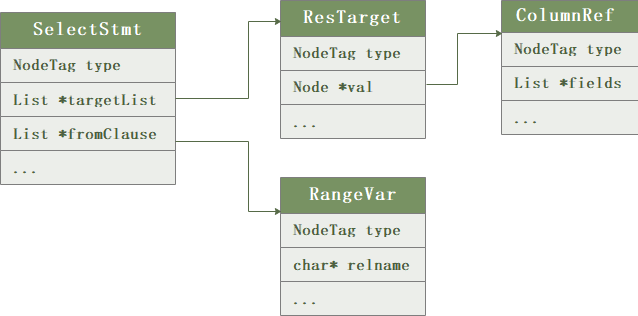

(gdb) p *parsetree_list
$47 = {type = T_List, length = 1, head = 0x7f5ff986c8f0, tail = 0x7f5ff986c8f0}(gdb) p *(Node *)(parsetree_list->head.data->ptr_value)
$45 = {type = T_SelectStmt}(gdb) set $stmt = (SelectStmt *)(parsetree_list->head.data->ptr_value)
(gdb) p *$stmt
$50 = {type = T_SelectStmt, distinctClause = 0x0, intoClause = 0x0, targetList = 0x7f5ffa43d588, fromClause = 0x7f5ff986c888, startWithClause = 0x0, whereClause = 0x0, groupClause = 0x0,
havingClause = 0x0, windowClause = 0x0, withClause = 0x0, valuesLists = 0x0, sortClause = 0x0, limitOffset = 0x0, limitCount = 0x0, lockingClause = 0x0, hintState = 0x0, op = SETOP_NONE, all = false,
larg = 0x0, rarg = 0x0, hasPlus = false}(gdb) p *($stmt->targetList)
$55 = {type = T_List, length = 2, head = 0x7f5ffa43d540, tail = 0x7f5ffa43d800}
(gdb) p *(Node *)($stmt->targetList->head.data->ptr_value)
$57 = {type = T_ResTarget}
(gdb) set $restarget1=(ResTarget *)($stmt->targetList->head.data->ptr_value)
(gdb) p *$restarget1
$60 = {type = T_ResTarget, name = 0x0, indirection = 0x0, val = 0x7f5ffa43d378, location = 7}
(gdb) p *$restarget1->val
$63 = {type = T_ColumnRef}
(gdb) p *(ColumnRef *)$restarget1->val
$64 = {type = T_ColumnRef, fields = 0x7f5ffa43d470, prior = false, indnum = 0, location = 7}
(gdb) p *((ColumnRef *)$restarget1->val)->fields
$66 = {type = T_List, length = 1, head = 0x7f5ffa43d428, tail = 0x7f5ffa43d428}
(gdb) p *(Node *)(((ColumnRef *)$restarget1->val)->fields)->head.data->ptr_value
$67 = {type = T_String}
(gdb) p *(Value *)(((ColumnRef *)$restarget1->val)->fields)->head.data->ptr_value
$77 = {type = T_String, val = {ival = 140050197369648, str = 0x7f5ffa43d330 "a"}}
(gdb) set $restarget2=(ResTarget *)($stmt->targetList->tail.data->ptr_value)
(gdb) p *$restarget2
$89 = {type = T_ResTarget, name = 0x0, indirection = 0x0, val = 0x7f5ffa43d638, location = 10}
(gdb) p *$restarget2->val
$90 = {type = T_ColumnRef}
(gdb) p *(ColumnRef *)$restarget2->val
$91 = {type = T_ColumnRef, fields = 0x7f5ffa43d730, prior = false, indnum = 0, location = 10}
(gdb) p *((ColumnRef *)$restarget2->val)->fields
$92 = {type = T_List, length = 1, head = 0x7f5ffa43d6e8, tail = 0x7f5ffa43d6e8}
(gdb) p *(Node *)(((ColumnRef *)$restarget2->val)->fields)->head.data->ptr_value
$93 = {type = T_String}
(gdb) p *(Value *)(((ColumnRef *)$restarget2->val)->fields)->head.data->ptr_value
$94 = {type = T_String, val = {ival = 140050197370352, str = 0x7f5ffa43d5f0 "b"}}(gdb) p *$stmt->fromClause
$102 = {type = T_List, length = 1, head = 0x7f5ffa43dfe0, tail = 0x7f5ffa43dfe0}
(gdb) set $fromclause=(RangeVar*)($stmt->fromClause->head.data->ptr_value)
(gdb) p *$fromclause
$103 = {type = T_RangeVar, catalogname = 0x0, schemaname = 0x0, relname = 0x7f5ffa43d848 "item", partitionname = 0x0, subpartitionname = 0x0, inhOpt = INH_DEFAULT, relpersistence = 112 'p', alias = 0x0,
location = 17, ispartition = false, issubpartition = false, partitionKeyValuesList = 0x0, isbucket = false, buckets = 0x0, length = 0, foreignOid = 0, withVerExpr = false}
语义分析
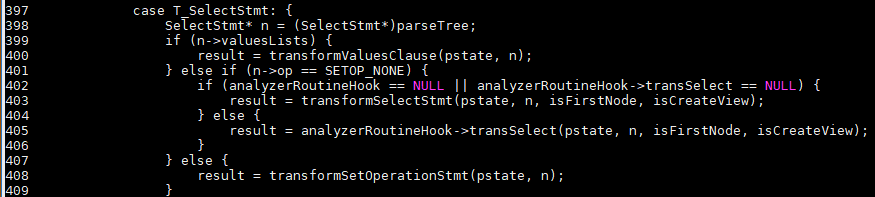
(gdb) p *result
$3 = {type = T_Query, commandType = CMD_SELECT, querySource = QSRC_ORIGINAL, queryId = 0, canSetTag = false, utilityStmt = 0x0, resultRelation = 0, hasAggs = false, hasWindowFuncs = false,
 hasSubLinks = false, hasDistinctOn = false, hasRecursive = false, hasModifyingCTE = false, hasForUpdate = false, hasRowSecurity = false, hasSynonyms = false, cteList = 0x0, rtable = 0x7f5ff5eb8c88,
 jointree = 0x7f5ff5eb9310, targetList = 0x7f5ff5eb9110,…}

(gdb) p *result->targetList
$13 = {type = T_List, length = 2, head = 0x7f5ff5eb90c8, tail = 0x7f5ff5eb92c8}

(gdb) p *(Node *)(result->targetList->head.data->ptr_value)
$8 = {type = T_TargetEntry}
(gdb) p *(TargetEntry*)(result->targetList->head.data->ptr_value)
$9 = {xpr = {type = T_TargetEntry, selec = 0}, expr = 0x7f5ff636ff48, resno = 1, resname = 0x7f5ff5caf330 "a", ressortgroupref = 0, resorigtbl = 24576, resorigcol = 1, resjunk = false}
(gdb) p *(TargetEntry*)(result->targetList->tail.data->ptr_value)
$10 = {xpr = {type = T_TargetEntry, selec = 0}, expr = 0x7f5ff5eb9178, resno = 2, resname = 0x7f5ff5caf5f0 "b", ressortgroupref = 0, resorigtbl = 24576, resorigcol = 2, resjunk = false}
(gdb)
(gdb) p *result->rtable
$14 = {type = T_List, length = 1, head = 0x7f5ff5eb8c40, tail = 0x7f5ff5eb8c40}
(gdb) p *(Node *)(result->rtable->head.data->ptr_value)
$15 = {type = T_RangeTblEntry}
(gdb) p *(RangeTblEntry*)(result->rtable->head.data->ptr_value)
$16 = {type = T_RangeTblEntry, rtekind = RTE_RELATION, relname = 0x7f5ff636efb0 "item", partAttrNum = 0x0, relid = 24576, partitionOid = 0, isContainPartition = false, subpartitionOid = 0……}
边栏推荐
- R语言ggplot2可视化:使用patchwork包将两个ggplot2可视化结果纵向堆叠起来(stacking)形成组合图、一个可视化结果堆叠在另外一个可视化结果上
- 利用MySqlBulkLoader实现批量插入数据的示例详解
- Express模板引擎
- 分布式理论须知
- R语言ggplot2可视化:patchwork包将一个ggplot2可视化结果和一个plot函数可视化结果横向组合起来形成最终结果图、两个可视化的组合结果对齐、并为组合图像的每个子图添加标题
- MIPS汇编语言学习-01-两数求和以及环境配置、如何运行
- S2b2c system website solution for kitchen and bathroom electrical appliance industry: create s2b2c platform Omni channel commercial system
- High "green premium" of environmental protection products? How far is the low-carbon lifestyle from people
- R language ggplot2 visualization: the patchwork package is used to customize and combine the three ggplot2 visualization results to form a composite graph. After the horizontal combination of two sub
- Flutter dart语言特点总结
猜你喜欢

Fleet | background Discovery issue 3: Status Management

Privacy computing fat - offline prediction
一文教你快速生成MySQL数据库关系图
教育行业SaaS应用管理平台解决方案:助力企业实现经营、管理一体化

Expand Disk C (allocate the memory of disk d to Disk C)
Fleet |「後臺探秘」第 3 期:狀態管理

WPF 视频硬解码渲染播放(无空域)(支持4K、8K、高帧率视频)

如何从零搭建10万级 QPS 大流量、高并发优惠券系统

【算法篇】刷了两道大厂面试题,含泪 ”重学数组“

C语言学习-19-全排列

随机推荐
ROS21讲
当下不做元宇宙,就像20年前没买房!
Classmate Zhang hasn't learned to be an anchor yet
Smart supplier management system for chemical manufacturing industry deeply explores the field of supplier management and improves supply chain collaboration
MIPS assembly language learning -02- logic judgment - foreground input
DBMS in Oracle_ output. put_ Line output problem solving process
Innovation and upgrading of supply chain system driven management mode in petrochemical industry and strengthening internal management of enterprises
Grand launch of qodana: your favorite CI code quality platform
Li Kou today's question -522 Longest special sequence
一个bug肝一周...忍不住提了issue
化学制品制造业智慧供应商管理系统深度挖掘供应商管理领域,提升供应链协同
halcon 基础总结(一)裁切图片并旋转图像
Flutter简单实现多语言国际化
The past and present life of distributed cap theorem
MongoDB 在腾讯零售优码中的应用
字节跳动数据平台技术揭秘:基于 ClickHouse 的复杂查询实现与优化
R language ggplot2 visualization: the patchwork package horizontally combines a ggplot2 visualization result and a plot function visualization result to form a final result graph, aligns the two visua
隆重推出 Qodana:您最爱的 CI 的代码质量平台
R语言使用nnet包的multinom函数构建无序多分类logistic回归模型、使用回归系数及其标准误计算每个系数对应的Z统计量的值
SAP mts/ato/mto/eto topic 9: front and back desk operation in m+m mode, strategy 50, preparation of raw materials and semi-finished products in advance