当前位置:网站首页>Introduction to machine learning compilation course learning notes lesson 2 tensor program abstraction
Introduction to machine learning compilation course learning notes lesson 2 tensor program abstraction
2022-06-30 22:34:00 【herosunly】
In this lesson slides Links are as follows :https://mlc.ai/summer22-zh/slides/2-TensorProgram.pdf;notes Links are as follows :https://mlc.ai/zh/chapter_tensor_program/.
List of articles
1. The outline of this lesson
- Metatensor function ( Tensor operator )
- Tensor program abstraction
Through this lesson, I have a deeper understanding of batch processing . Batch processing and small batch gradient descent are similar ( The premise is that the calculation is independent ). This will be described in more detail later .
2. Metatensor function
A meta tensor function is a single element ( Minimum particle size ) The tensor function of . With PyTorch Take addition in as an example :
import torch
C = torch.empty((128,), dtype=torch.float32)
a = torch.tensor(np.arange(128, dtype="float32"))
b = torch.tensor(np.ones(128, dtype="float32"))

torch.add(a,b,out=c) # torch.add can be viewed as a primitive tensor function
that torch.add How to achieve it ? Or in actual deployment , How to put different steps ( Multiple tensor functions ) Merge together ?
abstract And Realization Is one of the core concepts of this course . For the same tensor operator , There are different ways to achieve :
The second representation is a refinement of the first representation , The third representation is the use of low-level languages (C Language , Even in assembly language ) For more efficient implementation .
One most common MLC process that many frameworks offer is to transform the implementations of primitive functions(or dispatch them in runtime) to more optimized ones based on the environment.
A common method in tensor operator transformation is to map it directly to the corresponding operator library . For example CUDA Environment , You can use cudaAdd. Another common one is Finer grained program transformation . The former can be directly represented by symbols , The latter needs to be expressed in a circular form .

3. Tensor program abstraction
The tensor operator transformation mentioned above includes two common forms , One is to map directly to the corresponding operator library , The other is to carry out finer grained program transformation . The latter is called Tensor function abstraction .
The picture below is TVM An example in :
Tensor function abstraction includes three key elements :
- Multidimensional input 、 Output data .
- loop .
- In each cycle , Make the corresponding calculation .

It involves a problem : That is why we don't use C Language and other low-level languages . It mainly lies in that the core of machine learning compilation is not only that the program ape can complete the coding , It is more important to complete the tensor operator transformation , That is, given a tensor, it will be transformed from the original form to a more optimized form ( Try different transformations , Finally find the most optimized form ). If we can explore the equivalent space corresponding to the possible tensor function through the program , Can greatly improve efficiency .
3.1 Why do we need tensor program abstraction

stay Program-based transformnations Loop splitting in , In essence, it is to transform a single-layer cycle into a double-layer cycle ( Loop splitting is a common transformation ), and Transformed program It involves parallelization and vectorization , Vectorization here means that each step is based on the length 4 Unit of ( The batch ) To do an operation .
3.2 Common tensor transformations
3.2.1 Loop split

The equivalent substitution includes : x = x o ∗ 4 + x i x=x_o*4+x_i x=xo∗4+xi
3.2.2 Cyclic rearrangement
The essence of cycle rearrangement is to replace the sequence of two cycles .
3.2.3 Thread binding
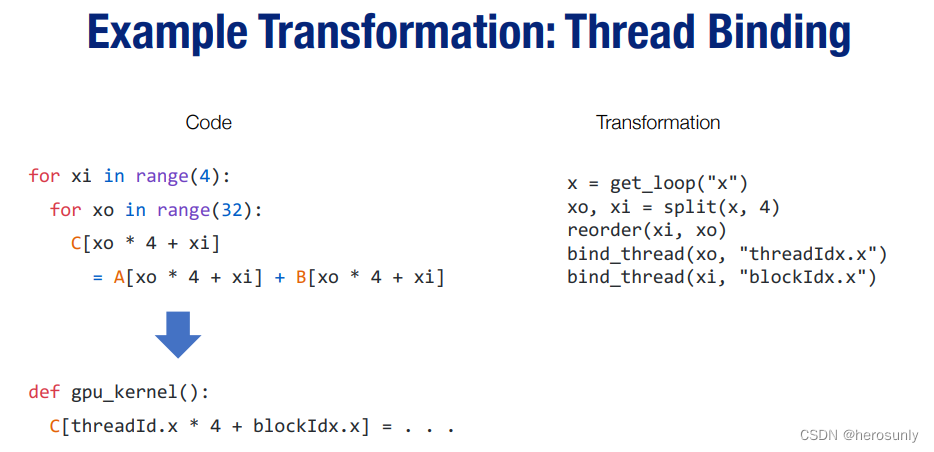
If in GPU Parallelize on , You can put xi and xo Corresponding to GPU On two threads of . By binding GPU The thread of gets the final result ( More in-depth explanations will be given in subsequent chapters ).
Try different transformation combinations in different hardware environments , Then, according to the test, the optimal transformation is obtained in the equivalent space corresponding to the tensor function . One thing to note is that , The transformation here must be equivalent . Here's a counterexample , In essence, it can be expressed as C = A + C C=A+C C=A+C,C For others index Under the C The results are dependent ( stay xo = 4, xi = 0 The situation will be right xo = 0, xi = 1 Results in dependency , And if we change the order of the loop xo = 0, xi = 1 It will be circulated to ), If it's just simple reorder, The order of the loop will change, causing the dependency to be broken , The left side of the equation will appear C To the right of the equation C There is no result yet . So there is no loop rearrangement here .
for xo in range(32):
    for xi in range(4):
        C[xo * 4 + xi] = A[xo * 4 + xi] + C[max(xo * 4 + xi – 1, 0)]
3.3 Other structures in tensor program abstraction
According to the above , We cannot change the program arbitrarily ( For example, some calculations will depend on the order between loops ). But fortunately , Most of the metatensor functions we are interested in have good properties ( For example, between loop iterations independence ).
The tensor program can combine this additional information into a part of the program , To make program transformation more convenient .
among vi = T.axis.spatial(128, i) Not only is it equivalent to vi=i, And show that vi Represents an iterator , And all iterations in the iterator are independent . This information is not necessary to execute the program , But it will make it more convenient for us to change this program . In this case , We know we can Safely parallel Or reorder all and vi About the cycle , As long as the actual implementation vi Value of from 0 To 128 The order of change .
23:20
4. Tensor program transformation practice
The first thing to say is : If there is already Colab account number , It is more recommended to directly use Colab Environmental Science , Then you can directly use the following pip Installation package .
4.1 Installation package
The official installation order is as follows , But because of https://mlc.ai/wheels You need a proxy to connect , If not Colab The following commands are not recommended for environment installation :
python3 -m pip install mlc-ai-nightly -f https://mlc.ai/wheels
The recommended method is to manually download a file that is suitable for the environment wheel file , Then install :
Personal environment is Linux+Python3.8 Environmental Science , The download link of the corresponding file is :https://github.com/mlc-ai/utils/releases/download/v0.9.dev0/mlc_ai_nightly-0.9.dev1661%2Bg2b34ced6c-cp38-cp38-manylinux_2_17_x86_64.manylinux2014_x86_64.whl.
4.2 Construct tensor program
import numpy as np
import tvm
from tvm.ir.module import IRModule
from tvm.script import tir as T
@tvm.script.ir_module
class MyModule:
    @T.prim_func
    def main(A: T.Buffer[128, "float32"],
             B: T.Buffer[128, "float32"],
             C: T.Buffer[128, "float32"]):
        # extra annotations for the function
        T.func_attr({
    "global_symbol": "main", "tir.noalias": True})
        for i in range(128):
            with T.block("C"):
                # declare a data parallel iterator on spatial domain
                vi = T.axis.spatial(128, i)
                C[vi] = A[vi] + B[vi]
TVMScript It's a way for us to Python The way to represent tensor programs in the form of abstract syntax trees . Notice that this code does not actually correspond to a Python Program , Instead, it corresponds to a tensor program in the compilation process of machine learning .TVMScript The language of is designed to communicate with Python Corresponding to grammar , And in Python On the basis of grammar, additional structure is added to help program analysis and transformation .
print(type(MyModule)) # tvm.ir.module.IRModule
MyModule yes IRModule An example of a data structure , yes A set of tensor functions .
We can go through script Function to get this IRModule Of TVMScript Express . This function is useful for checking between step-by-step program transformations IRModule Very helpful for .
print(MyModule.script())
@tvm.script.ir_module
class Module:
    @tir.prim_func
    def func(A: tir.Buffer[128, "float32"], B: tir.Buffer[128, "float32"], C: tir.Buffer[128, "float32"]) -> None:
        # function attr dict
        tir.func_attr({
    "global_symbol": "main", "tir.noalias": True})
        # body
        # with tir.block("root")
        for i in tir.serial(128):
            with tir.block("C"):
                vi = tir.axis.spatial(128, i)
                tir.reads(A[vi], B[vi])
                tir.writes(C[vi])
                C[vi] = A[vi] + B[vi]
4.3 Compile and run
Use build The function will have a IRModule Into executable functions , among llvm Express CPU As a hardware execution environment .
rt_mod = tvm.build(MyModule, target="llvm")  # The module for CPU backends.
type(rt_mod)
tvm.driver.build_module.OperatorModule
After compilation ,mod Contains a set of executable functions . We can get the corresponding functions by their names .
func = rt_mod["main"]
func
<tvm.runtime.packed_func.PackedFunc>
First we construct three tensors , among c Used to receive output :
a = tvm.nd.array(np.arange(128, dtype="float32"))
b = tvm.nd.array(np.ones(128, dtype="float32"))
c = tvm.nd.empty((128,), dtype="float32")
func(a, b, c)
print(c)
[  1.   2.   3.   4.   5.   6.   7.   8.   9.  10.  11.  12.  13.  14.
  15.  16.  17.  18.  19.  20.  21.  22.  23.  24.  25.  26.  27.  28.
  29.  30.  31.  32.  33.  34.  35.  36.  37.  38.  39.  40.  41.  42.
  43.  44.  45.  46.  47.  48.  49.  50.  51.  52.  53.  54.  55.  56.
  57.  58.  59.  60.  61.  62.  63.  64.  65.  66.  67.  68.  69.  70.
  71.  72.  73.  74.  75.  76.  77.  78.  79.  80.  81.  82.  83.  84.
  85.  86.  87.  88.  89.  90.  91.  92.  93.  94.  95.  96.  97.  98.
  99. 100. 101. 102. 103. 104. 105. 106. 107. 108. 109. 110. 111. 112.
 113. 114. 115. 116. 117. 118. 119. 120. 121. 122. 123. 124. 125. 126.
 127. 128.]
4.4 Tensor program transformation
Now we begin to transform the tensor program . A tensor program can be implemented through an auxiliary called scheduling (schedule) The data structure is transformed .
sch = tvm.tir.Schedule(MyModule)
type(sch)
tvm.tir.schedule.schedule.Schedule
We first try to split the loop .
# Get block by its name
block_c = sch.get_block("C")
# Get loops surrounding the block, Get block Outside the corresponding loop
(i,) = sch.get_loops(block_c)
# Tile the loop nesting.
i_0, i_1, i_2 = sch.split(i, factors=[None, 4, 4])
print(sch.mod.script())
take for i in tir.serial(128) Medium i Changed to i_0, i_1 and i_2. Another thing to note factors=[None, 4, 4] and tir.grid(8, 4, 4) The one-to-one correspondence between vi Equivalent to tir.axis.spatial(128, i_0 * 16 + i_1 * 4 + i_2). The latter is represented by a triple cycle .
@tvm.script.ir_module
class Module:
    @tir.prim_func
    def func(A: tir.Buffer[128, "float32"], B: tir.Buffer[128, "float32"], C: tir.Buffer[128, "float32"]) -> None:
        # function attr dict
        tir.func_attr({
    "global_symbol": "main", "tir.noalias": True})
        # body
        # with tir.block("root")
        for i_0, i_1, i_2 in tir.grid(8, 4, 4):
            with tir.block("C"):
                vi = tir.axis.spatial(128, i_0 * 16 + i_1 * 4 + i_2)
                tir.reads(A[vi], B[vi])
                tir.writes(C[vi])
                C[vi] = A[vi] + B[vi]
In addition, you can rearrange the loop , For example, will i_2 Move to i_1 On the outside .
sch.reorder(i_0, i_2, i_1)
print(sch.mod.script())
@tvm.script.ir_module
class Module:
    @tir.prim_func
    def func(A: tir.Buffer[128, "float32"], B: tir.Buffer[128, "float32"], C: tir.Buffer[128, "float32"]) -> None:
        # function attr dict
        tir.func_attr({
    "global_symbol": "main", "tir.noalias": True})
        # body
        # with tir.block("root")
        for i_0, i_2, i_1 in tir.grid(8, 4, 4):
            with tir.block("C"):
                vi = tir.axis.spatial(128, i_0 * 16 + i_1 * 4 + i_2)
                tir.reads(A[vi], B[vi])
                tir.writes(C[vi])
                C[vi] = A[vi] + B[vi]
Another common transformation is parallelization , For example, parallel operation on the outermost loop .
sch.parallel(i_0)
print(sch.mod.script())
@tvm.script.ir_module
class Module:
    @tir.prim_func
    def func(A: tir.Buffer[128, "float32"], B: tir.Buffer[128, "float32"], C: tir.Buffer[128, "float32"]) -> None:
        # function attr dict
        tir.func_attr({
    "global_symbol": "main", "tir.noalias": True})
        # body
        # with tir.block("root")
        for i_0 in tir.parallel(8):
            for i_2, i_1 in tir.grid(4, 4):
                with tir.block("C"):
                    vi = tir.axis.spatial(128, i_0 * 16 + i_1 * 4 + i_2)
                    tir.reads(A[vi], B[vi])
                    tir.writes(C[vi])
                    C[vi] = A[vi] + B[vi]
5. summary
2.4. summary
The meta tensor function represents the single unit computation in the computation of machine learning model .
- A machine learning compilation process can selectively transform the implementation of meta tensor functions .
A tensor program is an efficient abstraction of a tensor function .
- Key ingredients include : Multidimensional arrays 、 A nested loop 、 Calculation statement .
- Program transformation can be used to speed up the execution of tensor programs .
- Additional structures in tensor programs can provide more information for program transformation .
边栏推荐
- A new one from Ali 25K came to the Department, which showed me what the ceiling is
- Redis' transaction and locking mechanism
- Starting from pg15 xid64 ticket skipping again
- Graduation project
- 基于kubernetes平台微服务的部署
- AtCoder Beginner Contest 255
- 公有云市场迈入深水区,冷静的亚马逊云还坐得住吗?
- 十个最为戳心测试/开程序员笑话,念茫茫人海,该如何寻觅?
- 手机上怎么开股票账户?另外,手机开户安全么?
- 后疫情时代,云计算如何为在线教育保驾护航
猜你喜欢

What if the taskbar is blank after win11 update? Solution to blank and stuck taskbar after win11 update

Swift5.0 ----Swift FrameWork的创建及使用

Why does the computer speed slow down after vscode is used for a long time?

Redis的缓存穿透、缓存击穿和缓存雪崩

How to realize the center progress bar in wechat applet

What does the &?

2022中国国潮发展新动向

Nansen double disk encryption giant self rescue: how to prevent the collapse of billions of dominoes

基于kubernetes平台微服务的部署

ESP8266 成为客户端和服务器
随机推荐
总结的一些内存问题
十个最为戳心测试/开程序员笑话,念茫茫人海,该如何寻觅?
Cloud games | cloud computing drives the game industry into a "new era"
Anfulai embedded weekly report no. 271: June 20, 2022 to June 26, 2022
[BSP video tutorial] BSP video tutorial issue 19: AES encryption practice of single chip bootloader, including all open source codes of upper and lower computers (June 26, 2022)
B_ QuRT_ User_ Guide(31)
[golang] golang实现截取字符串函数SubStr
Discuz forum speed up to delete XXX under data/log PHP file
CNN经典网络模型详解-LeNet-5(pytorch实现)
AtCoder Beginner Contest 257
How to judge whether the JS object is empty
Domestic database disorder
HDFS集中式缓存管理(Centralized Cache Management)
pytorch 的Conv2d的详细解释
分享十万级TPS的IM即时通讯综合消息系统的架构
Meet the StreamNative | 杨子棵:是什么让我放弃了大厂 Offer
Tencent has been conducting advanced automated functional testing for 3 years. It is a gift to you who are confused in manual testing
Some memory problems summarized
请指教同花顺软件究竟是什么?另外想问,现在在线开户安全么?
Is it difficult to get a certified equipment supervisor? What is the relationship with the supervising engineer?