当前位置:网站首页>YOLOX backbone——CSPDarknet的实现
YOLOX backbone——CSPDarknet的实现
2022-06-24 07:12:00 【牧羊女说】
YOLOX所使用的主干特征提取网络为CSPDarknet,如下图左侧框所示。

图片来源: Pytorch 搭建自己的YoloX目标检测平台(Bubbliiiing 深度学习 教程)_哔哩哔哩_bilibili
CSPDarknet的几个要点总结如下。
1. Focus网络结构
Focus结构的具体操作是,在一幅图像中行和列的方向进行隔像素抽取,组成新的特征层,每幅图像可重组为4个特征层,然后将4个特征层进行堆叠,将输入通道扩展为4倍。堆叠后的特征层相对于原先的3通道变为12通道,如下图所示:

PyTorch代码实现如下:
class Focus(nn.Module):
    """Focus width and height information into channel space."""

    def __init__(self, in_channels, out_channels, ksize=1, stride=1, act="silu"):
        super().__init__()
        self.conv = BaseConv(in_channels * 4, out_channels, ksize, stride, act=act)

    def forward(self, x):
        # shape of x (b,c,w,h) -> y(b,4c,w/2,h/2)
        patch_top_left = x[..., ::2, ::2]
        patch_top_right = x[..., ::2, 1::2]
        patch_bot_left = x[..., 1::2, ::2]
        patch_bot_right = x[..., 1::2, 1::2]
        x = torch.cat(
            (
                patch_top_left,
                patch_bot_left,
                patch_top_right,
                patch_bot_right,
            ),
            dim=1,
        )
        return self.conv(x)
2. 残差网络Residual
CSPDarknet中的残差网络分为两个分支,主干分支做一次1x1卷积和一次3x3卷积,残差边部分不做任何处理,相当于直接将主干的输入和输出结合。

代码如下,
class Bottleneck(nn.Module):
    # Standard bottleneck
    def __init__(
        self,
        in_channels,
        out_channels,
        shortcut=True,
        expansion=0.5,
        depthwise=False,
        act="silu",
    ):
        super().__init__()
        hidden_channels = int(out_channels * expansion)
        Conv = DWConv if depthwise else BaseConv
        self.conv1 = BaseConv(in_channels, hidden_channels, 1, stride=1, act=act)
        self.conv2 = Conv(hidden_channels, out_channels, 3, stride=1, act=act)
        self.use_add = shortcut and in_channels == out_channels

    def forward(self, x):
        y = self.conv2(self.conv1(x))
        if self.use_add:
            y = y + x
        return y
其中的DWConv指的是Depthwise Convolution,在轻量级网络如YOLOX-Nano和YOLOX-Tiny会用到。
DWConv和BaseConv的定义如下:
class DWConv(nn.Module):
    """Depthwise Conv + Conv"""

    def __init__(self, in_channels, out_channels, ksize, stride=1, act="silu"):
        super().__init__()
        self.dconv = BaseConv(
            in_channels,
            in_channels,
            ksize=ksize,
            stride=stride,
            groups=in_channels,
            act=act,
        )
        self.pconv = BaseConv(
            in_channels, out_channels, ksize=1, stride=1, groups=1, act=act
        )

    def forward(self, x):
        x = self.dconv(x)
        return self.pconv(x)
class BaseConv(nn.Module):
    """A Conv2d -> Batchnorm -> silu/leaky relu block"""

    def __init__(
        self, in_channels, out_channels, ksize, stride, groups=1, bias=False, act="silu"
    ):
        super().__init__()
        # same padding
        pad = (ksize - 1) // 2
        self.conv = nn.Conv2d(
            in_channels,
            out_channels,
            kernel_size=ksize,
            stride=stride,
            padding=pad,
            groups=groups,
            bias=bias,
        )
        self.bn = nn.BatchNorm2d(out_channels)
        self.act = get_activation(act, inplace=True)

    def forward(self, x):
        return self.act(self.bn(self.conv(x)))

    def fuseforward(self, x):
        return self.act(self.conv(x))
3. CSPNet网络结构
CSPNet的结构跟Residual有点像,也是分成左右两部分,主干部分进行残差块的堆叠,另一部分则像残差边一样,经过少量处理后连接到主干部分的最后。图示如下:

图片来源于网络。
上图最右侧部分即为CSPNet的分解结构,其中,Bottleneck的数目根据不同的层可配置不同的数目 。该结构的代码实现如下:
class CSPLayer(nn.Module):
    """C3 in yolov5, CSP Bottleneck with 3 convolutions"""

    def __init__(
        self,
        in_channels,
        out_channels,
        n=1,
        shortcut=True,
        expansion=0.5,
        depthwise=False,
        act="silu",
    ):
        """
        Args:
            in_channels (int): input channels.
            out_channels (int): output channels.
            n (int): number of Bottlenecks. Default value: 1.
        """
        # ch_in, ch_out, number, shortcut, groups, expansion
        super().__init__()
        hidden_channels = int(out_channels * expansion)  # hidden channels
        # 主干部分第一次卷积
        self.conv1 = BaseConv(in_channels, hidden_channels, 1, stride=1, act=act)
        # 大的残差边部分第一次卷积
        self.conv2 = BaseConv(in_channels, hidden_channels, 1, stride=1, act=act)
        # 对堆叠结果进行卷积操作,注意堆叠后,输入的channels变成了两倍
        self.conv3 = BaseConv(2 * hidden_channels, out_channels, 1, stride=1, act=act)

        # 根据循环次数构建Bottleneck残差结构
        module_list = [
            Bottleneck(
                hidden_channels, hidden_channels, shortcut, 1.0, depthwise, act=act
            )
            for _ in range(n)
        ]
        self.m = nn.Sequential(*module_list)

    def forward(self, x):
        # X_1为主干部分
        x_1 = self.conv1(x)
        # x_2为大的残差边部分
        x_2 = self.conv2(x)
        # 主干部分利用残差结构堆叠进行特征提取
        x_1 = self.m(x_1)
        # 主干部分和大的残差边部分进行堆叠
        x = torch.cat((x_1, x_2), dim=1)
        # 对堆叠结果进行卷积处理
        return self.conv3(x)
4. SiLU激活函数
SiLU激活函数是Signoid和ReLU的改进版,具有有下界无上界、平滑、非单调的特性,在深层模型上的效果优于ReLU。类似这种图形:
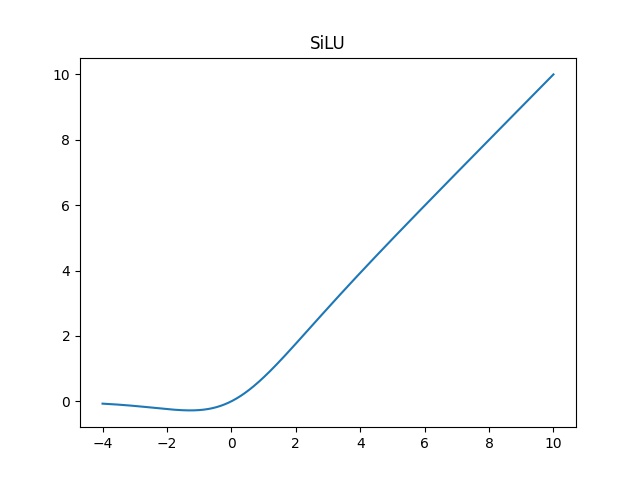
实现代码如下:
class SiLU(nn.Module):
    """export-friendly version of nn.SiLU()"""

    @staticmethod
    def forward(x):
        return x * torch.sigmoid(x)
5. SPP结构
SPP是Spatial Pyramid Pooling的缩写。在CSPDarknet中,使用了不同池化核大小的MaxPool进行特征提取,以提高网络的感受野。与在YOLOv4中将SPP用在FPN里面不同,在YOLOX中,SPP模块被用在了主干特征提取网络中。示意图如下:

实现代码如下:
class SPPBottleneck(nn.Module):
    """Spatial pyramid pooling layer used in YOLOv3-SPP"""

    def __init__(
        self, in_channels, out_channels, kernel_sizes=(5, 9, 13), activation="silu"
    ):
        super().__init__()
        hidden_channels = in_channels // 2
        self.conv1 = BaseConv(in_channels, hidden_channels, 1, stride=1, act=activation)
        self.m = nn.ModuleList(
            [
                nn.MaxPool2d(kernel_size=ks, stride=1, padding=ks // 2)
                for ks in kernel_sizes
            ]
        )
        conv2_channels = hidden_channels * (len(kernel_sizes) + 1)
        self.conv2 = BaseConv(conv2_channels, out_channels, 1, stride=1, act=activation)

    def forward(self, x):
        x = self.conv1(x)
        x = torch.cat([x] + [m(x) for m in self.m], dim=1)
        x = self.conv2(x)
        return x
6. CSPDarknet完整实现
好了,CSPDarknet的组成部分介绍完了,接下来,需要将以上子模块拼装成最终的CSPDarknet。代码如下:
class CSPDarknet(nn.Module):
    def __init__(
        self,
        dep_mul,
        wid_mul,
        out_features=("dark3", "dark4", "dark5"),
        depthwise=False,
        act="silu",
    ):
        super().__init__()
        assert out_features, "please provide output features of Darknet"
        self.out_features = out_features
        Conv = DWConv if depthwise else BaseConv

        # 输入图片大小是640x640x3
        # 初始基本通道为64
        base_channels = int(wid_mul * 64)  # 64
        base_depth = max(round(dep_mul * 3), 1)  # 3

        # 利用focus网络结构进行特征提取
        # 640x640x3 -> 320x320x12 -> 320x320x64
        self.stem = Focus(3, base_channels, ksize=3, act=act)

        # dark2
        # Conv: 320x320x64 -> 160x160x128
        # CSPLayer: 160x160x128 -> 160x160x128
        self.dark2 = nn.Sequential(
            Conv(base_channels, base_channels * 2, 3, 2, act=act),
            CSPLayer(
                base_channels * 2,
                base_channels * 2,
                n=base_depth,
                depthwise=depthwise,
                act=act,
            ),
        )

        # dark3
        # Conv: 160x160x128 -> 80x80x256
        # CSPLayer: 80x80x256 -> 80x80x256
        self.dark3 = nn.Sequential(
            Conv(base_channels * 2, base_channels * 4, 3, 2, act=act),
            CSPLayer(
                base_channels * 4,
                base_channels * 4,
                n=base_depth * 3,
                depthwise=depthwise,
                act=act,
            ),
        )

        # dark4
        # Conv: 80x80x256 -> 40x40x512
        # CSPLayer: 40x40x512 -> 40x40x512
        self.dark4 = nn.Sequential(
            Conv(base_channels * 4, base_channels * 8, 3, 2, act=act),
            CSPLayer(
                base_channels * 8,
                base_channels * 8,
                n=base_depth * 3,
                depthwise=depthwise,
                act=act,
            ),
        )

        # dark5
        # Conv: 40x40x512 -> 20x20x1024
        # SPPConv: 20x20x1024 -> 20x20x1024
        # CSPLayer: 20x20x1024 -> 20x20x1024
        self.dark5 = nn.Sequential(
            Conv(base_channels * 8, base_channels * 16, 3, 2, act=act),
            SPPBottleneck(base_channels * 16, base_channels * 16, activation=act),
            CSPLayer(
                base_channels * 16,
                base_channels * 16,
                n=base_depth,
                shortcut=False,
                depthwise=depthwise,
                act=act,
            ),
        )

    def forward(self, x):
        outputs = {}
        x = self.stem(x)
        outputs["stem"] = x
        x = self.dark2(x)
        outputs["dark2"] = x

        # dark3的输出为80x80x256的有效特征层
        x = self.dark3(x)
        outputs["dark3"] = x

        # dark4的输出为40x40x512的有效特征层
        x = self.dark4(x)
        outputs["dark4"] = x

        # dark5的输出为20x20x1024的有效特征层
        x = self.dark5(x)
        outputs["dark5"] = x
return {k: v for k, v in outputs.items() if k in self.out_features}边栏推荐
- 关于 GIN 的路由树
- Using skills of xargs -- the way to build a dream
- Liunx Mysql安装
- 110. 平衡二叉树-递归法
- Database to query the quantity of books lent in this month. If it is higher than 10, it will display "more than 10 books lent in this month". Otherwise, it will display "less than 10 books lent in thi
- China chip Unicorn Corporation
- 520. 检测大写字母
- every()、map()、forEarch()方法。数组里面有对象的情况
- 数据库迁移从PostgreSQL迁移到 MYSQL
- Sword finger offer 55 - I. depth DFS method of binary tree
猜你喜欢

WebRTC系列-网络传输之5选择最优connection切换

A tip to read on Medium for free

MySQL | store notes of Master Kong MySQL from introduction to advanced
A tip to read on Medium for free

What is the future development trend of Business Intelligence BI

华为路由器:GRE技术

One article explains in detail | those things about growth

【团队管理】测试团队绩效管理的25点小建议

【使用 PicGo+腾讯云对象存储COS 作为图床】
What is SRE? A detailed explanation of SRE operation and maintenance system
随机推荐
基于QingCloud的地理信息企业研发云解决方案
听说你还在花钱从网上买 PPT 模板?
1528. 重新排列字符串
Floating error waiting for changelog lock
2022.06.23(LC_144,94,145_二叉树的前序、中序、后序遍历)
Why can ping fail while traceroute can
QT source code analysis -- QObject (2)
ZUCC_ Principles of compiling language and compilation_ Experiment 0607 grammar analysis ll analysis
为什么ping不通,而traceroute却可以通
2022-06-23:给定一个非负数组,任意选择数字,使累加和最大且为7的倍数,返回最大累加和。 n比较大,10的5次方。 来自美团。3.26笔试。
Matlab camera calibrator camera calibration
JS to find and update the specified value in the object through the key
【牛客】HJ1 字符串最后一个单词的长度
Deep learning and neural networks: the six most noteworthy trends
Database migration from PostgreSQL to MySQL
表单图片上传在Chorme中无法查看请求体的二进制图片信息
华为路由器:GRE技术
The pie chart with dimension lines can set various parameter options
Become an IEEE student member
1844. 将所有数字用字符替换