当前位置:网站首页>ZABBIX monitoring host and resource alarm
ZABBIX monitoring host and resource alarm
2022-07-26 00:47:00 【Shuimu, time】
Zabbix What is it?
Zabbix It is an enterprise level distributed open source monitoring solution . Be able to monitor the server , Network devices , Objects such as applications . All reports 、 Statistics and configuration parameters can be accessed through Web Front page access .
Zabbix function
https://www.zabbix.com/documentation/3.4/zh/manual/introduction/features
• Data collection
• Flexible threshold definition
• Highly configurable alarm
• Real time chart display
• Web monitor
• Rich visual configuration
• Historical data storage
• Internet discovery
• Web Interface
• Zabbix API
• Authority management system
• extensible Agent
• Web
Zabbix The scope of monitoring
• Hardware :Zabbix IPMI Interface
• System :Zabbix Agent Interface
• Java :Zabbix JMX Interface
• Network devices :Zabbix SNMP Interface
• Application service :Zabbix Agent UserParameter
• URL:Zabbix Web monitor
What to monitor 
Zabbix Common terms
https://www.zabbix.com/documentation/3.4/zh/manual/definitions
• host (host)
• Host group (host group)
• Monitoring item (item)
• trigger (trigger)
• event (event)
• abnormal (problem)
• action (action)
• upgrade (escalation)
• medium (media)
• notice (notification)
• Remote command (remote command)
• Template (template)
• application (application)
• web scene (web scenario)
• front end (frontend)
• Zabbix API
Zabbix Components
https://www.zabbix.com/documentation/3.4/zh/manual/concepts

Zabbix Common terms
https://www.zabbix.com/documentation/3.4/zh/manual/definitions
• host (host)
• Host group (host group)
• Monitoring item (item)
• trigger (trigger)
• event (event)
• abnormal (problem)
• action (action)
• upgrade (escalation)
• medium (media)
• notice (notification)
• Remote command (remote command)
• Template (template)
• application (application)
• web scene (web scenario)
• front end (frontend)
• Zabbix API
Zabbix Deploy
- install MySQL
Deploy MySQL5.7 edition .
# yum -y install yum-utils
# rpm -ivh https://dev.mysql.com/get/mysql80-community-release-el7-1.noarch.rpm # # # # yum-config-manager --disable mysql80-community
yum-config-manager --enable mysql57-community
# yum install mysql-community-server mysql-community-devel
systemctl start mysqld
systemctl status mysqld
systemctl enable mysqld

 To reset root Account and password :
# grep 'temporary password' /var/log/mysqld.log
# mysql -uroot -p
mysql> ALTER USER 'root'@'localhost' IDENTIFIED BY '[email protected]';

 Modify the configuration file :
# vi /etc/my.cnf
[mysql]
socket = /tmp/mysql.sock
[mysqld]
user = mysql
port = 3306
datadir = /var/lib/mysql
socket = /tmp/mysql.sock
bind-address = 0.0.0.0
pid-file = /var/run/mysqld/mysqld.pid
character-set-server = utf8
collation-server = utf8_general_ci
log-error = /var/log/mysqld.log

max_connections = 10240
open_files_limit = 65535
innodb_buffer_pool_size = 3G
innodb_flush_log_at_trx_commit = 2
innodb_log_file_size = 256M

# systemctl restart mysqld
- Deploy Nginx
 Source code compilation and installation :
# wget http://nginx.org/download/nginx-1.15.3.tar.gz
# yum install gcc pcre-devel openssl-devel –y
# useradd -M -s /sbin/nologin nginx
# tar zxvf nginx-1.15.3.tar.gz
# cd nginx-1.15.3
# ./configure --prefix=/usr/local/nginx --user=nginx --group=nginx --with-http_ssl_module --with-http_stub_status_module
# make && make install

 Modify the configuration file , modify pid Location :
# vi /usr/local/nginx/conf/nginx.conf
pid        /var/run/nginx.pid;

 To configure systemd management service :
# vi /usr/lib/systemd/system/nginx.service
[Unit]
Description=The NGINX HTTP and reverse proxy server
After=syslog.target network.target remote-fs.target nss-lookup.target

[Service]
Type=forking
PIDFile=/var/run/nginx.pid
ExecStartPre=/usr/local/nginx/sbin/nginx -t
ExecStart=/usr/local/nginx/sbin/nginx
ExecReload=/usr/local/nginx/sbin/nginx -s reload
ExecStop=/bin/kill -s QUIT $MAINPID
PrivateTmp=true

[Install]
WantedBy=multi-user.target

 Boot and join boot on :
systemctl daemon-reload
systemctl start nginx
systemctl enable nginx
- Deploy PHP
# yum install epel-release –y

 Install dependency packages :
# yum install -y gcc gcc-c++ make gd-devel libxml2-devel \
libcurl-devel libjpeg-devel libpng-devel openssl-devel \
libxslt-devel

 Source code compilation and installation PHP:
# wget http://docs.php.net/distributions/php-5.6.36.tar.gz
# tar zxf php-5.6.36.tar.gz
# cd php-5.6.36
# ./configure --prefix=/usr/local/php \
--with-config-file-path=/usr/local/php/etc \
--enable-fpm --enable-opcache \
--with-mysql --with-mysqli  \
--enable-session --with-zlib --with-curl --with-gd \
--with-jpeg-dir --with-png-dir --with-freetype-dir \
--enable-mbstring --enable-xmlwriter --enable-xmlreader \
--enable-xml --enable-sockets --enable-bcmath --with-gettext
# make -j 8 && make install

 Copy configuration file :
cp php.ini-production /usr/local/php/etc/php.ini
cp sapi/fpm/php-fpm.conf /usr/local/php/etc/php-fpm.conf
cp sapi/fpm/php-fpm.service /usr/lib/systemd/system/

 To configure systemd management service :
# vi /usr/lib/systemd/system/php-fpm.service
[Unit]
Description=The PHP FastCGI Process Manager
After=syslog.target network.target

[Service]
Type=simple
PIDFile=/usr/local/php/var/run/php-fpm.pid
ExecStart=/usr/local/php/sbin/php-fpm --nodaemonize --fpm-config /usr/local/php/etc/php-fpm.conf
ExecReload=/bin/kill -USR2 $MAINPID

[Install]
WantedBy=multi-user.target

 Boot and join boot on :
systemctl daemon-reload
systemctl start php-fpm
systemctl enable php-fpm

 Import table structure :
mysql> create database zabbix;
mysql> grant all on zabbix.* to [email protected]'%' identified by '[email protected]';
tar zxvf zabbix-4.0.0.tar.gz
cd zabbix-4.0.0/database/mysql
mysql -uzabbix -p'[email protected]' zabbix < schema.sql
mysql -uzabbix -p'[email protected]' zabbix < images.sql
mysql -uzabbix -p'[email protected]' zabbix < data.sql
- Deploy Zabbix Server
Install dependency packages :
# yum install libxml2-devel libcurl-devel libevent-devel net-snmp-devel mysql-community-devel -y

 Source code compilation and installation zabbix:
# tar -zxf zabbix-4.0.0.tar.gz
# groupadd zabbix
# useradd -g zabbix zabbix -s /sbin/nologin
# cd zabbix-4.0.0
# ./configure --prefix=/usr/local/zabbix --enable-server --enable-agent --enable-java --with-mysql --enable-ipv6 --with-net-snmp --with-libcurl --with-libxml2
# make install

 Modify the configuration file :
# vi /usr/local/zabbix/etc/zabbix_server.conf
DBHost=localhost
DBName=zabbix
DBUser=zabbix
DBPassword=[email protected]
DBSocket=/tmp/mysql.sock
 To configure systemd management service :
# vi /usr/lib/systemd/system/zabbix_server.service
[Unit]
Description=Zabbix Server
After=syslog.target
After=network.target

[Service]
Environment="CONFFILE=/usr/local/zabbix/etc/zabbix_server.conf"
EnvironmentFile=-/etc/sysconfig/zabbix-server
Type=forking
Restart=on-failure
PIDFile=/tmp/zabbix_server.pid
KillMode=control-group
ExecStart=/usr/local/zabbix/sbin/zabbix_server -c $CONFFILE
ExecStop=/bin/kill -SIGTERM $MAINPID
RestartSec=10s
TimeoutSec=0

[Install]
WantedBy=multi-user.target

 Import table structure :
# cd zabbix-4.0.0/database/mysql
# mysql -uroot –[email protected]
mysql> create database zabbix;
mysql> use mysql;
mysql> source schema.sql;
mysql> source images.sql;
mysql> source data.sql;

 Boot and join boot on :
# systemctl daemon-reload
# systemctl start zabbix-server
# systemctl enable zabbix-server

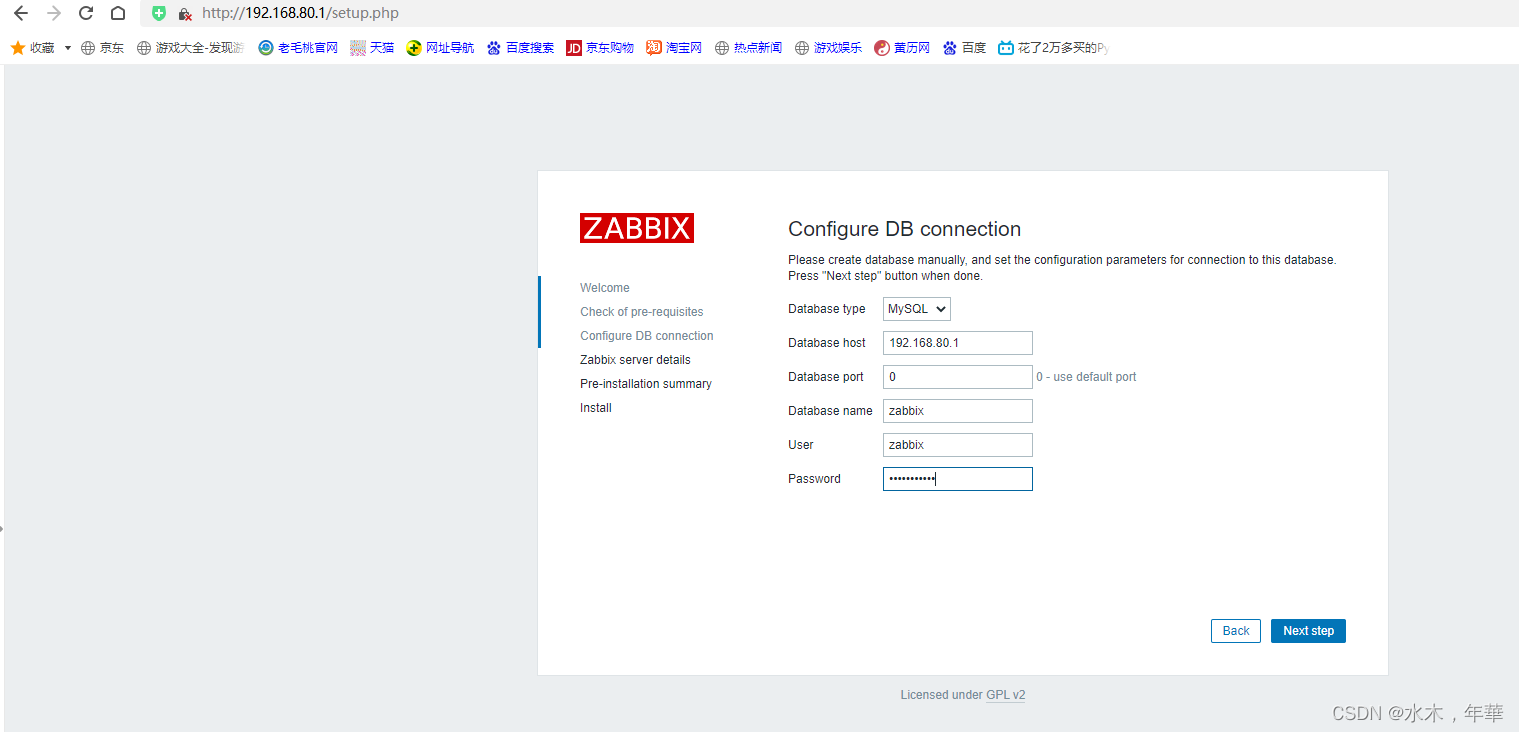
 start-up Agent, Also monitor this machine :
# /usr/local/zabbix/sbin/zabbix_agentd
Two 、 monitor Linux The server
- Deploy Zabbix Agent
CentOS7.x Operating system installation :
# rpm -ivh http://repo.zabbix.com/zabbix/4.0/rhel/7/x86_64/zabbix-agent-4.0.0-2.el7.x86_64.rpm
Add configuration file :
# vi /etc/zabbix/zabbix_agentd.conf
PidFile=/var/run/zabbix/zabbix_agentd.pid
LogFile=/var/log/zabbix/zabbix_agentd.log
DebugLevel=3
Server=<Zabbix The server IP>
ListenPort=10050
ListenIP=< Current server IP>
ServerActive=<Zabbix The server IP>
Hostname=< Current server IP>
HostMetadata=Linux
Boot and join boot on :
# systemctl start zabbix-agent
# systemctl enable zabbix-agent
- Connectivity testing
stay Zabbix The server executes the following command , Determine whether you can connect to Zabbix agent The server .
/usr/local/zabbix/bin/zabbix_get -s 192.168.80.2 -p 10050 -k "system.uptime"
774564
The returned number indicates that the connection is normal . Otherwise, it may be blocked by the firewall of the monitoring machine , Unable to connect , You can try to add a release rule to the monitored machine :
iptables -I INPUT -s 192.168.80.1 -p tcp --dport 10050 -j ACCEPT
- Web Page add host
host , Monitoring item , Triggers and graphics
3.1 Add host 
Create application set 
Create monitor item 
Add graphics 
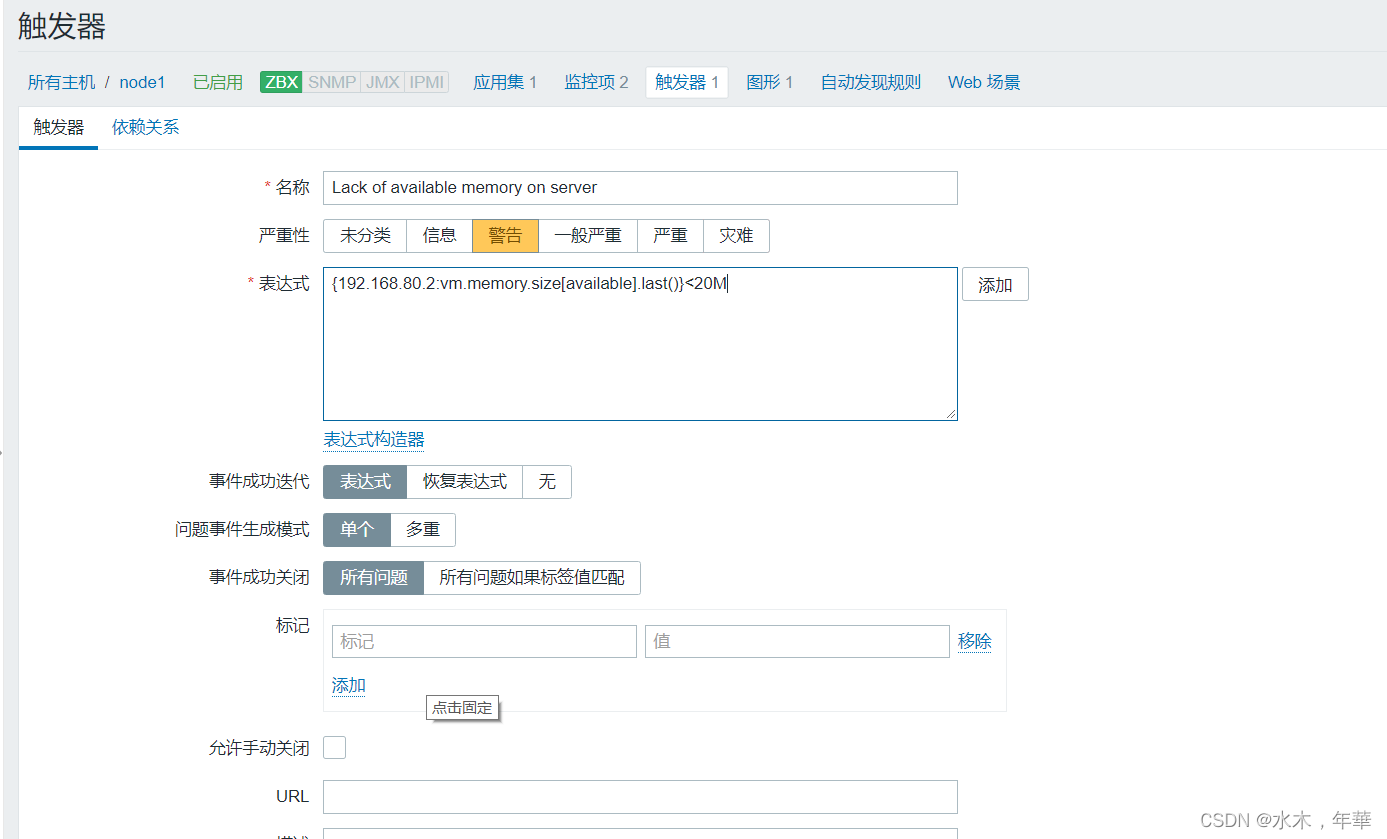
Create trigger

view drawings 
Templates 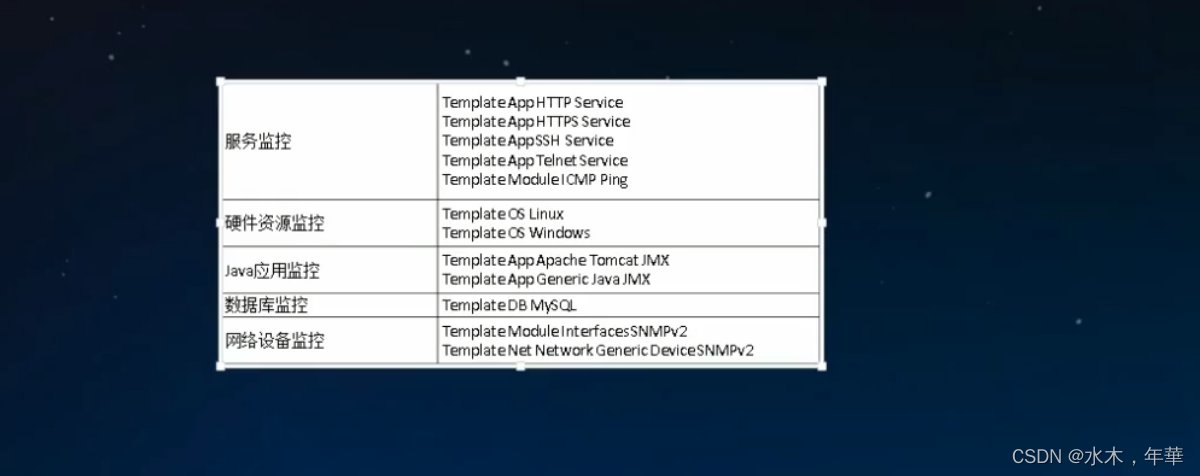
Import template 
Monitoring item
https://www.zabbix.com/documentation/3.4/zh/manual/config/items/itemtypes
• Monitor item format 
• Monitor item type
• Zabbix agent
• SNMP agent
• Simple check
• User parameters (user parameter) )
UserParameter=<key>,<command>
UserParameter=key[*],command
trigger
https://www.zabbix.com/documentation/3.4/zh/manual/config/triggers/expression
 Expression format :
{
    <server>:<key>.<function>(<parameter>)}<operator><constant>
 Example 1: come from www.zabbix.com The last load value of the host is greater than 5 When entering PROBLEM state
{
    www.zabbix.com:system.cpu.load[all,avg1].last()}>5
 Example 2: stay 5 Within minutes CPU iowait The average load is greater than 20 When entering PROBLEM state
{
    www.zabbix.com:system.cpu.util[,iowait].avg(5m)}>20
 Example 3: When the load is greater than 5 Or the last 10 The load in minutes is greater than 2 When entering PROBLEM state
{
    www.zabbix.com:system.cpu.load[all,avg1].last()}>5 or {
    www.zabbix.com:system.cpu.load[all,avg1].min(10m)}>2
 Example 4: When file /etc/passwd Check it out checksum When the value is different from the latest value, enter PROBLEM state
{
    www.zabbix.com:vfs.file.cksum[/etc/passwd].diff()}=1
 Example 5: When the network card “eth0” stay 5 Bytes received in minutes are greater than 100KB When entering PROBLEM state
{
    www.zabbix.com:net.if.in[eth0,bytes].min(5m)}>100K
 Example 6: stay 30 Within minutes 5 Enter when it is unreachable PROBLEM state
{
    zabbix.zabbix.com:icmpping.count(30m,0)}>5
 Example 7: stay 5 No data is received within minutes to enter PROBLEM state
{
    zabbix.zabbix.com:agent.ping.nodata(5m)}=1
The alarm
action (Action)
Define actions based on supported event sources :
Triggering event - When trigger The state of the from OK go to PROBLEM Or turn back
Discover the event - When network discovery occurs
Automatically register Events - When a new activity agent automatically registers
Internal events - When the item is not supported or the trigger enters an unknown state
mail
Change the alarm media type 
Create action 
Create operation 

 Alarm host :{
    HOSTNAME1}
 Alarm time :{
    EVENT.DATE} {
    EVENT.TIME}
 Alarm level :{
    TRIGGER.SEVERITY}
 The alarm information :{
    TRIGGER.NAME}
 Alarm items :{
    TRIGGER.KEY1}
 Details of the problem :{
    ITEM.NAME}:{
    ITEM.VALUE}
 current state :{
    TRIGGER.STATUS}:{
    ITEM.VALUE1}
 event ID:{
    EVENT.ID
Set the alarm media 
Change trigger , The trigger condition 
The test email has been sent 
Custom script alert 
# yum install mailx
# vi /etc/mail.rc     # Add email information
set from=xxxxxx@163.com smtp=smtp.163.com
set smtp-auth-user=baojingtongzhi@163.com smtp-auth-password=xxxxx # Authorization code
set smtp-auth=login
# echo "this is test mail." |mail -s "test mail" xxx@163.com
 Alarm script :
# cat /usr/local/zabbix/share/zabbix/alertscripts/sendmail.sh
#!/bin/bash
to=$1
subject=$2
body=$3
FILE=/tmp/mail.tmp
echo "$body" > $FILE
dos2unix -k $FILE     #  Solve the problem that the text becomes an attachment .bin
mail -s "$subject" "$to" < $FILE
Create media types 
User specified media type 
Change owner , Group test
chown zabbix.zabbix /usr/local/zabbix/share/zabbix/alertscripts/sendmail.sh
Nail alarm 
Nail add robot , Execute the following script
 cat dingding.py
#!/usr/bin/python
# -*- coding: utf-8 -*-
import requests
import json
import sys
import os

headers = {
    'Content-Type': 'application/json;charset=utf-8'}
api_url = "https://oapi.dingtalk.com/roboXXXXXXXXXXXXXXXXX"  # Nail robot Webhook Address

def msg(text):
    json_text= {

     "msgtype": "text",
     "text": {

         "content": text
     },
     "at": {

         "atMobiles": [
             "186..."
         ],
         "isAtAll": False
     }
    }
    print requests.post(api_url,json.dumps(json_text),headers=headers).content

if __name__ == '__main__':
    text = sys.argv[1]
    msg(text)
Create media types 
User specified media type 
test 
边栏推荐
猜你喜欢

Test the concept of left shift and right shift

Are you still counting the time complexity?

快速入门顺序表链表

DC-6--vulnhub靶场

Attack and defense world web question -favorite_ number

【RTOS训练营】作业讲解、队列和环形缓冲区、队列——传输数据、队列——同步任务和晚课提问

【无标题】如何实现可插拔配置?

Research on the integrated data quality management system and technical framework under the scenario of data circulation and transaction

sql(基础二)
Azure synapse analytics Performance Optimization Guide (1) -- optimize performance using ordered aggregate column storage indexes
随机推荐
【MATLAB appdesigner】27_ How to debug and view variables in appdesigner? (examples + skills)
Day06 MySQL knowledge points summary
HCIP第十二天
JMeter/IDEA中引用jar包json-path.jar的坎坷之路
BGP comprehensive experiment
openvino安装踩坑笔记
Leetcode notes 20. valid parentheses
开发还没联调,任务就要上线
以数据驱动管理转型,元年科技正当时
DC-6--vulnhub靶场
typing‘ has no attribute ‘_SpecialForm‘
LCA three postures (multiplication, tarjan+ joint search set, tree chain dissection)
[oops framework] random number generation management
hyperf使用之curd
The task will be launched before the joint commissioning of development
HOOPS Exchange助力混合计算流体动力学软件搭建3D格式导入读取功能 | 客户案例
使用CMake编译OpenFoam求解器
Leetcode 笔记 20. 有效的括号
Are you still counting the time complexity?
找出单身狗(力扣260)